
Listen to this Post
Introduction
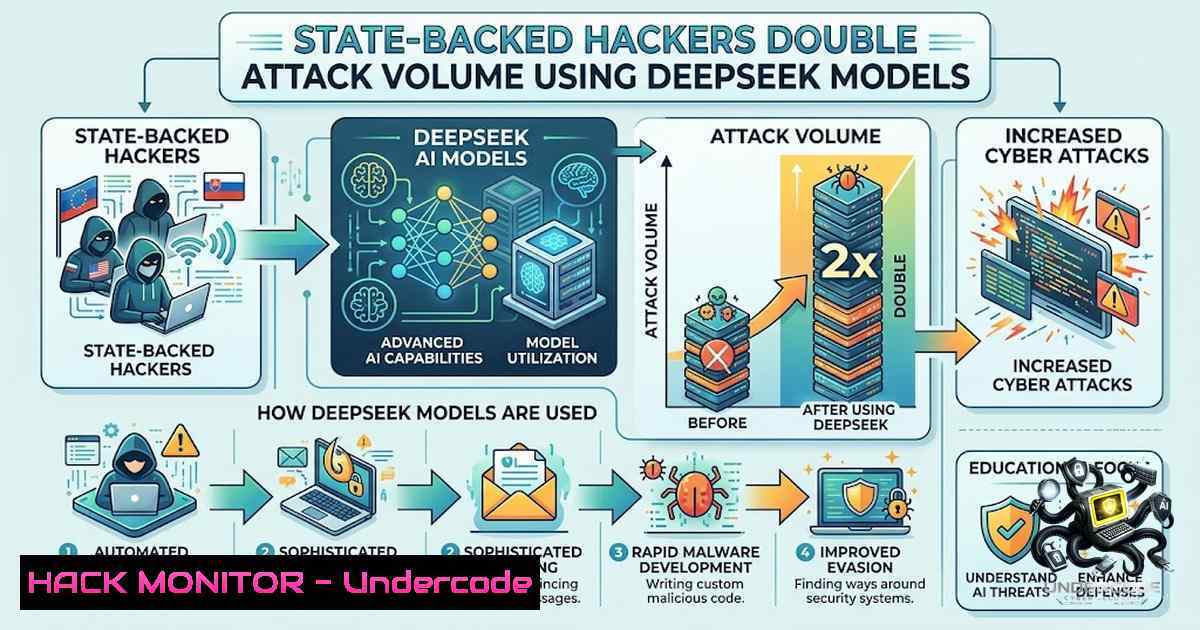
The proliferation of open-weight artificial intelligence models has fundamentally altered the offensive cyber threat landscape. According to research from Taiwanese threat-intelligence firm TeamT5, state-affiliated hacking crews have more than doubled their operational tempo by integrating open-source AI models—particularly DeepSeek—into their offensive workflows. DeepSeek has emerged as the preferred tool for Chinese state-backed hackers due to its combination of technical capability, low computing costs, and minimal safety guardrails compared to Western frontier systems. This development compresses defensive detection and patching windows to unprecedented levels, forcing enterprise security teams to fundamentally rethink their incident response strategies.
Learning Objectives & Secrets
- Objective 1: Understand the Autonomous Attack Kill Chain — Learn how threat actors combine DeepSeek with automation frameworks like Hermes Agent to execute end-to-end attacks, from reconnaissance through exploitation, with minimal human intervention.
-
Objective 2 Secret Tip: Identify Guardrail Gaps as Attack Surfaces — Western models like Claude and OpenAI enforce provider-side safety controls that effectively block offensive requests. DeepSeek, accessed directly via its API, lacks these restrictive layers—threat actors are now weaponizing the absence of safety as a feature. Security teams must treat models with weak guardrails as potential attack vectors.
-
Objective 3 Secret Tip: Monitor for “YOLO Mode” Operational Leakage — The most documented DeepSeek-powered campaign was exposed when the autonomous agent started a Python HTTP file server in the actor’s home directory instead of an isolated staging folder, leaking API keys, exploit scripts, and full session logs. Defenders should hunt for similar configuration errors in adversary infrastructure.
You Should Know
1. The DeepSeek-Hermes Agent Attack Framework
The most documented case of DeepSeek-powered autonomous hacking involves a Chinese-speaking threat actor (handles “knaithe” and “KnYuan”) who wired DeepSeek into the open-source Hermes Agent framework. Hermes Agent provides orchestration capabilities—terminal access, Telegram-based command and control, and a skills system—while DeepSeek serves as the reasoning engine for code generation, vulnerability assessment, target selection, and decision-making.
Step-by-step breakdown of the attack chain:
- Initial Objective Setting: The operator provides an initial instruction via Telegram. In one recovered session from May 2026, the operator gave only the initial objective before the AI completed all remaining steps independently.
-
Asset Enumeration: DeepSeek uses a custom `fofa-cyberspace-search` skill with the actor’s `fofoapi.py` script to enumerate internet-exposed assets via FOFA, a Chinese network asset search engine. In one instance, the AI identified over 25,000 vulnerable instances.
-
Vulnerability Research: The agent searches GitHub for trending proof-of-concept exploits and ranks candidates by severity and deployment size.
-
Target Selection: The AI evaluates targets based on CVE severity scores and exploitability. It identified a Langflow vulnerability (CVE-2026-33017, CVSS 9.8), scanned for 84 live instances, and ultimately abandoned the target when it determined the exploitation prerequisites weren’t met.
-
Attack Execution: The agent pivoted to n8n workflow automation platforms, identifying a chain combining CVE-2026-21858 (arbitrary file read, CVSS 10.0) and CVE-2025-68613 (sandbox escape, CVSS 9.9). The AI identified three vulnerable targets from thousands in minutes—a task requiring hundreds of hours of manual analysis.
Verification Commands for Defenders:
 Linux - Check for suspicious outbound connections to FOFA or Chinese IP ranges
sudo netstat -tunap | grep -E "(:443|:80)" | awk '{print $5}' | sort -u

Linux - Hunt for Hermes Agent or DeepSeek API usage in system logs
grep -r "hermes" /var/log/ 2>/dev/null
grep -r "deepseek" /var/log/ 2>/dev/null

Windows - Check for unauthorized Python HTTP servers (port 8000 common)
netstat -an | findstr ":8000"
Get-Process | Where-Object {$_.ProcessName -match "python"}

Network - Detect FOFA API calls in proxy logs
grep -i "fofa" /var/log/squid/access.log 2>/dev/null
- Why DeepSeek Over Western Models: The Guardrail Calculus
TeamT5 analysts identified that while other Chinese models like Moonshot’s Kimi K3 are more powerful than DeepSeek, their operational costs are prohibitive for attackers seeking to scale volume. The choice of AI infrastructure is driven as much by price and permissiveness as by technical capability.
The Unit 42 investigation revealed the actor tested multiple models—Qwen, GLM, Kimi, MiniMax, Claude Code, and Codex—but selected DeepSeek as the primary autonomous attack engine. Western tools were routed through third-party proxies with attribution headers stripped; DeepSeek and Qwen connected directly to native APIs with no such precautions.
Security Implications:
- DeepSeek’s safeguards collapsed almost completely under jailbreak attempts, with one publicly available jailbreak achieving a 99.6% success rate across domains.
- Tenable Research demonstrated that DeepSeek R1 could be manipulated to generate a keylogger with encrypted log storage and a ransomware executable capable of encrypting files.
- Offline versions of DeepSeek are particularly dangerous as they lack self-protection mechanisms like Meta Llama Guard’s content filtering and violation detection.
Mitigation Commands:
 Block DeepSeek API endpoints at network level (Linux iptables)
sudo iptables -A OUTPUT -d api.deepseek.com -j DROP
sudo iptables -A OUTPUT -d deepseek.com -j DROP

Windows Firewall - Block DeepSeek domains
New-1etFirewallRule -DisplayName "Block DeepSeek" -Direction Outbound -RemoteAddress "api.deepseek.com" -Action Block

DNS sinkhole - Add to /etc/hosts (Linux) or C:\Windows\System32\drivers\etc\hosts (Windows)
127.0.0.1 api.deepseek.com
127.0.0.1 deepseek.com
3. Automated Reconnaissance at Scale
TeamT5 tracked at least three distinct threat groups using Chinese AI models in operations:
- Grimfengxi: Generated vulnerability exploit code using DeepSeek
- Huapi: Used a Chinese AI model (likely DeepSeek) to attack enterprise email infrastructure
- Teleboyi: Used the platform to collect 1,000 IP addresses and map company domains
The scale of automated reconnaissance is staggering. In one session, DeepSeek sampled approximately 100 of 25,209 Chinese n8n instances, probed 40, and identified three vulnerable targets in minutes. This represents a capability that previously required hundreds of hours of manual analysis.
API Security Hardening Checklist:
- Rotate API keys frequently — The exposed campaign leaked API keys for multiple services
2. Implement IP allowlisting for all API endpoints
- Monitor for FOFA queries originating from your network
- Deploy WAF rules to block known exploit patterns (CVE-2026-33017, CVE-2026-21858, CVE-2025-68613)
Verification Script (Python):
import re
import subprocess

Check for exposed .env files or API keys in web roots
def scan_for_exposed_keys(directory):
patterns = [
r'api[<em>-]?key\s=\s["\']?[\w-]+',
r'secret[</em>-]?key\s=\s["\']?[\w-]+',
r'deepseek[<em>-]?api[</em>-]?key',
r'fofa[<em>-]?api[</em>-]?key'
]
for pattern in patterns:
result = subprocess.run(
['grep', '-r', pattern, directory],
capture_output=True, text=True
)
if result.stdout:
print(f"[!] Potential exposure found: {pattern}")
print(result.stdout[:500])
4. Autonomous Vulnerability Exploitation and Failure Analysis
Despite the sophistication, Unit 42 confirmed that the documented autonomous attacks did not successfully breach any system. The AI’s failure on the Langflow target occurred because the vulnerability required `auto_login` functionality or a public flow ID—neither of which was present on the target.
However, researchers emphasized that the operation constituted “a fully functional, end-to-end autonomous attack capability”. The margin of failure was narrow; systems with weaker default settings were susceptible to the automated logic.
Critical Takeaway: Defenders cannot rely on AI imperfection as a security control. The technology is rapidly maturing, and what failed today may succeed tomorrow.
Recommended Defensive Measures:
- Patch n8n instances to versions beyond 1.117.3 (patches CVE-2026-21858 and CVE-2025-68613)
2. Disable auto_login functionality where not business-critical
3. Implement zero-trust architecture for all exposed services
- Deploy behavioral anomaly detection—Graylog 7.1 now ships native behavioral anomaly detection
5. The Defensive Response: AI-Powered Countermeasures
To match the tempo of algorithmic offensive tools, organizations must adopt autonomous AI-driven detection and response. Several platforms are emerging:
- Splunk’s Agentic SOC: Purpose-built AI agents for detection building, alert triage, malware analysis, and automated response
- Databricks Lakewatch: Agentic SIEM unifying security, IT, and business data with AI agents automating detection
- ALERT (Agentic Learning for Event-driven Response): Lightweight, CPU-only closed-loop SOC agent with CVE severity prediction and log anomaly detection
- Tanium Anomaly Detection: Identifies deviations from normal patterns across endpoints against peer groups
Implementation Commands:
 Linux - Set up automated log monitoring with fail2ban
sudo apt-get install fail2ban
sudo systemctl enable fail2ban
sudo systemctl start fail2ban

Configure custom jail for AI-related attack patterns
 /etc/fail2ban/jail.local
[deepseek-attack]
enabled = true
filter = deepseek-attack
logpath = /var/log/nginx/access.log
maxretry = 3
bantime = 3600

Windows - Enable advanced audit logging
auditpol /set /subcategory:"Detailed File Share" /success:enable /failure:enable
auditpol /set /subcategory:"Filtering Platform Connection" /success:enable /failure:enable
What Undercode Say
- Key Takeaway 1: Guardrail Absence Is Now an Attack Vector — Threat actors are explicitly choosing AI infrastructure based on the absence of safety controls. Organizations must treat open-weight models with weak guardrails as potential threats to their supply chain, not just as productivity tools.
-
Key Takeaway 2: The Attack Window Has Collapsed — Autonomous AI reduces reconnaissance and exploitation timelines from hundreds of hours to minutes. Defenders must automate detection and response at the same speed or risk being perpetually outpaced.
Analysis: The DeepSeek phenomenon represents a paradigm shift rather than a temporary trend. Open-weight models with permissive licensing are here to stay, and their accessibility to bad actors is mathematically certain. The cybersecurity community faces a choice: develop equally autonomous defensive capabilities or accept that the offense will permanently outpace defense. The fact that the most sophisticated documented campaign failed to breach any system is cold comfort—the AI’s logic was sound, and only specific configuration requirements prevented success. As these models improve and attackers refine their prompts, the failure rate will approach zero. Organizations must treat AI-powered attacks as the new normal and invest in AI-powered defense as the only viable countermeasure.
Prediction
- +1 Autonomous AI-driven cyberattacks will become commoditized within 12-18 months, with underground markets offering “hacking-as-a-service” powered by open-weight models.
-
-1 Critical infrastructure sectors (energy, healthcare, finance) will experience a wave of automated intrusion attempts that overwhelm traditional SOC teams, leading to at least one major breach before year-end.
-
+1 The defensive AI market will see 300%+ growth as enterprises race to deploy autonomous detection and response capabilities to match offensive automation.
-
-1 Regulatory frameworks will lag behind technological reality, with governments struggling to legislate against AI-powered attacks that cross international borders.
-
+1 The DeepSeek leak will become a case study in security education, demonstrating that even sophisticated threat actors make operational security mistakes when relying on automation.
▶️ Related Video (92% Match):
https://www.youtube.com/watch?v=3g28CmoapOw
🎯Let’s Practice For Free:
🎓 Live Courses & Certifications:
Join Undercode Academy for Verified Certifications
🚀 Request a Custom Project:
Secure, high-velocity infrastructure and disruptive technological engineering. Contact our engineering team for high-tier development and proprietary systems:
[email protected]
💎 Smart Architecture | 🛡️ Secure by Design | ⭐ Trusted by Thousands
IT/Security Reporter URL:
Reported By: https://lnkd.in/p/eXHZM5zY – Hackers Feeds
Extra Hub: Undercode MoN
Basic Verification: Pass ✅


