Listen to this Post
Introduction:
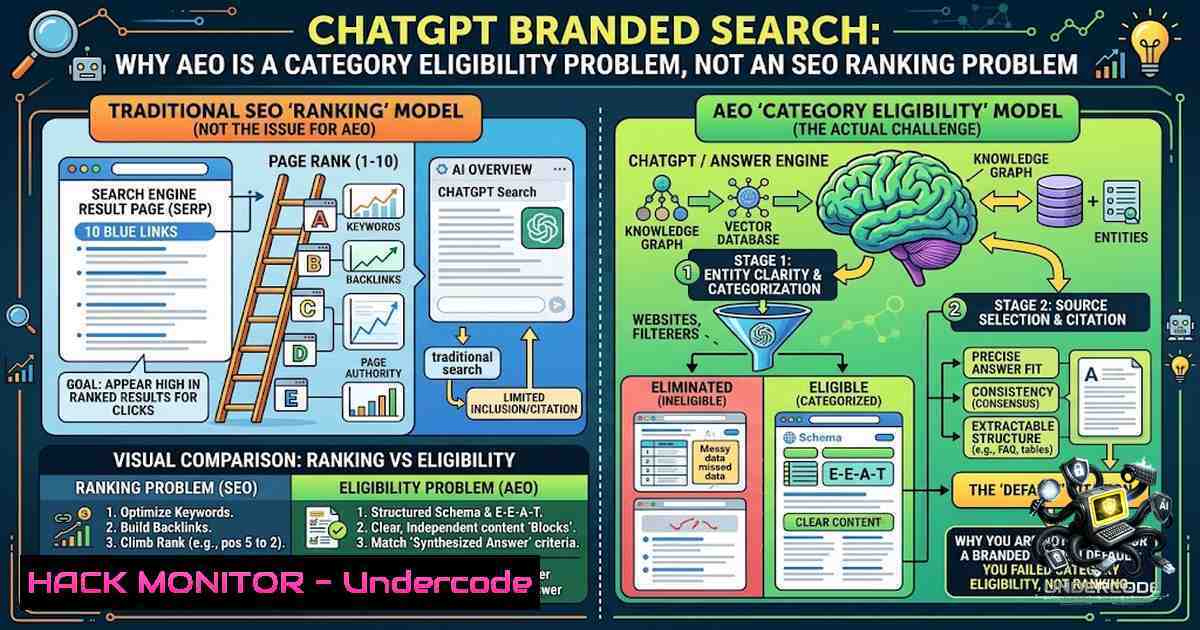
The landscape of digital discovery is undergoing a fundamental shift as generative AI and answer engines like ChatGPT, Perplexity, and Google AI Overviews increasingly become the primary entry point for B2B buyers. Unlike traditional search engines that rank pages based on backlinks and keywords, these AI systems synthesize responses by drawing from their training data and retrieved web content. Recent analysis reveals a critical insight: ChatGPT defaults to branded search in its query fan-outs, using its pre-trained knowledge to determine which brands are associated with a category before performing any web search. This means that Generative Engine Optimization (GEO) and Answer Engine Optimization (AEO) are not about ranking tactics but about category eligibility and entity association—a fundamental departure from traditional SEO.
Learning Objectives:
- Understand why ChatGPT and other LLMs default to branded search and pre-determine vendor shortlists based on category association.
- Learn the distinction between SEO, AEO, and GEO, and why category eligibility has become the new battleground.
- Acquire actionable technical strategies—including entity schema markup, llms.txt implementation, and citation density techniques—to improve brand visibility in AI-generated answers.
You Should Know:
- The Branded Search Default: How ChatGPT Pre-Determines Its Recommendations
When a user asks ChatGPT “what are the best enterprise AI agent builders?”, the system does not perform a neutral category-level search as a traditional search engine would. Instead, it generates a pre-determined shortlist based on brands it already associates with that category. In one documented example, the very first web query in the network stream was preloaded with specific vendors: “2026 enterprise AI agent platform builders Microsoft Copilot Studio Salesforce Agentforce Google Vertex AI Agent Builder ServiceNow AI Agents IBM watsonx Orchestrate AWS Bedrock Agents comparison”.
The network log revealed 16 unique web search queries, all targeting specific brands with site-specific searches like site:microsoft.com, site:salesforce.com, and site:aws.amazon.com. ChatGPT already knew these brands were strong “enterprise AI platform” entities and did not start with a neutral market scan.
Why This Matters for Your Brand: No amount of GEO “hacks” or manipulative tactics will get your brand recommended by ChatGPT if the AI does not already recognize you as belonging to that category. As Gaetano DiNardi notes, “the brands with the strongest category entity salience are winning in AI search”. Topical drift—spreading your content too thinly across too many categories—is now a real problem that will hinder your success in AEO/GEO, unlike traditional SEO where it was less consequential.
Step-by-Step Guide: Auditing Your Brand’s Category Entity Salience
- Identify Your Flagship Category: Define the single category you want to be associated with. Do not spread across too many seeds.
-
Query the AI: Ask ChatGPT, Perplexity, and Gemini: “What are the best [your category] solutions?” and “List the top [your category] vendors.”
-
Analyze the Network Stream: In ChatGPT’s web interface, open Developer Tools (F12), navigate to the Network tab, and filter for “search” or “query” requests. Extract all sub-queries to see which brands are being searched.
-
Assess Your Position: If your brand is not in the pre-seeded shortlist, you have a category eligibility problem, not a ranking problem.
-
Monitor Competitors: Track which brands consistently appear and analyze their entity signals (schema markup, Wikipedia mentions, G2/Clutch profiles, news citations).
-
SEO vs. AEO vs. GEO: Understanding the Three Layers of Modern Search Visibility
These three disciplines are not interchangeable—they represent sequential stages of visibility:
- SEO (Search Engine Optimization): The practice of earning visibility in traditional search engine results pages through technical site health, authoritative content, and earned links. SEO gets your pages found and ranked. However, with Google AI Overviews now appearing in around a quarter of all searches, organic clicks can be reduced by up to 30% for informational queries.
-
GEO (Generative Engine Optimization): The practice of ensuring that AI systems and answer engines accurately understand who you are, what you know, and why you should be considered a credible source. GEO gets you into the consideration set—the difference between an AI that ignores your brand and one that recognizes you as an authoritative voice.
-
AEO (Answer Engine Optimization): The practice of structuring content so that search engines and LLMs can extract it as a direct answer. AEO makes the difference between being a possible option and being selected as the answer.
As one framework explains: “SEO determines how you get ranked. GEO determines how AI systems interpret your content and position you as a possible choice. AEO makes the difference between being a possible option and being selected as the answer”.
Step-by-Step Guide: Implementing AEO/GEO Technical Foundations
- Implement Organization and FAQPage Schema Markup: Use Schema.org structured data to help AI systems understand your entity. Example JSON-LD for Organization:
{
"@context": "https://schema.org",
"@type": "Organization",
"name": "Your Company Name",
"description": "Clear description of what your company does and the category it serves",
"url": "https://yourdomain.com",
"sameAs": ["https://www.g2.com/products/your-product", "https://www.crunchbase.com/organization/your-company"]
}
- Create an `llms.txt` File: Place a file at `https://yourdomain.com/llms.txt` containing a structured summary of your content for LLM consumption. Format:
 Your Company Name
About
[2-3 sentences explaining your company and category]

Key Pages
- /page1: [bash]
- /page2: [bash]

FAQ
Q: What is [your category]?
A: [Clear, concise answer]
- Structure Direct-Answer Blocks: Place clear, concise answers to common questions at the top of each page, using `
` or `
` headers with question phrasing.
-
Build Verifiable External Mentions: Ensure your company is listed on authoritative third-party platforms like G2, Clutch, Crunchbase, and industry analyst reports (Gartner, Forrester).
3. The Network Stream Analysis: Extracting ChatGPT’s Sub-Queries
One of the most powerful techniques for understanding how ChatGPT perceives your category is analyzing the network stream during a query. In the documented example, ChatGPT generated 16 unique web search queries, including:
– `2026 enterprise AI agent platform builders Microsoft Copilot Studio Salesforce Agentforce Google Vertex AI Agent Builder ServiceNow AI Agents IBM watsonx Orchestrate AWS Bedrock Agents comparison`
– `Gartner enterprise AI agents platforms 2025 2026 agentic AI platforms`
– `Forrester wave agentic AI platforms 2025 enterprise AI agents`
– `Microsoft Copilot Studio autonomous agents enterprise governance documentation 2026 site:microsoft.com`
– `Salesforce Agentforce enterprise AI agents features official 2026 site:salesforce.com`
Notice the pattern: ChatGPT does not search “best AI agent builders” broadly. It searches for specific brands with `site:` operators. This confirms that the brand shortlist is pre-determined before any search occurs.
Step-by-Step Guide: Analyzing Your Category’s Network Stream
- Open ChatGPT in a Chromium-based browser (Chrome, Edge, or Safari).
-
Open Developer Tools: Press `F12` or right-click and select “Inspect”.
-
Navigate to the Network tab and clear existing logs.
-
Ask a category-level question: “What are the best [your category] solutions?”
-
Filter for search queries: Look for requests containing
search,query, or `web-search` in the Name column. -
Extract the sub-queries: Click on each request and examine the Payload or Request tab to see the exact search strings.
-
Document the brand shortlist: Note which brands appear in the first query. If your brand is absent, you are not yet recognized as belonging to that category.
Linux Command for Monitoring AI Search Visibility:
 Monitor mentions of your brand across AI search results using curl and jq
 This example queries a hypothetical AI search API

curl -X POST "https://api.openai.com/v1/chat/completions" \
-H "Authorization: Bearer $OPENAI_API_KEY" \
-H "Content-Type: application/json" \
-d '{
"model": "gpt-4",
"messages": [{"role": "user", "content": "What are the best enterprise AI agent platforms?"}],
"stream": false
}' | jq '.choices[bash].message.content'
- Category Eligibility: The New Battleground for AI Search Visibility
The fundamental insight from recent AEO/GEO analysis is that “GEO is a category eligibility problem, not an SEO ranking problem”. Answer engines create vendor shortlists based on pre-seeded, pre-determined entity knowledge. In the enterprise AI agent example, ChatGPT did not perform a neutral category-level search; it generated a pre-determined shortlist from brands it already associated with the category.
This has profound implications:
- Traditional SEO tactics are insufficient: Backlinks and keyword density will not help if the AI does not recognize your brand as belonging to the category.
- Entity salience is paramount: The brands with the strongest category entity association are winning in AI search.
- Topical focus beats breadth: Spreading your content across too many categories dilutes your entity association.
Step-by-Step Guide: Building Category Entity Salience
- Define Your Flagship Category Clearly: Use consistent category terminology across your website, social media, and third-party profiles.
-
Optimize Your Wikipedia and Knowledge Graph Presence: Ensure your company has a Wikipedia page or is listed in knowledge bases like Crunchbase, G2, and Capterra.
-
Earn Analyst Recognition: Get mentioned in Gartner, Forrester, or industry-specific analyst reports. ChatGPT’s network stream explicitly searches for `Gartner enterprise AI agents platforms` and
Forrester wave agentic AI platforms. -
Generate Consistent Third-Party Citations: Encourage customers, partners, and industry publications to mention your brand in the context of your category.
-
Use Consistent Brand-Category Pairing: In all your content, consistently pair your brand name with your flagship category (e.g., “YourCompany — the leading
platform").</p></li> </ol> <h2 style="color: yellow;">Windows PowerShell Command for Monitoring Brand Mentions:</h2> <p>[bash] Use Invoke-WebRequest to check if your brand appears in AI-generated responses This is a basic example; replace with actual API calls as needed $headers = @{ "Authorization" = "Bearer $env:OPENAI_API_KEY" "Content-Type" = "application/json" } $body = @{ model = "gpt-4" messages = @( @{ role = "user"; content = "What are the best enterprise AI agent platforms?" } ) } | ConvertTo-Json $response = Invoke-RestMethod -Uri "https://api.openai.com/v1/chat/completions" ` -Method Post -Headers $headers -Body $body $response.choices[bash].message.content- The Future of AEO/GEO: From Hacks to Credibility
The era of “GEO hacking”—manipulating AI recommendations through tactical exploits—is coming to an end. As answer engines become more sophisticated, they will prioritize useful content, domain authority, and genuine presence in the space. The best play for AEO/GEO will be just like SEO: creating genuinely useful content, building domain authority, and maintaining a consistent presence.
What This Means for Practitioners:
- Template-based AEO tools will be deprioritized: When AI systems can detect and deprioritize templated, AI-generated content, the value of generic optimization tools will diminish.
- Deep category expertise matters: Content that demonstrates deep problem/solution understanding, unique perspectives, and genuine expertise cannot be AI-generated into oblivion.
- Entity clarity is non-1egotiable: AI systems need to know precisely what your organization is and what it stands for.
Step-by-Step Guide: Building a Sustainable AEO/GEO Strategy
- Audit Your Current Entity Signals: Use tools like GrackerAI AEO Visibility Tracking or Adobe LLM Optimizer to assess your current visibility.
-
Create Category-Specific Content Hubs: Develop comprehensive guides, comparisons, and FAQs that demonstrate deep category expertise.
-
Implement Direct-Answer Formatting: Structure content so that key answers are easily extractable—use clear headers, bullet points, and concise summaries.
-
Build Citation Density: Earn mentions from credible third parties. Research shows that citation statistics and fluency signals increase AI citation rates more reliably than backlink profiles alone.
-
Monitor and Iterate: Regularly query AI systems to check if your brand appears and adjust your strategy accordingly.
Linux Command for Batch Monitoring:
!/bin/bash
 Batch script to query multiple AI models for category mentions

MODELS=("gpt-4" "claude-3-opus" "gemini-pro")
CATEGORY="enterprise AI agent platforms"

for MODEL in "${MODELS[@]}"; do
echo "=== Querying $MODEL for '$CATEGORY' ==="
curl -s -X POST "https://api.$MODEL/v1/chat/completions" \
-H "Authorization: Bearer $API_KEY" \
-H "Content-Type: application/json" \
-d "{\"model\": \"$MODEL\", \"messages\": [{\"role\": \"user\", \"content\": \"What are the best $CATEGORY?\"}]}" \
| jq '.choices[bash].message.content' | grep -i "yourbrand" && echo "Found your brand!" || echo "Brand not found"
done
What Undercode Say:
- Category eligibility is the new SEO: ChatGPT and other answer engines pre-determine which brands belong to a category before performing any search. If your brand is not in that pre-seeded shortlist, no amount of traditional SEO will help.
-
Topical focus beats breadth: Spreading your content across too many categories dilutes your entity association. The brands winning in AI search are those with the strongest category entity salience.
Analysis: The shift from traditional search to AI-powered answer engines represents a fundamental change in how brands are discovered. Unlike Google’s algorithm, which ranks pages based on hundreds of signals including backlinks and keyword relevance, ChatGPT and similar systems rely heavily on their training data to pre-determine which brands are relevant to a category. This means that brands must focus on building strong entity associations through consistent category positioning, third-party citations, and structured data—not just on creating content and earning backlinks. The tools and hacks that worked for SEO will not translate to AEO/GEO success. Instead, brands need to treat category eligibility as a strategic imperative, investing in analyst recognition, knowledge graph presence, and consistent brand-category pairing. The brands that adapt to this new reality will dominate AI-generated recommendations; those that continue to rely on traditional SEO tactics will become invisible to the growing number of buyers who start their research in ChatGPT rather than Google.
Prediction:
- +1 Brands that invest early in building category entity salience—through analyst reports, knowledge graph optimization, and consistent third-party citations—will capture the majority of AI-driven referral traffic within the next 12-18 months, as answer engines become the primary discovery channel for B2B buyers.
-
-1 The proliferation of generic AEO/GEO tools and “hacks” will create a noisy, low-quality content ecosystem that AI systems will increasingly learn to deprioritize, penalizing brands that rely on templated, AI-generated content rather than genuine expertise and authority.
-
+1 The convergence of AEO and GEO with traditional SEO will create a new discipline—call it “Entity Optimization”—that requires a holistic approach combining technical structured data, content authority, and off-site entity signals, opening new opportunities for brands that can demonstrate genuine category expertise.
-
-1 Brands that fail to recognize the distinction between ranking and category eligibility will continue investing in outdated SEO tactics while losing visibility in AI-generated answers, effectively becoming invisible to a growing segment of their target audience.
-
+1 The emphasis on category eligibility will drive a return to quality content and genuine expertise, as AI systems become better at distinguishing between authoritative sources and manipulative tactics, ultimately benefiting both brands and consumers.
▶️ Related Video (76% Match):
https://www.youtube.com/watch?v=0CITvxk3Lpg
🎯Let’s Practice For Free:
🎓 Live Courses & Certifications:
Join Undercode Academy for Verified Certifications
🚀 Request a Custom Project:
Secure, high-velocity infrastructure and disruptive technological engineering. Contact our engineering team for high-tier development and proprietary systems:
[email protected]
💎 Smart Architecture | 🛡️ Secure by Design | ⭐ Trusted by ThousandsIT/Security Reporter URL:
Reported By: https://lnkd.in/p/efnbUMhn – Hackers Feeds
Extra Hub: Undercode MoN
Basic Verification: Pass ✅🔐JOIN OUR CYBER WORLD [ CVE News • HackMonitor • UndercodeNews ]
📢 Follow UndercodeTesting & Stay Tuned:


