
Listen to this Post
Introduction:
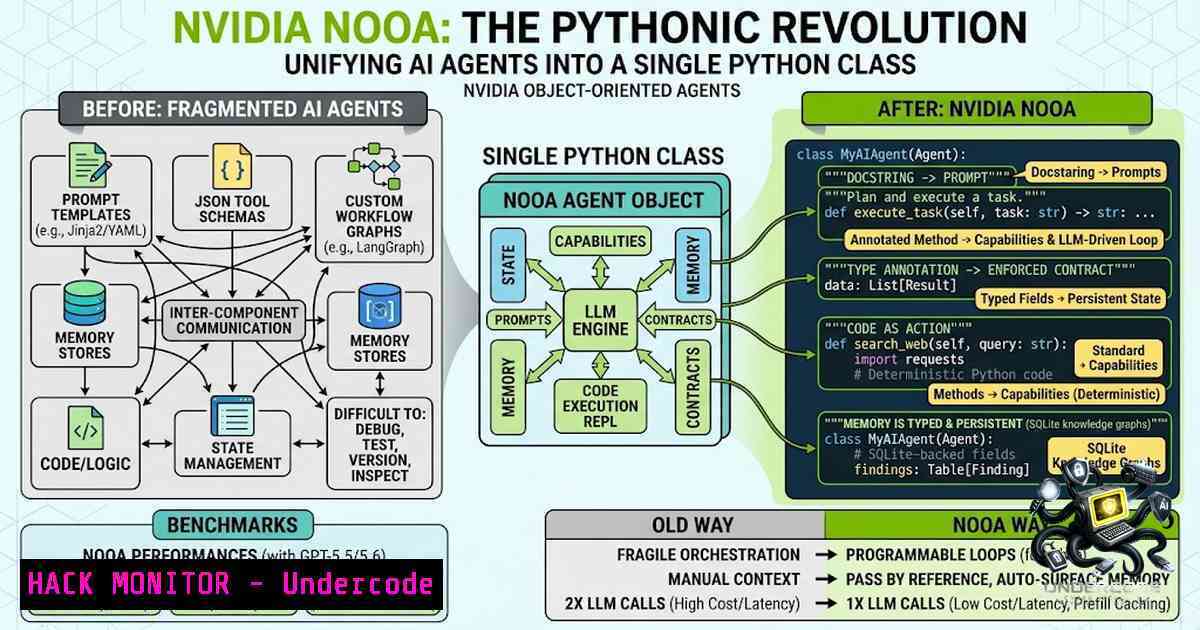
For years, building AI agents has meant juggling fragmented abstractions—prompt templates in one place, tool schemas in another, callback code scattered across files, and workflow graphs that resemble spaghetti. NVIDIA Labs recently open-sourced NOOA (NVIDIA Object-Oriented Agents), a framework that collapses all of this complexity into a single, familiar Python class. The core insight? An agent is just a Python object—its methods are its capabilities, its fields hold its state, its docstrings serve as prompts, and its type annotations become enforced runtime contracts. This paradigm shift transforms agent development into traditional software engineering, making agents diffable, testable, traceable, and version-controllable using the same tools developers already know and love.
Learning Objectives & Secrets:
- Objective 1: Master the “Agent-as-a-Python-Object” Paradigm — Learn how to structure AI agents as single Python classes where fields store state, methods define capabilities, docstrings act as natural language prompts, and type hints become enforceable I/O contracts. This eliminates the need for separate prompt templates, JSON tool schemas, and custom workflow graphs.
-
Objective 2 Secret Tip: Leverage the Ellipsis (
...) Magic — A method body containing an ellipsis (...) is automatically handed over to an LLM at runtime to complete the action. A method with normal Python code executes deterministically. This elegant convention draws a clear line between probabilistic model reasoning and deterministic code right inside the source file. -
Objective 3 Secret Tip: Achieve 50% Fewer LLM Calls with Typed I/O and Pass-by-Reference — NOOA matches or beats complex agent frameworks on benchmarks like SWE-bench Verified (82.2% accuracy with GPT-5.5) while using roughly half the input tokens and LLM calls compared to standard harnesses. The secret lies in typed input/output (no free text) and pass-by-reference over live Python objects instead of serialized JSON dumps.
You Should Know:
- Agent as a Python Object: The Core Architecture
NOOA’s fundamental innovation is treating an agent as a standard Python class. Here’s how it works:
from nooa import Agent

class SupportAgent(Agent):
"""You are a support agent for a customer service system."""

State lives on the object — fields are typed
order_db: OrderDB

Ordinary method — just deterministic Python
def is_refund_eligible(self, order: Order) -> bool:
"""Return whether an order is eligible for a refund."""
return order.delivered and order.days_since_delivery <= 30

Agentic method — the `...` body is completed by an LLM at runtime
async def triage(self, message: str, photo: Image | None, order: Order | None) -> Ticket:
"""Triage a customer message and create a support ticket."""
...
In this model, fields are state, methods are capabilities, docstrings are prompts, and type annotations are contracts. A method with a normal body runs as ordinary, deterministic Python; a method whose body contains an ellipsis (...) becomes an agentic method, executed by an LLM-driven loop at runtime.
The payoff is profound: agent development becomes traditional software development. Agents can be diffed, code-reviewed, unit-tested, traced, versioned, and refactored using the same IDEs and tools already in use for every other codebase.
2. The Six Model-Facing Capabilities That Drive Performance
NOOA’s architecture identifies six model-facing interface ideas that drive agent performance:
| Capability | Description | Example |
||||
| Typed I/O | Agentic calls have typed arguments and validated return values, not free text | `def scan_port(host: str, port: int) -> dict:` |
| Pass-by-Reference | Model operates on live Python objects with bounded previews instead of serialized dumps | `self.vulnerabilities.append(issue)` |
| Code as Action | Model acts by writing Python with control flow and inline method calls | `socket.connect((host, port))` |
| Programmable Loop Engineering | Orchestration loops are ordinary Python | `for ip in subnet: self.scan(ip)` |
| Explicit Object State | State persists as fields, not just in conversation history | `self.last_scan = datetime.now()` |
| Harness APIs | Context and memory are Python APIs | `self.memory.query(tags=[“exploit”])` |
NOOA is, to our knowledge, the first framework to combine all six on a single surface. Surveying fourteen agent frameworks and harnesses, the research team found the community already converging on several of these ideas—often as experimental or partial features—and they present the comparison to encourage further adoption.
- The Ellipsis (
...) Magic: Where Deterministic Meets Generative
One of NOOA’s most elegant design decisions is the use of Python’s ellipsis (...) as a marker for LLM-driven methods. Here’s what happens:
- A normal method body executes as deterministic Python—testable, reusable, and statically checkable.
- A method body containing `…` is completed at runtime by an LLM-driven loop.
The method signature provides the input/output contract, the docstring describes the task, and self—with all its methods and state—becomes the model’s available toolkit. The framework includes two built-in strategies:
- PredictStrategy: Calls the model once and validates the result against the return type—ideal for classification or extraction tasks.
- CodeActStrategy: Lets the model write Python in a Jupyter-style REPL, observe outputs, update state, and iterate until it calls
return_result(...).
If the result doesn’t match the return type, the call doesn’t silently fail—the runtime hands the error back to the model for correction. This boundary is crucial: semantic judgment goes to the model, precise rules stay in ordinary code.
- Performance Benchmarks: 82.2% on SWE-bench with 50% Fewer Tokens
NVIDIA evaluated NOOA across multiple benchmarks with striking results:
| Benchmark | Score | Details |
||||
| SWE-bench Verified | 82.2% | Using GPT-5.5, ~29 model calls and 1.1M tokens per task |
| CyberGym L1 | 86.8% | Vulnerability rediscovery with network access blocked |
| ARC-AGI-3 | 85.1% | Interactive reasoning with GPT-5.6-sol at under $20 per game |
The baseline approach achieved only 78.2% but required 66 calls and twice as many tokens. A 253-line NOOA agent hit these scores—the framework is model-agnostic by design. NOOA matches or beats complex agent frameworks while using up to 50% fewer LLM calls and roughly half the input tokens.
5. Memory System: SQLite-Powered Knowledge Graphs
NOOA’s memory subsystem stores typed, relational knowledge in a human-readable SQLite database. Key features include:
- Structured Records: Each memory has `content` (the knowledge), `tags` (categorization), `importance` (priority 0.0–1.0), and `relationships` (links to other records like “supports” or “contradicts”).
- Automatic Context Management: The memory system supports knowledge accumulation and efficient context management through pass-by-reference, eliminating the need for context compaction or summarization pipelines.
Install the memory subsystem with:
uv add nooa-memory
 or
uv add "nooa[bash]"
6. Security Considerations: NOT a Containment Boundary
NOOA can execute LLM-generated Python, which may transmit private data, delete files, or modify its environment. NVIDIA is refreshingly direct about the risk: the framework’s AST checks and module deny-lists are defense-in-depth guardrails, not a containment boundary.
“NOOA validates generated code (AST checks) and applies module deny-lists before execution. These are defense-in-depth guardrails, not a containment boundary.”
For production deployments, agents that execute generated code must run behind operating-system-level isolation—a container, virtual machine, or NVIDIA’s OpenShell sandbox. NOOA provides inspection and tracing; the OS-level sandbox is the actual containment perimeter.
Installation and Quick Start
Add NOOA to a Python project with `uv` (recommended) or pip:
 Using uv (recommended)
uv init my-agent-project
cd my-agent-project
uv add nooa

Or with pip
pip install nooa

Optional sub-packages
uv add nooa-cli  CLI, trace viewer, eval runner
uv add nooa-memory  Long-term memory subsystem
uv add nooa-bench  BenchAgent and Harbor benchmark runner
uv add "nooa[cli,memory]"  Several at once
Clone the repository for evaluation pipeline access:
git clone https://github.com/NVIDIA-1eMo/labs-OO-Agents.git
uv venv --python 3.13 && uv pip install ./labs-OO-Agents
What Undercode Say:
- Key Takeaway 1: NOOA represents a fundamental paradigm shift—not just another agent framework, but a return to first principles. By treating agents as Python objects, NVIDIA has made agentic behavior testable, traceable, and refactorable using standard tools like
pytest, linters, and IDE debuggers. The best software abstraction isn’t a new domain-specific language—it’s the programming language you already use. -
Key Takeaway 2: The security implications are critical. NOOA’s ability to execute LLM-generated Python is powerful but dangerous. Organizations must implement OS-level isolation (containers, VMs, or OpenShell) before deploying NOOA agents in production. The framework’s AST checks and module deny-lists are helpful guardrails but not a security boundary. This is reminiscent of the early days of containerization—powerful capabilities require equally powerful safeguards.
Analysis: NOOA is to AI agents what PyTorch was to deep learning: a powerful runtime that presents users with a simple, familiar Python programming model. The framework’s design philosophy—”where Python has existing abstractions, adopt them directly”—reduces cognitive overhead for developers while giving models access to a richer, more structured interface. The performance numbers are impressive: 82.2% on SWE-bench with 50% fewer tokens isn’t incremental improvement—it’s a step function change in efficiency. However, the security model demands respect. NOOA is a framework for building agents, not a sandbox for running them. Organizations must pair it with robust isolation strategies. The simultaneous launch of the Open Secure AI Alliance—a 37-member coalition including Microsoft, Cisco, CrowdStrike, and the Linux Foundation—signals that NVIDIA understands this challenge and is mobilizing the industry to address it.
Prediction:
- +1 NOOA will accelerate the commoditization of AI agent development, lowering the barrier to entry for Python developers and enabling a new wave of agentic applications across cybersecurity, IT automation, and software engineering.
-
+1 The framework’s efficiency gains (50% fewer tokens, half the LLM calls) will make AI agents economically viable for a broader range of use cases, particularly in enterprise environments where token costs have been a barrier to adoption.
-
-1 The security model—requiring OS-level isolation for production deployments—will be a significant operational hurdle for many organizations. Expect a wave of security incidents as teams deploy NOOA agents without adequate containment.
-
+1 The Open Secure AI Alliance, with NOOA as its first technical contribution, will catalyze the development of open-source security tooling for AI agents, creating a defense-in-depth ecosystem around agentic systems.
-
-1 The fragmentation of agent frameworks will persist in the short term, but NOOA’s Pythonic approach and Apache 2.0 license position it as a strong candidate for becoming the de facto standard for agent development in Python.
▶️ Related Video (84% Match):
https://www.youtube.com/watch?v=3EE446V2yHI
🎯Let’s Practice For Free:
🎓 Live Courses & Certifications:
Join Undercode Academy for Verified Certifications
🚀 Request a Custom Project:
Secure, high-velocity infrastructure and disruptive technological engineering. Contact our engineering team for high-tier development and proprietary systems:
[email protected]
💎 Smart Architecture | 🛡️ Secure by Design | ⭐ Trusted by Thousands
IT/Security Reporter URL:
Reported By: https://lnkd.in/p/emEMxXfA – Hackers Feeds
Extra Hub: Undercode MoN
Basic Verification: Pass ✅


