
Listen to this Post
Introduction
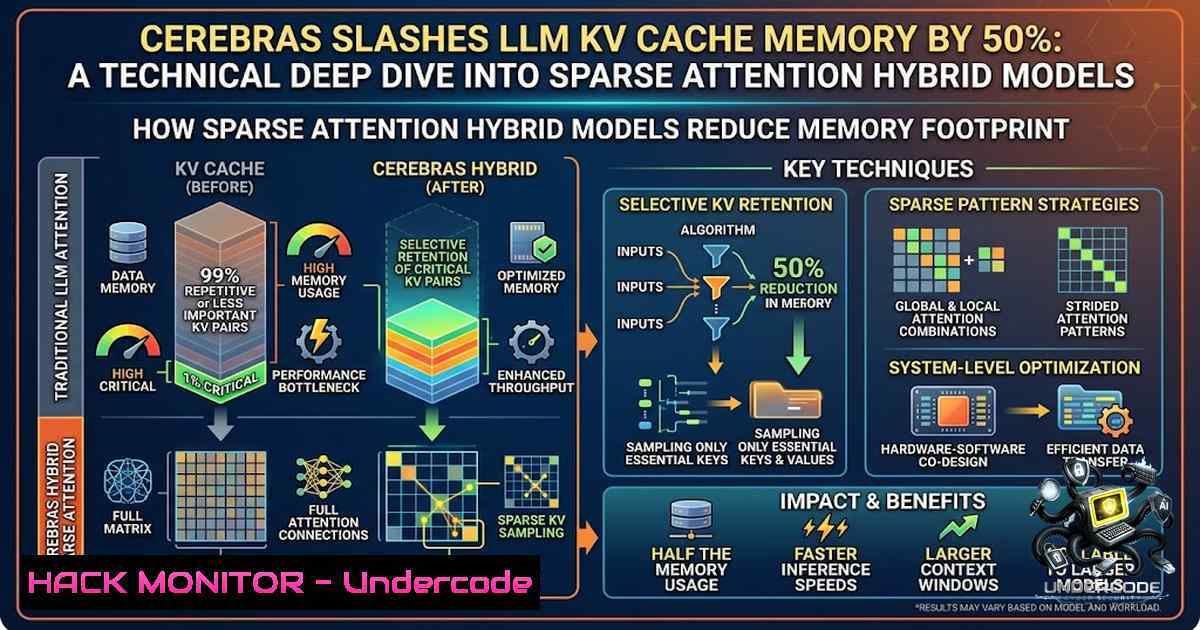
The exponential growth of large language model (LLM) context windows has created a formidable memory bottleneck that threatens the economic viability of production-scale AI deployment. As context lengths expand from thousands to millions of tokens, the Key-Value (KV) cache—which stores intermediate attention representations for autoregressive decoding—grows proportionally, consuming vast GPU memory and severely limiting concurrent request serving capacity. Cerebras Systems has tackled this challenge head-on by releasing hybrid dense/sparse attention versions of Llama-3.1-8B-Instruct that achieve nearly 50% KV cache memory reduction while largely maintaining—and in some cases improving—long-context benchmark performance. This breakthrough signals a fundamental shift in LLM inference optimization: the path to efficiency lies not solely in faster hardware, but in making models require less memory in the first place.
Learning Objectives & Secrets
- Objective 1: Understand the KV Cache Memory Bottleneck. Learn why KV cache dominates GPU memory during long-context inference and how it grows linearly with sequence length, creating fundamental constraints on batch size, concurrency, and economic viability.
-
Objective 2 Secret Tip: Master the Hybrid Sparse-Dense Attention Architecture. Discover how selectively replacing dense attention layers with sparse lambda-mask attention—while keeping sensitive layers dense—achieves 1.6–1.7× KV cache reduction without catastrophic quality degradation. The secret lies in identifying which layers are most sensitive to sparsification and preserving them.
-
Objective 3 Secret Tip: Leverage Attention Sinks and Memory Tokens. Learn how always retaining a small set of initial “sink” tokens in the KV cache preserves critical attention patterns that dense models have learned during pretraining. Pair this with learnable memory tokens that aggregate information from context chunks for enhanced long-context processing.
You Should Know
- The KV Cache Memory Wall: Understanding the Bottleneck
During autoregressive generation, each decoding step requires computing attention between the current query token and all previous tokens’ Key and Value representations. Rather than recomputing these from scratch, LLM inference engines cache K and V tensors for every token in the sequence. For an 8B parameter model at float32 precision with a 16K sequence length, the KV cache alone consumes approximately 2.15 GB of GPU memory. As context windows expand to 100K or 1M tokens, this cache grows to tens or hundreds of gigabytes—far exceeding the memory capacity of even the most powerful GPUs.
This creates a cascade of operational constraints: smaller batch sizes, lower request concurrency, increased latency from memory swapping, and ultimately, higher inference costs per token. The problem is so severe that single-GPU deployment becomes memory-bound, while multi-GPU setups become communication-bound. Cerebras’s insight was to address this at the architectural level rather than merely throwing more hardware at the problem.
- Sparse Attention with Sliding Windows and Lambda Masks
The core technique behind Cerebras’s hybrid models is replacing dense attention with sparse sliding-window attention in most layers. Instead of each token attending to every previous token in the sequence, each token only attends to a local window—in this case, an 8K token sliding window. This reduces the KV cache from full O(n²) attention to O(n × window_size) memory complexity.
However, vanilla sliding-window attention introduces a critical problem: the “attention sink” phenomenon. In pretrained dense models like Llama, the first few tokens—particularly the
 token—consistently receive disproportionately high attention scores regardless of semantic relevance. If these sink tokens are evicted from the cache once they fall outside the sliding window, model performance degrades significantly.

Cerebras’s solution uses a lambda-shaped attention mask that always retains sink tokens in the KV cache alongside the sliding window. This builds on work from StreamingLLM and LM-Infinite, but crucially, Cerebras applied this sparse attention pattern during training rather than as a post-hoc inference modification. This approach avoids the computational overhead of adjusting position IDs or clamping relative distances at each decoding step.

<h2 style="color: yellow;">3. Selective Dense Layers: Protecting Sensitive Attention Heads</h2>

Not all attention layers are created equal. Some layers—particularly those closer to the output—are more sensitive to sparsification than others. Cerebras identified which layers in the 32-layer Llama-3.1-8B architecture could tolerate sparsity and which required dense computation. The result is two models:

<ul>
<li>Llama-3-CBHybridM-8B: 28 sparse attention layers out of 32 (87.5% sparsity)</li>
<li>Llama-3-CBHybridL-8B: 25 sparse attention layers out of 32 (78.1% sparsity)</li>
</ul>

The remaining dense layers act as “anchors” that preserve global context and maintain model coherence. This selective approach demonstrates that wholesale sparsity is unnecessary—targeted sparsification of the right layers achieves most of the memory benefit with minimal quality trade-off.

<h2 style="color: yellow;">4. Memory Tokens and Long-Context Fine-Tuning</h2>

To compensate for the reduced receptive field of sliding-window attention, Cerebras introduced auxiliary “memory” tokens added to the input sequence. These learnable tokens aggregate information from chunks of the context, effectively compressing distant information into a compact representation that remains accessible within the sliding window.

Critically, Cerebras performed long-context fine-tuning specifically to adapt the model to the new sparse attention pattern. Rather than applying sparse attention as a post-training hack, the model was trained from the outset to work with the lambda-shaped attention mask. This training-time adaptation is essential—models pretrained on dense attention do not seamlessly transition to sparse attention without significant performance degradation.

Cerebras also released the synthetic long instruction-following data used for fine-tuning, enabling the broader community to replicate and extend this work.

<h2 style="color: yellow;">5. Benchmark Results: The Memory-Accuracy Trade-Off</h2>

The hybrid models deliver compelling results across standard long-context benchmarks:

| Metric | Llama-3.1-8B-Instruct | CBHybridM-8B | CBHybridL-8B |

<h2 style="color: yellow;">|--|-|--|--|</h2>

| KV Cache Memory (16K seq) | 2.147 GB | 1.275 GB | 1.376 GB |
| LongBench Macro-Mean (EN) | 58.606 | 60.485 | 60.937 |
| HELMET Macro-Mean | 59.289 | 56.238 | 58.564 |

<h2 style="color: yellow;">Data source: Cerebras Hugging Face model cards</h2>

The CBHybridM-8B achieves the greatest memory reduction (1.275 GB, approximately 40.6% reduction from baseline) with strong LongBench performance that actually exceeds the dense baseline on English tasks. The CBHybridL-8B offers slightly less memory reduction but better HELMET performance, providing a tunable trade-off between memory efficiency and benchmark accuracy.

Notably, the KV cache memory numbers are measured at a representative sequence length of 16K, though LongBench samples vary with ~14.5K being the 75th percentile. At longer contexts, the memory savings compound significantly.

<ol>
<li>Practical Implementation: Loading and Using Cerebras Hybrid Models</li>
</ol>

Cerebras has released the models on Hugging Face with straightforward loading:

[bash]
from transformers import AutoTokenizer, AutoModelForCausalLM
import torch

model_id = "cerebras/Llama-3-CBHybridM-8B"

tokenizer = AutoTokenizer.from_pretrained(model_id, trust_remote_code=True)
model = AutoModelForCausalLM.from_pretrained(
model_id,
torch_dtype=torch.bfloat16,
device_map="auto",
trust_remote_code=True
)

messages = [
{"role": "system", "content": "You are a helpful assistant."},
{"role": "user", "content": "Explain the KV cache memory bottleneck."}
]

input_ids = tokenizer.apply_chat_template(
messages,
tokenize=True,
add_generation_prompt=True,
return_tensors="pt"
)

outputs = model.generate(
input_ids,
max_new_tokens=512,
do_sample=True,
temperature=0.7
)

response = tokenizer.decode(outputs[bash], skip_special_tokens=True)
The `trust_remote_code=True` parameter is required because Cerebras uses custom attention implementations that extend the standard Llama attention class. The sparse lambda-mask attention is implemented in the `CBSparseLlamaAttention` class, which inherits from `LlamaAttention` and overrides the attention computation.
7. Complementary Optimization Techniques for Production Systems
While Cerebras’s sparse attention addresses the architectural root cause of KV cache growth, production systems should combine this with other optimization techniques:
vLLM with PagedAttention: vLLM’s PagedAttention divides the KV cache into fixed-size blocks (pages) stored in non-contiguous memory, eliminating fragmentation and enabling efficient memory reuse across requests. This is particularly effective when combined with continuous batching and prefix caching.
 Serve a Cerebras hybrid model with vLLM
vllm serve cerebras/Llama-3-CBHybridM-8B \
--gpu-memory-utilization 0.9 \
--max-model-len 32768 \
--enforce-eager
KV Cache Quantization: FP8 KV cache quantization can halve KV memory at near-zero quality cost. vLLM supports FP8 KV cache via the `–kv-cache-dtype fp8` flag.
vllm serve cerebras/Llama-3-CBHybridM-8B \
--kv-cache-dtype fp8 \
--gpu-memory-utilization 0.9
SGLang RadixAttention: For workloads with shared prefixes (e.g., multi-turn conversations, RAG with common system prompts), SGLang’s RadixAttention caches and reuses KV cache for common prefixes using a radix tree data structure.
python -m sglang.launch_server \
--model-path cerebras/Llama-3-CBHybridM-8B \
--host 0.0.0.0 \
--port 30000
Prefix Caching in Transformers: Hugging Face Transformers is exploring paged-KV cache implementations inspired by PagedAttention, with significant implications for the `generate()` method.
What Undercode Say
- Key Takeaway 1: Memory optimization is the new performance frontier. For production AI systems serving long-context workloads, KV cache memory reduction delivers more tangible benefits than chasing marginal gains in raw GPU throughput. A 50% reduction in KV cache memory translates directly to higher concurrency, longer contexts, and better inference economics.
-
Key Takeaway 2: Sparse attention must be trained, not applied post-hoc. Cerebras’s success demonstrates that sparse attention patterns must be integrated during training, not bolted on during inference. The attention sink phenomenon and layer-specific sensitivity require careful architectural design and fine-tuning to preserve model quality.
-
Key Takeaway 3: The hybrid approach is the winning formula. Not all layers need to be sparse; selective density provides the optimal balance between memory efficiency and performance. Cerebras’s two model variants offer a tunable trade-off, allowing practitioners to choose based on their specific memory constraints and quality requirements.
Prediction
-
+1 Sparse attention hybrid models will become the default architecture for production LLM inference within 12–18 months, as the economic imperative of reducing memory costs outweighs marginal quality improvements from dense attention.
-
+1 The combination of architectural sparsity (Cerebras-style), paged memory management (vLLM PagedAttention), and quantization (FP8 KV cache) will enable 8B-class models to serve 100K+ context windows on a single consumer GPU, democratizing long-context AI applications.
-
+1 Model providers will increasingly release multiple sparsity variants of their flagship models, allowing users to choose the optimal memory-performance trade-off for their specific use case—similar to how quantization levels (4-bit, 8-bit, FP16) are now standard options.
-
-1 Without careful fine-tuning and attention sink preservation, naive application of sliding-window attention will continue to produce unacceptable quality degradation, leading to failed deployments and skepticism about sparse attention approaches.
-
-1 The fragmentation of attention implementations (custom kernels, vendor-specific optimizations, framework-specific hacks) will create significant operational complexity for teams trying to deploy hybrid sparse models across heterogeneous hardware environments.
▶️ Related Video (74% Match):
https://www.youtube.com/watch?v=80bIUggRJf4
🎯Let’s Practice For Free:
🎓 Live Courses & Certifications:
Join Undercode Academy for Verified Certifications
🚀 Request a Custom Project:
Secure, high-velocity infrastructure and disruptive technological engineering. Contact our engineering team for high-tier development and proprietary systems:
[email protected]
💎 Smart Architecture | 🛡️ Secure by Design | ⭐ Trusted by Thousands
IT/Security Reporter URL:
Reported By: https://lnkd.in/p/eZXV8dJA – Hackers Feeds
Extra Hub: Undercode MoN
Basic Verification: Pass ✅


