Listen to this Post
Introduction:
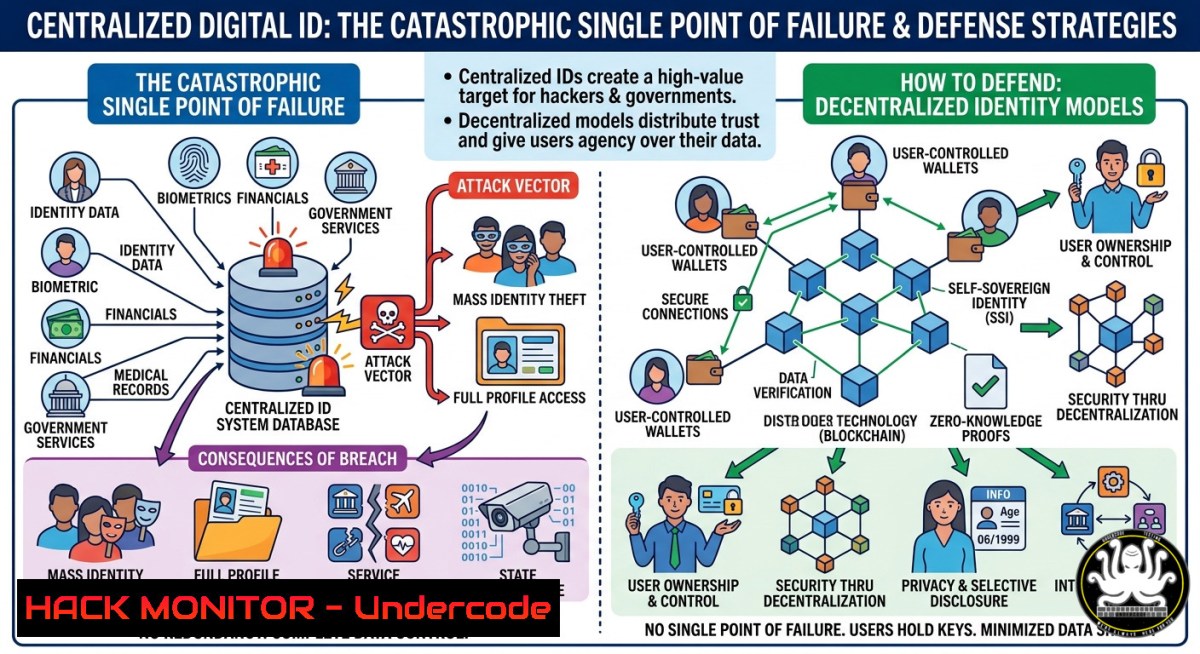
Centralized Digital ID systems promise convenience but violate every core principle of cybersecurity risk management. According to ISO 31000, NIST RMF, and the classic Likelihood × Impact model, these systems create an unacceptable risk profile: a single breach exposes biometrics, financial records, health data, and behavioral profiles – permanently. With AI-driven attacks accelerating and a global cybersecurity talent shortage of 4.8 million professionals, the question is not if a major centralized ID system will be breached, but when.
Learning Objectives:
- Understand why centralized Digital ID systems fail NIST and ISO 31000 risk frameworks.
- Learn practical commands and configurations to assess, harden, and implement decentralized identity solutions.
- Apply mitigation techniques against identity theft, API abuse, and quantum threats.
You Should Know:
- Risk Assessment of Centralized Digital ID Using NIST & ISO 31000
The post correctly applies likelihood × impact = risk score. For centralized ID, impact is catastrophic (loss of confidentiality, no reset possible), likelihood is high to almost certain within 3–5 years. This falls into the “red zone” – risk that must be avoided entirely.
Step‑by‑step guide to perform your own risk assessment (Linux/Windows):
On Linux (using NIST’s OSCAL tooling or simple risk calculator):
 Install jq for JSON processing
sudo apt install jq -y

Example: Calculate risk score (1-5 scale)
echo '{"likelihood": 4, "impact": 5}' | jq '.risk = (.likelihood  .impact)'
 Output: {"likelihood":4,"impact":5,"risk":20} → Unacceptable (max 25)
On Windows PowerShell (risk matrix generator):
$risk = @{Likelihood=4; Impact=5}
$risk.Risk = $risk.Likelihood  $risk.Impact
Write-Host "Risk Score: $($risk.Risk) - CRITICAL"
What this does: Quantifies risk to justify rejecting centralized ID architectures. Use this in security memos to stakeholders.
2. Defense-in-Depth vs. Centralization – Practical Hardening
Centralization undermines defense-in-depth. Instead, implement decentralized identity using self-sovereign identity (SSI) principles with unprivileged keys.
Step‑by‑step guide to deploy a decentralized identity verifier (Linux, using did‑cli):
 Install did-cli (Decentralized Identity CLI)
git clone https://github.com/decentralized-identity/did-cli.git
cd did-cli
npm install

Create a new DID (Decentralized Identifier)
node bin/did-cli.js create key
 Example output: did:key:z6Mkr...

Verify a verifiable credential without central authority
node bin/did-cli.js verify credential.json
Windows alternative (using WSL or Docker):
 Run did-cli via Docker
docker run -it decentralize/did-cli create key
Why this helps: It eliminates the single point of failure. Even if one system is compromised, your identity key remains under your control.
- The Human Element & AI-Driven Attacks – Simulated Phishing Defense
The post notes that 60% of breaches involve the human element, and attackers now use open-source AI to automate personalization. Defend by deploying AI‑resistant phishing simulations and zero‑trust email filters.
Step‑by‑step guide to set up an AI‑aware phishing simulation (using Gophish on Linux):
 Install Gophish
wget https://github.com/gophish/gophish/releases/download/v0.12.0/gophish-v0.12.0-linux-64bit.zip
unzip gophish-.zip
cd gophish-

Edit config.json to enforce multi-factor and reporting
nano config.json
 Set "use_ssl": true, "admin_server" listen on localhost only

Run Gophish
./gophish
 Access admin panel at https://localhost:3333, default credentials admin/gophish
Configure AI‑based email filtering with RSPAMD (Linux):
sudo apt install rspamd -y
sudo systemctl enable rspamd
 Add AI/ML neural network module
echo 'neural = {
servers = "127.0.0.1:3333";
symbols = "NEURAL_NET";
}' | sudo tee -a /etc/rspamd/local.d/classifier-bayes.conf
sudo systemctl restart rspamd
- API Security in Centralized ID Systems – Exploitation & Mitigation
Centralized Digital IDs rely on APIs for authentication and data exchange. These APIs become high‑value targets. Attackers exploit OAuth misconfigurations, JWT weaknesses, and lack of rate limiting.
Step‑by‑step guide: Test for JWT weaknesses (Linux using jwt_tool):
 Install jwt_tool
git clone https://github.com/ticarpi/jwt_tool
cd jwt_tool
pip install -r requirements.txt

Analyze a JWT token from a centralized ID system
python3 jwt_tool.py eyJhbGciOiJIUzI1NiIsInR5cCI6IkpXVCJ9.eyJzdWIiOiIxMjM0NTY3ODkwIiwibmFtZSI6IkpvaG4gRG9lIiwiaWF0IjoxNTE2MjM5MDIyfQ.SflKxwRJSMeKKF2QT4fwpMeJf36POk6yJV_adQssw5c

Test for algorithm confusion (set to "none")
python3 jwt_tool.py [bash] -X a -k /dev/null
Mitigation on Windows (using Azure API Management policies):
 Add IP whitelisting and rate limiting to API
$apiPolicy = @"
<policies>
<inbound>
<rate-limit calls="10" renewal-period="60" />
<ip-filter action="allow">
<address-range from="10.0.0.0" to="10.0.0.255" />
</ip-filter>
<validate-jwt header-name="Authorization" failed-validation-httpcode="401">
<issuer-signing-keys>
<key>Base64EncodedKey</key>
</issuer-signing-keys>
</validate-jwt>
</inbound>
</policies>
"@
 Apply via Azure CLI
az apim api policy set --resource-group myRG --service-name myAPIM --api-id myAPI --policy "$apiPolicy"
5. Third‑Party Breaches – Supply Chain Hardening
Third‑party involvement in breaches doubled in 2025. Centralized ID systems often integrate with dozens of external vendors, each a potential backdoor.
Step‑by‑step guide: Audit third‑party risk using OWASP Dependency‑Check (Linux/Windows):
Linux:
 Install OWASP Dependency-Check
wget https://github.com/jeremylong/DependencyCheck/releases/download/v10.0.0/dependency-check-10.0.0-release.zip
unzip dependency-check-.zip
cd dependency-check/bin
./dependency-check.sh --project "IDSystem" --scan /path/to/source --format HTML --out report.html
Windows (PowerShell):
 Download and run Dependency-Check
Invoke-WebRequest -Uri "https://github.com/jeremylong/DependencyCheck/releases/download/v10.0.0/dependency-check-10.0.0-release.zip" -OutFile "depcheck.zip"
Expand-Archive depcheck.zip -DestinationPath C:\depcheck
cd C:\depcheck\bin
.\dependency-check.bat --project "IDSystem" --scan "C:\code" --format HTML --out report.html
What Undercode Say:
- Centralized Digital ID violates ISO 31000 proportionality – the risk of permanent identity theft far outweighs any usability benefit.
- Defense-in-depth and zero trust are incompatible with a single database of everything – resilience must be built by design, not bolted on after a breach.
Prediction: Within five years, at least one major government‑deployed centralized Digital ID will suffer a catastrophic breach, exposing millions of biometric and health records. This will trigger a global shift toward self‑sovereign identity (SSI) and decentralized ledgers, but only after billions in damages and irreversible privacy loss. The EU, despite its GDPR framework, will face severe political and legal backlash for pushing the EUDI Wallet without mandatory decentralized architecture. Organizations that adopt decentralized identity now will become the benchmark for post‑breach trust.
▶️ Related Video (66% Match):
🎯Let’s Practice For Free:
IT/Security Reporter URL:
Reported By: Corina Pantea – Hackers Feeds
Extra Hub: Undercode MoN
Basic Verification: Pass ✅


