Listen to this Post
Introduction:
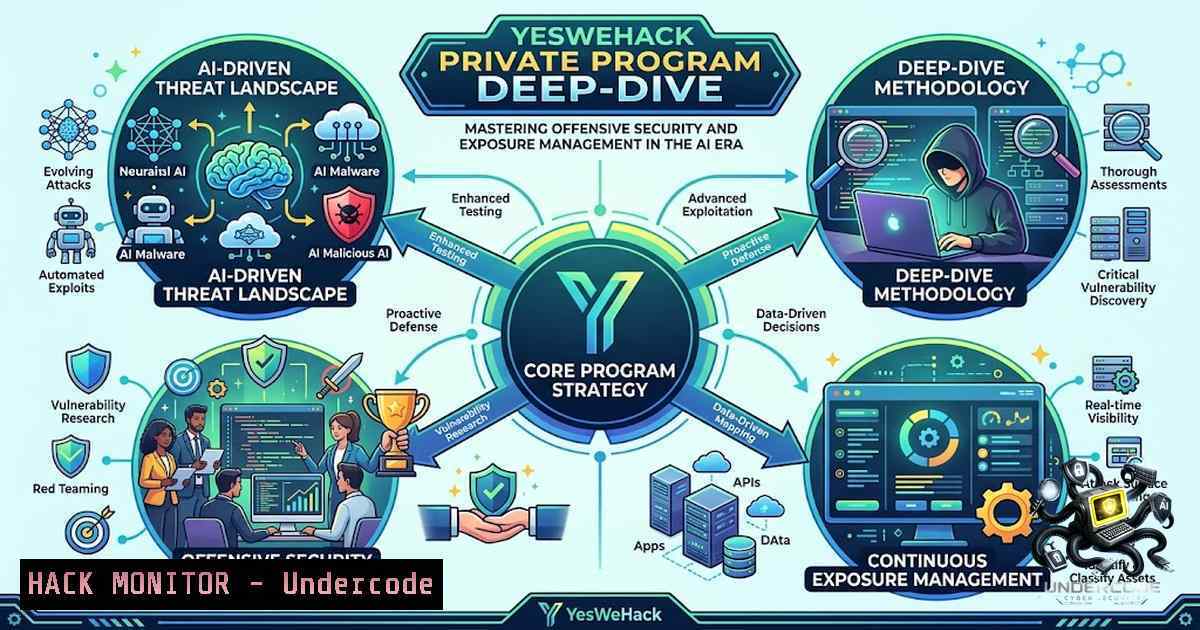
In an era where attack surfaces expand faster than security teams can track, organizations are increasingly turning to crowdsourced security models to identify vulnerabilities before malicious actors exploit them. YesWeHack, a leading offensive security and exposure management platform, offers private bug bounty programs that connect vetted security researchers with organizations seeking to harden their digital infrastructure. This article provides a comprehensive technical deep-dive into the YesWeHack private program ecosystem, exploring reconnaissance methodologies, tool configurations, and vulnerability exploitation techniques essential for modern offensive security operations.
Learning Objectives:
- Understand the architecture and operational mechanics of YesWeHack’s private bug bounty programs
- Master reconnaissance methodologies and toolchains for effective vulnerability discovery
- Implement grey-box testing strategies and credential management for in-depth security assessments
- Leverage AI-powered testing solutions alongside human expertise for comprehensive coverage
You Should Know:
- Understanding YesWeHack Private Programs: Architecture and Access Control
Private bug bounty programs on YesWeHack represent a controlled, invitation-only security testing environment where organizations can engage handpicked ethical hackers to uncover vulnerabilities. Unlike public programs accessible to all verified hunters, private programs offer organizations full control over researcher selection, reduced report volumes, and better alignment between scope complexity and hunter expertise.
Step-by-step guide to understanding private program mechanics:
Step 1: Program Initiation and Scope Definition
Organizations begin by defining their attack surface—web applications, APIs, mobile apps, cloud infrastructure, and other internet-facing assets. The scope determines what researchers can test and what remains out of bounds. Organizations should always start with a private program before considering public exposure.
Step 2: Hunter Selection and Invitation
YesWeHack’s platform selects hunters whose skillset and experience best match the organization’s assets, budget, and testing requirements. Only thoroughly vetted and high-ranking hunters receive invitations to private programs.
Step 3: Credentials Management
Private programs uniquely support credentials management features, enabling organizations to create, assign, or revoke access to hunters on specific scopes. Two credential options exist:
– Email Credentials: Hunters request credentials through the platform, providing an email address for account creation
– Login Credentials: Organizations provision and import batches of accounts that are automatically assigned when hunters request access
Step 4: Grey-Box Testing Implementation
Grey-box testing provides hunters with partial system knowledge, typically through credentials to specific environments. This enables deeper exploration of post-authentication flaws, API misuse, business logic errors, and misconfigurations that black-box testing might miss.
Linux/Windows Command Examples for Scope Validation:
 Linux - Subdomain enumeration for scope mapping
amass enum -d target.com -o subdomains.txt

Linux - HTTP probing to discover live assets
cat subdomains.txt | httpx -silent -o live_hosts.txt

Windows - Port scanning using PowerShell
Test-1etConnection -ComputerName target.com -Port 443

Linux - API endpoint discovery
ffuf -u https://target.com/FUZZ -w /usr/share/wordlists/dirb/common.txt -fc 404
- Reconnaissance Methodology: The 2026 Attack Surface Mapping Workflow
Reconnaissance forms the foundation of any successful bug bounty engagement. A structured methodology discovers everything an organization exposes to the internet, with each phase feeding the next: enumeration expands the surface, discovery and scanning enrich it, and correlation turns the map into ranked findings.
Step-by-step reconnaissance workflow:
Phase 1: Passive Intelligence and Scope Mapping
Identify the organization’s global footprint, network boundaries, and historical data. This includes ASN and network mapping to understand the target’s infrastructure.
 ASN Discovery
whois -h whois.radb.net -- '-i origin AS64496' | grep -Eo "([0-9]{1,3}.){3}[0-9]{1,3}" | sort -u

Certificate Transparency Logs
curl -s "https://crt.sh/?q=%.target.com&output=json" | jq -r '.[].name_value' | sort -u
Phase 2: DNS Resolution and Subdomain Brute-Forcing
Enumerate subdomains using both passive and active techniques.
 Passive subdomain enumeration
subfinder -d target.com -silent -o passive_subs.txt

Active brute-forcing
puredns bruteforce /usr/share/wordlists/subdomains.txt target.com -r resolvers.txt -o active_subs.txt

DNS resolution and filtering
cat passive_subs.txt active_subs.txt | sort -u | dnsx -silent -a -resp -o resolved.txt
Phase 3: HTTP Probing and Technology Discovery
Identify live web services and underlying technologies.
 HTTP probing with status code and title extraction
cat resolved.txt | httpx -silent -status-code -title -tech-detect -o live_tech.txt

Screenshot capture for visual reconnaissance
cat live_hosts.txt | gowitness scan --file - --destination ./screenshots/
Phase 4: Directory and Parameter Discovery
Fuzz for hidden directories, files, and parameters.
 Directory fuzzing
ffuf -u https://target.com/FUZZ -w /usr/share/wordlists/dirbuster/directory-list-2.3-medium.txt -fc 404,403 -o dirs.json

Parameter discovery
ffuf -u https://target.com/?FUZZ=test -w /usr/share/wordlists/param.txt -fc 404 -o params.json
Phase 5: Vulnerability Correlation and Prioritization
Map findings to potential vulnerabilities and prioritize based on severity and exploitability.
- Tool Configuration for Bug Bounty Hunting on YesWeHack
YesWeHack provides specialized tools that integrate directly with the platform, streamlining the hunting workflow.
YesWeBurp Configuration (Burp Suite Extension):
This extension gives hunters access to all their YesWeHack bug bounty programs directly from within Burp Suite.
Step-by-step setup:
- Install the Extension: Download YesWeBurp from the YesWeHack researcher tools page
- Configure JWT Authentication: Provide your YesWeHack JWT token to access private program scopes
- Scope Configuration: Configure Burp according to public and private programs by adding scopes and defining User-Agents
- Traffic Interception: All traffic within defined scopes is automatically proxied through Burp for analysis
YesWeCaido Integration (Caido Toolkit):
YesWeCaido fetches all bug bounty programs with their details to your Caido instance.
 Python script to fetch private program scopes via YesWeCaido API
import requests
import json

headers = {'Authorization': 'Bearer YOUR_JWT_TOKEN'}
response = requests.get('https://yeswehack.com/api/programs/private', headers=headers)
programs = response.json()

for program in programs:
print(f"Program: {program['name']}")
for scope in program['scopes']:
print(f" Scope: {scope['target']} - {scope['type']}")
PwnFox Configuration (Firefox/Burp Extension):
Described as “an IDOR Hunter’s best friend,” PwnFox containerizes up to eight sessions within one Firefox browser, with color-coded proxied traffic.
Features:
- Single-click BurpProxy integration
- Container profiles for session isolation
- PostMessage Logger for XSS detection
- Toolbox Injection and Security Header Remover
4. Vulnerability Exploitation and Mitigation Techniques
Understanding common vulnerability classes and their exploitation vectors is essential for effective bug bounty hunting.
IDOR (Insecure Direct Object References):
IDOR vulnerabilities occur when an application exposes internal object references without proper authorization checks.
Exploitation approach:
- Identify endpoints with numeric or UUID identifiers (e.g.,
/api/user/1234,/download?file=report.pdf)
2. Modify identifiers to access unauthorized resources
- Test for horizontal (same role, different user) and vertical (different role) privilege escalation
 Automated IDOR testing with Burp Intruder
 Payload: Sequential numeric values
 Position: /api/user/§1234§

Python script for parameter fuzzing
import requests
for i in range(1, 10000):
response = requests.get(f'https://target.com/api/user/{i}')
if response.status_code == 200 and 'unauthorized' not in response.text.lower():
print(f'Potential IDOR: /api/user/{i}')
Mitigation strategies:
- Implement robust access control checks on every request
- Use indirect reference maps instead of direct object references
- Validate user permissions for each requested resource
SSRF (Server-Side Request Forgery):
SSRF vulnerabilities allow attackers to make requests from the vulnerable server to internal or external resources.
Exploitation approach:
- Identify features that fetch external resources (e.g., URL preview, webhook, document ingestion)
- Test with internal IP addresses (127.0.0.1, 10.0.0.0/8, 172.16.0.0/12, 192.168.0.0/16)
- Use URL encoding and DNS rebinding to bypass filters
 SSRF payload examples
https://target.com/fetch?url=http://169.254.169.254/latest/meta-data/
https://target.com/fetch?url=http://localhost:8080/admin
https://target.com/fetch?url=http://[::1]:22

DNS rebinding bypass (using public services)
https://target.com/fetch?url=http://1e100.net/  Google's IP
Mitigation strategies:
- Implement allowlists for permitted URLs
- Validate and sanitize user-supplied URLs
- Restrict outbound network access from application servers
5. AI-Powered Security Testing: The Agentic Pentest Revolution
YesWeHack has launched Agentic Pentest, an on-demand solution using autonomous AI agents to test organizations’ assets and deliver same-day findings.
Step-by-step guide to AI-powered testing:
Step 1: Define Testing Scope
Specify assets to be tested—web applications, mobile apps, APIs, and other internet-facing assets.
Step 2: Select Testing Model
Choose from black box, grey box, or white box testing approaches depending on available information.
Step 3: Deploy Autonomous Agents
AI agents operate within guardrails developed by YesWeHack to protect system confidentiality, integrity, and availability throughout testing.
Step 4: Receive and Validate Findings
Findings are delivered as testing progresses, with optional 24/7 expert triage to validate, reproduce, and enrich reports.
Step 5: Centralized Remediation
Manage Agentic Pentest findings alongside vulnerabilities from bug bounty programs and human-led continuous pentesting.
Key advantages:
- Faster and simpler setup than traditional human-led pentesting
- Broader coverage and greater scalability
- Lower costs while identifying high-impact vulnerabilities including OWASP Top 10
6. API Security Hardening and Testing
APIs represent a critical attack surface in modern applications, often exposing sensitive data and business logic.
Common API vulnerabilities:
- Broken object-level authorization
- Broken user authentication
- Excessive data exposure
- Lack of rate limiting
- Mass assignment
Testing methodology:
 API endpoint discovery
ffuf -u https://api.target.com/FUZZ -w /usr/share/wordlists/api-endpoints.txt -fc 404

API parameter fuzzing
ffuf -u https://api.target.com/v1/users?FUZZ=test -w /usr/share/wordlists/api-params.txt

GraphQL introspection query
curl -X POST https://api.target.com/graphql -d '{"query":"query { __schema { types { name fields { name } } } }"}'
Mitigation strategies:
- Implement proper authentication (OAuth2, JWT)
- Validate all inputs and outputs
- Apply rate limiting to prevent abuse
- Use API gateways for centralized security controls
7. Cloud Infrastructure Hardening
With YesWeHack now available on AWS Marketplace, organizations can integrate offensive security testing directly into their cloud workflows.
AWS-specific security considerations:
 AWS IAM policy audit
aws iam list-policies --scope Local --only-attached

S3 bucket permissions check
aws s3api get-bucket-acl --bucket target-bucket
aws s3api get-bucket-policy --bucket target-bucket

Security group analysis
aws ec2 describe-security-groups --filters Name=vpc-id,Values=vpc-xxxxx

CloudTrail log analysis
aws cloudtrail lookup-events --lookup-attributes AttributeKey=EventName,AttributeValue=ConsoleLogin
Hardening recommendations:
- Implement least-privilege IAM policies
- Enable CloudTrail for audit logging
- Restrict security group ingress rules
- Use AWS Config for continuous compliance monitoring
What Undercode Say:
Key Takeaway 1: Private bug bounty programs represent the optimal entry point for organizations new to crowdsourced security, offering controlled testing environments with reduced report volumes and targeted researcher expertise. Starting private before moving public enables organizations to mature their security processes and define precise scopes.
Key Takeaway 2: The integration of AI-powered testing solutions like Agentic Pentest alongside human-led bug bounty programs creates a comprehensive offensive security strategy. AI augments rather than replaces human expertise, with expert triage teams ensuring zero false positives and actionable findings.
Analysis: The evolution of offensive security platforms like YesWeHack reflects a broader industry shift toward unified exposure management. Security teams no longer need isolated tools; they require integrated solutions that map, test, fix, and comply across their entire attack surface. The availability of YesWeHack on AWS Marketplace and the expansion of bug bounty testing to AI-powered systems demonstrate how the platform adapts to emerging threats. As attackers leverage AI to accelerate exploitation, defensive strategies must equally embrace automation while maintaining human oversight. The private program model’s credential management and grey-box testing capabilities provide organizations with the control needed to secure sensitive assets without exposing them to unnecessary risk.
Prediction:
- +1 The continued growth of crowdsourced security platforms will democratize access to elite security talent, enabling organizations of all sizes to benefit from professional-grade vulnerability discovery
- +1 AI-powered autonomous pentesting will become standard practice, reducing time-to-remediation from weeks to hours while maintaining human validation for complex findings
- -1 The rise of AI-assisted attacks will outpace traditional security testing methods, forcing organizations to adopt continuous, multi-layered offensive security strategies to stay ahead
- +1 Private bug bounty programs will evolve to incorporate automated credential management and dynamic scope adjustment, further streamlining the testing process
- -1 Organizations that delay adoption of crowdsourced security models will face increasing exposure to undetected vulnerabilities as attackers become more sophisticated
▶️ Related Video (80% Match):
🎯Let’s Practice For Free:
🎓 Live Courses & Certifications:
Join Undercode Academy for Verified Certifications
🚀 Request a Custom Project:
Secure, high-velocity infrastructure and disruptive technological engineering. Contact our engineering team for high-tier development and proprietary systems:
[email protected]
💎 Smart Architecture | 🛡️ Secure by Design | ⭐ Trusted by Thousands
IT/Security Reporter URL:
Reported By: Murrtada Ahmmed – Hackers Feeds
Extra Hub: Undercode MoN
Basic Verification: Pass ✅


