Listen to this Post
Introduction:
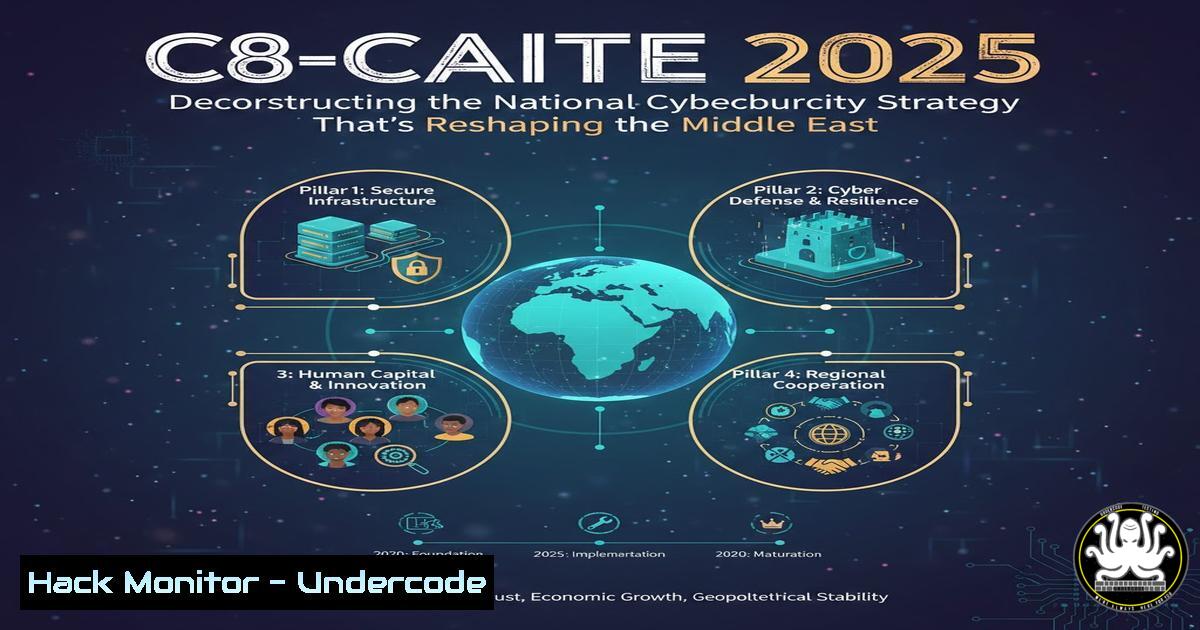
The recent C8-CAITE 2025 event in Jordan represents a pivotal shift in regional cybersecurity strategy, moving beyond theoretical discussions to implementable national security frameworks. This gathering of global experts, national institutions, and academic voices under the National Cyber Security Center (NCSCJO) signals a new era of coordinated cyber defense initiatives. The behind-the-scenes efforts described by participants reveal the extensive planning and multi-disciplinary approach required for effective national cybersecurity operations.
Learning Objectives:
- Understand the strategic importance of national cybersecurity centers in regional security ecosystems
- Master critical security hardening techniques for enterprise and government infrastructure
- Develop incident response capabilities aligned with national cybersecurity frameworks
You Should Know:
1. National Cybersecurity Center Architecture and Implementation
The establishment of national cybersecurity centers like NCSCJO represents a fundamental shift from organizational to national-level security paradigms. These centers serve as coordination hubs for threat intelligence sharing, incident response coordination, and security policy enforcement across government and critical infrastructure sectors.
Step-by-step guide explaining what this does and how to use it:
– Phase 1: Establish centralized threat intelligence platform using open-source solutions like MISP (Malware Information Sharing Platform)
 Install MISP on Ubuntu server
sudo apt update
sudo apt install misp-core
sudo misp-modules
– Phase 2: Implement national CSIRT (Computer Security Incident Response Team) with standardized operating procedures
– Phase 3: Develop sector-specific security baselines for critical infrastructure (energy, finance, healthcare)
– Phase 4: Establish secure communication channels using PGP encryption for sensitive threat intelligence sharing
– Phase 5: Conduct regular national cyber exercises simulating advanced persistent threats
2. Cloud Infrastructure Hardening for Government Workloads
As government services migrate to cloud platforms, securing these environments becomes paramount for national security. The multi-cloud strategies discussed at C8-CAITE emphasize defense-in-depth approaches across hybrid environments.
Step-by-step guide explaining what this does and how to use it:
– Implement cloud security posture management (CSPM) using tools like AWS Security Hub or Azure Security Center
 AWS CLI command to enable Security Hub
aws securityhub enable-security-hub
 Configure security standards
aws securityhub update-standards-control --standards-control-arn "arn:aws:securityhub:us-east-1:123456789012:control/cis-aws-foundations-benchmark/v/1.2.0/1.1" --control-status "ENABLED"
– Enforce encryption at rest and in transit using customer-managed keys
– Deploy cloud workload protection platforms (CWPP) for runtime security
– Implement strict identity and access management policies with mandatory multi-factor authentication
– Configure comprehensive logging and monitoring using cloud-native SIEM solutions
3. AI-Powered Threat Detection and Analysis
Artificial intelligence and machine learning are revolutionizing threat detection capabilities, enabling proactive identification of sophisticated cyber attacks before they cause significant damage.
Step-by-step guide explaining what this does and how to use it:
– Deploy behavioral analytics platforms using TensorFlow or PyTorch for anomaly detection
 Python code snippet for network anomaly detection
import tensorflow as tf
from tensorflow import keras
import numpy as np

model = keras.Sequential([
keras.layers.Dense(64, activation='relu', input_shape=(num_features,)),
keras.layers.Dense(32, activation='relu'),
keras.layers.Dense(1, activation='sigmoid')
])

model.compile(optimizer='adam',
loss='binary_crossentropy',
metrics=['accuracy'])
– Implement natural language processing for phishing email detection
– Configure security orchestration, automation and response (SOAR) platforms with AI-driven playbooks
– Train models on national-level threat intelligence feeds for localized threat prediction
– Establish continuous learning pipelines to adapt to evolving attack techniques
4. Zero Trust Architecture Implementation
The zero trust model “never trust, always verify” forms the foundation of modern security architectures, particularly crucial for protecting national critical infrastructure.
Step-by-step guide explaining what this does and how to use it:
– Deploy identity-aware proxies using solutions like Zscaler or Cloudflare Zero Trust
– Implement micro-segmentation using next-generation firewalls
 Windows PowerShell for network segmentation audit
Get-NetFirewallRule | Where-Object {$_.Enabled -eq 'True'} | Select-Object Name, DisplayName, Direction, Action
– Enforce device compliance checks before granting network access
– Implement continuous authentication monitoring throughout user sessions
– Deploy privileged access management (PAM) solutions for administrative access control
– Establish application-level encryption for all internal communications
5. Critical Infrastructure Protection Frameworks
Protecting national critical infrastructure requires specialized security measures that address both IT and operational technology (OT) environments.
Step-by-step guide explaining what this does and how to use it:
– Conduct comprehensive asset discovery and inventory using specialized OT scanning tools
 Nmap command for OT network discovery (use with caution)
nmap -sU -p U:161,123,47808 192.168.1.0/24 --script snmp-brute
– Implement network segmentation between IT and OT environments using industrial DMZ
– Deploy intrusion detection systems specifically designed for industrial control systems
– Establish security monitoring for SCADA and PLC systems using protocol-aware solutions
– Develop incident response playbooks specifically for operational technology incidents
– Conduct regular tabletop exercises simulating attacks on critical infrastructure
6. Security Awareness and Professional Development
The human element remains critical in cybersecurity defense, requiring continuous education and skills development aligned with national security priorities.
Step-by-step guide explaining what this does and how to use it:
– Develop role-based security training programs using frameworks like NICE Cybersecurity Workforce Framework
– Implement phishing simulation platforms with progressive difficulty levels
– Establish cybersecurity certification pathways aligned with national security requirements
– Create capture-the-flag (CTF) environments for hands-on skills development
– Develop mentorship programs connecting experienced professionals with new entrants
– Conduct regular skills gap analysis and training needs assessment
7. Incident Response and Digital Forensics Readiness
Effective incident response capabilities are essential for minimizing damage from security breaches and supporting attribution and legal proceedings.
Step-by-step guide explaining what this does and how to use it:
– Establish comprehensive logging infrastructure using SIEM solutions
 Linux command to forward logs to SIEM via syslog
sudo nano /etc/rsyslog.conf
 Add: . @siem-server.domain.com:514
sudo systemctl restart rsyslog
– Develop incident severity classification matrix and escalation procedures
– Implement digital forensics workstations with appropriate tooling (Autopsy, FTK, Volatility)
– Create evidence preservation procedures meeting legal standards
– Establish secure communication channels for incident coordination
– Conduct regular purple team exercises to test detection and response capabilities
What Undercode Say:
- The C8-CAITE 2025 event represents a strategic pivot from reactive cybersecurity to proactive national cyber defense, establishing Jordan as a regional leader in cybersecurity governance and capability development.
- The multi-stakeholder approach demonstrated at the event creates a blueprint for other nations seeking to develop comprehensive cybersecurity ecosystems that bridge government, private sector, and academic interests.
The significance of C8-CAITE 2025 extends far beyond a single conference, representing a fundamental shift in how Middle Eastern nations approach cybersecurity at a strategic level. The emphasis on building domestic capabilities while maintaining international partnerships creates a sustainable model for cyber sovereignty. The technical implementations discussed reflect mature understanding of both current threat landscapes and emerging challenges, particularly in areas of cloud security, AI defense, and critical infrastructure protection. This holistic approach positions Jordan not just as a participant in global cybersecurity discussions, but as an emerging contributor to cybersecurity best practices and innovation.
Prediction:
The strategic initiatives launched at C8-CAITE 2025 will establish Jordan as a regional cybersecurity hub within three years, attracting international investment and talent while developing exportable cybersecurity technologies and methodologies. This will create a ripple effect across Middle Eastern cybersecurity markets, driving increased standardization and cooperation between nations. The focus on AI-integrated security operations will position early adopters with significant defensive advantages against nation-state actors, while the emphasis on critical infrastructure protection will become increasingly crucial as operational technology networks face sophisticated targeting. Within five years, we predict the Jordanian cybersecurity model will be studied and partially adopted by at least three other Middle Eastern nations, creating de facto regional security standards.
🎯Let’s Practice For Free:
IT/Security Reporter URL:
Reported By: Alaakasasbeh Aepaesaetaezaeraea – Hackers Feeds
Extra Hub: Undercode MoN
Basic Verification: Pass ✅


