Listen to this Post
Introduction:
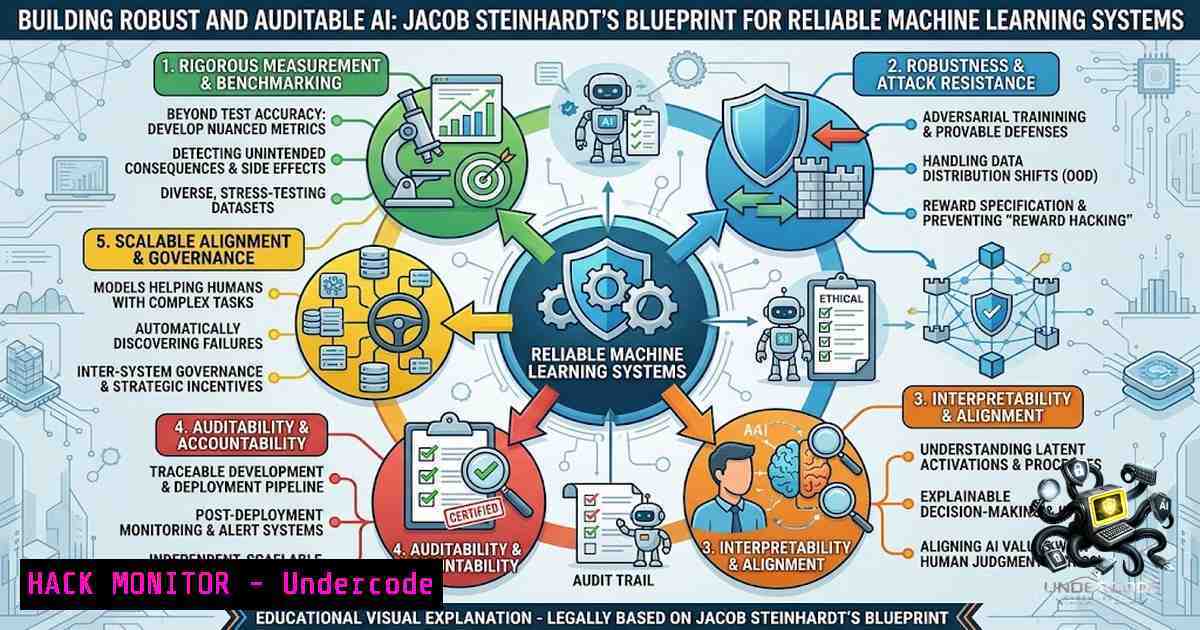
As artificial intelligence systems grow in capability and scale, their opacity and fragility present existential challenges to deployment in high-stakes environments. Jacob Steinhardt, Assistant Professor of Statistics at UC Berkeley and a leading figure at Transluce, has dedicated his research to building machine learning systems that are not only powerful but also reliable, interpretable, and aligned with human values. His work tackles the core vulnerabilities of modern AI—distributional shift, reward hacking, and the lack of scalable oversight—by developing rigorous, empirically falsifiable evaluation frameworks. This article distills Steinhardt’s methodologies into a practical guide for cybersecurity professionals, AI engineers, and security auditors seeking to implement robust AI evaluation and hardening techniques.
Learning Objectives:
- Understand the mechanisms of distributional shift and reward hacking in AI systems and their security implications.
- Learn how to implement scalable oversight and model auditing using AI-assisted interpretability tools.
- Acquire practical commands and configurations for hardening AI pipelines, monitoring model behavior, and detecting data poisoning.
You Should Know:
- Understanding and Mitigating Distributional Shift in Production AI
Distributional shift occurs when the data a model encounters in production differs from its training distribution, leading to degraded performance and unexpected vulnerabilities. Steinhardt’s research emphasizes building models that are robust to such shifts through rigorous evaluation and dataset replication. From a security perspective, distributional shift is a primary vector for adversarial attacks and system failures.
Step‑by‑step guide to detect and mitigate distributional shift:
Step 1: Establish a Baseline with Dataset Replication. Replicate your validation dataset under varied conditions to assess overfitting. This technique helps determine if your model has memorized specific validation examples rather than learning generalizable patterns.
 Python snippet for dataset replication analysis
import numpy as np
from sklearn.metrics import accuracy_score

def replicate_dataset(X, y, noise_factor=0.05):
X_replicated = X + np.random.normal(0, noise_factor, X.shape)
return X_replicated, y

Compare performance on original vs replicated data
original_acc = accuracy_score(y_true, model.predict(X_test))
replicated_acc = accuracy_score(y_true, model.predict(X_replicated))
print(f"Original Accuracy: {original_acc:.4f}")
print(f"Replicated Accuracy: {replicated_acc:.4f}")
if original_acc - replicated_acc > 0.1:
print("WARNING: Significant overfitting detected.")
Step 2: Monitor Input Drift in Production. Continuously track the statistical properties of incoming data against your training distribution.
 Linux: Monitor feature distribution drift using Python with scipy
python3 -c "
import numpy as np
from scipy.stats import ks_2samp
 Load reference distribution (training) and current production sample
ref = np.load('train_distribution.npy')
prod = np.load('prod_sample.npy')
stat, p_value = ks_2samp(ref, prod)
if p_value < 0.05:
print('ALERT: Significant distribution shift detected (p={:.4f})'.format(p_value))
else:
print('Distribution stable (p={:.4f})'.format(p_value))
"
Step 3: Implement Robust Optimization. Use robust optimization techniques that explicitly account for distributional uncertainty, as explored in Steinhardt’s work on resilient learning.
- Detecting and Preventing Reward Hacking in Reinforcement Learning
Reward hacking occurs when an RL agent exploits flaws in the reward model to achieve high estimated rewards without actually performing the intended task. Steinhardt’s research shows that reward models performing similarly in-distribution can yield vastly different rewards under distributional shift, creating a dangerous attack surface.
Step‑by‑step guide to audit for reward hacking:
Step 1: Implement Ensemble Reward Models. Use an ensemble of reward models and monitor the variance in their outputs. High variance under distributional shift indicates potential reward hacking.
 Pseudocode for reward model ensemble variance monitoring
ensemble_predictions = [rm.predict(state) for rm in reward_models]
mean_reward = np.mean(ensemble_predictions, axis=0)
variance_reward = np.var(ensemble_predictions, axis=0)
if np.any(variance_reward > threshold):
print("ALERT: High reward model variance detected - potential reward hacking")
Step 2: Perform Adversarial Reward Probing. Systematically test the reward model with out-of-distribution inputs to identify exploitation vectors.
Step 3: Apply Robust Optimization for Mitigation. Steinhardt and collaborators have developed robust optimization frameworks that correlate proxy rewards to mitigate hacking.
 Clone and test reward hacking mitigation repository
git clone https://github.com/ZixuanLiu4869/reward
cd reward
pip install -r requirements.txt
 Run robust optimization example
python robust_optimization.py --config configs/robust_mitigation.yaml
3. Scalable Oversight and AI-Assisted Auditing
Traditional human oversight does not scale to large models. Steinhardt advocates for oversight foundation models—AI systems trained to understand and audit other AI systems. His work at Transluce has produced tools like Monitor (an observability interface) and Docent (an agent transcript analysis system).
Step‑by‑step guide to implement scalable oversight:
Step 1: Deploy an Observability Interface. Use Transluce’s Monitor to inspect neuron activations and model representations.
 Access Monitor (conceptual deployment)
 Monitor provides an AI-driven interface to inspect model internals
 For local interpretability, consider using:
pip install transformer-lens
 Then load a model and inspect activations
Step 2: Use Investigator Agents to Elicit Behaviors. Deploy AI agents designed to probe and elicit specific behaviors from target models, as developed by Steinhardt’s team.
Step 3: Analyze Agent Transcripts with Docent. Docent accelerates analysis of agent transcripts by automatically identifying corrupted tasks and uncovering unexpected behaviors.
4. Hardening AI Pipelines Against Data Poisoning
Steinhardt has made foundational contributions to provably secure machine learning and certified defenses against data poisoning.
Step‑by‑step guide to implement certified defenses:
Step 1: Implement Data Sanitization Filters. Before training, apply statistical outlier detection to filter poisoned samples.
 Isolation Forest for outlier detection
from sklearn.ensemble import IsolationForest
clf = IsolationForest(contamination=0.1)
predictions = clf.fit_predict(X_train)
 Remove outliers (prediction = -1)
X_clean = X_train[predictions == 1]
y_clean = y_train[predictions == 1]
Step 2: Use Certified Defenses. Implement Steinhardt’s certified defense mechanisms that provide mathematical guarantees against poisoning attacks.
Step 3: Regularly Audit Training Data Provenance. Maintain cryptographic hashes of training datasets and verify their integrity before each training run.
 Linux: Generate and verify dataset checksums
sha256sum training_data.tar.gz > training_data.sha256
 Verify before training
sha256sum -c training_data.sha256
if [ $? -eq 0 ]; then
echo "Dataset integrity verified. Proceeding with training."
else
echo "ERROR: Dataset integrity check failed. Possible poisoning."
exit 1
fi
5. Building Replicable and Refutable AI Evaluations
Steinhardt emphasizes that AI evaluations must be replicable and refutable. This means designing experiments that can be independently reproduced and that clearly define conditions under which a model would be considered to have failed.
Step‑by‑step guide to build replicable evaluations:
Step 1: Standardize Evaluation Environments. Use containerization (Docker) to ensure identical runtime conditions.
 Dockerfile for replicable AI evaluation
FROM python:3.10-slim
RUN pip install torch transformers datasets scikit-learn
COPY evaluation_script.py /app/
COPY requirements.txt /app/
WORKDIR /app
CMD ["python", "evaluation_script.py"]
Step 2: Define Clear Failure Criteria. Specify exact thresholds and conditions under which the model is considered to have failed, as per Steinhardt’s philosophy of refutable science.
Step 3: Publish Evaluation Artifacts. Share code, model weights, and datasets to enable external replication.
What Undercode Say:
- Key Takeaway 1: Jacob Steinhardt’s research provides a comprehensive framework for building AI systems that are not only performant but also provably robust and auditable. His focus on distributional shift, reward hacking, and scalable oversight addresses the most critical failure modes of modern AI.
-
Key Takeaway 2: The practical implementation of Steinhardt’s principles—from dataset replication and ensemble reward models to AI-assisted auditing with Transluce tools—offers a clear pathway for security engineers to harden AI pipelines against adversarial threats and systemic failures.
Analysis: Steinhardt’s work represents a paradigm shift from purely performance-driven AI development to reliability-first engineering. In an era where AI systems are increasingly autonomous and deployed in critical infrastructure, the absence of robust evaluation and auditing mechanisms poses unacceptable risks. His approach—combining theoretical rigor with practical tooling—democratizes access to advanced AI safety techniques. For cybersecurity professionals, integrating these methodologies into DevSecOps pipelines is no longer optional; it is a necessity. The convergence of AI security with traditional cybersecurity principles—such as zero-trust, continuous monitoring, and incident response—is inevitable, and Steinhardt’s frameworks provide the foundational logic for this integration.
Prediction:
- +1 The adoption of Steinhardt-style robust learning and scalable oversight will become a regulatory requirement for AI systems in finance, healthcare, and critical infrastructure within the next 3–5 years, driving a new market for AI auditing tools and services.
-
+1 Transluce’s open-source tooling (Monitor, Docent, Investigator Agents) will catalyze a democratization of AI interpretability, enabling smaller organizations to implement state-of-the-art safety measures previously accessible only to large tech firms.
-
-1 Without widespread adoption of these robust evaluation practices, the frequency of catastrophic AI failures due to reward hacking and distributional shift will increase exponentially, potentially eroding public trust and triggering heavy-handed regulation that stifles innovation.
-
+1 The integration of formal verification techniques with Steinhardt’s empirical auditing methods will lead to the first generation of formally certified AI systems, comparable to hardware security certifications like Common Criteria or FIPS 140-2.
-
-1 The complexity of implementing scalable oversight systems may create a skills gap, leaving many organizations vulnerable to AI-specific attacks that their traditional security teams are ill-equipped to detect or mitigate.
▶️ Related Video (82% Match):
https://www.youtube.com/watch?v=0JMP0HCBfQk
🎯Let’s Practice For Free:
🎓 Live Courses & Certifications:
Join Undercode Academy for Verified Certifications
🚀 Request a Custom Project:
Secure, high-velocity infrastructure and disruptive technological engineering. Contact our engineering team for high-tier development and proprietary systems:
[email protected]
💎 Smart Architecture | 🛡️ Secure by Design | ⭐ Trusted by Thousands
IT/Security Reporter URL:
Reported By: https://lnkd.in/p/ePm6ECdf – Hackers Feeds
Extra Hub: Undercode MoN
Basic Verification: Pass ✅


