Listen to this Post
Introduction:
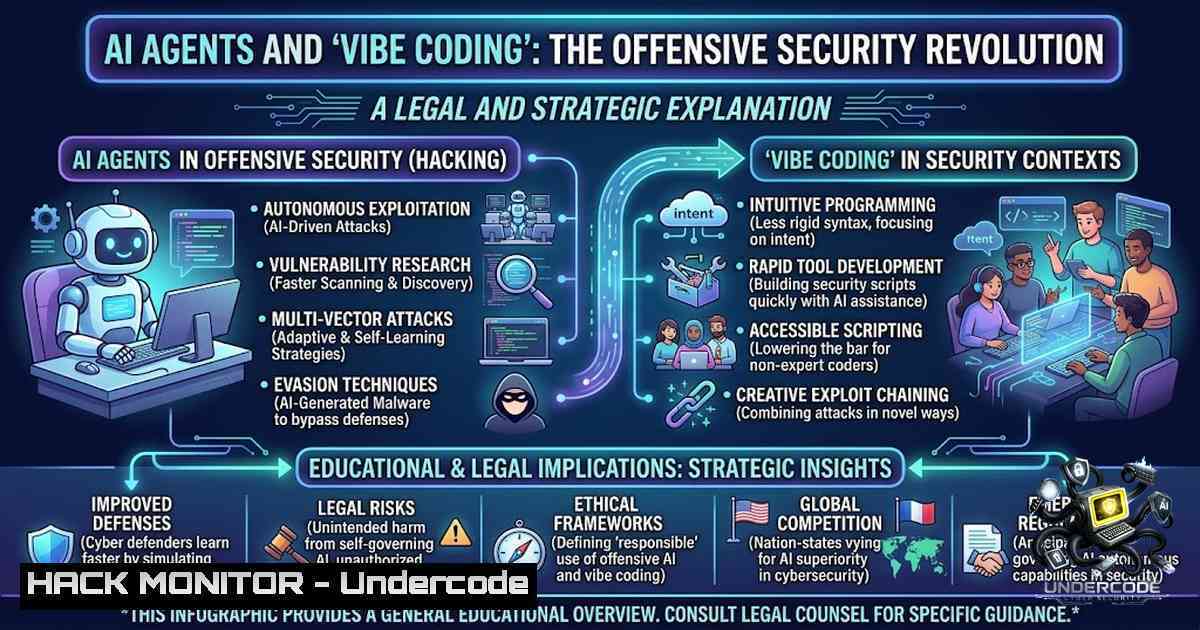
The convergence of “vibe coding”—the practice of generating software by describing intent to an AI model in natural language—and autonomous AI-powered exploitation agents is fundamentally reshaping the offensive security landscape. What was once the stuff of Hollywood hacker flicks is now a tangible reality: AI agents can autonomously discover, validate, and exploit vulnerabilities across web applications, APIs, cloud infrastructure, and even Active Directory environments, compressing the entire attack lifecycle into a single automated sequence. This article dissects the technical underpinnings of this paradigm shift, provides actionable commands and configurations for both attackers and defenders, and offers a critical analysis of where this revolution is headed.
Learning Objectives:
- Understand the core concepts of vibe coding and AI-driven auto-exploitation, including their capabilities and inherent security risks.
- Master the installation and configuration of leading open-source AI penetration testing frameworks like VibePenTester, DarkMoon, and CyberStrike.
- Learn to execute autonomous reconnaissance, vulnerability scanning, and exploitation chains using AI agents.
- Implement defensive strategies, including AI-powered code scanning (SAST/DAST) and infrastructure hardening, to mitigate AI-generated threats.
You Should Know:
1. The Arsenal: Open-Source AI Penetration Testing Frameworks
The democratization of AI-powered hacking is driven by a growing ecosystem of open-source frameworks. These tools transform large language models (LLMs) into autonomous red-team agents capable of reasoning, planning, and executing complex attack chains.
- VibePenTester: This tool coordinates specialized security agents to discover and validate common web vulnerabilities. It supports OpenAI, Anthropic, and local Ollama models, and uses Playwright for browser automation.
-
DarkMoon: An autonomous AI pentesting engine that operates across web, cloud, identity, CI/CD, and even IoT firmware. Its standout feature is a privacy gateway that tokenizes sensitive data (IPs, credentials) before sending them to the LLM, ensuring no real data ever leaves your perimeter.
-
CyberStrike: Described as the first open-source AI agent built for offensive security, it transforms any LLM subscription into an autonomous red team agent with over 13 specialized agents and 7,600+ security skills.
-
Pencheff: An autonomous penetration testing platform where you provide a target URL and credentials in natural language. Pencheff handles reconnaissance, vulnerability scanning, exploit chain analysis, and compliance-mapped reporting, using a 9-phase swarm orchestration.
Installation and Configuration (Linux/macOS):
Most of these tools are Python or Node.js-based. Here’s a typical setup for VibePenTester:
 Clone the repository
git clone https://github.com/firetix/vibe-coding-penetration-tester.git
cd vibe-coding-penetration-tester

Create and activate a Python virtual environment
python -m venv .venv
source .venv/bin/activate

Install dependencies
pip install -r requirements.txt

Install Playwright browsers
playwright install

Configure environment variables
cp .env.example .env
 Edit .env to add your OPENAI_API_KEY or ANTHROPIC_API_KEY
For CyberStrike (Node.js):
npm i -g @cyberstrike-io/cyberstrike@latest && cyberstrike
On first run, the TUI will prompt for your LLM provider and API key.
2. Executing an Autonomous Penetration Test
Once configured, running an autonomous penetration test is often as simple as specifying a target URL. The AI agent then orchestrates the entire process: reconnaissance, crawling, authentication, vulnerability discovery, exploitation, and reporting.
Step-by-Step Guide:
- Reconnaissance: The agent uses tools like `naabu` for port scanning and `httpx` for probing HTTP services.
- Crawling and Authentication: The agent crawls the application to discover the attack surface. If credentials are provided, it attempts to authenticate.
- Vulnerability Scanning: The agent deploys specialized modules to test for OWASP Top 10 vulnerabilities, including SQL injection, XSS, and broken access control.
- Exploitation: Upon finding a vulnerability, the agent attempts to exploit it, chaining vulnerabilities together to achieve a broader impact, such as privilege escalation or data exfiltration.
- Reporting: The agent generates a detailed report in formats like Markdown, JSON, or even compliance-mapped reports (e.g., PCI-DSS, NIST).
Example CLI Command (VibePenTester):
 Perform a domain-level scan using OpenAI's GPT-5.2
python main.py --url https://example.com --scope domain --provider openai --model gpt-5.2
Example CLI Command (Pencheff):
 Initiate a full engagement with a 9-phase swarm
pencheff engage --target https://example.com --credentials user:pass
- The Dark Side of Vibe Coding: Insecure by Default
While AI agents are powerful offensive tools, the code they generate is often riddled with vulnerabilities. This creates a dangerous feedback loop: vibe-coded applications are deployed, and AI-powered attackers automatically exploit them.
- Alarming Statistics: Veracode found that 45% of AI-generated code contains exploitable vulnerabilities. A Georgia Tech study scanning over 43,000 security advisories found 74 confirmed cases of AI-introduced vulnerabilities, with 14 being critical risks.
-
Common Failures: AI agents excel at avoiding well-defined issues like SQLi but fail miserably at complex logic such as authorization, business logic, and SSRF. They also consistently skip implementing security controls altogether.
-
The “Vibe Security” Skill: To counter this, tools like the `vibe-security` agent skill have emerged. This skill audits AI-generated code for common issues like hardcoded secrets, disabled Row-Level Security (RLS) in databases, and client-submitted prices.
Scanning Vibe-Coded Code (Linux):
The `vibescan` tool orchestrates over 30 security tools (Semgrep, Trivy, Nuclei, etc.) to perform SAST, DAST, and sandboxed exploit simulation.
 Clone and run vibescan
git clone https://github.com/Armur-Ai/vibescan
cd vibescan
./vibescan --path /path/to/your/vibe-coded/app
4. Defending Against Autonomous AI Attacks
Defending against AI-driven attacks requires a shift from reactive to proactive, AI-powered defense. The attackers are compressing the entire attack lifecycle into minutes; defenders must do the same.
- AI-Powered Defense: The only way to fight autonomous AI attackers is with autonomous AI defenses. Deploy AI-driven monitoring tools that analyze user and system behavior in real-time to detect anomalies.
-
Zero Trust and Micro-Segmentation: Implement strict access controls and micro-segmentation. Treat virtualization and management platforms as Tier-0 assets. Align firewall policies with workload models to reduce unnecessary connectivity and make lateral movement harder.
-
Hardened Backups: Decouple backup environments from the corporate Active Directory domain and utilize immutable storage to counter the destruction of recovery capabilities.
-
Extended Logging: Extend log retention policies well beyond the standard 90-day window to aid in post-breach investigation.
Windows Command for Auditing AI-Generated Code:
While many tools are Linux-first, you can use Windows Subsystem for Linux (WSL) to run them. For native Windows, you can use tools like `findstr` to search for common insecure patterns:
findstr /s /i /m "password.=.\".\"" .js .py .java
This searches for hardcoded password patterns in your source code.
- The Future: Agentic AI and the Offensive Security Arms Race
The integration of AI into offensive security marks a fundamental shift. We are moving from automated scanners that follow static checklists to agentic systems that reason, plan, and adapt.
- Multi-Agent Orchestration: Frameworks like `vulnswarm` and `HPTSA` use teams of LLM agents to collaborate on vulnerability discovery and exploit development, with some research showing they can even exploit zero-day vulnerabilities.
-
The Privacy Imperative: As these agents become more powerful, the risk of data exfiltration grows. Projects like DarkMoon address this with privacy gateways that ensure sensitive data never leaves your perimeter.
-
The Skills Gap: The barrier to entry for sophisticated hacking is collapsing. A developer with no security training can now deploy an AI agent to find and exploit vulnerabilities in their own or others’ applications. This democratization of offense necessitates a parallel democratization of defense.
What Undercode Say:
- The Hacker Flick is Now Reality: The futuristic hacking scenes from movies are no longer fiction. AI agents are now capable of autonomously executing complex, multi-stage attacks that previously required a team of skilled security professionals.
- Speed is the New Currency: The ability to compress the entire attack lifecycle into an automated sequence means that the window for detection and response has shrunk from weeks to minutes. Organizations must adopt AI-driven defenses to keep pace.
Analysis:
The intersection of vibe coding and auto-exploitation represents a double-edged sword. On one hand, it empowers security professionals with unprecedented capabilities to identify and remediate vulnerabilities at scale. On the other, it arms malicious actors with tools that can automate the discovery and exploitation of the very vulnerabilities that vibe coding introduces. The key differentiator will be the human element: the ability to craft precise prompts, interpret AI-generated findings, and implement strategic fixes. The organizations that thrive will be those that treat AI not as a replacement for human expertise, but as a force multiplier. The coming years will see an escalating arms race between AI-powered attackers and defenders, with the outcome depending on who can best integrate AI into their workflows while maintaining rigorous oversight and ethical boundaries.
Expected Output:
Introduction:
The convergence of “vibe coding” and autonomous AI-powered exploitation agents is fundamentally reshaping the offensive security landscape. AI agents can now autonomously discover, validate, and exploit vulnerabilities across web applications, APIs, and cloud infrastructure, compressing the entire attack lifecycle into a single automated sequence. This article dissects the technical underpinnings of this paradigm shift and provides actionable commands for both attackers and defenders.
What Undercode Say:
- The Hacker Flick is Now Reality: AI agents are now capable of autonomously executing complex, multi-stage attacks that previously required a team of skilled security professionals.
- Speed is the New Currency: The ability to compress the entire attack lifecycle into an automated sequence means that the window for detection and response has shrunk from weeks to minutes.
Expected Output:
Prediction:
- +1 The democratization of AI-powered penetration testing will lead to a significant increase in the overall security posture of the software ecosystem, as more organizations can afford to conduct regular, comprehensive security assessments.
- -1 The ease of use of these AI agents will lower the barrier to entry for cybercriminals, leading to a surge in automated, large-scale attacks that exploit common vulnerabilities in vibe-coded applications.
- +1 The resulting arms race will accelerate the development of AI-powered defensive systems, leading to more intelligent, adaptive, and autonomous security solutions that can counteract threats in real-time.
- -1 Organizations that fail to adopt AI-driven defenses and continue to rely on manual, reactive security practices will be increasingly vulnerable to autonomous attacks, potentially leading to catastrophic data breaches and financial losses.
- +1 The focus on privacy-preserving architectures, such as DarkMoon’s tokenization gateway, will set new standards for data security in AI applications, ensuring that sensitive information is protected even when using powerful LLMs.
▶️ Related Video (84% Match):
🎯Let’s Practice For Free:
🎓 Live Courses & Certifications:
Join Undercode Academy for Verified Certifications
🚀 Request a Custom Project:
Secure, high-velocity infrastructure and disruptive technological engineering. Contact our engineering team for high-tier development and proprietary systems:
[email protected]
💎 Smart Architecture | 🛡️ Secure by Design | ⭐ Trusted by Thousands
IT/Security Reporter URL:
Reported By: https://lnkd.in/p/expindDQ – Hackers Feeds
Extra Hub: Undercode MoN
Basic Verification: Pass ✅


