Listen to this Post
Introduction:
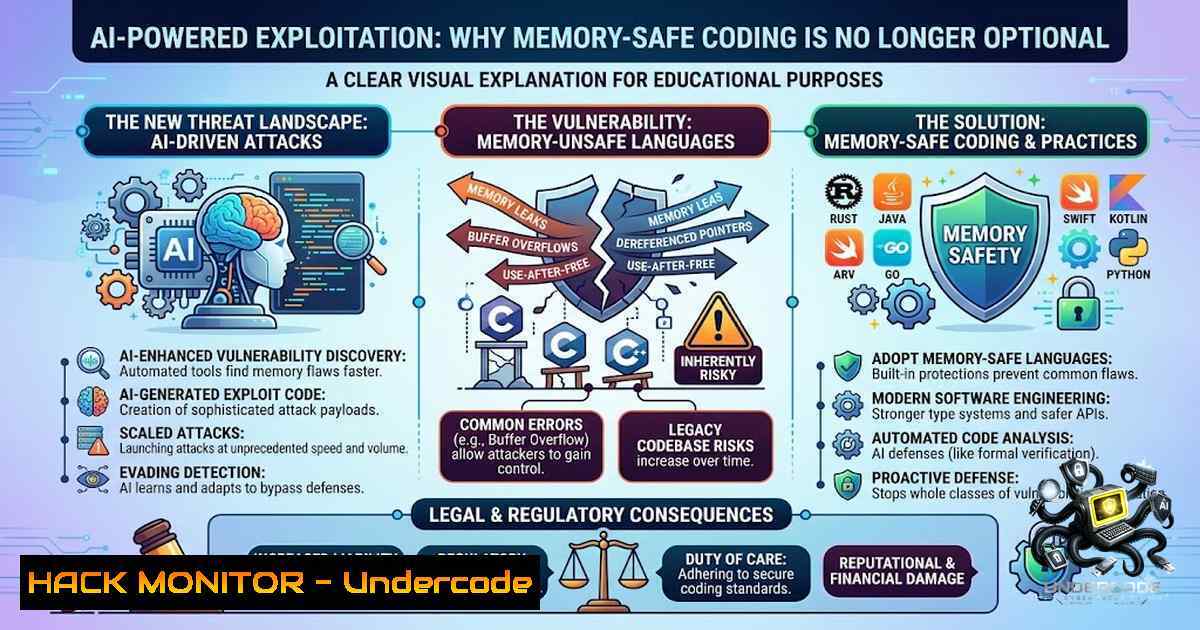
The cybersecurity battleground has fundamentally shifted. At Black Hat USA 2026, Microsoft’s corporate vice president for AI security, David Weston, delivered a stark warning: artificial intelligence is enabling hacking gangs to discover and weaponize software vulnerabilities at an unprecedented pace. While the majority of breaches still originate from stolen credentials or phishing, the volume of security flaws Microsoft must patch each month has grown ninefold since March 2025—and this surge is “heavily correlated to the rising use of AI.” The most striking revelation? Approximately 70% of these vulnerabilities stem from memory safety issues—coding mistakes that could be eliminated by adopting safer programming languages like Rust. As attackers leverage AI tools like Claude to target critical infrastructure—including a Mexican water utility—the economics of cyber defense demand a proactive shift from reactive patch management to secure-by-construction development.
Learning Objectives:
- Understand how AI is accelerating both vulnerability discovery and exploit generation, and why traditional patch management is no longer sufficient.
- Identify the role of memory safety vulnerabilities (CWE-787, CWE-416) in the modern threat landscape and quantify their prevalence.
- Learn practical strategies for shifting security left, including SAST integration, memory-safe language adoption, and AI-assisted code remediation.
- Gain hands-on familiarity with tools and commands for vulnerability scanning, legacy code translation, and secure development workflows.
You Should Know:
- The AI Acceleration of Vulnerability Discovery and Exploitation
The assumption that exploited vulnerabilities are scarce is “being undermined as we speak,” Weston cautioned. Microsoft’s internal data confirms a sharp increase in both vulnerability discovery and in-the-wild exploitation. The company’s MDASH (Multi-Model Agentic Scanning Harness) code-scanning platform identified more than 200 Linux kernel vulnerabilities within its internal Azure Linux distribution. Alarmingly, Microsoft added an internal module capable of transforming static analysis into proof-of-concept exploits—and out of those 200 vulnerabilities, researchers automatically generated 182 PoCs, many of which were fully working exploits.
Third-party benchmarks corroborate this trend. ExploitGym, a vulnerability benchmark, demonstrated that out of 898 real-world vulnerabilities, approximately 157 working exploits could be automatically generated. Attackers are already operationalizing these capabilities. In one documented incident, hackers used Anthropic’s Claude AI to target a Mexican water utility, demonstrating that AI-driven attacks are not theoretical—they are happening now.
Step‑by‑step guide to AI-assisted vulnerability analysis (defensive perspective):
Security teams can adopt AI-assisted tooling to keep pace with attackers. Below is a workflow using Microsoft’s MDASH principles and open-source alternatives:
- Set up a static analysis pipeline: Integrate SAST tools like Semgrep, CodeQL, or SonarQube into your CI/CD pipeline. Run scans on every commit:
Example: Running Semgrep locally
semgrep --config=auto --sarif -o results.sarif ./src
-
Automate PoC generation for critical findings: Use tools like ExploitGym or custom scripts to validate whether a static finding is actually exploitable. While Microsoft’s internal module is proprietary, open-source frameworks like Metasploit can be used to test known vulnerabilities:
Search for a specific CVE in Metasploit
msfconsole -q -x "search cve:2025-; exit"
-
Prioritize reachable vulnerabilities: Not all findings are equally dangerous. Use reachability analysis to filter out theoretical flaws that aren’t reachable in your runtime environment. Tools like Safeguard or GitHub’s dependency graph can help surface only exploitable paths.
-
Monitor for AI-generated attack patterns: Deploy intrusion detection systems (IDS) with behavioral analytics. On Linux, auditd can track suspicious process executions:
Monitor for unusual process spawning
auditctl -a always,exit -F arch=b64 -S execve -k process_exec
ausearch -k process_exec --format text | tail -20
2. Memory Safety: The 70% Problem
Weston’s keynote highlighted a critical statistic: about 70% of vulnerabilities are related to memory safety issues—out-of-bounds writes (CWE-787), use-after-free (CWE-416), and buffer overflows (CWE-120). These flaws rank consistently at the top of MITRE’s CWE Top 25 Most Dangerous Software Weaknesses. The root cause is often the use of memory-unsafe languages like C and C++, which lack built-in protections against common memory corruption errors.
The difficulty in fixing these problems has historically been the expense and complexity of rewriting legacy codebases. However, the AI threat landscape changes the calculus. When attackers can automate exploit generation against memory-unsafe code at scale, the cost of inaction becomes untenable.
Step‑by‑step guide to identifying and mitigating memory safety vulnerabilities:
- Inventory memory-unsafe code: Use tools like `cargo-audit` for Rust projects or `clang-tidy` for C/C++ to identify risky patterns:
For C/C++ projects, use Clang Static Analyzer
scan-build --use-cc=clang make
-
Prioritize remediation based on exploitability: Not all memory safety issues are equally urgent. Focus on:
– CWE-787 (Out-of-bounds Write): Often leads to RCE.
– CWE-416 (Use After Free): Commonly exploited in browser and kernel vulnerabilities.
– CWE-120 (Buffer Copy without Size Check): Classic overflow vector.
- Adopt memory-safe languages for new development: Rust, Go, and Python (with appropriate safeguards) eliminate entire classes of memory errors. For Rust, the ownership model ensures memory safety without a garbage collector:
// Rust prevents use-after-free at compile time fn main() { let s = String::from("hello"); // let r = &s; // cannot borrow as mutable // s.push_str(", world!"); // would cause compile error } -
Use AddressSanitizer during testing: Catch memory errors early in the development cycle:
Compile with AddressSanitizer (GCC/Clang)
gcc -fsanitize=address -g -o vulnerable_program vulnerable_program.c
./vulnerable_program
-
Shift Left: Building Security In, Not Bolting It On
Weston called for a move away from traditional patch management in favor of secure development practices. “What we want to do is retrain the physics here,” he said. “We want to figure out where we can use this production advantage to actually turn the tables.” The industry can offset gains in attacker productivity by adopting secure-by-construction, formal verification, and prevention-before-verification approaches.
Shifting left means integrating security activities earlier in the development timeline—toward design and coding—rather than concentrating them just before release. Practical measures include:
– Running SAST and dependency scanning on every commit or pull request.
– Using reachability analysis to surface only genuinely exploitable issues.
– Automating controls in CI and failing builds only on new high-severity issues.
Step‑by‑step guide to implementing a shift-left security program:
- Integrate security scanning into your IDE: Use plugins like Semgrep for VS Code or GitHub Copilot with security-aware prompts. Provide developers with a self-service CLI that runs the same scans locally as the pipeline.
-
Automate dependency scanning: Add tools like Dependabot or Snyk to your pull request checks:
GitHub Actions workflow for dependency scanning
name: Dependency Scan
on: [bash]
jobs:
scan:
runs-on: ubuntu-latest
steps:</p></li>
</ol>

<p>- uses: actions/checkout@v3
- uses: actions/setup-1ode@v3
- run: npm audit --audit-level=high
- Implement threat modeling during design: Use frameworks like STRIDE to identify potential attack surfaces before a single line of code is written. Tools like OWASP Threat Dragon can automate this process.
-
Enforce security gates in CI/CD: Block merges only on critical, exploitable findings with a known fix path:
Example: Fail build if critical SAST findings exist</p></li>
</ol>

<p>- name: Run Semgrep
run: semgrep --config=auto --sarif -o results.sarif ./src
- name: Check for critical findings
run: |
if grep -q '"level": "error"' results.sarif; then
echo "Critical findings detected. Failing build."
exit 1
fi
4. AI-Assisted Remediation: RustAssistant and DARPA TRACTOR
Microsoft has not only identified the problem—it is actively developing solutions. In 2025, Microsoft Research introduced RustAssistant, an LLM-based tool that automatically suggests fixes for Rust compilation errors. RustAssistant achieves a peak accuracy of roughly 74% on real-world compilation errors in popular open-source Rust repositories. The tool iterates with an LLM to fix errors and generate patches, significantly lowering the barrier to adopting memory-safe languages.
Meanwhile, DARPA’s TRACTOR program (Translating All C to Rust) aims to substantially automate the translation of legacy C code to Rust. The goal is to achieve the same quality and style that a skilled Rust developer would produce, thereby eliminating the entire class of memory safety vulnerabilities present in C programs. Recent advances like ORBIT—a guided agentic orchestration system—have achieved 100% compilation success and 91.7% correctness in C-to-Rust transpilation, reducing unsafe Rust code blocks to nearly zero.
Step‑by‑step guide to using RustAssistant and C-to-Rust conversion tools:
1. Install Rust and Cargo:
curl --proto '=https' --tlsv1.2 -sSf https://sh.rustup.rs | sh
source ~/.cargo/env
- Use RustAssistant (research prototype): While not yet publicly released as a standalone product, the methodology can be replicated using LLM APIs:
Pseudocode for LLM-based Rust error fixing import openai def fix_rust_error(code, error_message): prompt = f"Fix this Rust compilation error:\n\n{code}\n\nError: {error_message}" response = openai.ChatCompletion.create(model="gpt-4", messages=[{"role": "user", "content": prompt}]) return response.choices[bash].message.content -
Explore C-to-Rust translation tools: For legacy codebases, evaluate tools like `c2rust` (open-source transpiler) or commercial solutions. The DARPA TRACTOR benchmarks provide a reference for quality assessment:
Install c2rust (experimental)
cargo install c2rust
c2rust transpile --output-dir ./rust_output ./legacy_c_code.c
-
Validate translated code: Use Rust’s built-in testing framework to ensure functional equivalence:
cargo test --release
cargo clippy -- -W clippy::pedantic  Enforce idiomatic Rust
5. Defending Against AI-Powered Attacks: A Multi-Layered Approach
Weston cautioned against engaging attackers on their own terms: “Hand-to-hand combat with attackers will cause us to lose in defense.” Instead, defenders must leverage AI and automation to shift the economic advantage. While AI enables attackers to be more agile, there are also countermeasures that help defenders.
Organizations should adopt a defense-in-depth strategy that includes:
- Zero-trust architecture: Assume breach and verify every access request.
- Automated patch management: AI can prioritize patches based on exploitability and criticality.
- Continuous monitoring and threat hunting: Use AI-driven SIEM tools to detect anomalies.
- Secure development training: Educate developers on memory-safe coding practices.
Step‑by‑step guide to hardening systems against AI-driven exploits:
- Implement credential hygiene: Since most breaches start with stolen passwords, enforce MFA and use password managers. On Windows, use LAPS to manage local admin passwords:
PowerShell: Enforce MFA via Conditional Access policies (Azure AD)
This is a policy configuration, not a command-line script
-
Harden Linux kernels against memory corruption: Enable kernel hardening features:
Enable kernel address space layout randomization (KASLR)
echo 1 > /proc/sys/kernel/randomize_va_space
Restrict kernel pointer access
echo 2 > /proc/sys/kernel/kptr_restrict
-
Deploy endpoint detection and response (EDR): Use tools like Microsoft Defender for Endpoint or CrowdStrike to detect and respond to AI-generated attack patterns. CrowdStrike’s 2026 Threat Hunting report noted that 88% of observed vulnerability attacks began within 48 hours of public PoC release—indicating the need for rapid detection.
-
Conduct regular tabletop exercises: Simulate AI-assisted breach scenarios to test incident response readiness.
What Undercode Say:
- AI is a double-edged sword: While attackers are weaponizing AI to discover and exploit vulnerabilities at machine speed, defenders can also leverage AI for automated scanning, PoC generation, and remediation. The race is on to see who can operationalize AI more effectively.
- Memory safety is the new battleground: With 70% of vulnerabilities rooted in memory safety issues, organizations that adopt memory-safe languages like Rust gain a structural advantage. The cost of rewriting legacy code is high, but the cost of a major breach is higher—and rising.
- Shift left is no longer optional: Traditional patch management cannot keep pace with AI-driven exploitation. Security must be built into the development lifecycle from the very beginning, with automated checks, developer feedback loops, and continuous threat modeling.
Analysis: The Microsoft Black Hat keynote underscores a pivotal moment in cybersecurity. The ninefold increase in CVEs since March 2025 is not an anomaly—it is a direct consequence of AI lowering the barrier to vulnerability discovery. Attackers are no longer limited by human bandwidth; they can now scan, analyze, and exploit software flaws at scale. The attack on the Mexican water utility using Claude is a harbinger of what is to come: AI-powered attacks against critical infrastructure. Defenders must respond with equal force—not by patching faster, but by building software that cannot be easily exploited in the first place. The shift to memory-safe languages, automated remediation tools, and shift-left security practices represents the only viable long-term strategy. Organizations that delay this transition will find themselves fighting an asymmetric battle they cannot win.
Prediction:
- +1 The adoption of memory-safe languages like Rust will accelerate significantly over the next 3–5 years, driven by both security imperatives and AI-assisted migration tools like DARPA TRACTOR. This will gradually reduce the prevalence of memory safety vulnerabilities in new software.
- -1 The gap between vulnerability discovery and exploitation will continue to narrow, with AI enabling attackers to weaponize flaws within hours of disclosure. Organizations without automated patch management and AI-driven threat detection will face escalating breach risks.
- +1 AI-assisted development tools like RustAssistant will lower the barrier to adopting secure languages, enabling smaller teams to write memory-safe code without extensive training. This democratization of security will benefit the entire software ecosystem.
- -1 Legacy C/C++ codebases will remain a persistent vulnerability for years, as automated translation tools are not yet production-ready at scale. Critical infrastructure and embedded systems will be particularly exposed.
- +1 The cybersecurity industry will increasingly adopt agentic AI platforms for autonomous vulnerability remediation, shifting the balance of power back toward defenders. Early adopters will gain a significant competitive advantage in security posture.
▶️ Related Video (90% Match):
🎯Let’s Practice For Free:
🎓 Live Courses & Certifications:
Join Undercode Academy for Verified Certifications
🚀 Request a Custom Project:
Secure, high-velocity infrastructure and disruptive technological engineering. Contact our engineering team for high-tier development and proprietary systems:
[email protected]
💎 Smart Architecture | 🛡️ Secure by Design | ⭐ Trusted by ThousandsIT/Security Reporter URL:
Reported By: https://lnkd.in/p/eHxqbHKd – Hackers Feeds
Extra Hub: Undercode MoN
Basic Verification: Pass ✅🔐JOIN OUR CYBER WORLD [ CVE News • HackMonitor • UndercodeNews ]
📢 Follow UndercodeTesting & Stay Tuned:
- Use RustAssistant (research prototype): While not yet publicly released as a standalone product, the methodology can be replicated using LLM APIs:


