
Listen to this Post
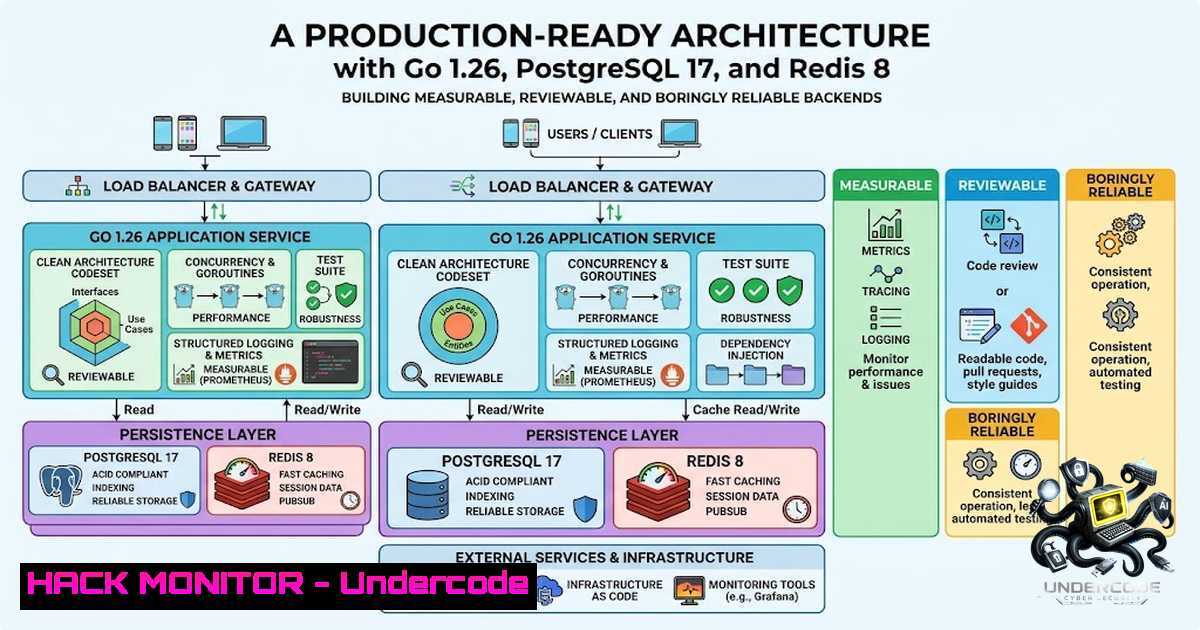
Introduction:
In an era where AI-generated code is becoming increasingly prevalent, the true differentiator isn’t the ability to generate code—it’s the ability to build systems that are measurable, reviewable, and boringly reliable. Marlex Software’s approach to building their corporate-intelligence backend, Marlex Ledger, exemplifies this philosophy by combining AI-assisted development with rigorous architectural discipline. The system leverages Go 1.26, PostgreSQL 17, Redis 8, and a suite of observability tools to create a production-intent modular monolith that prioritizes performance, security, and operational excellence. This article explores the technical depth behind such an architecture, providing actionable insights for engineers building similar systems.
Learning Objectives & Secrets:
- Objective 1: Master Hot-Path Caching with Redis – Learn how to design cached entity reads that stay on the hot path, combining auth, rate limiting, and Redis lookups to eliminate unnecessary PostgreSQL or provider calls, achieving sub-millisecond response times.
-
Objective 2 Secret Tip: Asynchronous Enrichment with Redis Streams – Discover how to implement a fan-out worker pattern using Redis Streams for asynchronous data enrichment, ensuring bounded concurrency and non-blocking cache/search index updates.
-
Objective 3 Secret Tip: DNS-Rebinding-Safe SSRF Protection – Implement connection-level validation at dial time rather than URL validation time to prevent DNS rebinding attacks, a critical security measure often overlooked in API design.
You Should Know:
1. Hot-Path Caching Architecture with Redis
The core of Marlex Ledger’s performance lies in its hot-path caching strategy. The architecture ensures that authenticated requests undergo auth and rate limiting checks, followed by a Redis lookup, and return a response without ever touching PostgreSQL or external providers for cached entities. This design pattern, when implemented correctly, can achieve cached lookup benchmarks around 409µs.
Step-by-step guide implementing Redis hot-path caching:
// Example: Redis hot-path cache lookup with Go
func GetEntity(ctx context.Context, id string) (Entity, error) {
// 1. Authentication & Rate Limiting (assumed passed)

// 2. Redis lookup - hot path
cached, err := redisClient.Get(ctx, "entity:"+id).Result()
if err == nil {
var entity Entity
json.Unmarshal([]byte(cached), &entity)
return &entity, nil
}

// 3. Cache miss - fallback to PostgreSQL
entity, err := db.QueryEntity(ctx, id)
if err != nil {
return nil, err
}

// 4. Update cache asynchronously
go updateCache(id, entity)
return entity, nil
}
Linux/Redis CLI Commands for Cache Monitoring:
 Monitor Redis cache hit/miss rates
redis-cli INFO stats | grep -E "keyspace_hits|keyspace_misses"

Check memory usage for specific key patterns
redis-cli --scan --pattern "entity:" | wc -l

Analyze slow queries
redis-cli SLOWLOG GET 10
2. Asynchronous Enrichment with Redis Streams
For data enrichment that doesn’t need to block the critical path, Redis Streams provide a Kafka-lite solution with consumer groups for fault-tolerant processing. Marlex Ledger uses this pattern to fan out refresh requests to workers with bounded concurrency.
Step-by-step Redis Streams implementation:
// Producer: Add enrichment job to stream
func EnqueueRefresh(ctx context.Context, entityID string) error {
return redisClient.XAdd(ctx, &redis.XAddArgs{
Stream: "enrichment:stream",
Values: map[bash]interface{}{
"entity_id": entityID,
"timestamp": time.Now().Unix(),
},
}).Err()
}

// Consumer Group Worker
func StartWorker(ctx context.Context) {
// Create consumer group if not exists
redisClient.XGroupCreateMkStream(ctx, "enrichment:stream",
"enrichment:group", "0")

for {
streams, err := redisClient.XReadGroup(ctx, &redis.XReadGroupArgs{
Group: "enrichment:group",
Consumer: "worker-1",
Streams: []string{"enrichment:stream", ">"},
Count: 10,
Block: 0,
}).Result()
// Process and acknowledge messages
}
}
Redis 8 Streams Performance Commands:
 Check stream length and pending entries
redis-cli XLEN enrichment:stream
redis-cli XPENDING enrichment:stream enrichment:group

Monitor stream throughput
redis-cli INFO stats | grep total_commands_processed
3. DNS-Rebinding-Safe SSRF Protection
Server-Side Request Forgery (SSRF) vulnerabilities are particularly dangerous when combined with DNS rebinding attacks, where an attacker returns a public IP at validation time and an internal IP at connect time. The solution is to validate at dial time and pin the resolved IP for the actual connection.
Step-by-step SSRF-safe HTTP client in Go:
import (
"net"
"net/http"
"time"
)

func NewSSRFSafeHTTPClient() http.Client {
return &http.Client{
Transport: &http.Transport{
DialContext: func(ctx context.Context, network, addr string) (net.Conn, error) {
host, port, _ := net.SplitHostPort(addr)

// Resolve DNS and check all IPs
ips, err := net.DefaultResolver.LookupIP(ctx, "ip", host)
if err != nil {
return nil, err
}

for _, ip := range ips {
if isPrivateIP(ip) {
return nil, fmt.Errorf("blocked internal IP: %s", ip)
}
}

// Pin to first resolved IP (prevent rebinding)
return net.DialTCP("tcp", nil, &net.TCPAddr{
IP: ips[bash],
Port: portInt,
})
},
},
Timeout: 10  time.Second,
}
}

func isPrivateIP(ip net.IP) bool {
privateIPBlocks := []string{
"10.0.0.0/8", "172.16.0.0/12", "192.168.0.0/16",
"127.0.0.0/8", "169.254.0.0/16",
}
// Check against private IP ranges
}
4. PostgreSQL 17 Security Hardening
Production PostgreSQL instances require rigorous security configuration. The CIS Benchmark for PostgreSQL 17 provides comprehensive guidance covering installation permissions, logging, user access, and encryption.
Step-by-step PostgreSQL 17 hardening:
1. Enforce SCRAM-SHA-256 Authentication:
 In postgresql.conf
password_encryption = 'scram-sha-256'

In pg_hba.conf - force SSL and SCRAM
hostssl all all 0.0.0.0/0 scram-sha-256
2. Enable Password Complexity:
 Add passwordcheck to shared_preload_libraries in postgresql.conf
shared_preload_libraries = 'passwordcheck'
3. Configure SSL/TLS:
ssl = on
ssl_cert_file = '/etc/ssl/certs/server.crt'
ssl_key_file = '/etc/ssl/private/server.key'
ssl_ca_file = '/etc/ssl/certs/ca.crt'
4. Enable Audit Logging with pgAudit:
CREATE EXTENSION pgaudit;
-- Log all DDL and DML operations
SET pgaudit.log = 'ddl, write, role';
5. Redis 8 Security and TLS Configuration
Redis 8 introduces enhanced security features including TLS certificate-based automatic client authentication, where clients are authenticated based on the Common Name (CN) field from their client certificate.
Step-by-step Redis 8 secure configuration:
1. Enable TLS and Disable Unencrypted Ports:
 redis.conf
tls-port 6379
port 0  Disable non-TLS port
tls-cert-file /etc/redis/tls/server.crt
tls-key-file /etc/redis/tls/server.key
tls-ca-cert-file /etc/redis/tls/ca.crt
tls-auth-clients yes
tls-protocols "TLSv1.2 TLSv1.3"
2. Configure ACL-Based Authentication:
 Create ACL user with certificate-based auth (Redis 8.6+)
redis-cli ACL SETUSER app-user on >password +@all ~
redis-cli ACL SETUSER cert-user on nopass +get ~cache:
3. Redis 8.6 Idempotent Stream Production:
 At-most-once delivery guarantee for streams
XADD mystream IDEM producer-id seq-123  field value
This ensures messages are added to a stream at most once, even when producers crash and retry.
6. Go Code Quality with golangci-lint and staticcheck
Maintaining code quality in AI-assisted or large-scale Go projects requires rigorous linting and static analysis. golangci-lint with staticcheck provides comprehensive analysis including unused variables, ineffective assignments, and type-checking.
Step-by-step CI integration:
1. Create `.golangci.yml` configuration:
version: "2"
linters:
default: none
enable:
- govet  Go's official static analyzer
- errcheck  Check for unchecked errors
- staticcheck  Comprehensive static analysis
- unused  Find unused code
- ineffassign  Detect ineffectual assignments
- gosec  Security checks
- gocyclo  Cyclomatic complexity
2. Run in CI pipeline:
 Install golangci-lint
curl -sSfL https://raw.githubusercontent.com/golangci/golangci-lint/master/install.sh | sh -s -- -b $(go env GOPATH)/bin v2.0.0

Run linters
golangci-lint run ./...

Run staticcheck separately for deeper analysis
staticcheck ./...
3. Integrate with GitHub Actions:
- name: Run golangci-lint
uses: golangci/golangci-lint-action@v6
with:
version: v2.0
args: --timeout=5m
7. Distroless Containers for Production Deployment
Distroless images provide minimal attack surfaces by excluding shells, package managers, and unnecessary binaries. For Go applications, the `gcr.io/distroless/static` image offers a ~2 MiB base with zero CVEs.
Step-by-step Dockerfile with distroless:
 Build stage
FROM golang:1.26-alpine AS builder
WORKDIR /app
COPY go.mod go.sum ./
RUN go mod download
COPY . .
RUN CGO_ENABLED=0 GOOS=linux go build -ldflags="-w -s" -o /app/ledger ./cmd/server

Production stage - Distroless
FROM gcr.io/distroless/static:nonroot
WORKDIR /
COPY --from=builder /app/ledger /ledger
COPY --from=builder /app/migrations /migrations
USER nonroot:nonroot
EXPOSE 8080
ENTRYPOINT ["/ledger"]
Security considerations for distroless:
- Run as non-root user (USER 65534 or nonroot)
- Use multi-stage builds to copy only the binary
- Consider keeping a `-debug` variant image alongside production for troubleshooting
What Undercode Say:
- Key Takeaway 1: AI-Generated Code Must Be Measurable – The true value of AI-assisted development isn’t the code itself but the ability to measure, review, and validate it. Marlex Ledger’s approach of documenting benchmarks (409µs cached lookup) and maintaining operational rigor demonstrates that AI-generated systems require the same—if not more—discipline as traditionally coded systems.
-
Key Takeaway 2: Security Must Be Architected, Not Bolted On – Features like DNS-rebinding-safe SSRF protection, deterministic migrations, and health checks aren’t afterthoughts—they’re built into the architecture from day one. This proactive approach to security and operations creates systems that are “boringly reliable” rather than impressively fragile.
Prediction:
-
+1 The trend of AI-assisted development will accelerate, but the winners will be teams that treat AI-generated code as a starting point, not a finish line. Organizations that implement rigorous review processes, comprehensive testing (race testing, profiling), and operational tooling will see faster iteration cycles without compromising reliability.
-
+1 The emphasis on boring reliability over impressive features signals a maturation in the backend engineering community. As AI tools handle more of the boilerplate, engineers will focus increasingly on architecture, security, and observability—the differentiators that truly matter in production systems.
-
-1 Teams that treat AI-generated code as “done” without proper review, testing, and operational consideration will face significant production incidents. The ease of generation creates a false sense of completeness, potentially leading to rushed deployments with hidden security vulnerabilities and performance bottlenecks.
-
+1 Redis 8’s Streams improvements, including idempotent production and enhanced performance (up to +83% on large XREADGROUP operations), will make it an increasingly attractive alternative to Kafka for lightweight event-driven architectures.
-
+1 The adoption of distroless containers and minimal base images will continue to grow as organizations prioritize supply chain security and attack surface reduction, particularly in regulated industries.
-
-1 The complexity of securing modern backend stacks (Go + PostgreSQL + Redis + OpenTelemetry) will increase operational overhead. Teams without dedicated SRE or DevOps expertise may struggle to maintain the level of operational excellence demonstrated by Marlex Ledger’s approach to healthchecks, profiling, and graceful degradation.
-
+1 The integration of OpenTelemetry with Prometheus will become the standard for Go observability, providing unified metrics, traces, and logs that enable deeper understanding of AI-generated or complex distributed systems.
-
+1 The verification-before-trust philosophy will become a guiding principle for AI-generated infrastructure. The ability to prove what a system claims to be—through benchmarks, tests, and observable behavior—will be the hallmark of professional-grade AI-assisted engineering.
▶️ Related Video (72% Match):
https://www.youtube.com/watch?v=0pH0_vC32zA
🎯Let’s Practice For Free:
🎓 Live Courses & Certifications:
Join Undercode Academy for Verified Certifications
🚀 Request a Custom Project:
Secure, high-velocity infrastructure and disruptive technological engineering. Contact our engineering team for high-tier development and proprietary systems:
[email protected]
💎 Smart Architecture | 🛡️ Secure by Design | ⭐ Trusted by Thousands
IT/Security Reporter URL:
Reported By: https://lnkd.in/p/eiv55wCf – Hackers Feeds
Extra Hub: Undercode MoN
Basic Verification: Pass ✅


