Listen to this Post
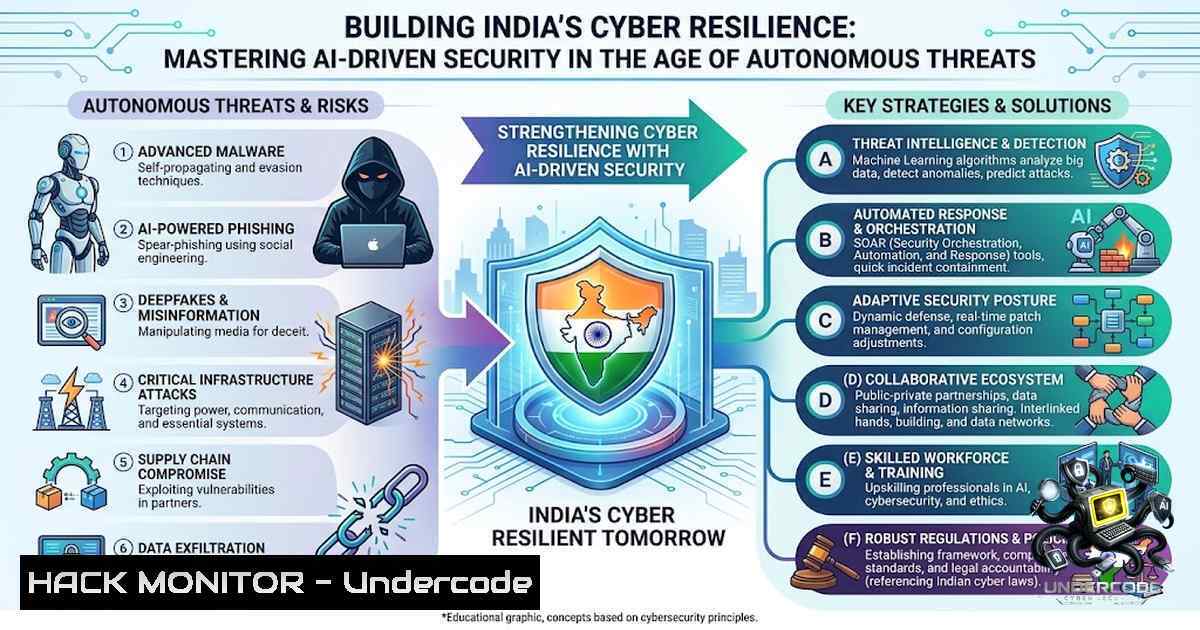
Introduction:
As India celebrates its independence, the call for a “Skilled, Secure, and Cyber-Resilient” nation has never been more urgent. The convergence of artificial intelligence with cybersecurity is fundamentally reshaping the threat landscape—while AI empowers defenders with unprecedented automation and analytical capabilities, it simultaneously equips adversaries with tools to launch faster, more sophisticated, and autonomous attacks. Building a cyber-resilient India requires not just technological investment but a workforce trained to master these dual-edged capabilities, transforming knowledge into responsibility and technology into a shield for national security.
Learning Objectives:
- Understand how AI is transforming both offensive and defensive cybersecurity operations, including autonomous threat detection and AI-assisted penetration testing.
- Master essential Linux and Windows commands for security auditing, incident response, and system hardening.
- Learn to implement cloud security hardening, API protection, and zero-trust architectures in enterprise environments.
You Should Know:
- The AI Shift in Cyber Risk: Defending Against Autonomous Threats
Artificial intelligence is rapidly transforming cyber risk. According to a joint statement by Five Eyes cybersecurity agencies, AI accelerates the speed, scale, and sophistication of cyber threats while simultaneously helping defenders identify weaknesses sooner and respond more quickly to incidents. Agentic AI systems—those capable of autonomous tool access and operational decisions—create new attack surfaces, including risks of privilege escalation, prompt injection attacks, unintended deceptive behavior, and data compromise across interconnected systems.
CERT-In has identified several AI-driven threat vectors, including automated reconnaissance against internet-facing infrastructure, AI-generated phishing and impersonation attacks with highly convincing multilingual content, autonomous multi-stage attack orchestration, and rapid weaponization of vulnerabilities. These threats demand a proactive, AI-enhanced defense strategy.
Step-by-Step Guide: AI-Assisted Security Auditing with Kali Linux
Kali Linux 2026.2 introduces nine new tools designed for modern security auditing. To perform an AI-assisted security audit:
- Install Kali Linux 2026.2 and update the tool repository:
sudo apt update && sudo apt full-upgrade -y
-
Use `shell-gpt` for AI-assisted command generation—this tool translates natural language queries into precise security commands:
shell-gpt "Show all active network connections and listening ports"
-
Deploy `tookie-osint` for social media reconnaissance to identify potential attack surfaces:
tookie-osint -u target_username
-
Use `legba` for multi-protocol credential auditing—a powerful password sprayer and enumerator:
legba http-post --target http://target.com/login --username admin --password-list rockyou.txt
-
Leverage `penelope` for post-exploitation shell management to maintain secure remote access during penetration tests:
penelope --listen 4444
2. Cloud Security Hardening: Implementing Zero-Trust Architecture
Cloud misconfigurations remain the leading cause of data breaches. The 2026 cloud security landscape demands a zero-trust methodology, strong identity and access management (IAM), and continuous threat detection. Organizations must treat identity as the real perimeter and enforce least-privilege access across all workloads.
Step-by-Step Guide: Hardening an AWS Environment
- Enable MFA on the root account and remove all root access keys entirely—this is the single most critical security step:
aws iam delete-access-key --user-1ame root --access-key-id <KEY_ID>
-
Scope security groups to specific CIDR blocks and ports rather than leaving them open to
0.0.0.0/0:aws ec2 authorize-security-group-ingress --group-id sg-xxxxx --protocol tcp --port 443 --cidr 203.0.113.0/24
-
Implement IAM roles instead of static access keys—use Access Analyzer and Service Control Policies (SCPs) to enforce least-privilege access:
aws iam create-role --role-1ame SecureRole --assume-role-policy-document file://trust-policy.json
-
Enable GuardDuty and VPC Flow Logs across all regions with Lambda-based auto-remediation for detected threats:
aws guardduty create-detector --enable
aws ec2 create-flow-logs --resource-ids vpc-xxxxx --traffic-type ALL --log-destination-type cloud-watch-logs
-
Rotate KMS customer keys annually and enforce TLS 1.3 for all data in transit.
3. API Security: Protecting the Digital Backbone
APIs are the backbone of modern digital infrastructure, yet they remain a primary attack vector. The OWASP API Security Top 10 highlights Broken Object Level Authorization (BOLA) as the most critical vulnerability. NIST’s SP 800-228A provides comprehensive guidelines for securing RESTful APIs across pre-runtime and runtime phases.
Step-by-Step Guide: Securing RESTful APIs
- Use UUIDs instead of sequential numeric IDs to prevent BOLA attacks—predictable IDs allow attackers to enumerate and access unauthorized resources:
import uuid
resource_id = str(uuid.uuid4())
-
Implement ownership checks on every backend request—never trust client-side authorization:
if request.user.id != resource.owner_id:
return HttpResponseForbidden()
-
Deploy OAuth2/OIDC with short-lived access tokens and refresh token rotation:
Generate a short-lived JWT jwt.encode({"sub": user_id, "exp": datetime.utcnow() + timedelta(minutes=15)}, SECRET_KEY) -
Implement rate limiting with sliding window enforcement—set per-IP or per-token limits of 10–50 requests per second:
limit_req_zone $binary_remote_addr zone=api:10m rate=10r/s;
-
Validate all incoming payloads against strict schemas and maintain comprehensive API inventory and observability.
-
Incident Response: Rapid Compromise Triage on Linux and Windows
When a breach is suspected, the first ten minutes are critical. Security teams must quickly identify active sessions, running processes, network connections, and persistence mechanisms.
Step-by-Step Guide: Initial Compromise Triage
Linux Commands:
 Elevate privileges
sudo -i

Check currently logged-in users
who -a
w

Identify running processes
ps auxf
ss -tulwn  Active network connections

Check scheduled tasks
crontab -l
ls -la /etc/cron

Review authentication logs
tail -1 100 /var/log/auth.log
journalctl -xe -1 100

Check for persistence mechanisms
systemctl list-units --type=service --state=running
Windows Commands (PowerShell):
 Check logged-in users
query user

List running processes
Get-Process
netstat -ano | findstr ESTABLISHED

Review scheduled tasks
Get-ScheduledTask

Check security event logs
Get-WinEvent -LogName Security -MaxEvents 50

Audit file integrity
sfc /scannow
5. Building a Cyber-Resilient Workforce: Training and Certification
India’s cyber resilience depends on a skilled workforce. Hacking World Cyber Security offers AI-driven training programs in ethical hacking, penetration testing, Python for security, networking, and cyber forensics. Industry-recognized certifications such as Certified Ethical Hacker (CEH), CompTIA Security+, and CISSP validate essential security skills.
Step-by-Step Guide: Starting Your Cybersecurity Career Path
- Begin with foundational certifications like CompTIA Security+ or Certified Cybersecurity Technician (CCT) to build core knowledge.
-
Progress to offensive security with the Certified Ethical Hacker (CEH) certification, which delivers advanced training in offensive techniques and cyber-range scenarios.
-
Develop practical skills through hands-on labs and capture-the-flag (CTF) exercises. Hacking World provides state-of-the-art labs with enterprise-grade networking devices and AI-based security tools.
-
Specialize in AI security with emerging certifications like CompTIA SecAI+, focused on AI security and operational technology.
-
Join cybersecurity communities and participate in exercises like CERT-In’s “Building Resilience against Frontier AI-driven Cyber Threats” drills.
What Undercode Say:
-
Knowledge is Responsibility, Not a Weapon: In the age of AI-powered cyber threats, technical skills must be wielded with ethical responsibility. The same tools that enable penetration testing can cause catastrophic damage if misused. Cybersecurity professionals are guardians of digital sovereignty.
-
India’s Digital Future Depends on Cyber Resilience: With cyberattacks in India doubling from 1.4 million in FY2022 to 2.9 million, the nation cannot afford to be reactive. Proactive defense—powered by AI, zero-trust architectures, and a skilled workforce—is the only path forward. Government initiatives like CERT-In’s AI-driven defense drills and industry collaborations are critical steps.
The convergence of AI and cybersecurity is not a future trend—it is the present reality. Organizations and individuals who embrace AI-enhanced defense while mastering foundational security principles will lead India’s cyber resilience journey. As Vinay Kumar’s message reminds us, independence in cyberspace is as vital as independence in the physical world. Learn. Defend. Innovate. Protect.
Prediction:
- +1 AI-driven security automation will reduce mean time to detection (MTTD) and response (MTTR) by over 60% within the next two years, as machine-speed threats force the abandonment of manual security operations.
-
+1 India’s cybersecurity workforce will expand by 40% by 2028, driven by government initiatives, private training institutes like Hacking World, and increasing enterprise demand for certified professionals.
-
-1 The proliferation of autonomous AI agents will introduce new classes of zero-day vulnerabilities that traditional IAM and perimeter defenses cannot address, requiring entirely new governance models.
-
-1 AI-generated phishing and social engineering attacks will become indistinguishable from legitimate communications, increasing successful breach rates by 30–50% unless organizations adopt AI-powered defense-in-depth strategies.
-
+1 CERT-In’s sovereign AI initiatives and sandbox environments will establish India as a global leader in AI-driven cyber defense, creating exportable security frameworks and best practices.
-
-1 The skills gap in AI security will widen as traditional cybersecurity curricula fail to keep pace with autonomous threat evolution, necessitating rapid upskilling and new certification pathways.
▶️ Related Video (82% Match):
https://www.youtube.com/watch?v=6sLPlemf4vM
🎯Let’s Practice For Free:
🎓 Live Courses & Certifications:
Join Undercode Academy for Verified Certifications
🚀 Request a Custom Project:
Secure, high-velocity infrastructure and disruptive technological engineering. Contact our engineering team for high-tier development and proprietary systems:
[email protected]
💎 Smart Architecture | 🛡️ Secure by Design | ⭐ Trusted by Thousands
IT/Security Reporter URL:
Reported By: https://lnkd.in/p/eXJAZWU5 – Hackers Feeds
Extra Hub: Undercode MoN
Basic Verification: Pass ✅


