Listen to this Post
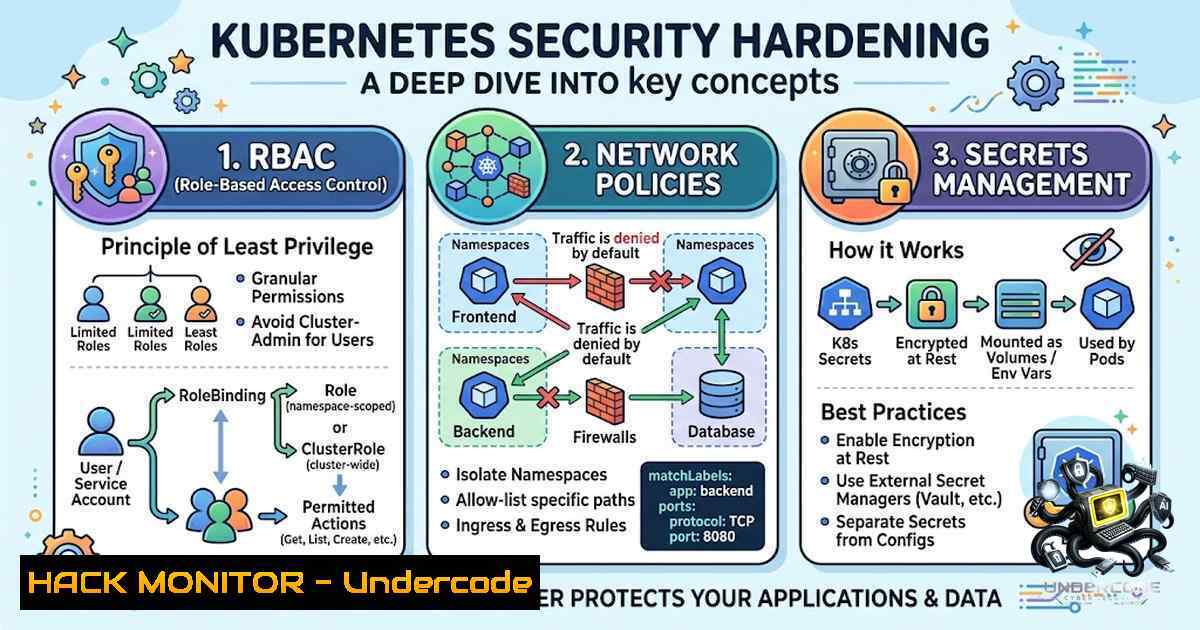
Introduction:
As organizations rapidly adopt Kubernetes for container orchestration, the attack surface expands significantly, demanding rigorous security configurations. Misconfigured Role-Based Access Controls (RBAC), permissive network policies, and improperly stored secrets are among the top vulnerabilities exploited in cloud-1ative environments. This article provides a technical, hands-on guide to hardening your Kubernetes clusters, moving from theoretical best practices to actionable Linux, Windows, and kubectl commands that fortify your infrastructure against modern threats.
Learning Objectives:
- Implement least-privilege RBAC policies to restrict service account and user permissions.
- Enforce micro-segmentation using Kubernetes Network Policies to limit east-west traffic.
- Securely manage and inject sensitive data using Secrets, External Secret Operators, and HashiCorp Vault.
- Audit cluster configurations using open-source tools like kube-bench and Falco.
- Automate security scanning for container images within your CI/CD pipeline.
You Should Know:
1. Implementing Least-Privilege RBAC with Audit Logging
Role-Based Access Control (RBAC) is the primary mechanism for controlling access to the Kubernetes API. A common pitfall is granting overly permissive roles to service accounts. Start by auditing existing cluster roles and bindings using the following command:
`kubectl describe clusterrolebinding`
To implement least privilege, create a specific Role that grants minimal required permissions for a namespace.
Example YAML for a restrictive Role:
apiVersion: rbac.authorization.k8s.io/v1
kind: Role
metadata:
namespace: my-app
name: pod-reader
rules:
- apiGroups: [""]
resources: ["pods"]
verbs: ["get", "list"]
Bind this role to a specific service account:
`kubectl create rolebinding read-pods –role=pod-reader –serviceaccount=my-1s:my-sa -1 my-app`
To track who did what, enable audit logging by configuring the `–audit-policy-file` and `–audit-log-path` in the kube-apiserver manifest. On Linux hosts, you can parse logs using `grep` and `jq` to filter for unauthorized attempts:
`cat /var/log/kubernetes/audit.log | jq ‘select(.responseStatus.code == 403)’`
This pipeline provides a real-time view of security violations and helps fine-tune RBAC policies.
2. Securing Pod-to-Pod Communication with Network Policies
By default, Kubernetes allows all pods to communicate with each other, creating significant risk. Network Policies enable micro-segmentation, effectively acting as a firewall for your pods. You must ensure your CNI (Container Network Interface) supports NetworkPolicy (e.g., Calico, Cilium).
Create a NetworkPolicy that denies all ingress traffic except from a specific frontend pod.
apiVersion: networking.k8s.io/v1
kind: NetworkPolicy
metadata:
name: backend-deny-all-except-frontend
spec:
podSelector:
matchLabels:
app: backend
policyTypes:
- Ingress
ingress:
- from:
- podSelector:
matchLabels:
app: frontend
ports:
- protocol: TCP
port: 8080
Apply this policy and test connectivity using a temporary debugging pod:
`kubectl run test –rm -it –image=busybox — /bin/sh`
Inside the pod, use `wget` to test access to the backend service. If a request originates from a pod without the correct label, the connection will time out, confirming the policy’s enforcement. This method effectively reduces the blast radius of a potential pod compromise.
- Secrets Management: From Plain YAML to Vault Integration
Storing secrets as base64-encoded strings in YAML manifests is insecure, as they are easily decodable. Instead, use an External Secret Operator (ESO) to sync secrets from a provider like HashiCorp Vault or AWS Secrets Manager. This prevents secrets from being stored in your Git repository.
For Windows administrators, you can use the `curl` command with the Vault API to inject secrets dynamically. Example using Linux `curl` to fetch a secret:
`export VAULT_TOKEN=”s.your-token”; curl -s –header “X-Vault-Token: $VAULT_TOKEN” http://vault:8200/v1/secret/data/myapp | jq -r .data.data.password`
To automate this in a Kubernetes pod, deploy the Vault Agent Sidecar Injector, which automatically authenticates using Kubernetes Service Account Token Review APIs. Mount the secrets as a volume or expose them as environment variables without them being visible in pod logs.
A step-by-step guide:
- Deploy the Vault Helm chart: `helm install vault hashicorp/vault –set “injector.enabled=true”`
2. Annotate your deployment to enable injection:
annotations:
vault.hashicorp.com/agent-inject: "true"
vault.hashicorp.com/role: "myapp-role"
vault.hashicorp.com/agent-inject-secret-db-creds: "secret/data/db-creds"
This approach ensures secrets are ephemeral, rotated, and audited by Vault.
4. Vulnerability Scanning and Image Hardening
Attackers often exploit outdated dependencies. Integrate vulnerability scanning into your CI/CD pipeline using tools like Trivy or Grype. Running a scan against an image on Linux:
`trivy image –severity HIGH,CRITICAL python:3.9-slim`
For Windows containers, scanning works similarly, but you must ensure the image is compatible. Beyond scanning, enforce Immutable Image tags and use a minimal base image (e.g., `distroless` or alpine) to reduce the attack surface. A tutorial step: In GitHub Actions, add a step to fail the build if a critical vulnerability is found:
- name: Run Trivy
run: trivy image --exit-code 1 --severity CRITICAL my-app:latest
Additionally, use the `–allow-list` feature to ignore specific vulnerabilities that are untriaged. This automation shifts security left, catching issues before they reach production.
5. Configuring Audit Policies and Threat Detection
Kubernetes audit logs are essential for detecting anomalies such as privilege escalations or suspicious API calls. Configure the API server to log requests at the `Metadata` or `RequestResponse` level. On Linux, you can set up a filter to monitor for `create` and `patch` operations on clusterroles:
`grep ‘”verb”:”create”‘ /var/log/kubernetes/audit.log | grep -i clusterrole`
To scale detection, deploy Falco as a DaemonSet. Falco parses system calls and Kubernetes events in real-time. For example, to detect a shell being spawned in a container, use the Falco rule:
- rule: Shell in Container
desc: Detect shell processes in containers
condition: proc.name = "bash" and container.id != host
output: "Shell created in container (user=%user.name command=%proc.cmdline)"
Deploy Falco via Helm:
`helm install falco falcosecurity/falco –set “falco.webserver.enabled=true”`
Once deployed, you can use `kubectl logs` to review Falco’s alerts, which can be forwarded to a SIEM for comprehensive monitoring. This proactive detection can thwart ransomware attempts that rely on manual exploitation.
What Undercode Say:
- Key Takeaway 1: Security in Kubernetes is a layered approach. Configuring RBAC and Network Policies is the foundation, but dynamic secret management and runtime detection are equally critical.
- Key Takeaway 2: Automation is non-1egotiable. Tools like Falco and Trivy must be integrated into the pipeline and runtime environments to ensure continuous security posture.
- Analysis: The shift toward ephemeral environments increases the complexity of maintaining security, as misconfigurations are often replicated across namespaces. The industry is seeing a surge in “Policy-as-Code” using OPA (Open Policy Agent) to enforce guardrails. While this adds overhead, the cost of a data breach due to misconfigured cloud infrastructure far outweighs the investment. Furthermore, the rise of AI-powered code assistants may inadvertently introduce insecure YAML configurations if not properly audited; hence, security awareness in development teams is paramount. Organizations must also consider the geopolitical implications of supply chain attacks on container images, requiring stringent provenance verification (e.g., SLSA level 3).
Prediction:
- +1 The adoption of WebAssembly (Wasm) modules alongside Kubernetes will reduce the dependency on vulnerable OS libraries, shrinking the container attack surface significantly by 2027.
- -1 AI-generated infrastructure code will likely increase the frequency of subtle misconfigurations, requiring more robust validation layers and leading to a spike in zero-day exploits targeting Kubernetes operators.
- +1 The integration of eBPF-based security observability will become standard, enabling near-real-time detection of zero-day exploits without significant performance penalties, positively shifting the defender’s advantage.
▶️ Related Video (82% Match):
🎯Let’s Practice For Free:
🎓 Live Courses & Certifications:
Join Undercode Academy for Verified Certifications
🚀 Request a Custom Project:
Secure, high-velocity infrastructure and disruptive technological engineering. Contact our engineering team for high-tier development and proprietary systems:
[email protected]
💎 Smart Architecture | 🛡️ Secure by Design | ⭐ Trusted by Thousands
IT/Security Reporter URL:
Reported By: https://lnkd.in/p/erbbTuD3 – Hackers Feeds
Extra Hub: Undercode MoN
Basic Verification: Pass ✅


