
Listen to this Post
Introduction
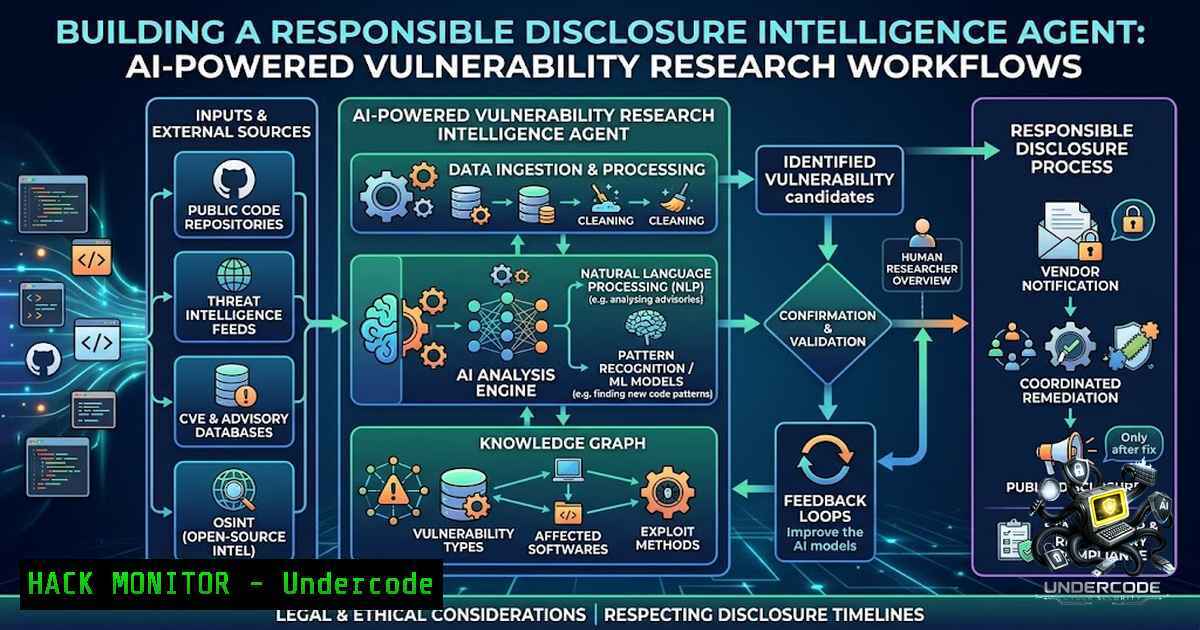
The intersection of artificial intelligence and cybersecurity is rapidly evolving, with AI agents increasingly being deployed to augment traditional security research methodologies. At the Lyzr Agent Labs event in Hyderabad, security researcher Kottamasum Lakshmi Karthikeya demonstrated this convergence by building a Responsible Disclosure Intelligence Agent—a multi-agent workflow designed to streamline the discovery and analysis of publicly documented VDPs (Vulnerability Disclosure Programs), responsible disclosure programs, and bug bounty programs. The system operates on the principle of “Evidence > Assumption,” performing passive security research without scanning, exploitation, credential attacks, or unauthorized testing. This article explores the technical architecture, implementation steps, and security implications of building such AI-powered security research agents.
Learning Objectives & Secrets
- Objective 1: Master Multi-Agent Workflow Orchestration – Learn to design and implement a discovery→analysis→verification→prioritization→tracking pipeline that distributes security research tasks across specialized AI agents while maintaining data integrity and evidence-based reasoning.
-
Objective 2 (Secret Tip): Implement Uncertainty Preservation – Rather than forcing the AI to hallucinate missing information, configure your agent to explicitly flag knowledge gaps and preserve uncertainty. Use Lyzr’s Reflection mechanism to make agents review their own answers and identify when information is incomplete or unverified.
-
Objective 3 (Secret Tip): Build Evidence-Based Verification Layers – Integrate groundedness checks that confirm information exists in supplied context before accepting it as valid. This prevents the agent from fabricating vulnerability details and ensures all findings are traceable to original sources.
You Should Know
1. Setting Up the Lyzr Agent Development Environment
The Lyzr ADK (Agent Development Kit) is a Python library for building, deploying, and managing AI agents with built-in RAG, memory, tools, and responsible AI guardrails. To begin building your own security research agent:
Installation:
pip install lyzr-adk
Authentication Setup:
export LYZR_API_KEY="your-api-key"
Or create a `.env` file in your project root:
LYZR_API_KEY=your-api-key
Initialize the SDK:
from lyzr import Studio

studio = Studio(api_key="your-api-key")  or omit if using .env
Create a Basic Security Research Agent:
agent = studio.create_agent(
name="VDP Discovery Agent",
provider="gpt-4o",
role="Security Research Assistant",
goal="Discover and analyze publicly documented vulnerability disclosure programs",
instructions="""
You are a security research agent focused on passive intelligence gathering.
- Only analyze publicly available information
- Do not perform any scanning or active testing
- Always cite your sources
- When information is missing, explicitly state uncertainty
- Prioritize evidence over assumptions
"""
)
Test Your Agent:
response = agent.run("What are the latest responsible disclosure programs from major tech companies?")
print(response.response)
2. Implementing Multi-Agent Workflow for Security Research
The Responsible Disclosure Intelligence Agent follows a five-phase workflow: Discover → Analyze → Verify → Prioritize → Track. Here’s how to implement each phase using Lyzr’s multi-agent capabilities:
Phase 1: Discovery Agent – Scans public sources for VDPs and bug bounty program announcements.
discovery_agent = studio.create_agent(
name="Discovery Agent",
provider="gpt-4o",
role="Intelligence Gatherer",
goal="Identify publicly documented vulnerability disclosure and bug bounty programs",
instructions="""
Search for and identify VDPs, responsible disclosure programs, and bug bounty initiatives.
Extract: program name, organization, scope, reward structure, disclosure policy URL.
Flag any programs that appear outdated or inactive.
"""
)
Phase 2: Analysis Agent – Evaluates discovered programs for completeness and quality.
analysis_agent = studio.create_agent(
name="Analysis Agent",
provider="gpt-4o",
role="Program Analyst",
goal="Analyze vulnerability disclosure programs for completeness and quality",
instructions="""
Evaluate each discovered program against:
- Clear disclosure timeline (expected response time)
- Scope definition (what's in/out of scope)
- Reward structure (if bug bounty)
- Contact/reporting mechanism
- Public acknowledgment policy
Score each program 1-10 and flag missing critical elements.
"""
)
Phase 3: Verification Agent – Cross-references findings against original sources.
verification_agent = studio.create_agent(
name="Verification Agent",
provider="gpt-4o",
role="Evidence Verifier",
goal="Verify all findings against original source documentation",
instructions="""
For each finding, verify:
- Does the information exist in the cited source?
- Is the interpretation accurate?
- Are there contradictions between sources?
Flag any unverifiable claims with [bash] tag.
"""
)
3. Adding Responsible AI Guardrails for Security Compliance
Lyzr embeds Responsible AI directly into its core architecture, providing built-in PII redaction, encryption, and access controls that ensure compliance with GDPR, HIPAA, and other global regulations. For security research agents, these guardrails are essential:
Create a Responsible AI Policy:
from lyzr import PIIType, PIIAction

rai_policy = studio.create_rai_policy(
name="SecurityResearchGuardrails",
description="Safety guardrails for security research agents",
toxicity_threshold=0.3,
pii_detection={
PIIType.EMAIL: PIIAction.REDACT,
PIIType.PHONE: PIIAction.REDACT,
PIIType.CREDIT_CARD: PIIAction.BLOCK
},
prompt_injection_protection=True
)
Apply the Policy to Your Agent:
secure_agent = studio.create_agent(
name="Secure Research Agent",
provider="gpt-4o",
role="Security Researcher",
goal="Conduct passive security research with strict safety controls",
instructions="...",
rai_policy=rai_policy
)
Input-Level Guardrails: Lyzr’s Responsible AI guardrails work at the input level, evaluating requests before they are processed. This prevents prompt injection attempts and blocks harmful content before reaching the LLM.
4. Building Knowledge Bases for Vulnerability Intelligence
Knowledge bases enable RAG (Retrieval Augmented Generation) by storing and querying documents. For a security research agent, this means maintaining a curated database of VDP documentation, disclosure policies, and security advisories:
Create a Knowledge Base:
kb = studio.create_knowledge_base(
name="VDP Knowledge Base",
vector_store="qdrant",
embedding_model="text-embedding-3-large"
)
Populate with Security Documents:
 Add PDF documentation
kb.add_pdf("disclosure_policies.pdf")

Add web content from disclosure program pages
kb.add_website("https://www.example.com/security", max_pages=50)

Add structured data
kb.add_text("""
Organization: TechCorp
Program: Responsible Disclosure
Scope: All web applications and APIs
Response Time: 72 hours
Reward: Up to $10,000
""")
Query the Knowledge Base:
response = agent.run(
"What are TechCorp's disclosure requirements?",
knowledge_bases=[bash]
)
5. Implementing Memory and Context for Long-Running Research
Memory allows agents to maintain conversation context across sessions. For security research workflows that span days or weeks, this is critical:
research_agent = studio.create_agent(
name="Long-Term Research Agent",
provider="gpt-4o",
role="Security Researcher",
goal="Track vulnerability disclosure programs over time",
instructions="Maintain historical context of all discovered programs",
memory=100  Keep last 100 messages for context
)
Add Context for Organizational Knowledge:
context = studio.create_context(
name="research_focus",
value="Focus on financial services and healthcare sector VDPs"
)

agent = studio.create_agent(
name="Focused Researcher",
provider="gpt-4o",
role="Sector-Specific Security Researcher",
goal="Track disclosure programs in target sectors",
instructions="...",
contexts=[bash]
)
6. Deploying and Integrating Your Security Research Agent
Once testing is complete, deploy your agent for production use:
Deployment via Agent Studio:
- Navigate to Agents in the sidebar and select your agent
2. Select Deploy in the top navigation
- Copy the Agent API cURL command for integration
API Integration Example:
curl -X POST https://api.lyzr.ai/v1/agents/{agent_id}/run \
-H "Authorization: Bearer YOUR_API_KEY" \
-H "Content-Type: application/json" \
-d '{"message": "What are the latest disclosure program updates?"}'
Export Agent Configuration for Version Control:
The Deploy tab provides Agent JSON—the full agent configuration for importing or version-controlling the agent definition.
What Undercode Say
- Key Takeaway 1: The “Evidence > Assumption” principle is foundational for AI security research. By implementing verification layers and groundedness checks, security researchers can prevent AI hallucinations from contaminating vulnerability intelligence. Always configure agents to flag uncertainty rather than fabricate missing information.
-
Key Takeaway 2: Multi-agent workflows—with specialized agents for discovery, analysis, verification, prioritization, and tracking—provide superior results compared to single-agent approaches. Each agent can focus on a specific phase of the research lifecycle, maintaining quality control at every step.
The Responsible Disclosure Intelligence Agent represents a paradigm shift in how security researchers can leverage AI. Rather than replacing human judgment, these agents augment traditional research methodologies by automating the tedious aspects of program discovery and analysis. The key insight is that AI agents excel at pattern recognition and data aggregation across thousands of public sources—tasks that would take human researchers weeks or months. However, the system explicitly preserves uncertainty, ensuring that researchers know exactly where AI confidence is high versus where human verification is needed. As the ecosystem evolves, improvements in date-based filtering, historical comparison, and research-quality scoring will further enhance these capabilities.
Prediction
- +1 AI-powered security research agents will become standard tools in security teams within 12-18 months, reducing the time required for vulnerability program analysis by 60-80% while maintaining human oversight for critical verification.
-
+1 The integration of responsible AI guardrails—PII redaction, prompt injection protection, and content filtering—will set the standard for AI security tools, making them enterprise-ready and compliant with global regulations like GDPR and HIPAA.
-
-1 Organizations that fail to implement verification layers in their AI security agents risk acting on hallucinated intelligence, potentially leading to misprioritized vulnerabilities and wasted security resources. The “Evidence > Assumption” principle must be non-1egotiable.
-
+1 The democratization of AI agent building through low-code platforms like Lyzr Architect will enable more security professionals to create custom research workflows without deep programming expertise, expanding the security researcher talent pool.
-
-1 As AI agents become more capable of security research automation, the volume of vulnerability reports may surge, potentially overwhelming disclosure programs and requiring new triage and prioritization mechanisms.
▶️ Related Video (88% Match):
https://www.youtube.com/watch?v=-Tz_FWVYgnM
🎯Let’s Practice For Free:
🎓 Live Courses & Certifications:
Join Undercode Academy for Verified Certifications
🚀 Request a Custom Project:
Secure, high-velocity infrastructure and disruptive technological engineering. Contact our engineering team for high-tier development and proprietary systems:
[email protected]
💎 Smart Architecture | 🛡️ Secure by Design | ⭐ Trusted by Thousands
IT/Security Reporter URL:
Reported By: https://lnkd.in/p/emRg-aEY – Hackers Feeds
Extra Hub: Undercode MoN
Basic Verification: Pass ✅


