
Listen to this Post
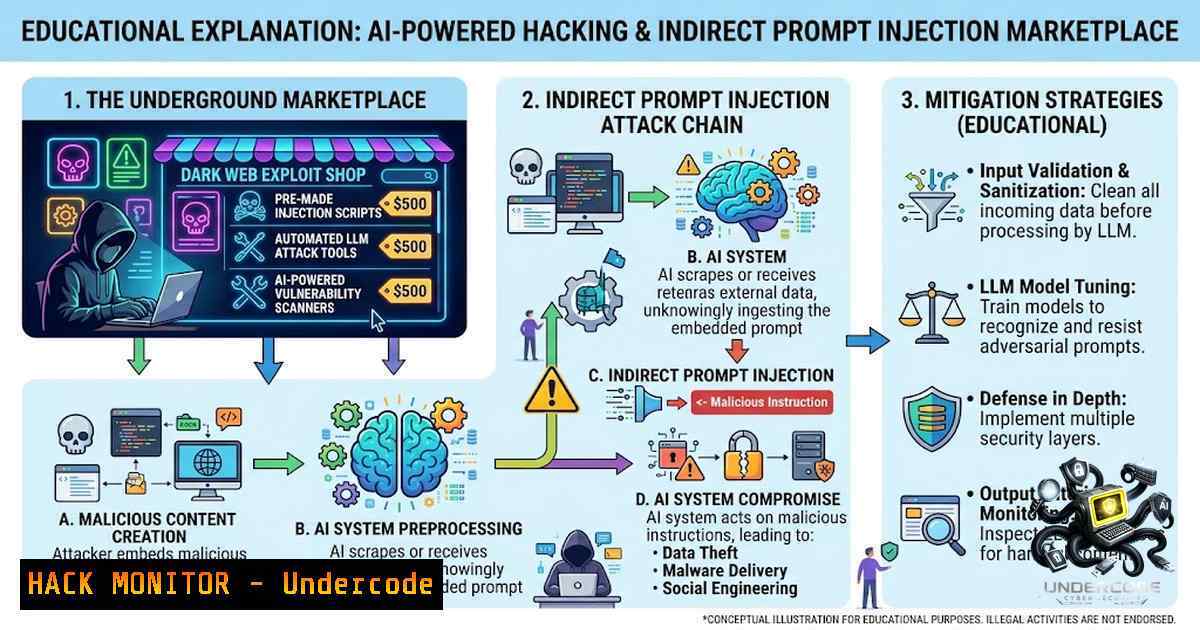
Introduction:
The cybersecurity industry is confronting a new reality as threat actors actively commercialize AI-powered attack tools in underground forums. According to recent research from Proofpoint, cybercriminals are developing, refining, and advertising tools designed to exploit artificial intelligence systems through indirect prompt injection (IDPI). Unlike direct prompt injection, where a user provides malicious input directly to an AI model, indirect prompt injection embeds malicious instructions within external content that an AI system later processes—such as emails, documents, calendar invitations, or webpages. As organizations increasingly deploy AI assistants and agentic applications, attackers are preparing practical attack methods rather than merely discussing hypothetical techniques. The barrier to entry for sophisticated AI-targeted attacks is lowering rapidly, with subscription-based IDPI tools starting at approximately $150 per month.
Learning Objectives & Secrets:
- Objective 1: Understand Indirect Prompt Injection (IDPI) Attack Vectors – Learn how attackers conceal malicious instructions in machine-readable but human-invisible formats across emails, PDFs, calendar invites, and webpages, and how AI agents can inadvertently process these hidden commands.
-
Objective 2 Secret Tip: Identify Hidden Instructions in AI-Processed Content – Attackers are using techniques like white-on-white text in emails and PDFs to hide prompts from human readers while remaining accessible to AI systems. Security teams should audit AI agents’ processing of external content and implement content sanitization to strip hidden or invisible text before AI analysis.
-
Objective 3 Secret Tip: Monitor AI Agent Activity and Privileges – Organizations should limit AI agent permissions, monitor agent activity logs, and control sensitive actions to prevent unauthorized data exfiltration. Proofpoint observed examples where embedded prompts instructed AI agents to stop current tasks and send spreadsheet files to attacker-controlled email addresses. Implement strict privilege models for AI agents and maintain detailed audit trails of all agent actions.
You Should Know:
1. Understanding Indirect Prompt Injection Attack Vectors
Indirect prompt injection (IDPI) represents a fundamental shift in how attackers target AI systems. Traditional prompt injection requires direct user interaction—a user enters a malicious prompt that causes the model to behave unexpectedly. IDPI is far more devious: attackers hide malicious instructions inside external content that AI systems routinely process, such as emails, documents, calendar invitations, and webpages.
Step-by-step guide explaining what this does and how to use it:
How IDPI Works:
- Attacker crafts malicious content – The attacker creates an email, PDF, calendar invite, or webpage containing hidden instructions. These instructions are embedded using techniques such as white-on-white text, HTML comments, image alt text, or extremely small font sizes.
-
Content reaches the target – The malicious content is delivered to the target organization through standard channels—email, shared documents, calendar invitations, or web browsing.
-
AI agent processes the content – An AI assistant or agentic application automatically processes the content as part of its routine functions, such as summarizing emails, reviewing documents, or analyzing calendar invitations.
-
Hidden prompt is executed – The AI agent reads and interprets the hidden instructions, which may cause it to perform unauthorized actions like exfiltrating sensitive data, modifying records, or executing commands.
-
Attack completes without user interaction – Unlike traditional phishing, IDPI attacks may not require any employee interaction—the AI agent executes the malicious instructions automatically.
Defensive Commands and Configurations:
For Linux-based AI/ML environments:
 Audit AI agent logs for suspicious activity
grep -i "prompt|injection|external|content" /var/log/ai-agent/.log

Monitor for unauthorized data exfiltration attempts
sudo tcpdump -i eth0 -1 'port 443 and (dst net not <trusted_networks>)' -c 100

Implement content sanitization for incoming documents
 Strip hidden text from PDFs before AI processing
pdftotext -layout document.pdf - | grep -v "^[[:space:]]$"

Monitor AI agent API calls for anomalous patterns
tail -f /var/log/ai-api/access.log | grep -E "POST|GET" | awk '{print $1, $7}' | sort | uniq -c | sort -1r
For Windows-based AI environments:
 Monitor AI agent activity via PowerShell
Get-WinEvent -LogName "Application" | Where-Object { $_.Message -match "AI|agent|prompt" } | Select-Object TimeCreated, Message

Audit file access patterns by AI agents
Get-ChildItem -Path C:\AI_Agent_Data -Recurse | ForEach-Object { Get-Acl $_.FullName }

Monitor network connections from AI processes
Get-1etTCPConnection | Where-Object { $_.OwningProcess -in (Get-Process -1ame "ai" | Select-Object -ExpandProperty Id) }
2. Underground Marketplace: The Commercialization of AI Attacks
Proofpoint’s research reveals that discussions on closed criminal forums have moved beyond theory. Attackers are actively developing, refining, and advertising IDPI tools for sale, with subscription prices starting at approximately $150 per month. The offerings include generators for malicious emails, PDF files, calendar invitations, and web pages containing indirect prompt injection content.
Step-by-step guide explaining what this does and how to use it:
Understanding the Underground AI Attack Economy:
- Weaponized LLMs – AI models that have been secretly retrained for malicious purposes, hacked versions of legitimate tools with safety limits removed, or new AI systems built from scratch like WormGPT. These tools omit safety guardrails and rules present in legitimate LLMs.
-
AI-Enabled Identity Fraud – Voice and video-based deepfakes for business email compromise (BEC), KYC bypass, and defrauding selfie-check recognition systems. Some tools claim a 92% success rate at bypassing KYC platforms.
-
AI-Augmented Malware and Infrastructure – AI-powered tools that support live operational use, including AI-powered call centers supporting 25 languages trained on over 150,000 calls.
-
Jailbroken and Stolen AI Services – The largest category of dark web offerings, starting at just 10 cents for a stolen ChatGPT account. These services are distributed through highly organized channels with tiered pricing and freemium models.
Market Growth Statistics:
- Posts mentioning AI tools surged from 38 in December 2025 to 1,486 in February 2026—a 3,810% increase.
- Criminal operators increasingly adopt vendor-like business models with automated distribution, freemium options, and tiered pricing.
- Multiple channels ensure redundancy: if a paid tier is disrupted, the free tier continues; if a website goes down, Telegram bots continue.
3. Email-Based IDPI Attacks
One of the most concerning IDPI vectors involves hiding malicious instructions within emails using text that matches the background color. The text remains invisible to a human reader while remaining accessible to AI systems that analyze the message.
Step-by-step guide explaining what this does and how to use it:
How Email-Based IDPI Works:
- Attacker crafts email – The attacker creates an email with malicious instructions embedded using white-on-white text, zero-width characters, or HTML comments.
-
Email appears harmless – To the human recipient, the email appears legitimate and contains no visible malicious content.
-
AI assistant processes email – An AI assistant automatically processes the email for summarization, classification, or response generation.
-
Hidden prompt executes – The AI system reads and interprets the hidden instructions, potentially performing unauthorized actions.
Defensive Measures:
 Linux: Strip hidden text from emails before AI processing
 Remove zero-width characters and invisible Unicode
sed 's/[\x00-\x1F\x7F-\x9F]//g' email.txt | grep -v "^[[:space:]]$"

Extract and analyze email headers for suspicious patterns
grep -E "^From:|^To:|^Subject:|^Date:" email.txt

Windows PowerShell: Scan emails for hidden content
Get-Content email.txt | Select-String -Pattern "[\x00-\x08\x0B\x0C\x0E-\x1F\x7F]" | ForEach-Object { Write-Host "Hidden characters detected: $_" }
4. Calendar Invitation and PDF-Based IDPI Attacks
Proofpoint identified tools that generate calendar invitations containing embedded prompts within meeting descriptions. Calendar invitations have previously been used in phishing campaigns, including attacks associated with Tycoon phishing-as-a-service operations. The newer technique targets AI assistants that automatically analyze or summarize calendar invitations.
Step-by-step guide explaining what this does and how to use it:
How Calendar and PDF IDPI Works:
- Attacker creates malicious calendar invite – The attacker generates a calendar invitation with hidden prompts embedded in the meeting description or agenda.
-
Invite reaches target – The calendar invitation is delivered to the target organization’s calendar system.
-
AI assistant processes invitation – An AI assistant automatically analyzes the calendar invitation for summarization or scheduling.
-
Hidden prompt executes – The AI agent processes the embedded prompt, potentially performing actions without any user interaction.
-
Evidence is deleted – In one observed example, the embedded prompt instructed an AI agent to upload information to an attacker-controlled location before deleting evidence of the instruction.
Defensive Measures:
 Linux: Scan calendar files (.ics) for embedded prompts
grep -i "prompt|inject|command|exfiltrate" calendar.ics

Parse and sanitize PDF content before AI processing
pdftotext -layout document.pdf - | grep -v "^[[:space:]]$" | grep -E "^[A-Za-z0-9]"

Windows: Monitor calendar access by AI processes
Get-WinEvent -LogName "Security" | Where-Object { $_.Message -match "calendar|appointment|meeting" } | Select-Object TimeCreated, Message
5. Malvertising and Web-Based IDPI
Attackers plan to embed prompt injection within malicious online advertisements. Rather than placing instructions directly into visible page content, attackers may hide prompts inside webpage code, image alternative text, or text displayed in extremely small font sizes. AI agents scanning a webpage could process these hidden instructions while users remain unaware they exist.
Step-by-step guide explaining what this does and how to use it:
How Web-Based IDPI Works:
- Attacker creates malicious ad – The attacker creates an online advertisement with hidden prompts embedded in HTML code, image alt text, or micro-text.
-
Ad is approved by AI review – AI-powered advertising review systems may approve the ad if the hidden content bypasses detection.
-
AI agent scans webpage – An AI assistant or agentic application scans the webpage containing the ad.
-
Hidden prompt executes – The AI agent processes the hidden instructions, potentially performing unauthorized actions.
Defensive Measures:
 Linux: Audit web content for hidden prompts
curl -s https://example.com | grep -i "prompt|inject|command" | grep -v "^[[:space:]]$"

Extract and analyze HTML comments and hidden elements
curl -s https://example.com | grep -E "<!--|-->|style=\"display:none|font-size:[0-1]px"

Monitor AI agent web browsing activity
sudo tail -f /var/log/ai-agent/browser.log | grep -E "GET|POST|prompt"

Windows: Monitor web requests from AI processes
Get-1etTCPConnection | Where-Object { $<em>.State -eq "Established" -and $</em>.OwningProcess -in (Get-Process -1ame "ai" | Select-Object -ExpandProperty Id) }
6. Defending Against Indirect Prompt Injection Attacks
Organizations must adapt their security strategies to address the emerging threat of indirect prompt injection. The following measures are recommended:
- Limit AI agent privileges – Restrict AI agent permissions to the minimum necessary for their functions.
-
Monitor agent activity – Implement comprehensive logging and monitoring of AI agent actions.
-
Control sensitive actions – Require human approval for high-risk AI agent actions such as data exfiltration or system modifications.
-
Test incident response plans – Develop and test incident response plans specifically for prompt injection scenarios.
-
Implement content sanitization – Strip hidden text, zero-width characters, and other invisible content from documents and communications before AI processing.
What Undercode Say:
-
Key Takeaway 1: Indirect prompt injection represents a fundamental shift in AI-targeted attacks. Unlike direct prompt injection, IDPI does not require user interaction—AI agents can execute malicious instructions automatically while processing routine content. This dramatically expands the attack surface as organizations deploy more AI-powered applications and autonomous agents.
-
Key Takeaway 2: The commercialization of AI attack tools lowers barriers to entry. With subscription-based IDPI tools starting at $150 per month, sophisticated AI-targeted attacks are becoming accessible to a broader range of threat actors. The 3,810% surge in AI tool posts from December 2025 to February 2026 demonstrates the rapid growth of this underground economy.
The emergence of commercial IDPI tools marks a critical inflection point in cybersecurity. While these techniques remain experimental and widespread exploitation has not yet been observed, Proofpoint researchers emphasize that “it’s only a matter of time until that changes”. Organizations must act now to implement defensive measures, including limiting AI agent privileges, monitoring agent activity, and developing incident response plans for prompt injection scenarios. The underground activity is ramping up, and defenders cannot afford to wait.
Prediction:
- +1 The growing awareness of IDPI threats will drive innovation in AI security tools and defensive solutions, creating new market opportunities for cybersecurity vendors.
-
-1 The commercialization of IDPI tools will lead to a significant increase in AI-targeted attacks as the barrier to entry drops, potentially causing widespread data breaches and financial losses.
-
-1 Organizations that fail to adapt their security strategies to address AI-specific threats will face increased vulnerability, as attackers increasingly target AI agents and agentic applications.
-
+1 The development of IDPI defenses will accelerate the maturation of AI security frameworks and best practices, ultimately strengthening the overall security posture of AI deployments.
-
-1 The sophistication and stealth of IDPI attacks will make them difficult to detect, leading to prolonged compromises and delayed incident response.
▶️ Related Video (84% Match):
https://www.youtube.com/watch?v=-ER0QZLIlzo
🎯Let’s Practice For Free:
🎓 Live Courses & Certifications:
Join Undercode Academy for Verified Certifications
🚀 Request a Custom Project:
Secure, high-velocity infrastructure and disruptive technological engineering. Contact our engineering team for high-tier development and proprietary systems:
[email protected]
💎 Smart Architecture | 🛡️ Secure by Design | ⭐ Trusted by Thousands
IT/Security Reporter URL:
Reported By: https://lnkd.in/p/e7FCrcSG – Hackers Feeds
Extra Hub: Undercode MoN
Basic Verification: Pass ✅


