
Listen to this Post
Introduction:
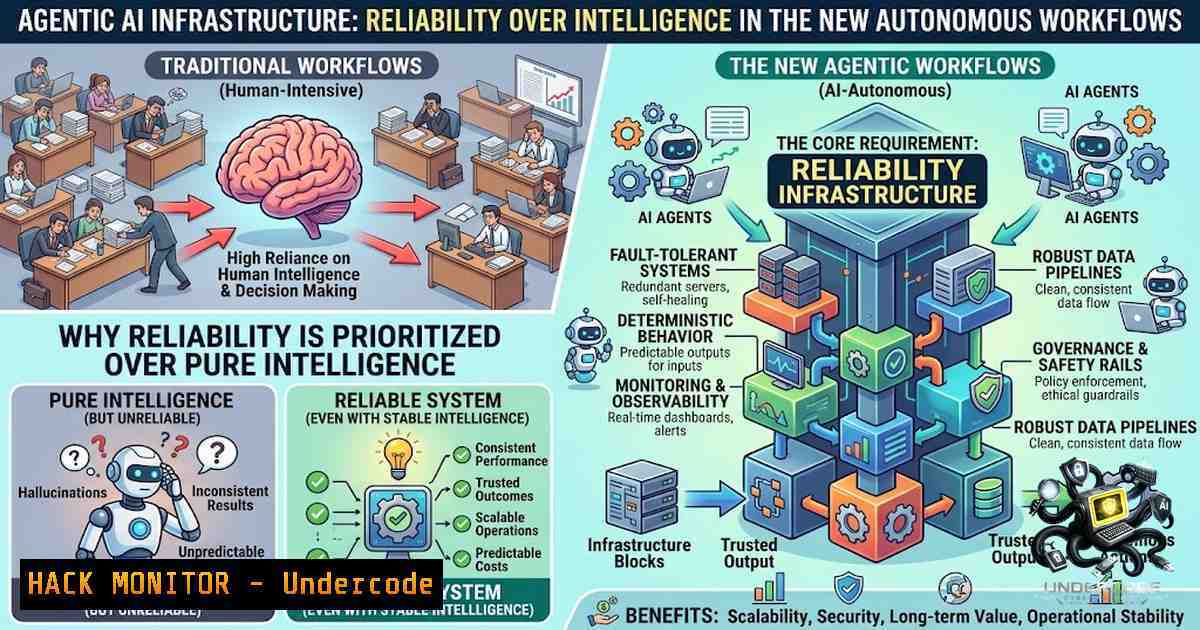
The rapid proliferation of Large Language Models (LLMs) and agentic frameworks has shifted the cybersecurity and IT discourse from “can AI do this?” to “can we trust AI to do this autonomously?” The recent convergence of high-profile outages—GitHub, Claude, and Codex—alongside major infrastructure moves like SpaceX’s acquisition of Cursor and the formation of the Agentic AI Foundation (backing MCP and A2A), highlights a critical pivot. The core challenge is no longer model capability but the resilience, security, and observability of the execution layer where agents operate, demanding a new focus on infrastructure hardening, API security, and disaster recovery protocols.
Learning Objectives & Secrets:
- Objective 1: Understand Agentic Infrastructure Components. Differentiate between Model Context Protocol (MCP) for tool/data access and Agent-to-Agent (A2A) for inter-agent coordination, and identify the security implications of each.
- Objective 2 Secret Tip: Master Idempotency and Retry Logic. Learn to implement robust, idempotent operation patterns with exponential backoff and jitter in agent workflows to prevent cascading failures during service outages, using Python and Redis.
- Objective 3 Secret Tip: Decouple and Monitor Critical Workflows. Discover how to architect agentic systems for high availability by implementing circuit breakers, health checks, and distributed tracing to move beyond single-homed dependencies and ensure recoverability.
You Should Know:
1. Hardening the Model Context Protocol (MCP) Layer
MCP acts as the universal translator between agents and external tools/databases. Securing this layer is paramount, as a compromised MCP can expose internal APIs and sensitive data. Step‑by‑step guide:
– Step 1: Authenticate and Authorize. Implement API key rotation and OAuth 2.0 for all MCP connections. Use environment variables to store secrets, not hardcoded strings.
– Step 2: Validate and Sanitize Inputs. Agents can generate unexpected payloads. Implement strict schema validation (e.g., using JSON Schema or Pydantic) for all tool calls to prevent injection attacks.
– Step 3: Rate Limit and Monitor. Configure rate limiting per agent or tenant to prevent a single misbehaving agent from overwhelming internal services.
– Commands (Linux): Use `curl` to test MCP endpoints: curl -X POST https://mcp-gateway.internal/v1/tools -H "Authorization: Bearer $API_KEY" -d '{"tool":"search","query":"test"}'. Use `jq` to parse and validate JSON responses: curl ... | jq '.'.
2. Securing Agent-to-Agent (A2A) Communication
A2A protocols define how agents coordinate, share context, and delegate tasks. Unsecured A2A channels are a prime vector for lateral movement and data exfiltration. Step‑by‑step guide:
– Step 1: Enable Mutual TLS (mTLS). Ensure every agent has a unique client certificate for identity verification during peer-to-peer communication.
– Step 2: Encrypt Message Payloads. Use envelope encryption—encrypt the message with a session key and encrypt that key with the recipient agent’s public key (like using `age` or gpg).
– Step 3: Implement Audit Logging. Log all inter-agent messages (metadata only, not content if sensitive) to a centralized SIEM for anomaly detection.
– Commands (OpenSSL): Generate a client certificate: openssl req -1ew -1ewkey rsa:2048 -days 365 -1odes -x509 -keyout agent1.key -out agent1.crt. Configure a service like Envoy to enforce mTLS.
3. Embracing “Origin” for Agent-Friendly Version Control
Origin, as described, is source code control designed for agents. This implies high-throughput, immutable change management. For IT and security, this means a shift from human-centric code review to automated, policy-as-code enforcement.
– Step 1: Implement Policy-as-Code. Use Open Policy Agent (OPA) to define rules that agents must pass before committing code or configuration changes. For example, a rule might require all Terraform changes to include a security tag.
– Step 2: Automate Vulnerability Scanning. Integrate static analysis and software composition analysis (SCA) into the agent’s commit pipeline using tools like `trivy` or snyk.
– Commands (Terraform/OPA): Write a simple OPA policy to block insecure Terraform configurations: deny
 { resource := input.resources[bash]; resource.type == "aws_security_group"; resource.properties.ingress[bash].cidr_blocks[bash] == "0.0.0.0/0"; msg = "Port exposed to internet" }</code>. Run it with <code>opa eval --data policy.rego --input tfplan.json "data.terraform.deny"</code>.

<h2 style="color: yellow;">4. Building Resilient Retry Logic with Exponential Backoff</h2>

To prevent the "angry bees" scenario, agents must implement sophisticated retry mechanisms. Step‑by‑step guide for Python:
- Step 1: Use the `tenacity` library. It provides battle-tested retry decorators.
- Step 2: Configure Jitter. Add randomness to retry intervals to avoid thundering herd problems on a recovering service.
- Step 3: Implement a Circuit Breaker. Use a library like `pybreaker` to stop retries altogether if a service is completely down and fail fast.
- Code Snippet:
[bash]
from tenacity import retry, stop_after_attempt, wait_exponential, retry_if_exception_type
import requests

@retry(stop=stop_after_attempt(5),
wait=wait_exponential(multiplier=1, min=2, max=10),
retry=retry_if_exception_type(requests.exceptions.RequestException))
def call_agent_api(endpoint, payload):
response = requests.post(endpoint, json=payload)
response.raise_for_status()
return response.json()
5. Monitoring Agentic Workflows with Distributed Tracing
Visibility is key to managing blast radius. Traditional logging is insufficient. Step‑by‑step guide:
- Step 1: Instrument Agent Code. Use OpenTelemetry to generate traces and spans for every action, tool call, and inter-agent communication.
- Step 2: Export to Observability Backend. Send traces to a Jaeger or Zipkin instance.
- Step 3: Create Alerts. Set up alerts in Prometheus/Alertmanager for high error rates or latency spikes in specific workflow steps (e.g., "MCP search tool latency > 5s").
- Commands (Docker): Run a Jaeger All-in-One for testing: docker run -d --1ame jaeger -e COLLECTOR_OTLP_ENABLED=true -p 16686:16686 -p 4318:4318 jaegertracing/all-in-one:latest. Send traces to the OTLP endpoint at `http://localhost:4318/v1/traces`.
6. Hardening Cloud Infrastructure Against Cascading Failures
The infrastructure hosting the agent must be as resilient as the agent logic.
- Step 1: Decouple Services. Use queue-based load leveling (e.g., with RabbitMQ or AWS SQS) between agents and external APIs to absorb spikes in requests.
- Step 2: Implement Fallback Mechanisms. If an external model API (like Claude) is down, have a fallback to a locally hosted open-source model (even if less capable) to complete low-criticality tasks.
- Step 3: Regular Chaos Engineering. Inject failures (e.g., simulate API downtime) to test agent resilience using tools like `chaostoolkit` or AWS FIS.
- Commands (AWS CLI): Create a Chaos Experiment to stop a critical EC2 instance to test failover: aws fis create-experiment-template --actions '{"stop-instance":{"actionId":"aws:ec2:stop-instances","parameters":{"duration":"PT5M","instanceIds":"i-12345"}}}'.
What Undercode Say:
- Key Takeaway 1: The true competitive moat in agentic AI is shifting from model benchmarks to the reliability, security, and auditability of the execution infrastructure. The industry is actively building "the rails" in public, but must now prioritize hardening them.
- Key Takeaway 2: Organizations must adopt a "design for failure" mentality for autonomous systems. This involves technical debt in the form of idempotency, circuit breakers, and decentralized monitoring—capabilities that are often afterthoughts but are now foundational to prevent catastrophic cascades.
Prediction:
- +1 The standardization of protocols like MCP and A2A will lead to a boom in AI infrastructure startups specializing in reliability, observability, and security tooling, creating a new cybersecurity sub-market.
- -1 The gap between rapid infrastructure development and the hardening of these systems will lead to high-profile data breaches, where attackers exploit inter-agent communication vulnerabilities to execute complex, multi-stage attacks autonomously, highlighting the "blast radius" concern.
- +1 The acquisition of Cursor by SpaceX signals that major cloud providers and enterprises will prioritize proprietary, secure, agentic source-code management, driving innovation in Policy-as-Code and zero-trust CI/CD pipelines.
- -1 Until idempotency and robust retry mechanisms become standard, we will see significant financial and operational losses from "invisible" 2 AM agent failures, forcing a market correction towards infrastructure-first AI development.
▶️ Related Video (86% Match):
🎯Let’s Practice For Free:
🎓 Live Courses & Certifications:
Join Undercode Academy for Verified Certifications
🚀 Request a Custom Project:
Secure, high-velocity infrastructure and disruptive technological engineering. Contact our engineering team for high-tier development and proprietary systems:
[email protected]
💎 Smart Architecture | 🛡️ Secure by Design | ⭐ Trusted by Thousands
IT/Security Reporter URL:
Reported By: https://lnkd.in/p/eHDtEgx3 - Hackers Feeds
Extra Hub: Undercode MoN
Basic Verification: Pass ✅


