
Listen to this Post
Introduction:
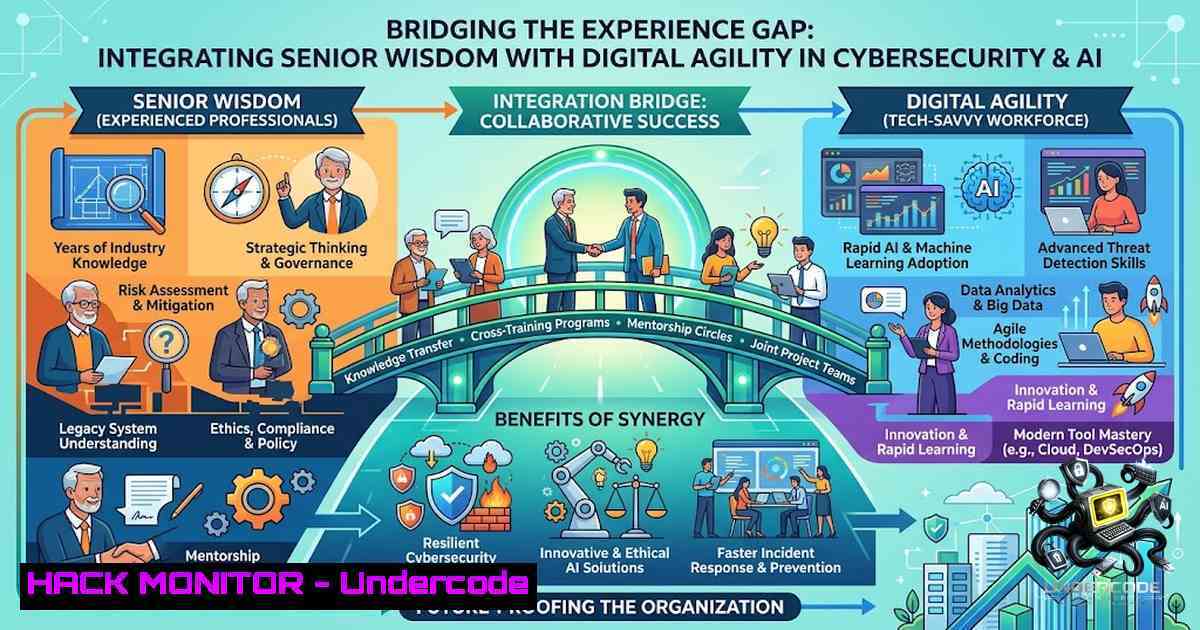
The modern cybersecurity and IT landscape is at a crossroads, facing a critical debate between the seasoned, risk-averse strategies of senior professionals and the agile, tech-1ative approaches of younger generations. As organizations navigate complex threat landscapes and integrate AI-driven tools, a significant philosophical gap has emerged, challenging traditional notions of work-smart versus work-wise. This article synthesizes insights from industry veterans and digital natives to explore how we can bridge this experience gap, ensuring that domain knowledge and cutting-edge technology work in concert to build resilient systems.
Learning Objectives & Secrets:
- Objective 1: Understand how to effectively integrate deep domain knowledge (expertise) with modern AI tools (like GPT-4, Gemini, and Claude) to enhance threat detection and incident response, moving beyond surface-level analysis.
- Objective 2 (Secret Tip): Master the art of “work-wise” risk management by applying the strategic foresight of senior leaders to the rapid prototyping capabilities of younger developers, creating a balanced approach to vulnerability management.
- Objective 3 (Secret Tip): Learn to critically evaluate AI-generated outputs and automated solutions by embedding layers of human verification (red teaming) and contextual analysis, preventing the production of “soulless” or insecure code and configurations.
You Should Know:
- The Philosophy of “Work-Wise” vs. “Work-Smart” in Cyber Defense
The current discourse pits the “high-level interns” (senior professionals) against the “young guns” (digital natives). The core takeaway is not about who is right, but about what each group brings to the cybersecurity table. Senior professionals, typically those with 15-30 years of experience, possess a deep, intuitive understanding of systemic risks and business continuity. They have lived through major cyber events like the Morris Worm (1988), the ILOVEYOU bug (2000), and the rise of Ransomware-as-a-Service (RaaS). This “work-wise” approach focuses on “risk management” and “real viability”—seeing the hidden dependencies and single points of failure that a pure “tool-first” approach might miss.
Conversely, the younger generation excels at “work-smart,” leveraging new tools, automation, and agile methodologies to accelerate processes. They are fluent in AI, cloud-1ative architectures, and DevSecOps pipelines. The cybersecurity industry needs both. A work-smart analyst can automate the triage of thousands of alerts using SOAR (Security Orchestration, Automation, and Response). However, a work-wise CISO can interpret those alerts within the context of the business’s supply chain, legal liabilities, and long-term brand reputation.
Step‑by‑Step Guide: Leveraging Both Perspectives for an Incident Response Plan
1. Threat Intelligence Gathering (Younger): Use AI and OSINT (Open Source Intelligence) tools to quickly gather data on emerging threats and indicators of compromise (IoCs).
2. Impact Assessment (Senior): Map the technical findings to business-critical assets. Answer: “If this vulnerability is exploited, what is the true financial and operational impact?”
3. Remediation Strategy (Younger): Propose and prototype quick fixes, such as updating WAF (Web Application Firewall) rules or patching vulnerable endpoints.
4. Validation (Senior): Test the fixes against a “what-if” scenario. Does the fix create a new bottleneck? Does it disrupt a legacy authentication system?
5. Implementation (Hybrid): Implement the patch with a rollback plan designed by the senior team, while the younger team monitors performance metrics for anomalies.
2. Mastering Prompt Engineering for Security (Linux/Windows/AI)
The reliance on “prompting” tools like GPT-4, Gemini, and Claude is a central theme. A work-smart individual uses these tools to generate scripts. A work-wise individual uses them to generate resilient, secure, and contextually accurate scripts. The key is to embed domain knowledge into the prompts. For example, asking “Write a Python script to scan for open ports” is insufficient. A domain-knowledge-enhanced prompt would be: “Write a Python script using `nmap` and `socket` to scan for open ports on a corporate network, ensuring it avoids scanning RFC 1918 ranges that are reserved for internal use, and generates a JSON output suitable for ingestion into a SIEM.”
Linux Command Example: The Art of Network Discovery (Automated & Manual)
A younger analyst might just run:
nmap -sS -p- -T4 192.168.1.1/24
A senior analyst, understanding the noise this creates in a SIEM, the network bandwidth consumed, and the potential to trigger IDS/IPS, would modify this to be more “work-wise.”
Step‑by‑Step Guide to a Targeted Reconnaissance Scan:
- Define Scope (Domain Knowledge): Identify the specific subnet you are authorized to scan.
- Set Speed and Timing: Use `-T2` (polite) or `-T3` (normal) to avoid disrupting sensitive services.
- Specify Ports: Instead of scanning all 65535 ports, focus on common services (
-p 21,22,23,25,80,110,143,443,445,3389). - Avoid Host Discovery: Use `-Pn` if you know the host is up to avoid ICMP echo requests that many firewalls block.
- Add OS Detection: Use `-O` to guess the OS, which is crucial for vulnerability mapping.
Windows Command (PowerShell):
Using `Test-1etConnection` for a quick, non-intrusive check on a single machine:
Test-1etConnection -ComputerName target_host -Port 443
This verifies a specific route and port, a more surgical approach than a broad sweep.
- API Security and Configuration Management (The “Tool” Trap)
The discussion warns against becoming an “empty shell” that only knows how to chat with GPT. In cybersecurity, a prime example is misconfiguring cloud security groups or API gateways. A work-smart developer might use an AI tool to generate a YAML configuration for an AWS API Gateway. However, a work-wise professional ensures that the API has proper authentication, rate limiting, and WAF integration.
Step‑by‑Step Guide to Hardening an API using OWASP Guidelines:
1. Authentication: Implement OAuth 2.0 or JWT (JSON Web Tokens) with short expiration times. Avoid relying solely on API keys, as they can be easily exposed in client-side code.
2. Rate Limiting: In NGINX, use the `limit_req` directive to prevent brute force and DDoS attacks.
limit_req_zone $binary_remote_addr zone=api:10m rate=5r/s;
3. Input Validation: Never trust user input. Whitelist allowed parameters to prevent SQL injection and XSS.
4. TLS Security: Enforce HTTPS and use TLS 1.3. Disable insecure ciphers.
5. Logging & Monitoring: Ensure all API calls are logged with a unique request ID for audit trails.
4. Cloud Hardening: Addressing Systemic Failures
The “systemic flaw” detected by senior professionals often relates to cloud architecture. A younger team might spin up hundreds of serverless functions. However, a senior team knows that each function expands the attack surface, increases cost, and creates a complex web of IAM (Identity and Access Management) roles that can be misconfigured.
Step‑by‑Step Guide: Conducting an IAM Role Audit in AWS (Linux/Windows)
1. Use the AWS CLI (Linux/WSL):
aws iam list-users
2. Check for Unused Keys:
aws iam list-access-keys --user-1ame "User_Name"
3. Analyze Policies: Review policies for overly permissive actions (like “ on Resource). A wise approach is to apply the principle of least privilege (PoLP).
4. Windows Alternative (PowerShell): Use the AWS Tools for PowerShell.
Get-IAMUserList
5. Vulnerability Exploitation and Mitigation (The Tradecraft)
Young professionals often learn exploitation frameworks like Metasploit to “hack.” Wise professionals use Metasploit to test, but they also know how to detect and mitigate these attacks. They understand the underlying network packets, process memory, and system calls.
Step‑by‑Step Guide: Using Nmap and Metasploit for Educational Mitigation:
1. Identify Vulnerable Service: Use Nmap to find a service with a known CVE (e.g., EternalBlue on port 445).
nmap -sV -p445 target_ip
2. Exploit (in a lab): Use Metasploit to understand the exploit chain.
3. Mitigation: The wise professional will not just patch the server, but also implement network segmentation, disable SMBv1, and ensure endpoint detection and response (EDR) can detect the exploit behavior, not just the static signature.
What Undercode Say:
Key Takeaway 1: True cybersecurity maturity is defined not by the tools you wield, but by the “domain knowledge” that guides their application. Tools like GPT and Gemini are force multipliers; they cannot replace the “deep impact” of understanding a business’s unique threat model.
Key Takeaway 2: The future of IT leadership lies in a “hybrid mindset.” We must actively mentor the younger generation on “risk management” and “systemic thinking,” while learning from their agility. The “generation gap” is a vulnerability; bridging it is a security control in itself.
Analysis:
The philosophical debate presented in the source material mirrors the evolution of the cybersecurity industry. Initially, it was all about building firewalls and hardening systems (“work hard”). Then, it evolved to penetration testing and automated scanning (“work smart”). Now, we are entering the era of cyber resilience and automated response, which requires “work-wise” leadership to navigate the complex interplay between quantum computing threats, AI-driven attacks, and geopolitical espionage. The senior professionals’ “business sense” acts as the “human-in-the-loop” for AI decisions, preventing catastrophic automated responses. Conversely, the younger generation’s acceptance of automation is crucial for scaling security operations in a world where there are simply not enough human analysts to handle the volume of alerts. Their “hacking” is the innovation that drives the industry forward. The key is to ensure that this “hacking” is rooted in a profound respect for the consequences, a lesson that only experience can truly teach.
Prediction:
+1 The integration of generative AI with security tools will democratize advanced security analytics, allowing junior analysts to perform tasks that required years of experience, thus shrinking the skills gap.
-1 The over-reliance on AI for code generation will lead to a surge in novel vulnerabilities, as developers lack the “domain knowledge” to identify subtle logic flaws introduced by LLMs, creating a new wave of “shadow code.”
+1 We will see the rise of a new professional role: the “AI Security Architect,” a hybrid of a senior network engineer and an ML engineer, who possesses both the “work-wise” strategic vision and the technical acumen to “work-smart” with machine learning models.
-1 The tension between the “work-wise” and “work-smart” philosophies will worsen internal communication, creating silos that hinder incident response, unless formal mentorship and cross-functional training programs are instituted.
+1 Organizations that successfully implement a “reverse mentorship” program, where juniors teach AI tools to seniors and seniors teach risk management to juniors, will gain a significant competitive advantage in cybersecurity, building teams that are both resilient and innovative.
▶️ Related Video (80% Match):
🎯Let’s Practice For Free:
🎓 Live Courses & Certifications:
Join Undercode Academy for Verified Certifications
🚀 Request a Custom Project:
Secure, high-velocity infrastructure and disruptive technological engineering. Contact our engineering team for high-tier development and proprietary systems:
[email protected]
💎 Smart Architecture | 🛡️ Secure by Design | ⭐ Trusted by Thousands
IT/Security Reporter URL:
Reported By: https://lnkd.in/p/eGGx8N7C – Hackers Feeds
Extra Hub: Undercode MoN
Basic Verification: Pass ✅


