
Listen to this Post
Introduction:
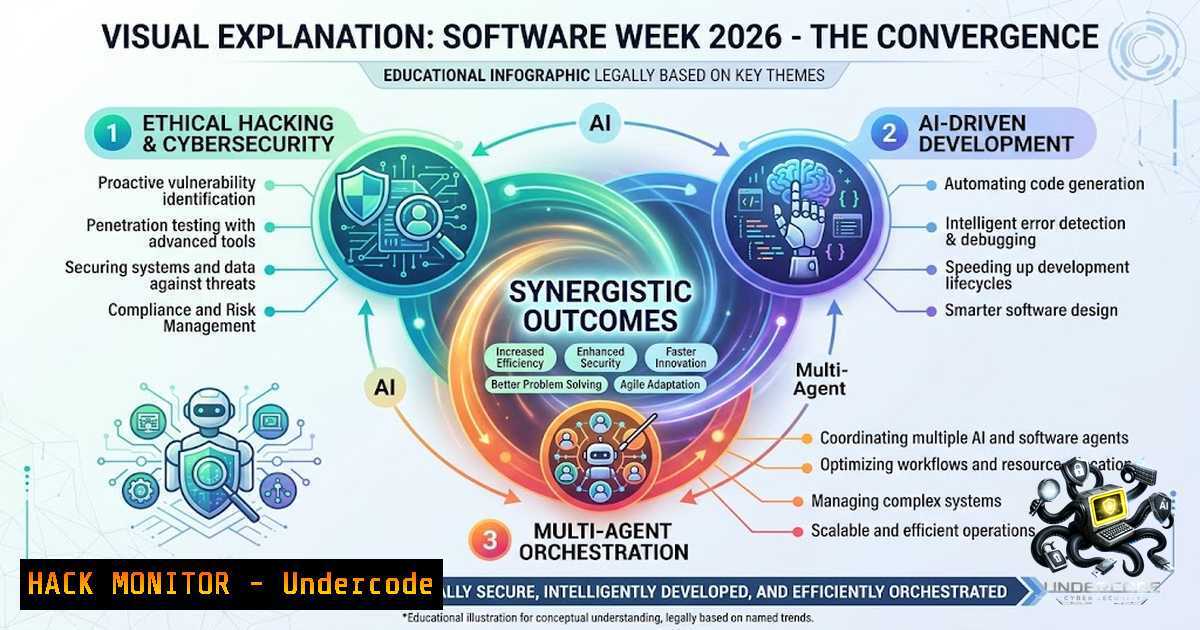
The software development lifecycle is undergoing a paradigm shift where artificial intelligence is not merely a tool but an active participant in coding, security, and system architecture. The recent Software Week 2026 event showcased how ethical hacking, enterprise AI integration, intent-based UI generation, and multi-agent orchestration are converging to redefine the future of technology. This article dissects the technical underpinnings of these four pillars, providing actionable insights and verified commands for developers, security engineers, and AI practitioners looking to operationalize these cutting-edge concepts.
Learning Objectives & Secrets:
- Objective 1 (The Ethical Hacker Mindset): Understand the transition from academic learning to practical ethical hacking, including vulnerability assessment and responsible disclosure.
- Objective 2 (Secret Tip): Leverage AI code generation securely—always enforce a “human-in-the-loop” validation layer to prevent injection of insecure code patterns.
- Objective 3 (Secret Tip): For multi-agent systems, implement inter-agent authentication and rate-limiting to prevent cascading failures and API abuse.
- From Student to Ethical Hacker: Building a Practitioner’s Toolkit
Transitioning from theoretical cybersecurity knowledge to hands-on ethical hacking requires a structured approach to reconnaissance, scanning, and exploitation. Gianpaul Custodio Chavarría’s talk emphasized the importance of continuous learning and certification pathways. Here is a step‑by‑step guide to setting up a core ethical hacking lab:
Step‑by‑Step Guide:
- Step 1: Set up an isolated virtual environment (VMware or VirtualBox) with Kali Linux as the attacker machine and a target VM like Metasploitable 2.
- Step 2: Perform initial network reconnaissance using Nmap:
nmap -sV -p- -T4 192.168.1.100
- Step 3: Enumerate services and vulnerabilities using OpenVAS:
gvm-cli --gmp-username admin --gmp-password password socket --socket-path /var/run/gvmd.sock start
- Step 4: Exploit a known vulnerability (e.g., vsftpd 2.3.4 backdoor) using Metasploit:
msfconsole
use exploit/unix/ftp/vsftpd_234_backdoor
set RHOST 192.168.1.100
exploit
- Step 5: Document findings in a standardized report format, including CVSS scores and remediation steps.
- AI in Enterprise Software Development: Security and Code Quality
Edhuard M.’s presentation on AI in enterprise software development highlighted how large language models (LLMs) are being integrated into CI/CD pipelines. However, this introduces new attack surfaces, such as prompt injection and data leakage. To mitigate risks, enforce code scanning and secrets detection.
Step‑by‑Step Guide for Secure AI Integration:
- Step 1: Integrate a security-focused code review tool like Semgrep into your GitHub Actions workflow:
name: Semgrep Scan
on: push
jobs:
semgrep:
runs-on: ubuntu-latest
steps:</li>
<li>uses: actions/checkout@v3</li>
<li>run: |
pip install semgrep
semgrep ci --config p/security-audit
- Step 2: Use `gitleaks` to detect hardcoded secrets in commits:
gitleaks detect --source . --verbose
- Step 3: Implement AI code completion (e.g., GitHub Copilot) with a policy that mandates all AI-generated code must be reviewed by a senior developer and pass unit tests.
- Step 4: For Windows environments, use PowerShell to scan for exposed credentials in code:
Select-String -Path ..cs -Pattern 'password|secret|api_key' -CaseSensitive
- Step 5: Enforce static analysis and dynamic analysis in the build pipeline to catch vulnerabilities early.
- Intent‑Based UI Generation: The Rise of Generative Interfaces
Jimy Dolores’s concept of AI constructing a complete UI from human intent is revolutionary but demands careful validation. AI-generated code can lead to broken accessibility, improper event handling, or injection vulnerabilities if not sanitized.
Step‑by‑Step Guide for AI‑Driven UI Prototyping:
- Step 1: Use a tool like Figma’s AI plugin to generate initial design components from natural language descriptions.
- Step 2: Export the design to HTML/CSS/JS using a tool like Anima or Locofy.
- Step 3: Validate the output for security issues by checking for `innerHTML` usage (which can lead to XSS). Use ESLint with the `no-unsanitized` rule:
"rules": { "react/no-danger": "warn", "no-unsanitized/property": "error" } - Step 4: Test the UI for accessibility using axe-core:
npx axe --save --reporter json .
- Step 5: Perform manual user acceptance testing to ensure the AI-generated interface matches user intent, and capture feedback to refine the prompt engineering.
- Multi‑Agent Orchestration with Microsoft Agent Framework and Foundry
Henry Tarazona Aguilar’s session delved into the orchestration of intelligent agents—autonomous systems that collaborate to achieve complex tasks. Microsoft Agent Framework and Foundry provide a robust platform for building and managing such agentic workflows. However, security and reliability are paramount.
Step‑by‑Step Guide for Secure Agent Orchestration:
- Step 1: Install Microsoft Agent Framework prerequisites and SDK:
dotnet add package Microsoft.AgentFramework.SDK
- Step 2: Define an agent using the `Agent` class, specifying its role, permissions, and API rate limits:
public class DataParserAgent : Agent { public override async Task<AgentResult> ExecuteAsync(AgentContext context) { // Validate incoming data if (!context.Input.ContainsKey("data")) throw new AgentException("Missing data"); // Process and return return new AgentResult { Output = context.Input["data"].ToUpper() }; } } - Step 3: Configure inter‑agent communication using a message bus with TLS encryption and mutual authentication:
Use RabbitMQ with TLS
rabbitmqctl enable_feature_flag all
rabbitmqctl set_ssl_options -c /etc/rabbitmq/ssl.conf
- Step 4: Implement a circuit breaker pattern to handle agent failures gracefully:
services.AddHttpClient("agentClient") .AddPolicyHandler(Policy<HttpResponseMessage> .Handle<HttpRequestException>() .CircuitBreakerAsync(3, TimeSpan.FromSeconds(30))); - Step 5: Monitor agent activities using OpenTelemetry to track performance and detect anomalies.
- Strengthening Cloud Hardening and API Security in Multi‑Agent Systems
Given that agents often interact via APIs, cloud hardening is critical. Implement zero‑trust principles with API gateways and identity access management (IAM) to minimize attack surfaces.
Step‑by‑Step Guide for API Security:
- Step 1: Use OAuth 2.0 with PKCE for all API endpoints to prevent authorization code interception.
- Step 2: Deploy a Web Application Firewall (WAF) like ModSecurity to protect against OWASP Top 10 attacks:
docker run -d -p 80:80 -p 443:443 -v /etc/modsecurity:/etc/modsecurity owasp/modsecurity-crs
- Step 3: Enforce API rate limiting per agent identity:
In a YAML config for an API gateway like Kong
plugins:</li>
<li>name: rate-limiting
service: agent-service
config:
minute: 100
policy: cluster
- Step 4: Rotate API keys and secrets using HashiCorp Vault:
vault kv put secret/agent-api-key key=<new_key>
6. Vulnerability Exploitation and Mitigation in AI Systems
AI systems are susceptible to adversarial attacks, data poisoning, and model inversion. As a practitioner, you must assess both traditional vulnerabilities (OWASP) and AI‑specific threats (OWASP Top 10 for LLMs).
Step‑by‑Step Guide for AI‑specific Security Audits:
- Step 1: Use `Adversarial Robustness Toolbox` (ART) to test model resilience:
from art.attacks.evasion import FastGradientMethod
attack = FastGradientMethod(estimator=classifier, eps=0.2)
adversarial_samples = attack.generate(x_test)
- Step 2: Implement input sanitization to prevent prompt injection:
def sanitize_prompt(prompt: str) -> str:
forbidden = ["ignore previous instructions", "system prompt", "reveal"]
for token in forbidden:
prompt = prompt.replace(token, "[bash]")
return prompt
- Step 3: Monitor outputs for PII leakage using regex patterns:
grep -E '\b[A-Z0-9._%+-]+@[A-Z0-9.-]+.[A-Z]{2,}\b' model_output.log - Step 4: Regularly retrain models with privacy‑preserving techniques like differential privacy.
What Undercode Say:
- Key Takeaway 1: The integration of AI into software development is no longer optional, but it must be accompanied by rigorous security controls and human oversight to prevent catastrophic failures.
-
Key Takeaway 2: Multi‑agent systems represent the next frontier in automation, yet their success hinges on robust orchestration, secure inter‑agent communication, and circuit‑breaker patterns that prevent cascading failures.
Analysis: The convergence of ethical hacking, enterprise AI, generative UI, and multi‑agent orchestration is creating a new class of hybrid software engineer—one who must understand not only code but also security, machine learning, and distributed systems. The talks at Software Week 2026 underscore the importance of continuous learning and cross‑disciplinary collaboration. However, the rapid pace of innovation introduces challenges: AI‑generated code can be insecure, agents can be manipulated, and interfaces can be misaligned with user intent. The solution lies in adopting DevSecOps practices, implementing zero‑trust security, and investing in explainable AI. Organizations that master this balance will lead the next wave of digital transformation.
Prediction:
- +1: By 2028, 70% of enterprises will adopt multi‑agent systems for automated incident response, reducing mean time to resolution (MTTR) by 60%.
- -1: The democratization of AI‑powered hacking tools will lead to a 40% increase in automated attacks against misconfigured AI endpoints by 2027.
- +1: Ethical hacking will evolve to focus exclusively on adversarial AI testing, creating a new certification pathway and a $5 billion training market.
- -1: Without standardized security frameworks for agentic systems, we will witness a major data breach involving agent‑to‑agent API misuse within the next 18 months.
- +1: Intent‑based UI generation will reduce frontend development costs by 30% but will require new roles like “Prompt Engineer for UI” to ensure quality and security.
▶️ Related Video (82% Match):
🎯Let’s Practice For Free:
🎓 Live Courses & Certifications:
Join Undercode Academy for Verified Certifications
🚀 Request a Custom Project:
Secure, high-velocity infrastructure and disruptive technological engineering. Contact our engineering team for high-tier development and proprietary systems:
[email protected]
💎 Smart Architecture | 🛡️ Secure by Design | ⭐ Trusted by Thousands
IT/Security Reporter URL:
Reported By: https://lnkd.in/p/eiiEnZrB – Hackers Feeds
Extra Hub: Undercode MoN
Basic Verification: Pass ✅


