
Listen to this Post
Introduction:
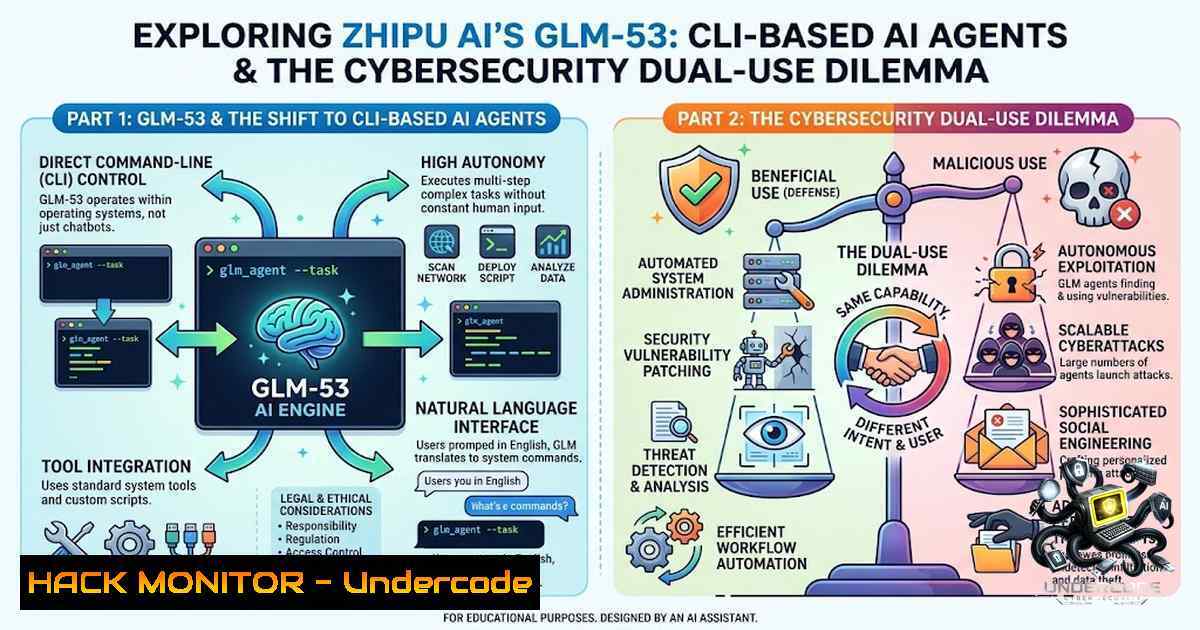
The release of Zhipu AI’s GLM-5.3 marks a significant milestone in the evolution of large language models, particularly in the realm of terminal-based operations. While the model demonstrates a staggering 6x improvement in Terminal-Bench scores over its predecessor, the most contentious development lies in its exceptional performance on Capture The Flag (CTF) challenges and cybersecurity testing. This capability positions GLM-5.3 as a powerful double-edged sword—offering unprecedented defensive capabilities for code auditing and vulnerability scanning while simultaneously raising alarms about its potential for automated exploitation, igniting a critical debate within the AI and security communities about regulation and ethical deployment.
Learning Objectives & Secrets:
- Objective 1: Mastering Post-Training Optimization. Understand how intensive post-training on CLI workflows, tool-calling, and script execution environments dramatically enhances AI agent performance in terminal-based tasks.
- Objective 2 Secret Tips: Unlocking CTF Potential. Leverage GLM-5.3’s advanced reasoning for defensive security by using it to automate the identification of vulnerable code patterns in complex software stacks, effectively mimicking human CTF player strategies.
- Objective 3 Secret Tips: Navigating the Dual-Use Nature. Implement stringent access controls and monitoring to prevent the misuse of such powerful AI tools for offensive purposes, focusing on safe deployment within isolated sandbox environments.
You Should Know:
- The Post-Training Powerhouse: CLI, Tool-Calling, and Script Execution
Zhipu AI’s success with GLM-5.3 is rooted in a novel approach to post-training, moving beyond simple conversational fine-tuning to specialized reinforcement learning in terminal environments. This isn’t just about generating code; it’s about executing, debugging, and managing complex system interactions in real-time. To replicate or understand this, engineers can explore the concept of “agentic workflows” using frameworks like LangChain or AutoGen. A fundamental aspect is the ability to parse command-line outputs, generate subsequent commands based on errors, and maintain a persistent state.
Step‑by‑Step Guide to Simulating GLM-5.3’s Core Logic:
- Environment Setup: Create an isolated Docker container to act as a sandboxed terminal. Use a Python script with the `subprocess` module to send commands to this container.
- Tool Definition: Define a set of tools (e.g.,
file_reader,directory_lister,bash_executor). In GLM-5.3, these are likely integrated during training. For a local test, use the `requests` library to simulate a tool API call. - Prompt Engineering: In your LLM prompt, define the tools available. For example: `You have access to the following tools: bash(command: str) -> output, python(code: str) -> output.`
4. Iterative Execution: Feed the LLM a high-level goal (e.g., “Find all .env files containing API keys”). The LLM should output a `bash` command. Execute it, capture the output, and feed it back to the LLM for the next step. This iterative loop mimics the “tool-calling” workflow that drives the GLM-5.3 performance boost.
Linux Commands for Tool Simulation: To test vulnerability scanning reminiscent of GLM-5.3’s prowess, a DevOps engineer might use:
 Simulate automated code scanning for hardcoded secrets
grep -r --include=".py" "API_KEY" .
 Use Semgrep for advanced pattern matching (similar to AI-based static analysis)
semgrep --config=auto .
- Defensive Security Applications: Automating Code Auditing and Vulnerability Scanning
The defensive potential of GLM-5.3 is immense. Security teams can deploy it as a tireless junior security engineer capable of performing static and dynamic analysis at scale. Its ability to understand context and “think” like an attacker (due to its CTF training) makes it uniquely suited to identify subtle logic flaws that traditional SAST (Static Application Security Testing) tools often miss. For instance, it can be tasked with reviewing a new microservice deployment for misconfigurations or insecure API endpoints.
Step‑by‑Step Guide for Automated Defensive Auditing:
- Input Preparation: Feed the AI agent a code repository. This can be done by using `git clone` to pull the code into a read-only volume attached to the AI agent’s execution environment.
- Targeted Querying: Instead of asking for a generic review, use specific prompts. For example: “Review the authentication middleware in this repository for potential JWT (JSON Web Token) misconfigurations.”
- Output Parsing: The AI will generate an analysis report. You can pipe the output into a Python script to parse it and create a structured JSON report (e.g., using `jq` or
python -m json.tool). - Remediation Automation: The most advanced step is to have the AI generate a pull request with proposed patches. This is risky but can be done by having the AI output `git diff` patches, which are then manually reviewed by a human.
Windows Commands for Vulnerability Scanning: While Linux/Unix dominates the server space, Windows environments are equally critical. A defender can use PowerShell to simulate AI-driven checks:
 Simulate AI checking for insecure services
Get-Service | Where-Object {$<em>.Status -eq 'Running' -and $</em>.StartType -eq 'Automatic'}
 Check for weak registry permissions (a common vulnerability)
Get-Acl -Path "HKLM:\SOFTWARE\Microsoft\Windows\CurrentVersion\Run" | Format-List
- The Offensive Risk: Automated Exploitation and the Dual-Use Threat
The flip side is the risk of weaponization. A model that can excel at CTF challenges can be trivially adapted to exploit real-world systems. While Zhipu AI likely implements safety filters, open-source variants or API-based misuse could lead to fully automated pentesting tools that require no human expertise. The risk is not just in exploitation but in the speed and scale—an AI can probe thousands of systems simultaneously, finding and exploiting vulnerabilities like Log4Shell or misconfigured cloud buckets.
Step‑by‑Step Guide to Understanding the Offensive Potential:
- Reconnaissance Automation: An attacker could deploy the AI to run `nmap` and `gobuster` scans, with the LLM interpreting results to identify weak entry points. The AI can chain commands like `nmap -sV -p- 192.168.1.1` and `curl -v –path-as-is http://target/../../etc/passwd`.
- Exploit Generation: The AI can be prompted with “Write a Python script to exploit CVE-2023-XXXX given this vulnerability description.” While security controls might block this, attackers can use jailbreaking to bypass restrictions.
- Payload Delivery: The AI can manage a reverse shell session using `netcat` or
meterpreter, effectively acting as an automated command-and-control interface.
Mitigation Commands (Cloud Hardening): To defend against such AI-driven automated attacks, cloud hardening is essential:
 AWS: Enforce IMDSv2 to prevent metadata service exploitation
aws ec2 modify-instance-metadata-options --instance-id i-xxxx --http-tokens required --http-put-response-hop-limit 1
 Kubernetes: Apply a restrictive NetworkPolicy
kubectl apply -f - <<EOF
apiVersion: networking.k8s.io/v1
kind: NetworkPolicy
metadata:
name: deny-all
spec:
podSelector: {}
policyTypes:
- Ingress
EOF
4. The Governance Conundrum: Regulating CLI-Based AI Agents
The debate surrounding GLM-5.3 centers on regulation. Should such capabilities be tightly controlled? Proponents of open development argue that restricting AI hampers defensive innovation, as the best defense is a deep understanding of offense. They advocate for “responsible disclosure” and community-driven defenses, much like the OWASP Top 10. Opponents argue that the barrier to entry for cybercrime is lowered to near-zero, necessitating strict government oversight akin to ITAR (International Traffic in Arms Regulations) for encryption.
Step‑by‑Step Guide for API Security (A Key Attack Vector): To protect APIs from AI agents that can automatically find and exploit vulnerabilities:
1. Rate Limiting: Implement strict rate limiting to prevent brute-force or automated probing. Example using Nginx: `limit_req zone=one burst=5 nodelay;`
2. API Gateway Authentication: Use OAuth2 or JWT with short expiration times. Ensure tokens are validated. A `curl` command to test a vulnerable JWT endpoint: curl -H "Authorization: Bearer $TOKEN" https://api.example.com/admin`.echo $payload | jq -e ‘. | has(“expectedField”)’
3. Input Validation: Use a strict allowlist for API inputs. `jq` can be used to validate JSON payloads:.awk ‘{print $1}’ access.log | sort | uniq -c | sort -1r | head -20`.
4. Monitoring and Alerting: Set up alerts for anomalous access patterns. A quick `awk` script to parse logs for suspicious high-frequency requests:
5. Implications for DevOps and MLOps Teams
For engineering teams, GLM-5.3 represents a shift from code-assistants to task-executors. The traditional CI/CD pipeline can now include an AI “guardian” that not only lints code but actively tests it in a sandboxed environment, simulating attacks before deployment. This requires a shift in mindset—from building for “least privilege” in code to building for “minimum influence” of the AI.
DevOps Command to Integrate AI Scanning:
 A conceptual command to run an AI audit on a new feature branch
ai-auditor --git-repo . --target-scan --output-report security_report.json
 Post-scan, use jq to check for high-severity issues
jq '.vulnerabilities[] | select(.severity=="HIGH")' security_report.json
Windows PowerShell for CI/CD:
 Pushing logs to Azure Sentinel for AI anomaly detection
$log = Get-Content "C:\Logs\app.log" | Out-String
Invoke-RestMethod -Method Post -Uri "https://api.sentinel.azure.com/ingest" -Body $log
What Undercode Say:
- Key Takeaway 1: The 6x performance leap is not an incremental improvement but a fundamental change in how LLMs interact with system environments. Post-training on tool-calling is the new frontier, moving AI from “read-only” to “write-execute.”
- Key Takeaway 2: The dual-use nature of GLM-5.3 is the real story. Organizations must not wait for regulations; they must implement internal “AI red teams” and build pipelines that assume AI will be used maliciously, preparing their defenses accordingly.
- Key Takeaway 3: The debate on regulation overlooks a critical point: the inevitability of open-source models catching up. Regulation will only slow down defensive capabilities in the West while state actors and less regulated entities develop similar tools unimpeded. The only viable defense is aggressive automation of security ourselves.
- Key Takeaway 4: DevOps engineers must become security engineers. The ability to prompt an AI to scan, audit, and patch is becoming a core competency. Teams should integrate “AI Agent Evaluation” into their CI/CD pipelines to test how well their systems withstand AI-driven probing.
- Key Takeaway 5: The “Terminal-Bench” metric is a new standard. We are likely to see a surge in benchmarks that test AI’s ability to actually do things in a shell, rather than just answer questions about code. This will change how we evaluate and hire for IT and security roles.
Prediction:
- -1 The risk of automated, AI-driven ransomware attacks will increase exponentially within the next 18 months. Tools like GLM-5.3 will be used to automate lateral movement and privilege escalation, significantly reducing the “time-to-compromise” for attackers.
- +1 Defensive AI will evolve into a “security immune system,” capable of generating its own patches and deploying them in milliseconds. We will see a new class of cybersecurity insurance that mandates the use of these AI defenders.
- -1 The regulatory response will be heavy-handed and fragmented, leading to a “Splinternet” of AI where models are restricted by geographical location, hindering global collaboration on security research.
- +1 The open-source community will rapidly build “anti-AI-exploitation” tools, such as honeypots specifically designed to trap and retrain malicious AI agents, turning the attacker’s own intelligence against them.
▶️ Related Video (78% Match):
🎯Let’s Practice For Free:
🎓 Live Courses & Certifications:
Join Undercode Academy for Verified Certifications
🚀 Request a Custom Project:
Secure, high-velocity infrastructure and disruptive technological engineering. Contact our engineering team for high-tier development and proprietary systems:
[email protected]
💎 Smart Architecture | 🛡️ Secure by Design | ⭐ Trusted by Thousands
IT/Security Reporter URL:
Reported By: https://lnkd.in/p/eGg6CDAW – Hackers Feeds
Extra Hub: Undercode MoN
Basic Verification: Pass ✅


