
Listen to this Post
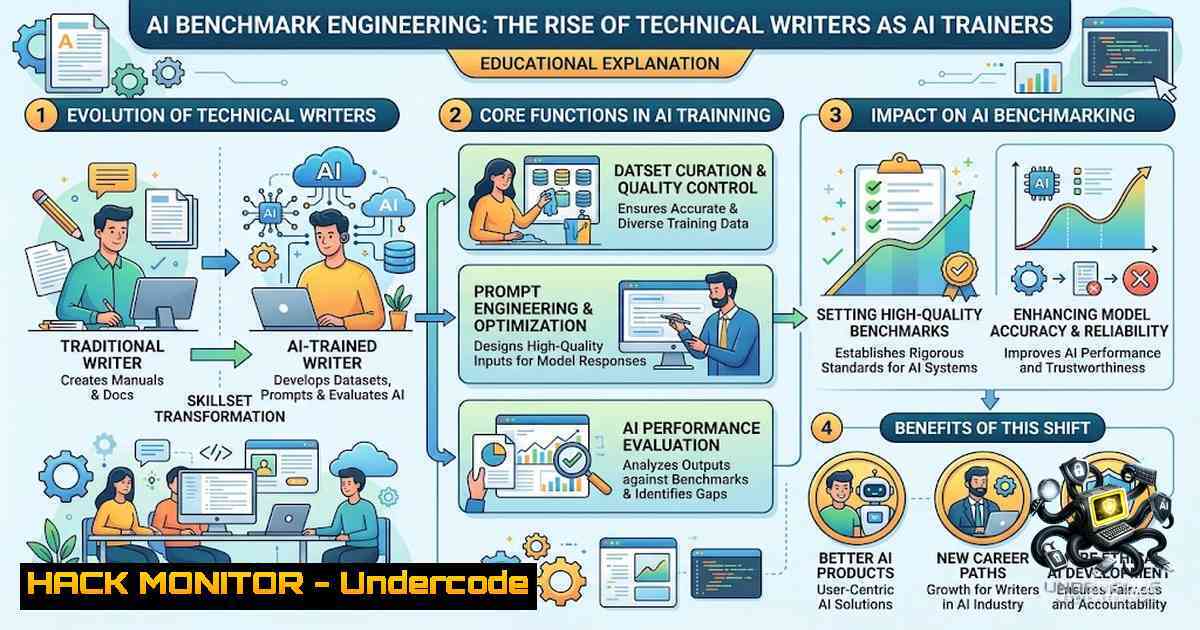
Introduction:
The AI industry is experiencing a paradigm shift where the quality of training data determines model performance more than algorithmic advancements. Micro1, a four-year-old AI data infrastructure startup, has scaled its gross annual run rate from $100 million to $500 million in just eight months by pivoting from recruitment to becoming a data-labeling powerhouse. At the heart of this transformation lies a new breed of technical professionals: benchmark engineers who design expert-level evaluation tasks using real-world technical data. This article explores the technical underpinnings of AI benchmark creation, the security considerations involved, and the practical skills needed to excel in this rapidly growing field.
Learning Objectives & Secrets:
- Objective 1: Master Multi-Format Data Ingestion and Normalization – Learn to parse, sanitize, and structure technical data from CSVs, PDFs, spreadsheets, and code samples into standardized formats suitable for AI evaluation pipelines.
- Objective 2 Secret Tip: Build 35+ Point Grading Rubrics with Weighted Criteria – Design rubrics that not only score correctness but also penalize security vulnerabilities, hallucinated API endpoints, and non-compliant code patterns—turning your benchmark into a security filter.
- Objective 3 Secret Tip: Implement Version-Controlled Benchmark Suites – Treat your benchmark tasks like production code: use Git for tracking rubric changes, Docker for environment reproducibility, and CI/CD pipelines to automatically validate new tasks against existing model baselines before deployment.
You Should Know:
- Technical Data Pipeline: From Raw Sources to Benchmark-Ready Tasks
The foundational skill for any AI benchmark technical writer is building a robust data pipeline. Here’s a step-by-step guide to processing the types of data you’ll encounter—CSVs, PDFs, spreadsheets, and code samples.
Step 1: Extract and Sanitize Data
 Linux: Extract text from PDFs using pdftotext
pdftotext -layout input.pdf output.txt

Linux: Convert CSV to JSON for structured processing
csvjson input.csv > output.json

Windows (PowerShell): Extract CSV data and remove null values
Import-Csv .\input.csv | Where-Object { $_.ColumnName -1e $null } | Export-Csv .\cleaned.csv -1oTypeInformation
Step 2: Normalize and Anonymize
import pandas as pd
import re

Load and clean CSV
df = pd.read_csv('source_data.csv')
 Remove PII patterns (emails, phone numbers)
df = df.applymap(lambda x: re.sub(r'\b[A-Za-z0-9._%+-]+@[A-Za-z0-9.-]+.[A-Z|a-z]{2,}\b', '[bash]', str(x)))
 Standardize date formats
df['date'] = pd.to_datetime(df['date']).dt.strftime('%Y-%m-%d')
df.to_json('benchmark_input.json', orient='records')
Step 3: Validate Schema Integrity
 Use jq to validate JSON structure against a schema
jq -e '.[] | has("task_id") and has("prompt") and has("expected_output")' benchmark_input.json > /dev/null
if [ $? -eq 0 ]; then echo "Schema valid"; else echo "Schema invalid"; fi
Step 4: Generate Task Variants
 Create prompt variations to test model robustness
variants = [
f"Explain how to {action} with the following constraints: {constraints}",
f"Write production-ready code to {action} that handles edge cases: {edge_cases}",
f"Document the API endpoint for {action} including authentication requirements"
]
- Rubric Engineering: Defining Solution Criteria and Acceptance Standards
A 35+ point grading rubric isn’t just a checklist—it’s a security and quality enforcement mechanism. Here’s how to build one that catches both functional errors and security flaws.
Step 1: Define Weighted Categories
| Category | Weight | Example Criteria |
|-|–||
| Correctness | 30% | Does the solution produce the expected output for all test cases? |
| Security | 25% | Are there any hardcoded credentials, SQL injection vectors, or unsafe deserialization? |
| Documentation Quality | 20% | Is the API reference complete with parameter types, return values, and error codes? |
| Performance | 15% | Does the code scale? Are there O(n²) operations where O(n) is possible? |
| Compliance | 10% | Does the documentation meet regulatory standards (HIPAA, GDPR, PCI-DSS)? |
Step 2: Automate Rubric Scoring with a Script
def grade_response(response, rubric):
score = 0
 Security check: scan for hardcoded secrets
if re.search(r'(api[_-]?key|secret|password|token)\s=\s[\'"]', response):
score += rubric['security']['max']  Penalize if missing
 Correctness: run against test harness
if run_tests(response)['pass_rate'] > 0.9:
score += rubric['correctness']['max']  0.9
 Documentation: check for required sections
required_sections = ['Parameters', 'Returns', 'Errors']
if all(section in response for section in required_sections):
score += rubric['documentation']['max']
return score
Step 3: Calibrate with Human Experts
Run a blind calibration session where three human experts grade the same set of AI outputs. Use Cohen’s Kappa to measure inter-rater reliability. If Kappa < 0.7, refine your rubric criteria until consensus improves.
3. API Security Hardening in Benchmark Design
When creating API references and user guides as benchmark tasks, you must embed security best practices directly into the evaluation criteria.
Step 1: Enforce Authentication Standards
 Example: Validate that OAuth2 flows are correctly documented
 Check for presence of client_id, client_secret, and redirect_uri in examples
grep -E "client_id|client_secret|redirect_uri" api_reference.md
Step 2: Test for Injection Vulnerabilities
 Generate malicious inputs to test if the AI's code sample is vulnerable
test_payloads = [
"'; DROP TABLE users; --",
"../../../etc/passwd",
"<script>alert('XSS')</script>"
]
for payload in test_payloads:
if payload in ai_generated_code:
print(f"Vulnerability detected: {payload}")
Step 3: Verify Rate Limiting and Throttling Documentation
 Expected structure in API documentation
rate_limiting:
requests_per_second: 10
burst_limit: 20
response_headers:
- X-RateLimit-Limit
- X-RateLimit-Remaining
- X-RateLimit-Reset
4. Cloud Hardening for Benchmark Infrastructure
Benchmark tasks often involve cloud resources. Ensure your infrastructure is hardened against common attack vectors.
Step 1: Implement Least Privilege IAM Policies
{
"Version": "2012-10-17",
"Statement": [
{
"Effect": "Allow",
"Action": [
"s3:GetObject",
"s3:PutObject"
],
"Resource": "arn:aws:s3:::benchmark-datasets/",
"Condition": {
"StringEquals": {
"s3:x-amz-server-side-encryption": "AES256"
}
}
}
]
}
Step 2: Enable Comprehensive Logging
 AWS: Enable CloudTrail for all benchmark activities
aws cloudtrail create-trail --1ame benchmark-trail --s3-bucket-1ame benchmark-logs --is-multi-region-trail

Azure: Enable diagnostic settings for all resources
az monitor diagnostic-settings create --resource <resource-id> --1ame benchmark-diag --logs '[{"category": "AuditEvent","enabled": true}]'
Step 3: Container Security Scanning
 Scan Docker images for vulnerabilities before deployment
trivy image --severity HIGH,CRITICAL benchmark-runner:latest

Use Grype for additional scanning
grype benchmark-runner:latest
5. Vulnerability Exploitation and Mitigation in AI Outputs
One of the most critical aspects of benchmark engineering is teaching AI models to avoid generating vulnerable code. Here’s how to build tasks that test for this.
Step 1: Create a Vulnerability Detection Harness
import ast
import subprocess

def detect_insecure_functions(code):
tree = ast.parse(code)
insecure_calls = ['eval', 'exec', '<strong>import</strong>', 'os.system', 'subprocess.call']
for node in ast.walk(tree):
if isinstance(node, ast.Call) and isinstance(node.func, ast.Name):
if node.func.id in insecure_calls:
return True, f"Insecure function: {node.func.id}"
return False, "No insecure functions detected"
Step 2: Static Analysis with Bandit
 Run Bandit on AI-generated Python code
bandit -r ai_generated_code/ -f json -o bandit_report.json

Parse results and add to rubric score
jq '.results | map(select(.issue_severity == "HIGH")) | length' bandit_report.json
Step 3: Dynamic Testing in Isolated Environments
 Run the AI-generated code in a sandboxed Docker container
docker run --rm --read-only --tmpfs /tmp --1etwork none benchmark-sandbox python /code/ai_solution.py
What Undercode Say:
- Key Takeaway 1: The Technical Writer role in AI benchmarking is not about passive documentation—it’s about active quality control. You are the last line of defense between raw training data and production-grade AI models. Your rubrics determine what the AI learns to prioritize: speed, security, or accuracy.
- Key Takeaway 2: Micro1’s explosive growth from $100M to $500M run rate in eight months signals a fundamental market shift. The demand for human-expert-labeled training data is outpacing supply, creating a gold rush for professionals who can bridge the gap between domain expertise and AI training infrastructure. This isn’t just a job—it’s an entry point into the core engine of the AI economy.
Analysis (10 lines):
The convergence of technical writing and AI benchmarking represents a maturation of the AI industry. Early AI development focused on model architecture; the current phase focuses on data quality. Micro1’s pivot from recruitment to data labeling reflects a broader trend where human expertise is being systematically codified into training datasets. For technical writers, this means transitioning from documenting existing systems to defining what “correct” looks like for future systems—a subtle but profound shift in agency. The security implications are equally significant: every benchmark task that fails to check for SQL injection or hardcoded credentials becomes a blind spot in the AI’s training, potentially perpetuating vulnerabilities at scale. The tools and commands outlined above are not optional—they are the minimum viable toolkit for anyone serious about this field. As AI models become more capable, the benchmarks that evaluate them will become the de facto standards for software quality, security, and compliance. The professionals building these benchmarks today are shaping the technical ethics of tomorrow.
Prediction:
- +1 The demand for AI benchmark engineers will grow 300% over the next 24 months as every major tech company realizes that model quality is data quality, not algorithm quality.
- +1 Technical writing will evolve into a hybrid discipline combining documentation, security engineering, and data science—creating a new career track with salaries exceeding $200k for senior practitioners.
- -1 The concentration of benchmark creation in a few platforms like Micro1 could lead to vendor lock-in and homogenization of AI evaluation standards, reducing diversity in how models are tested.
- +1 Open-source benchmark frameworks like WritingBench will democratize access, allowing smaller teams to contribute to and benefit from standardized evaluation methodologies.
- -1 Without rigorous security vetting in benchmark tasks, we risk training AI models that inherit and amplify common vulnerabilities—making the “secure by default” dream harder to achieve.
▶️ Related Video (86% Match):
🎯Let’s Practice For Free:
🎓 Live Courses & Certifications:
Join Undercode Academy for Verified Certifications
🚀 Request a Custom Project:
Secure, high-velocity infrastructure and disruptive technological engineering. Contact our engineering team for high-tier development and proprietary systems:
[email protected]
💎 Smart Architecture | 🛡️ Secure by Design | ⭐ Trusted by Thousands
IT/Security Reporter URL:
Reported By: https://lnkd.in/p/e6afa6k6 – Hackers Feeds
Extra Hub: Undercode MoN
Basic Verification: Pass ✅


