Listen to this Post
Introduction:
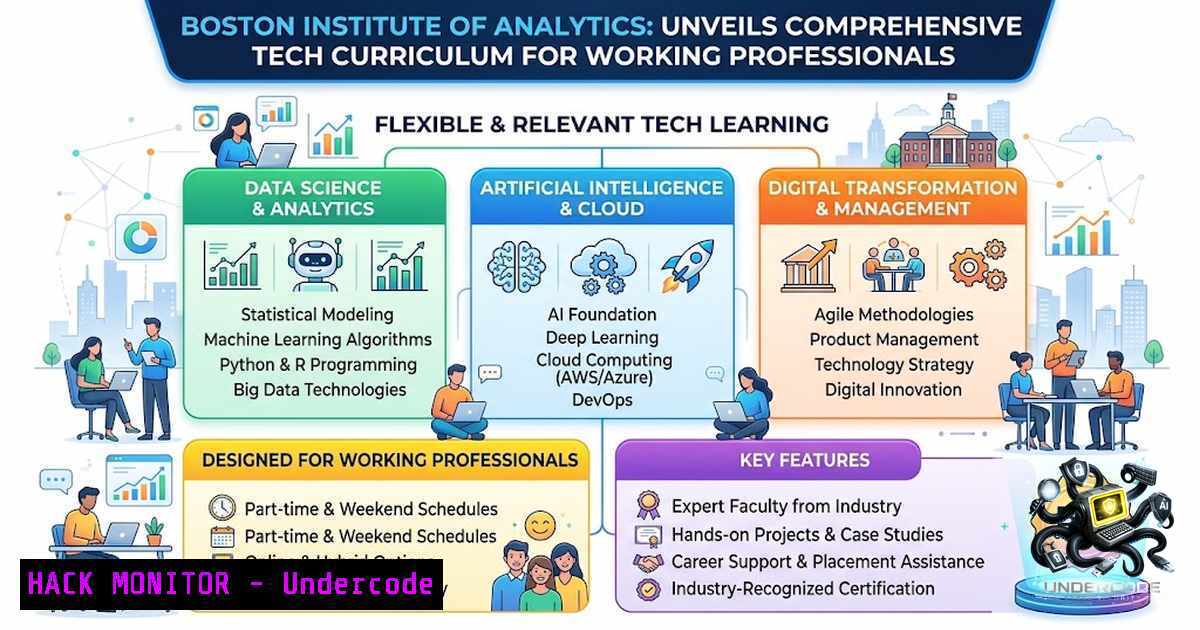
In an era where digital transformation dictates market leadership, the demand for specialized skills in Data Science, Artificial Intelligence, and Cybersecurity has surged exponentially. Boston Institute of Analytics (BIA) is bridging the critical skills gap by offering a flexible, industry-aligned curriculum designed specifically for working professionals. By integrating theoretical knowledge with real-world applications across its global network, BIA provides a viable alternative to traditional, expensive B-school programs, focusing on certifications that hold tangible value in the competitive tech landscape.
Learning Objectives:
- Master foundational and advanced techniques in Data Science, AI, and Cybersecurity with hands-on projects.
- Understand the architecture and implementation of Generative AI and Agentic AI systems.
- Execute security assessments and defensive strategies using industry-standard tools in Linux/Windows environments.
- Gain practical experience through live projects and case studies guided by industry professionals.
You Should Know:
- Setting Up a Virtual Lab Environment for Cybersecurity and AI Development
To maximize the learning from the BIA curriculum, establishing a robust virtual lab is essential. This allows students to practice Ethical Hacking and AI model development without risking corporate or personal infrastructure.
Step-by-step guide:
- Install VirtualBox or VMware: Download and install hypervisor software (Windows/Linux/macOS). This forms the bedrock for running isolated virtual machines (VMs).
- Deploy Kali Linux: Use `wget https://cdimage.kali.org/kali-2024.3/kali-linux-2024.3-installer-amd64.iso` to download the ISO. Create a new VM with 4GB RAM and 50GB storage, installing it with the default GUI tools (Metasploit, Burp Suite, Nmap).
- Deploy Ubuntu Server for AI: Download the Ubuntu 22.04 LTS server image. In the VM, install Python, Jupyter Notebook, and necessary libraries using:
sudo apt update && sudo apt install python3-pip python3-dev -y
pip3 install pandas numpy scikit-learn tensorflow torch jupyter
- Network Configuration: Set VM network adapters to “Bridged” or “NAT Network” to allow communication between attacker (Kali) and target (Ubuntu) machines. In Windows, use `ipconfig` to verify host IP, and in Linux use `ifconfig` or `ip a` to confirm connectivity.
- Securing an API Using Web Application Firewall (WAF) and Linux Commands
As AI and Data Science applications increasingly rely on APIs, securing them against exploitation is critical. This module demonstrates how to harden an API using ModSecurity, an open-source WAF integrated with Apache/Nginx.
Step-by-step guide:
- Install ModSecurity with Nginx: On your Linux VM, run:
sudo apt install nginx nginx-mod-http-headers-more-filter libmodsecurity3 -y
- Configure ModSecurity: Navigate to `/etc/nginx/` and enable ModSecurity by adding `modsecurity on;` and `modsecurity_rules_file /etc/nginx/modsecurity.conf;` in your site configuration.
- Apply OWASP Core Rule Set (CRS):
sudo git clone https://github.com/coreruleset/coreruleset /etc/nginx/owasp-crs
sudo cp /etc/nginx/owasp-crs/crs-setup.conf.example /etc/nginx/owasp-crs/crs-setup.conf
- Testing the WAF: Use `curl` to simulate a malicious SQL injection attempt:
curl -X GET "http://your-server-ip/api/users?id=' OR '1'='1"
If configured correctly, ModSecurity will return a 403 Forbidden error, blocking the payload.
- Windows Command: For Windows Server users with IIS, the process involves installing the IIS Web Application Firewall Module and defining rules via PowerShell:
Install-WindowsFeature -1ame Web-WAF
3. Harnessing Generative AI with Agentic Workflows
Generative AI has moved beyond simple text generation to agentic workflows, where AI models interact with APIs and tools to solve complex tasks autonomously. BIA’s curriculum emphasizes building these agents.
Step-by-step guide:
- Setting up a Virtual Environment:
python3 -m venv agentic_ai_env
source agentic_ai_env/bin/activate  For Linux/macOS
agentic_ai_env\Scripts\activate  For Windows
- Install Required Packages:
pip install openai langchain python-dotenv requests
- Building an Agent with LangChain: Create a `python` script (
agent.py) that uses the OpenAI API to reason and execute tasks (e.g., fetching real-time data).import os from langchain.agents import initialize_agent, AgentType from langchain.tools import tool from langchain.chat_models import ChatOpenAI</li> </ul> @tool def calculate(expression: str) -> str: """Evaluates a mathematical expression.""" return str(eval(expression)) tools = [bash] llm = ChatOpenAI(model="gpt-4", openai_api_key=os.getenv("OPENAI_API_KEY")) agent = initialize_agent(tools, llm, agent=AgentType.ZERO_SHOT_REACT_DESCRIPTION, verbose=True) agent.run("What is the square root of 256 multiplied by 2?")– Running and Debugging: Execute
python agent.py. This demonstrates the synergy between AI models and tool-calling agents—a core component of Agentic AI.- Cloud Hardening for AI and Data Science Workloads
With BIA’s focus on real-world projects, understanding cloud security is paramount. Azure and AWS are heavily used for AI workloads.
Step-by-step guide:
- Identity and Access Management (IAM): In AWS, create an IAM group with “ReadOnlyAccess” and “S3FullAccess” policies for development. Ensure MFA is enabled for root users. On Windows, use AWS CLI:
aws configure
- Network Security: Configure Security Groups to allow only specific IPs to connect to EC2 instances hosting Jupyter (port 8888).
- Data Encryption: Enable S3 bucket encryption by default. Use the Linux command to verify:
aws s3api get-bucket-encryption --bucket your-bucket-1ame
- Monitoring: Activate AWS CloudTrail and Azure Activity Logs to audit all API calls. Use `grep` to filter high-severity events:
aws cloudtrail lookup-events --lookup-attributes AttributeKey=EventName,AttributeValue=ConsoleLogin | grep -i "failed"
5. Vulnerability Exploitation and Mitigation in Ethical Hacking
The Ethical Hacking component of BIA’s program covers both offensive and defensive strategies. A common attack vector is exploiting misconfigured `sudo` privileges.
Step-by-step guide:
- Exploitation (Linux): Check current user’s sudo permissions:
sudo -l. If a user can run `/usr/bin/python` as root, they can break out of a restricted shell:sudo /usr/bin/python -c 'import pty;pty.spawn("/bin/bash")' - Mitigation (Windows): On Windows, enforce User Account Control (UAC) and remove users from the “Administrators” group via `lusrmgr.msc` or PowerShell:
Remove-LocalGroupMember -Group "Administrators" -Member "LowPrivUser"
- Cross-Platform Patching: Automate security updates. On Linux, use
sudo apt-get update && sudo apt-get upgrade -y. On Windows, use `wuauclt /detectnow /updatenow` to trigger Windows Update.
What Undercode Say:
- Key Takeaway 1: The shift from theoretical education to project-based learning, as advocated by BIA, significantly reduces the learning curve for transitioning into cybersecurity and AI roles.
- Key Takeaway 2: Agentic AI represents the next frontier; by integrating LangChain and API tools, professionals are learning to build systems that augment decision-making rather than just automating tasks.
BIA’s approach to upskilling is not just about acquiring knowledge but embedding professionals into a global network. By offering certifications that are recognized by the USA, it provides a competitive edge in the global job market. The emphasis on training from industry practitioners, rather than purely academics, ensures that students are job-ready from day one. However, it is crucial for aspirants to supplement this training with self-learning through platforms like TryHackMe (for security) and Kaggle (for data science) to solidify their skills, ensuring they can handle real-time debugging and incident response effectively.
Prediction:
- +1: Agentic AI is expected to dominate the tech landscape, leading to a surge in demand for professionals who can build and secure these autonomous systems. This will likely result in new job roles akin to “AI System Architects.”
- +1: The hybrid learning model (Offline/Online) adopted by institutes like BIA will become the industry standard, enabling a more diverse and globally distributed workforce to access top-tier education and bridge the global cybersecurity talent gap.
- -1: As more professionals reskill into AI and Cyber, there is a risk of market saturation in entry-level positions. Constant specialization in niche areas (e.g., Agentic AI security, Prompt Engineering) will become imperative to stay ahead.
▶️ Related Video (86% Match):
🎯Let’s Practice For Free:
🎓 Live Courses & Certifications:
Join Undercode Academy for Verified Certifications
🚀 Request a Custom Project:
Secure, high-velocity infrastructure and disruptive technological engineering. Contact our engineering team for high-tier development and proprietary systems:
[email protected]
💎 Smart Architecture | 🛡️ Secure by Design | ⭐ Trusted by ThousandsIT/Security Reporter URL:
Reported By: https://lnkd.in/p/e4PEmq84 – Hackers Feeds
Extra Hub: Undercode MoN
Basic Verification: Pass ✅🔐JOIN OUR CYBER WORLD [ CVE News • HackMonitor • UndercodeNews ]
📢 Follow UndercodeTesting & Stay Tuned:
- Cloud Hardening for AI and Data Science Workloads


