Listen to this Post
Introduction
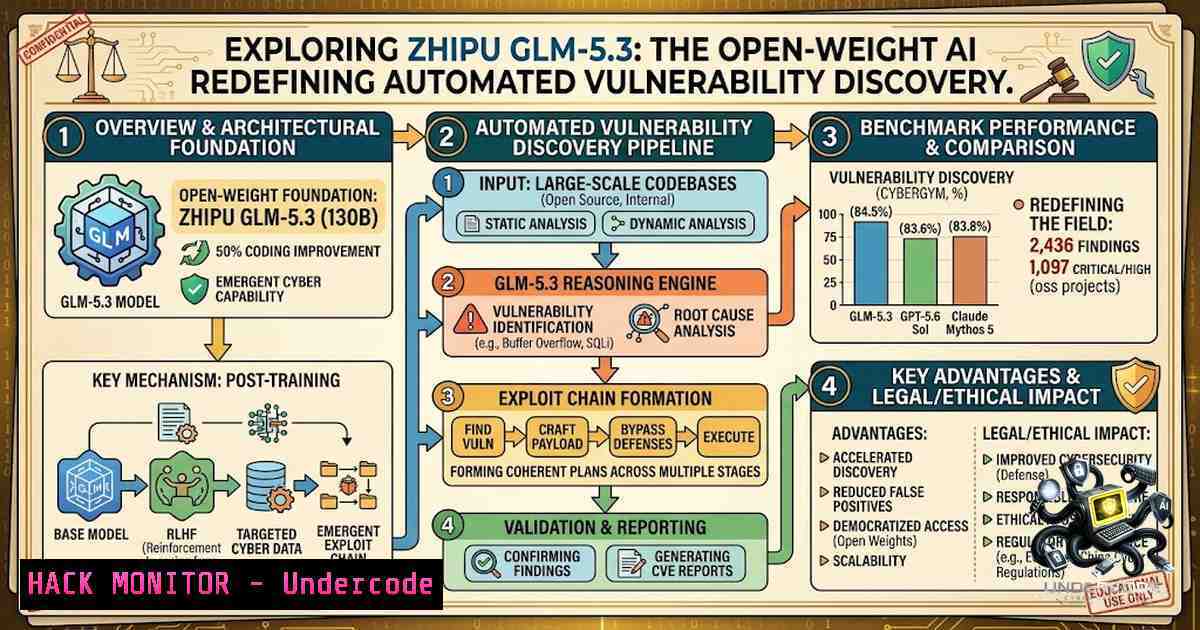
The cybersecurity landscape is witnessing a paradigm shift as artificial intelligence models evolve from mere code assistants to autonomous vulnerability hunters. Chinese AI lab Zhipu (Z.ai) has unveiled GLM-5.3, a 744-billion-parameter open-weight model that allegedly outperforms Anthropic’s Mythos 5 and OpenAI’s GPT-5.6 Sol on critical bug-finding benchmarks. What makes this announcement particularly significant is that GLM-5.3 achieves these gains not through architectural expansion—it uses the same base model as its predecessor GLM-5.2—but through “extreme post-training scaling” that unexpectedly unlocked sophisticated cyber reasoning capabilities. The model’s ability to identify 2,436 vulnerabilities across 269 real-world projects—including flaws dating back to 1981—signals a new era where defensive AI capabilities may no longer remain the exclusive domain of closed-source frontier models.
Learning Objectives
- Understand how post-training scaling can unlock emergent cybersecurity capabilities in large language models without architectural changes
- Learn to leverage AI-assisted vulnerability discovery workflows across Linux and Windows environments
- Master practical techniques for integrating LLM-based security scanning into CI/CD pipelines and code review processes
You Should Know
- Post-Training Scaling: The Secret Behind GLM-5.3’s Cyber Capabilities
Unlike traditional model upgrades that rely on larger parameter counts, GLM-5.3 derives every capability gain from scaled-up post-training on the same 744-billion-parameter base model as GLM-5.2. Zhipu expanded the long-horizon task environment to “dozens of times” its previous size, incorporating diverse real-world scenarios spanning complete software development, vulnerability mining, and enterprise automation workflows. The training pipeline relies on three core infrastructure components: IndexShare for百万级超长上下文处理, SAO (single-sample asynchronous reinforcement learning) for multi-step sequential tasks, and the open-source slime framework that unifies training, inference, and data caching.
What This Means for Security Practitioners:
The emergence of cyber capabilities during post-training—rather than deliberate architectural design—suggests that vulnerability discovery may be an emergent property of scale in task complexity. As Zhipu noted, “cyber capability developed faster than we expected” as training scaled. The model began reasoning across multiple stages of exploitation, “forming coherent plans for complete exploitation chains” rather than merely identifying isolated flaws.
Practical Implementation: Setting Up AI-Assisted Code Review
To integrate LLM-based vulnerability scanning into your workflow:
 Linux: Install and configure Semgrep for baseline static analysis
pip install semgrep
semgrep --config=p/r2c-security-audit /path/to/your/code

Run GLM-5.3 via API (once available)
curl -X POST https://api.z.ai/v1/chat/completions \
-H "Authorization: Bearer YOUR_API_KEY" \
-H "Content-Type: application/json" \
-d '{
"model": "glm-5.3",
"messages": [{"role": "user", "content": "Analyze this code for security vulnerabilities: [bash]"}],
"thinking": {"enabled": true, "effort": "high"}
}'

Windows PowerShell: Recursive file search for security-sensitive patterns
Get-ChildItem -Path . -Recurse -Include .c,.cpp,.py,.js | Select-String -Pattern "(strcpy|gets|system|eval|exec)"
Note: GLM-5.3’s API requires `thinking` enabled across three effort levels (low, high, max)—a breaking change for applications that previously ran with thinking disabled.
- Benchmark Performance: Where GLM-5.3 Excels and Where It Trails
GLM-5.3’s benchmark results reveal a nuanced capability profile that security teams must understand:
| Benchmark | GLM-5.3 | Mythos 5 | GPT-5.6 Sol | Description |
|–||-|-|-|
| CyberGym | 84.5% | 83.8% | 83.6% | White-box source code vulnerability identification |
| ExploitBench | 54.4% | 78.0% | 76.5% | Deep vulnerability reasoning and exploit development |
| ExploitGym (2h) | 105 tasks | 181 tasks | — | Throughput-constrained exploitation tasks |
Key Insight: While GLM-5.3 narrowly beats Western models at finding vulnerabilities from source code (CyberGym), it significantly lags in exploiting them (ExploitBench). This suggests the model excels at pattern recognition and flaw identification but requires further development for advanced exploit chain reasoning.
Real-World Validation:
Zhipu collaborated with Chinese security teams including Tsinghua University, Nankai University, and多家安全厂商 (Qianxin, NSFOCUS, CyberKunlun, DARKNAVY, Tencent Xuanwu) to test GLM-5.3 against real-world codebases. After expert review, deduplication, and validation, the model identified:
- 2,436 total vulnerabilities across 269 open-source projects
- 1,097 medium-to-high severity findings
- Flaws spanning system kernels, operating systems, browser engines, open-source infrastructure, web applications, and network protocols
- Oldest vulnerability dating to 1981—approximately 45 years old
- Average discovery lag of 26.6 years
Notable Discoveries:
- A zero-click vulnerability in a popular messaging app with hundreds of millions of daily active users, exploitable through seemingly normal messages
- Three Microsoft vulnerabilities chained together for remote code execution via email preview—reminiscent of the 2021 ProxyLogon attacks
- A DNS protocol vulnerability dating to 1983 that could amplify requests by a factor of 80,000, potentially affecting over 10 million public DNS services
3. Security Controls and Responsible Disclosure
Recognizing the dual-use nature of cyber-capable AI, Zhipu implemented a three-layer security architecture:
- Outer layer: A lightweight classifier that tags and blocks large-scale abuse requests
- Middle layer: An inference monitor that reviews task intent in real-time during model reasoning
- Inner layer: The model’s own safety alignment, enabling autonomous identification and rejection of malicious requests
Responsible Disclosure Framework:
Zhipu established the “Z.ai Security Disclosure Ledger” (安全披露账本):
- Patched vulnerabilities: Full details publicly disclosed
- Pending disclosure: Hash values published for future verification
- Vulnerabilities submitted to CNNVD/CNVD (China National Vulnerability Database)
The company will release GLM-5.3’s complete model weights approximately two weeks after the August 14 launch, following internal safety evaluation and hardening. Zhipu framed this as making defensive capabilities “public goods”—”an open world cannot have only open attack surfaces; it must also have an open shield”.
4. Practical Vulnerability Discovery Workflow with AI Assistance
Security teams can integrate LLM-based vulnerability discovery into existing workflows:
Step 1: Reconnaissance and Surface Scanning
 Linux: Use nmap for network reconnaissance
nmap -sV -sC -p- target.com

Use AI to analyze scan results
curl -X POST https://api.z.ai/v1/chat/completions \
-H "Authorization: Bearer $API_KEY" \
-d '{"model":"glm-5.3","messages":[{"role":"user","content":"Analyze these nmap results for potential attack vectors: [bash]"}]}'
Step 2: Source Code Analysis
 Linux: Clone target repository
git clone https://github.com/target/project.git

Use Semgrep for initial static analysis
semgrep --config=auto --json -o semgrep_results.json ./project

Feed results to GLM-5.3 for deeper analysis
python3 -c "
import json, requests
with open('semgrep_results.json') as f:
findings = json.load(f)
 Send to GLM-5.3 for prioritization and exploit path analysis
"
Step 3: Binary Analysis (Windows/Linux)
 Windows: Use Ghidra or IDA for binary analysis
 Linux: Use radare2
r2 -A ./binary

Extract functions and feed to AI for vulnerability pattern recognition
 Focus on dangerous functions: strcpy, gets, sprintf, system, exec
Step 4: Exploit Chain Validation
 Pseudo-code for AI-assisted exploit validation
def validate_exploit_chain(ai_findings):
"""Use GLM-5.3 to validate whether individual flaws form an exploitable chain"""
prompt = f"""
Given these vulnerability findings:
{ai_findings}

Determine if these can be chained together for complete exploitation.
Consider: privilege escalation, remote code execution, data exfiltration.
"""
response = call_glm53(prompt, thinking_effort="max")
return response
5. Comparative Analysis: GLM-5.3 vs. Commercial Alternatives
| Feature | GLM-5.3 | Mythos 5 | GPT-5.6 Sol |
|||-|-|
| License | Open-weight (Apache 2.0 expected) | Closed-source | Closed-source |
| Parameter Count | 744B | ~7.4T (est.) | Unknown |
| CyberGym Score | 84.5% | 83.8% | 83.6% |
| ExploitBench Score | 54.4% | 78.0% | 76.5% |
| Coding Bench (Agent’s Last Exam) | 28.5 | — | 28.6 |
| OpenVuln Service | Free for OSS maintainers | Enterprise only | Enterprise only |
| Cost Efficiency | Higher (50K tokens vs. 120K for comparable tasks) | Lower | Lower |
Cost Efficiency Advantage: GLM-5.3 achieves comparable or better results with significantly fewer output tokens—approximately 50,000 tokens on high-difficulty coding tasks versus ~120,000 tokens for comparable closed-source models.
6. The OpenVuln Initiative: Democratizing Security Scanning
Zhipu launched OpenVuln, a program where open-source maintainers can have a GLM model scan their repositories for bugs at no cost. This initiative aligns with the company’s philosophy that defensive capabilities should not remain “privileges of a few”. The program represents a significant shift in the accessibility of AI-powered security tools, potentially enabling smaller development teams to benefit from frontier-grade vulnerability discovery.
What Undercode Say
- Emergent Capabilities Are the Story: GLM-5.3’s cybersecurity prowess emerged unexpectedly during post-training scaling, not through deliberate architectural design. This suggests that frontier AI models may possess latent security capabilities that only manifest under specific training regimes—a finding with profound implications for AI safety and governance.
-
The Open-Source Security Divide Is Narrowing: With GLM-5.3’s weights scheduled for public release, open-source models are approaching—and in some cases surpassing—closed-source alternatives on specific security benchmarks. This democratization of AI-powered vulnerability discovery could fundamentally alter the cybersecurity landscape, empowering defenders while simultaneously lowering barriers for malicious actors.
The competitive dynamics revealed by GLM-5.3’s release highlight a critical tension in AI development: the same capabilities that enable robust defense also enable sophisticated attack. Zhipu’s three-layer safety architecture and delayed weight release acknowledge this duality, but the eventual open-sourcing of a model capable of identifying 1,000+ critical vulnerabilities across real-world projects raises important questions about responsible AI deployment in security contexts.
The model’s ability to identify a 45-year-old DNS protocol vulnerability that eluded decades of human and automated scrutiny demonstrates that AI can find flaws in infrastructure so fundamental that conventional security paradigms failed to detect them. This capability, while powerful for defenders, also represents a potential tool for offensive operations—a reality that security teams must address through robust monitoring, patch management, and defense-in-depth strategies.
Prediction
- +1 GLM-5.3’s open-weight release will accelerate innovation in automated security testing, enabling smaller security teams and open-source projects to access capabilities previously available only to well-funded enterprises. This democratization could reduce the average time-to-patch for critical vulnerabilities from months to days.
-
-1 The dual-use nature of GLM-5.3’s capabilities will inevitably attract malicious actors. The two-week delay in weight release provides limited protection, and once weights are public, the model could be fine-tuned for offensive purposes, potentially increasing the volume and sophistication of automated attacks.
-
+1 The emergence of cyber capabilities through post-training scaling suggests that other frontier models may possess similar latent abilities. This will likely trigger a wave of research into “security benchmarking” as a core component of AI evaluation, leading to more robust safety frameworks across the industry.
-
-1 The competitive pressure between U.S. and Chinese AI labs could accelerate the release of increasingly capable models without adequate safety precautions. As Zhipu noted, “AI development should not be a solo performance by one nation”—but international competition may incentivize speed over safety, increasing the risk of catastrophic AI-enabled cyber incidents.
-
+1 GLM-5.3’s discovery of a 45-year-old DNS vulnerability demonstrates that AI can identify flaws in foundational infrastructure that conventional security testing missed for decades. This capability, if properly harnessed, could lead to a new era of “infrastructure hardening” that significantly reduces the global attack surface.
▶️ Related Video (88% Match):
https://www.youtube.com/watch?v=10C8VMN3hjU
🎯Let’s Practice For Free:
🎓 Live Courses & Certifications:
Join Undercode Academy for Verified Certifications
🚀 Request a Custom Project:
Secure, high-velocity infrastructure and disruptive technological engineering. Contact our engineering team for high-tier development and proprietary systems:
[email protected]
💎 Smart Architecture | 🛡️ Secure by Design | ⭐ Trusted by Thousands
IT/Security Reporter URL:
Reported By: https://lnkd.in/p/eC_sTRsD – Hackers Feeds
Extra Hub: Undercode MoN
Basic Verification: Pass ✅


