
Listen to this Post
Introduction:
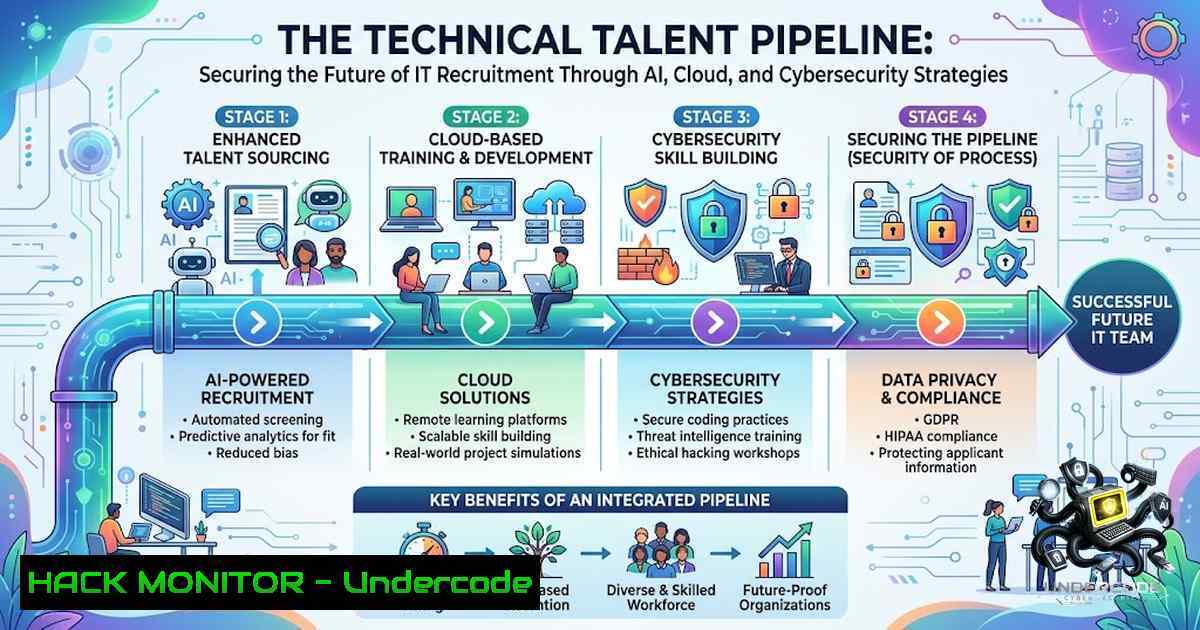
In the rapidly evolving landscape of cybersecurity and IT infrastructure, the acquisition of specialized technical talent has become a critical vulnerability and a strategic asset. The intersection of recruitment and cybersecurity is not merely about filling positions but about ensuring that the individuals who manage, secure, and develop digital assets possess the requisite skills to mitigate modern threats. As organizations migrate to cloud-1ative architectures and embrace artificial intelligence, the role of a Talent Acquisition Specialist transcends traditional HR functions, evolving into a technical gatekeeper who must comprehend the nuances of DevSecOps, zero-trust frameworks, and AI-driven security operations.
Learning Objectives & Secrets:
- Objective 1: Master the Art of Technical Credential Verification. Beyond checking certificates, implement a “white-box” interview technique where candidates are asked to explain real-world vulnerability remediation (e.g., patching a CVE in a production environment) to assess practical knowledge over theoretical memory.
- Objective 2 Secret Tip: Predictive Analytics for Retention. Utilize Python or R scripts to analyze historical hiring data and predict candidate churn based on salary benchmarks, project type, and tech stack. This allows for proactive salary adjustments and project allocation before the candidate becomes a flight risk.
- Objective 3 Secret Tip: The “Shadow Sourcing” Strategy. To source passive candidates for cybersecurity roles, monitor public bug bounty platforms (e.g., HackerOne, Bugcrowd). Identify top performers who are not actively applying but are demonstrating technical prowess, and create outreach campaigns based on their specific exploit discoveries.
You Should Know:
- Building a Secure and Automated Recruitment Pipeline with SOC 2 Compliance
The recruitment process involves the storage and transmission of highly sensitive personally identifiable information (PII) and proprietary technical assessments. Ensuring this data is secure is paramount to avoid data breaches that could cripple an organization.
To secure this pipeline, organizations must adopt a DevSecOps approach to their HR tech stack. This involves implementing Role-Based Access Control (RBAC) for all recruitment platforms, enforcing Multi-Factor Authentication (MFA) for all HR personnel, and ensuring that the Applicant Tracking System (ATS) is SOC 2 Type II compliant.
Step‑by‑step guide to secure the recruitment pipeline:
- Assess Current Infrastructure: Run a vulnerability scan against your recruitment portals using `Nmap` to identify open ports and exposed services.
Command: `nmap -sV -p- -T4 recruitment-portal.company.com`
- Implement API Security: Ensure that all third-party APIs (e.g., LinkedIn, job boards) used for sourcing are authenticated using OAuth 2.0 and have IP whitelisting enabled.
- Data Encryption at Rest: Ensure all resumes and personal data are encrypted at rest using AES-256. In AWS, this is managed via KMS.
Command (AWS CLI): `aws kms encrypt –key-id alias/recruitment-key –plaintext fileb://resume.txt –output text –query CiphertextBlob > resume.encrypted`
4. Monitor Access Logs: Set up a Security Information and Event Management (SIEM) system to monitor for unusual access patterns to the recruitment database. -
Automating Resume Screening Using AI and Natural Language Processing
Manual resume screening is inefficient and prone to human bias. Organizations are now leveraging Machine Learning models to filter candidates based on semantic similarity to job descriptions. A specialized model can be fine-tuned to recognize specific cybersecurity keywords (e.g., “SIEM,” “EDR,” “Zero Trust”) and rank candidates based on a weighted skill matrix.
To deploy such a system, a Python environment with specific libraries is required. The following script demonstrates how to calculate the cosine similarity between a job description and a candidate’s resume to generate a match score.
Step‑by‑step guide for AI-powered screening:
1. Set up the Environment:
Command: `pip install scikit-learn nltk pandas`
- Load the Data: Place job descriptions and resumes into a structured dataframe using
pandas. -
Text Preprocessing: Clean the text by removing stop words and tokenizing.
import pandas as pd
from sklearn.feature_extraction.text import TfidfVectorizer
from sklearn.metrics.pairwise import cosine_similarity

Sample job description (Cybersecurity focus)
job_desc = "Looking for a Security Engineer with expertise in AWS, IAM, and Threat Detection."
resumes = ["Experience in Azure, Python, and Log Analysis.", "5 years in AWS Security, SIEM implementation, and Pen Testing."]</p></li>
</ol>

<p>vectorizer = TfidfVectorizer().fit_transform([bash] + resumes)
vectors = vectorizer.toarray()
 Calculate cosine similarity between first element (job) and rest
cosine_sim = cosine_similarity(vectors[0:1], vectors[1:])
print(f"Match Score: {cosine_sim}")
4. Interpret Results: Resumes with a high cosine similarity (>0.7) should be prioritized for the initial screening.
3. Hardening Cloud Environments for Technical Assessments
Many technical roles require candidates to complete coding or infrastructure challenges. If these assessments are hosted in the cloud (e.g., AWS), they present a significant attack surface. A misconfigured S3 bucket containing assessment source code or a vulnerable EC2 instance hosting a test environment can lead to a full compromise.
To mitigate this, the “Principle of Least Privilege” must be strictly enforced. The following AWS CLI command ensures that an S3 bucket used for storing technical tests is not publicly accessible.Step‑by‑step guide to cloud hardening:
1. Identify Public Buckets:
Command (AWS CLI): `aws s3api list-buckets –query “Buckets[?PublicAccessBlockConfiguration==null]”`
2. Block Public Access:
Command: `aws s3api put-public-access-block –bucket tech-assessment-bucket –public-access-block-configuration BlockPublicAcls=true,IgnorePublicAcls=true,BlockPublicPolicy=true,RestrictPublicBuckets=true`
- Set Lifecycle Policies: Automatically delete the assessment environment after 48 hours to reduce the attack surface.
Command (Windows PowerShell for Azure): `Set-AzStorageContainer -1ame “assessment” -Permission Off`
4. Vulnerability Exploitation and Mitigation in Candidate Evaluation
To truly assess a candidate’s ability, some recruiters are incorporating “Capture The Flag” (CTF) challenges that simulate real-world attack scenarios. However, these challenges must be sandboxed to prevent the candidate from exploiting the host system.
A common vulnerability to simulate is the Log4Shell exploit (CVE-2021-44228). A candidate can be given a vulnerable application and asked to exploit it, but the sandbox must be configured to prevent outbound LDAP requests.
Step‑by‑step guide to setting up a secure CTF environment:
1. Isolate the Network: Use Docker to containerize the vulnerable application.Command: `docker run –1etwork none -p 8080:8080 vulnerable-app:log4j`
- Monitor Exploitation Attempts: Use a packet sniffer to see if the candidate attempts to exploit the vulnerability.
Command: `sudo tcpdump -i any port 1389 -vv` (Port 1389 is used for LDAP). - Mitigation Strategy: The candidate’s final task should be to patch the vulnerability. This is done by updating the affected library.
Command (Linux): `sudo yum update log4j` or `sudo apt-get install –only-upgrade log4j` - API Security and Data Protection in Internal HR Systems
The integration between the company’s HR system and external job portals relies heavily on Application Programming Interfaces (APIs). If these APIs are not secured, an attacker could scrape data, inject false candidate profiles, or steal sensitive employee data.
Implementing a robust API gateway with rate limiting and JWT (JSON Web Token) validation is essential.
Step‑by‑step guide to securing recruitment APIs:
- Check API Key Exposure: Use `git-secrets` to scan repositories for accidentally committed API keys.
Command: `git secrets –scan-history`
- Implement Rate Limiting: In a Linux environment, use Nginx to limit requests.
location /api/recruitment { limit_req zone=one burst=5; proxy_pass http://backend_hr; } - Validate JWT Tokens: Ensure all incoming requests have a valid signature. This can be tested using
curl.
Command: `curl -X POST -H “Authorization: Bearer” https://api.company.com/candidate` (Expected result: 403 Forbidden)
6. Training Courses and Certifications for Talent Acquisition Teams
To effectively recruit for AI and Cybersecurity roles, the Talent Acquisition team must speak the language of the engineers. Investing in courses such as CompTIA Security+, Certified Ethical Hacker (CEH), or AWS Cloud Practitioner for recruiters can drastically improve the quality of hire.
The following commands demonstrate how a recruiter can set up a local lab to understand basic networking, which helps in vetting IT Support and DevOps candidates.
Step‑by‑step guide to setting up a recruiter’s tech lab:
1. Install VirtualBox (Windows/Linux): Create a VM to simulate a candidate’s environment.2. Test Network Connectivity:
Command (Windows): `ping 8.8.8.8
</h2>curl -I https://www.linkedin.com` (To check HTTP response headers).
Command (Linux): - Run a Port Scan (Ethical): Use `Netstat` to see active connections on your own PC to understand the terminology candidates use.
Command (Windows): `netstat -an`
What Undercode Say:
- Key Takeaway 1: Recruitment is no longer a human-only function. Integrating AI to screen candidates is a force multiplier, allowing specialists to focus on high-value interactions and strategic hiring.
- Key Takeaway 2: The security of the recruitment pipeline is as important as the security of the production environment. A breach in the HR system is a direct path to corporate espionage.
Prediction:
- +1: Organizations that adopt AI-driven talent intelligence platforms will reduce time-to-hire by up to 40% and increase retention rates through better candidate-job alignment over the next two years.
- -1: The reliance on AI for screening introduces a significant risk of algorithmic bias, potentially leading to discrimination lawsuits and the exclusion of qualified candidates from non-traditional backgrounds.
- -1: As recruitment data becomes more valuable, it will become a primary target for ransomware groups, forcing HR departments to invest heavily in cyber insurance and incident response plans, driving up operational costs.
- +1: The role of the Talent Acquisition Specialist will evolve into a hybrid “Talent Security Architect,” blending technical knowledge with recruitment acumen, creating a new, highly lucrative career path in the cybersecurity industry.
- +1: The integration of practical CTF challenges in the interview process will standardize skill assessment, leading to a more competent and secure global IT workforce.
▶️ Related Video (76% Match):
🎯Let’s Practice For Free:
🎓 Live Courses & Certifications:
Join Undercode Academy for Verified Certifications
🚀 Request a Custom Project:
Secure, high-velocity infrastructure and disruptive technological engineering. Contact our engineering team for high-tier development and proprietary systems:
[email protected]
💎 Smart Architecture | 🛡️ Secure by Design | ⭐ Trusted by ThousandsIT/Security Reporter URL:
Reported By: https://lnkd.in/p/eS55Jc6h – Hackers Feeds
Extra Hub: Undercode MoN
Basic Verification: Pass ✅🔐JOIN OUR CYBER WORLD [ CVE News • HackMonitor • UndercodeNews ]
📢 Follow UndercodeTesting & Stay Tuned:
- Set Lifecycle Policies: Automatically delete the assessment environment after 48 hours to reduce the attack surface.


