Listen to this Post
Introduction:
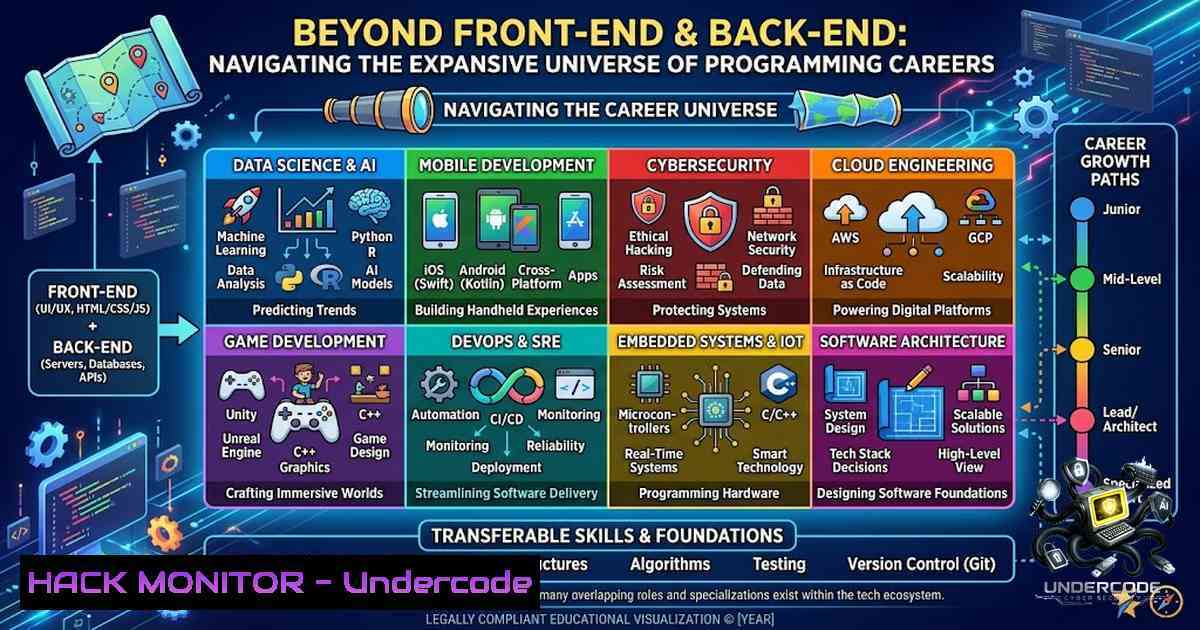
The common misconception that programming is limited to Front-End and Back-End web development severely underestimates the field’s vast potential. In reality, software development today encompasses a multidisciplinary spectrum ranging from artificial intelligence to embedded systems, each with distinct toolchains, threat models, and problem-solving paradigms. Choosing a career path is less about learning a single language and more about aligning with a specific problem domain and understanding its unique technical architecture.
Learning Objectives:
- Identify and differentiate between 10 distinct programming career paths and their core technologies.
- Evaluate the security, infrastructure, and data implications unique to each domain.
- Understand the foundational command-line tools and frameworks associated with modern development roles.
You Should Know:
1. Web Development & The Full-Stack Reality
Modern web development has evolved beyond simple HTML/CSS. Front-End development now involves complex state management (React, Vue, Angular) and build tools (Webpack, Vite), while Back-End focuses on API design, authentication, and database optimization. However, the “Full-Stack” title often requires knowledge of deployment, containerization, and cloud services.
Step‑by‑step: Setting up a Basic Full-Stack Environment
- Linux/macOS: `curl -o- https://raw.githubusercontent.com/nvm-sh/nvm/v0.39.0/install.sh | bash` (Install Node Version Manager).
- Windows: Download and install Node.js from the official website. Use PowerShell to verify:
node -v. - Backend Setup: Create a simple Express server.
mkdir backend && cd backend && npm init -y && npm install express. - Database: Run a local MongoDB instance via Docker:
docker run --1ame mongodb -d -p 27017:27017 mongo. - Security Check: Always use environment variables for database credentials. `npm install dotenv` and create a `.env` file. Never commit this file to Git.
2. Artificial Intelligence & Machine Learning Infrastructure
AI/ML is not just about Jupyter notebooks. Production-grade AI requires understanding of data pipelines, model versioning, and GPU acceleration. Security in AI involves protecting against data poisoning and adversarial attacks. Engineers must manage large datasets and complex dependency chains.
Step‑by‑step: Initializing an ML Project with Security in Mind
– Linux: python3 -m venv ml_env && source ml_env/bin/activate.
– Windows: `python -m venv ml_env` and ml_env\Scripts\activate.
– Install Libraries: pip install tensorflow pandas numpy scikit-learn.
– Data Validation: Use `pandas-profiling` to inspect data for anomalies before training.
– Model Security: Install `art` (Adversarial Robustness Toolbox) to test against evasion attacks: pip install adversarial-robustness-toolbox.
– Versioning: Initialize DVC (Data Version Control) to track datasets: `dvc init` and dvc add data/.
3. Cybersecurity & Ethical Hacking
This field focuses on offensive and defensive strategies, including vulnerability assessment, penetration testing, and security operations. It requires mastery of networking protocols, operating system internals, and reverse engineering. The primary goal is to identify weaknesses before malicious actors exploit them.
Step‑by‑step: Basic Network Reconnaissance (Linux/Windows)
- Linux (Kali): `netdiscover -r 192.168.1.0/24` (Identify live hosts on the network).
- Windows (PowerShell): `Test-1etConnection -ComputerName 8.8.8.8 -Port 80` (Test connectivity and port status).
- Port Scanning: `nmap -sV -p- 192.168.1.10` (Service and version detection). Use `-T4` for faster scanning.
- Vulnerability Scanning: `nikto -h http://example.com` (Web server scanning).
– Mitigation: Regularly update firewall rules: `sudo ufw allow from 192.168.1.0/24 to any port 22` (Linux UFW). - Windows Firewall:
netsh advfirewall firewall add rule name="Allow SSH" dir=in action=allow protocol=TCP localport=22.
4. Cloud & DevOps Engineering
DevOps bridges development and operations, emphasizing automation, CI/CD pipelines, and infrastructure as code (IaC). Security (DevSecOps) is integrated early in the lifecycle. Engineers work with tools like Kubernetes, Terraform, and Jenkins to manage scalable infrastructures.
Step‑by‑step: Hardening a Kubernetes Cluster
- Linux/macOS: Install `kubectl` and `k3d` for a local cluster:
curl -s https://raw.githubusercontent.com/k3d-io/k3d/main/install.sh | bash. - Deploy Application:
kubectl create deployment nginx --image=nginx. - Security Context: Apply a security policy to run containers as non-root: Add `securityContext: runAsNonRoot: true` to your pod spec.
- Network Policy: `kubectl apply -f network-policy.yaml` (restrict ingress/egress traffic).
- Secrets Management: Store sensitive data using `kubectl create secret generic db-secret –from-literal=password=’S3cur3!’` (avoid storing in Dockerfiles).
5. Game Development & Graphics Programming
Game development is highly specialized, requiring knowledge of linear algebra, physics simulation, and rendering pipelines. Unreal Engine (C++) and Unity (C) dominate the industry. Performance optimization and memory management are critical. Security concerns include anti-cheat mechanisms and server-side validation.
Step‑by‑step: Building a Simple Game Loop (Unity)
- Installation: Download Unity Hub and install the latest LTS version.
- New Project: Create a 3D Core project.
- Scripting: `sudo apt install mono-complete` (Linux) or install Visual Studio (Windows).
- Basic Movement: Write a `C` script attached to a GameObject to handle `Update()` and
FixedUpdate(). - Optimization: Use the Profiler (Window -> Analysis -> Profiler) to identify bottlenecks.
- Security: For online games, never trust the client. Validate all player actions server-side using a dedicated game server.
6. Blockchain & Web3 Development
Web3 focuses on decentralized applications (dApps) and smart contracts, primarily using Solidity. The ecosystem relies heavily on cryptographic principles. Security is paramount due to the immutability of blockchain records and the prevalence of smart contract vulnerabilities.
Step‑by‑step: Creating a Secure Smart Contract
- Linux/macOS: `npm install -g truffle` and
npm install -g ganache-cli. - Windows: Same via PowerShell (ensure Node.js is installed).
- Write Contract: Create `MyContract.sol` with
pragma solidity ^0.8.0. - Security Check: Use `OpenZeppelin` libraries for standard functions:
npm install @openzeppelin/contracts. - Testing: `truffle test` runs local tests. Use `ganache-cli` to simulate a blockchain.
- Mitigation: Add `require()` statements to check conditions and prevent re-entrancy attacks by updating state before transferring funds.
What Undercode Say:
- Key Takeaway 1: The specialization you choose dictates your technical arsenal. A Full-Stack developer lives in the HTTP layer, while a DevOps engineer governs infrastructure, and a Game Developer optimizes for frame rates. Your career path is defined by the problems you want to solve.
- Key Takeaway 2: Regardless of the path, foundational IT knowledge—network fundamentals (TCP/IP, DNS), operating system commands, and cloud concepts—remains a universal requirement for building scalable and secure systems.
Analysis: The post highlights a critical truth: newcomers are often overwhelmed by the sheer volume of fields. This analysis reveals that the industry is not hierarchical; each domain requires distinct skills and offers unique challenges. The shift toward AI and cybersecurity reflects current market demands, driven by data proliferation and threat evolution. Furthermore, the increasing integration of DevOps into all domains suggests that the ability to deploy and maintain code is no longer optional. Finally, the emphasis on “value creation” implies that soft skills and problem-solving are as important as coding ability, encouraging developers to move beyond syntax to system design and user impact.
Prediction:
- +1 The intersection of AI and Cybersecurity (AI Security) will become the most lucrative and in-demand sub-domain, with a projected shortage of skilled professionals.
- +1 Low-code and no-code platforms will not replace developers but will shift their focus toward architecture and complex integration tasks, emphasizing the “Systems & Software Engineering” path.
- +1 Edge computing and the expansion of IoT will drive demand for Embedded Systems and specialists in Rust and C++.
- -1 The rapid evolution of AI could outpace current educational curricula, creating a skills gap in machine learning operations (MLOps).
- -1 Increasing cloud complexity and reliance on third-party APIs will expand the attack surface, requiring developers in all fields to adopt “Shift-Left” security practices (security earlier in the development cycle).
▶️ Related Video (86% Match):
🎯Let’s Practice For Free:
🎓 Live Courses & Certifications:
Join Undercode Academy for Verified Certifications
🚀 Request a Custom Project:
Secure, high-velocity infrastructure and disruptive technological engineering. Contact our engineering team for high-tier development and proprietary systems:
[email protected]
💎 Smart Architecture | 🛡️ Secure by Design | ⭐ Trusted by Thousands
IT/Security Reporter URL:
Reported By: https://lnkd.in/p/ebrFCAiV – Hackers Feeds
Extra Hub: Undercode MoN
Basic Verification: Pass ✅


