Listen to this Post
Introduction:
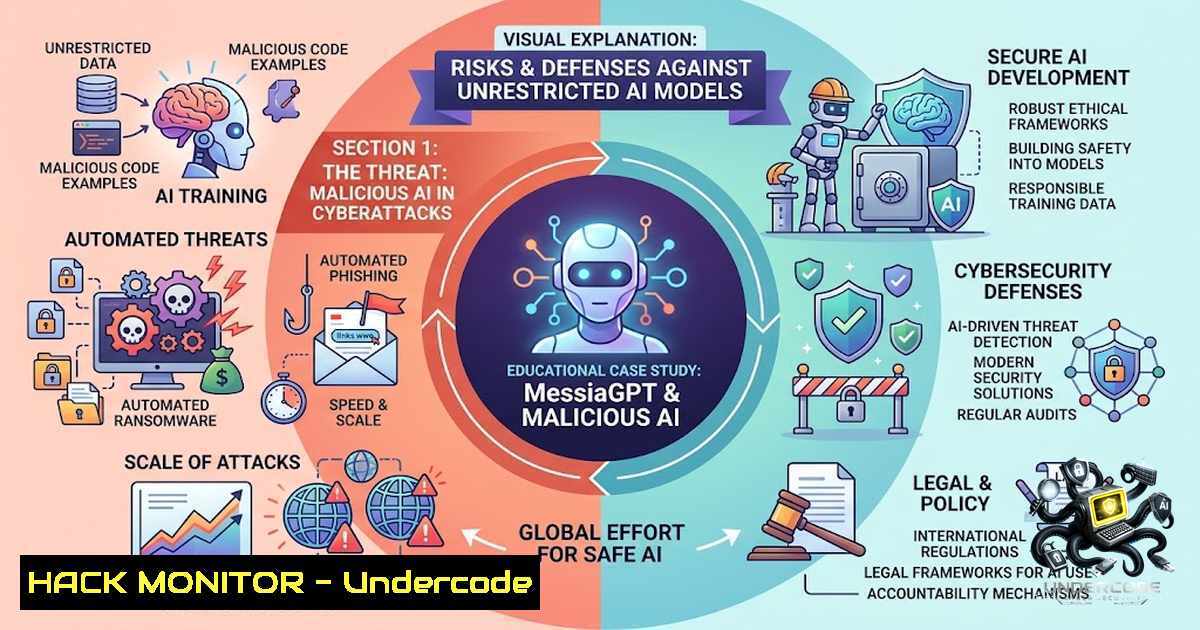
A newly surfaced criminal AI service called MessiahGPT is being openly marketed on BreachForums as a purpose-built offensive model that writes ransomware, phishing kits, stealers, crypters, and rootkits on demand, according to findings published by the Trellix Advanced Research Center. Unlike mainstream generative AI models that incorporate safety guardrails through Reinforcement Learning from Human Feedback (RLHF) and Constitutional AI layers, MessiahGPT is advertised as having zero ethical constraints—trained from scratch with no internal filters for harm or illegality. The service runs a live platform at messiahgpt[.]de alongside an active Telegram community, and its operators are not being subtle about who they are selling to. This development represents a significant evolution in the commoditization of cybercrime, where uncensored AI-as-a-service has evolved from informal Telegram bots into dedicated platforms with versioned websites, demo channels, and tiered pricing.
Learning Objectives:
- Understand the technical architecture and operational model of MessiahGPT, including its Mixture-of-Experts design and zero-safety-guardrail training approach
- Learn to detect and mitigate AI-generated phishing lures, ransomware variants, and social engineering attacks using signature-based and behavioral analysis techniques
- Implement practical defensive controls including egress filtering, DNS monitoring, and YARA rule deployment to protect enterprise environments from machine-generated threats
You Should Know:
1. Technical Architecture and Training Methodology
MessiahGPT is operated by the Dabial Leaks cybercrime group, a threat community historically associated with database sharing, digital disruption, and collaboration with hacktivist entities. The platform operates on a custom 128-expert Mixture of Experts (MoE) architecture with 16 experts active per token, featuring zero safety guardrails or ethical filtering. The advertised training corpus reads like a catalog of everything mainstream labs filter out: unrestricted manuals, dark web archives, leaked documentation, and raw internet scrapes with no post-filtering applied. None of these technical claims can be independently verified from outside the platform, and researchers are careful to say so. However, what is verifiable is that the service is live, reachable, and being promoted on one of the most trafficked criminal forums on the internet.
The commercial model is aggressively low-friction. MessiahGPT offers 50 free queries with no registration at all, letting prospective buyers test output quality before spending anything. Paid plans start at roughly $8 per month, payable only in cryptocurrency with no KYC checks. That price point matters more than it might appear. For under the cost of a streaming subscription, a low-skilled actor gains a tool that will reportedly produce complete, compilable malware and ready-to-deploy phishing kits—capability that previously required either genuine development skill or a relationship with a malware-as-a-service vendor.
2. Capabilities and Attack Vector Expansion
The use cases listed in the advertisement are explicit rather than euphemistic. Alongside ransomware and phishing kit generation, the operator promotes social engineering scripts, fraud and carding guides, data breach exploitation, physical attack planning, and chemical and explosive synthesis. The listing even includes a benchmark comparison table pitting MessiahGPT against ChatGPT-4o, DeepSeek-V3, and Mistral-Large, positioning itself as the only model that returns usable output across every category the others refuse. That framing is a strong signal about the audience: these are buyers who have already hit refusal walls on commercial platforms and are shopping specifically for a model without them.
Threat actors leverage the ecosystem across multiple attack stages, from parsing leaked database dumps to generating compilable ransomware. The platform offers a tiered model structure: JinnatGPT (Free Tier) for writing fundamental administrative scripts, ParaohaGPT (Pro Tier) for deep reasoning and multi-file code review, and MessiahGPT 2.0 (Team and Enterprise Tier) featuring deep reasoning chains, real-time web scrapers, and document analysis capabilities designed to ingest massive datasets. By lowering the barrier to entry for complex scripting, this structured software-as-a-service model ensures that amateur actors can easily scale their attacks, while sophisticated actors can automate the weaponization pipeline without standard commercial AI filters blockading their progress.
3. Detection and Mitigation Strategies for AI-Generated Threats
Traditional signature-based detection and template-matching phishing filters are rapidly diminishing in effectiveness against machine-generated variations. Security teams must adopt a multi-layered defensive approach. Here are practical detection and mitigation commands for Linux and Windows environments:
Linux: Monitor for Suspicious Email Patterns
 Monitor mail logs for phishing indicators
grep -E "urgent|verify|account|suspended|invoice" /var/log/mail.log | \
awk '{print $1, $2, $3, $9}' | sort | uniq -c | sort -1r

Analyze email headers for anomalies
cat /var/spool/mail/ | grep -E "^From:|^Subject:|^Date:" | head -50

Check for suspicious attachments
find /tmp -type f ( -1ame ".pdf" -o -1ame ".docx" -o -1ame ".zip" ) | \
while read file; do file "$file"; done
Linux: Block MessiahGPT Domain via Hosts File and IPTables
 Block domain via /etc/hosts
echo "127.0.0.1 messiahgpt.de" >> /etc/hosts
echo "127.0.0.1 www.messiahgpt.de" >> /etc/hosts

Block via iptables (drop all traffic to/from domain IP - resolve first)
sudo iptables -A OUTPUT -d <resolved_ip> -j DROP
sudo iptables -A INPUT -s <resolved_ip> -j DROP

Set default policy to deny all, then allow required services
sudo iptables -P INPUT DROP
sudo iptables -P FORWARD DROP
sudo iptables -P OUTPUT DROP
sudo iptables -A INPUT -p tcp --dport 22 -j ACCEPT  SSH
sudo iptables -A INPUT -p tcp --dport 443 -j ACCEPT  HTTPS
Windows: Block Domain via Hosts File and Firewall
 Edit C:\Windows\System32\drivers\etc\hosts as Administrator
echo 127.0.0.1 messiahgpt.de >> C:\Windows\System32\drivers\etc\hosts

Block via Windows Defender Firewall with Advanced Security
netsh advfirewall firewall add rule name="Block MessiahGPT" dir=out action=block remoteip=<resolved_ip>
netsh advfirewall firewall add rule name="Block MessiahGPT Domain" dir=out action=block remoteip=0.0.0.0/0 protocol=any
4. YARA Rules for AI-Generated Malware Detection
Deploying YARA rules can help identify patterns associated with AI-generated malware. While specific MessiahGPT signatures are still emerging, here is a template rule for detecting suspicious AI-generated code patterns:
rule AI_Generated_Malware_Suspicious {
meta:
description = "Detects suspicious patterns commonly found in AI-generated malware"
author = "Security Team"
date = "2026-08-16"
strings:
$ai_pattern1 = /(ransomware|encrypt|decrypt|phishing|stealer|crypter|rootkit)/ nocase
$ai_pattern2 = /(import\s+os|import\s+sys|import\s+subprocess|import\s+socket)/
$ai_pattern3 = /(base64|b64decode|b64encode|xor|AES|RSA)/
$ai_pattern4 = "requests.get"
$ai_pattern5 = "urllib.request"
condition:
uint16(0) == 0x5A4D or uint32(0) == 0x464C457F and
(ai_pattern1 >= 3 and ai_pattern2 >= 2 and (ai_pattern3 >= 2 or ai_pattern4 or ai_pattern5))
}
5. DNS Monitoring and Egress Controls
Defenders must implement strict egress controls blocking messiahgpt.de and actively monitor DNS queries linked to known dark AI domains. Here are practical monitoring commands:
 Monitor DNS queries for malicious domains in real-time
sudo tcpdump -i any -1 port 53 | grep -E "messiahgpt|darkgpt"

Query DNS logs for suspicious lookups
grep -E "messiahgpt|darkgpt" /var/log/syslog | grep -i "query"

Use dig to verify domain resolution and block accordingly
dig messiahgpt.de +short

Monitor outbound connections to known malicious IPs
sudo netstat -tunap | grep ESTABLISHED | awk '{print $5}' | cut -d: -f1 | sort -u
- Broader Ecosystem: DarkGPT and the Uncensored AI Marketplace
MessiahGPT is not operating in isolation. Trellix also tracked DarkGPT, a persistently advertised uncensored AI service circulating across multiple Russian-language Telegram channels, which offers bot access with three free queries before paid tiers kick in. Its marketing openly promises full freedom to write malicious code and exploits without restrictions, custom hacker scripts tailored to the buyer, real-time “instant hacks” for complex scenarios, a 24/7 assistant, access to a hacker community, and what the advertisement literally brands as “BlackHat AI uncensored power for darknet projects”. Whether DarkGPT is a genuinely fine-tuned local model or simply a jailbroken wrapper around a public LLM cannot be verified externally. What the repeated reposting across channels does indicate is durable demand: the operators are still spending on promotion, which suggests the revenue justifies it. Between DarkGPT’s staying power and MessiahGPT’s custom-model ambitions, uncensored AI has become a standing product category.
What Undercode Say:
- Key Takeaway 1: MessiahGPT represents a fundamental shift in the cybercrime landscape—the democratization of advanced offensive capabilities. For less than the cost of a streaming subscription, individuals with zero coding experience can now generate compilable ransomware, deployable phishing kits, and sophisticated social engineering scripts. This lowers the barrier to entry so dramatically that we can expect a surge in opportunistic attacks from a broader and more diverse pool of actors. The traditional assumption that sophisticated attacks require sophisticated skills is no longer valid.
-
Key Takeaway 2: Traditional signature-based detection and template-matching defenses are rapidly becoming obsolete against AI-generated threats. The machine-generated variations of phishing lures, ransomware variants, and social engineering scripts will overwhelm conventional security tools. Organizations must invest in behavioral analysis, anomaly detection, and AI-powered defensive systems that can identify malicious patterns rather than specific signatures. Egress filtering, DNS monitoring, and proactive threat hunting are no longer optional—they are essential components of a modern security posture.
Analysis: The emergence of MessiahGPT and similar uncensored AI services marks a pivotal moment in cybersecurity. What began as isolated jailbreak attempts on mainstream LLMs has evolved into a mature underground economy with tiered pricing, free trials, and dedicated infrastructure. The 3,800% increase in dark web forum mentions of AI hacking tools from late 2025 to early 2026 underscores the velocity of this trend. The implications are profound: security teams can no longer rely on the technical incompetence of attackers as a defensive assumption. AI-generated phishing emails will lack the grammatical errors and awkward phrasing that traditionally flagged them as suspicious. AI-generated malware will bypass signature-based antivirus through endless variation. The arms race has entered a new phase where both sides leverage generative AI—offenders to automate and scale attacks, defenders to detect and respond at machine speed. Organizations that fail to adapt will find themselves overwhelmed by the sheer volume and sophistication of AI-augmented threats. The window for proactive defense is closing rapidly.
Prediction:
- -1 The commoditization of uncensored AI tools like MessiahGPT will trigger a significant surge in ransomware and phishing attacks against small and medium-sized businesses that lack the resources to deploy advanced AI-powered defenses. The low cost of entry ($8/month) means attackers can operate with minimal financial risk while maximizing potential returns.
-
-1 Traditional cybersecurity frameworks that rely on signature-based detection and human-led incident response will become increasingly ineffective against machine-generated threats, forcing organizations to undergo costly and time-consuming security transformations.
-
+1 The visibility and publicity surrounding MessiahGPT will accelerate investment in AI-driven defensive technologies, including behavioral analysis, anomaly detection, and automated threat hunting platforms that can match machine-speed attacks with machine-speed responses.
-
+1 Security researchers and threat intelligence communities will develop new detection methodologies, YARA rules, and defensive frameworks specifically designed to counter AI-generated malware, creating a new specialized subfield within cybersecurity.
-
-1 The normalization of uncensored AI as a product category on underground forums will inspire copycat services and further fragmentation of the criminal AI ecosystem, making it increasingly difficult for law enforcement and security teams to track and disrupt these operations.
-
-1 The explicit promotion of physical attack planning and chemical/explosive synthesis capabilities represents an escalation beyond traditional cybercrime, potentially blurring the lines between cyber and physical threats in ways that demand coordinated response from both cybersecurity and law enforcement communities.
▶️ Related Video (78% Match):
https://www.youtube.com/watch?v=0tHb6U2604g
🎯Let’s Practice For Free:
🎓 Live Courses & Certifications:
Join Undercode Academy for Verified Certifications
🚀 Request a Custom Project:
Secure, high-velocity infrastructure and disruptive technological engineering. Contact our engineering team for high-tier development and proprietary systems:
[email protected]
💎 Smart Architecture | 🛡️ Secure by Design | ⭐ Trusted by Thousands
IT/Security Reporter URL:
Reported By: https://lnkd.in/p/eaDQhQcH – Hackers Feeds
Extra Hub: Undercode MoN
Basic Verification: Pass ✅


