Listen to this Post
Introduction:
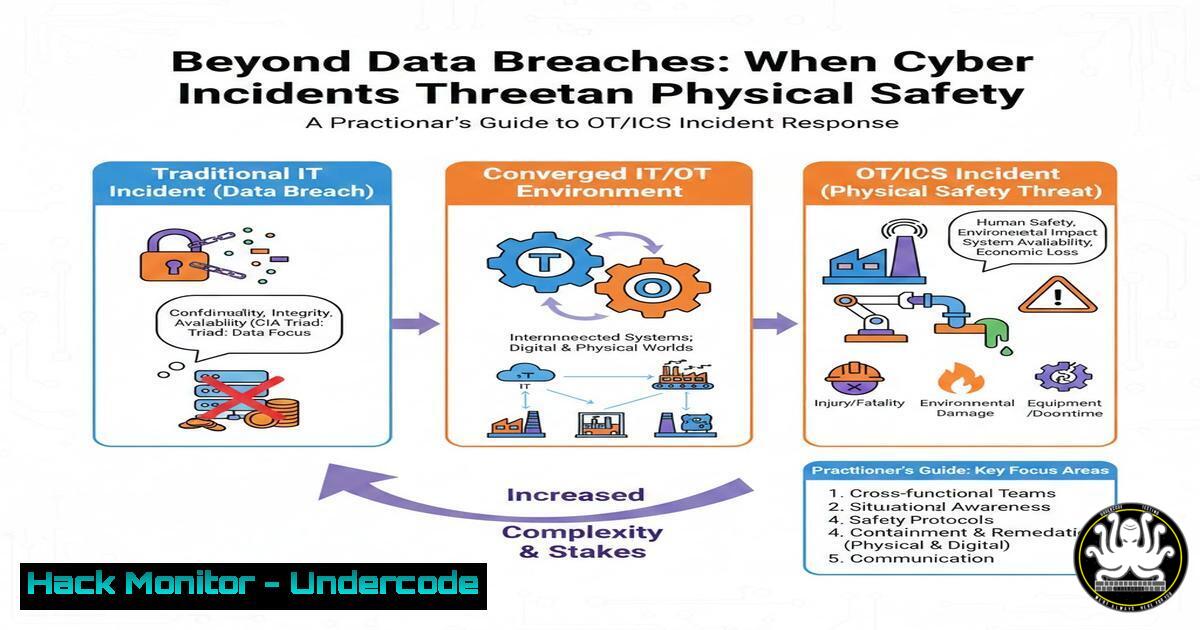
In the realm of Information Technology (IT), a cyber incident typically equates to data compromise, financial loss, and reputational damage. However, in the world of Operational Technology (OT) and Industrial Control Systems (ICS), which govern critical infrastructure like power grids, water treatment plants, and manufacturing lines, a cyber incident carries a starkly different weight. Here, a breach can directly disrupt physical processes, endanger human safety, and cause environmental catastrophe. Traditional IT-centric incident response protocols, focused on rapid containment and system wiping, are not just ineffective but dangerously counterproductive in environments where operational stability and safety are the supreme imperatives.
Learning Objectives:
- Understand the fundamental philosophical and practical divergences between IT and OT incident response.
- Learn the critical first steps for containing an OT incident without triggering unsafe process shutdowns.
- Develop a framework for cross-functional coordination between IT, OT, engineering, and safety teams during a crisis.
You Should Know:
- The Golden Rule: Safety and Stability Over Everything
The cardinal rule in OT incident response is that human safety and process integrity outweigh every other consideration. A compromised engineering workstation must not be disconnected if it is actively controlling a chemical reaction at high temperature and pressure. An immediate “patch and reboot” mandate could cause a turbine to overspeed or a pipeline pressure to exceed safe limits.
Step‑by‑step guide explaining what this does and how to use it.
1. Immediate Triage with Operations: Upon detection, the first call is not to the CISO but to the control room supervisor or lead engineer. The question is: “What physical process is this asset controlling, and what is its current state?”
2. Risk Assessment: Determine if the compromised system is part of a Safety Instrumented System (SIS). If so, any intervention must be pre-approved and potentially involve a full process shutdown under controlled, safe conditions.
3. Containment via Network Segmentation (Logical): Instead of pulling the plug, enact pre-defined network containment playbooks. Use existing firewall or industrial DMZ rules to isolate the segment.
Example Command (Industrial Firewall): `configure policy rule-base intrazone add rule 1 source
This rule isolates the asset within its own zone, preventing lateral movement while allowing operators to maintain visibility and control for a safe manual override.
2. Evidence Collection in a 24/7 Environment
Forensic imaging of a server in IT often means taking it offline for hours. In OT, the historian server collecting process data may be critical for regulatory compliance and operational trending. You cannot simply shut it down.
Step‑by‑step guide explaining what this does and how to use it.
1. Live Memory Acquisition: Use specialized, validated tools that can capture RAM from Windows-based OT assets (e.g., HMI, engineering workstation) with minimal footprint.
Example Tool/Command: Using `FTK Imager` in a pre-approved portable USB kit: `ftkimager –logfile C:\Evidence\memlog.txt \\.\PhysicalMemory C:\Evidence\memdump.mem`
2. Network Forensics: Capture traffic from critical choke points (e.g., between Cell/Area Zone and Process Control Zone). Use mirrors/SPAN ports.
Example Wireshark Filter for ICS Protocols: `scada or modbus or dnp3 or opcua` – This filters capture to common industrial protocols, helping identify malicious commands.
3. Disk Imaging Alternatives: If a full disk image is impossible, at a minimum, collect volatile data, process memory dumps, and relevant log files (Windows Event logs, application logs) via scripted, read-only methods.
3. Communication Protocols: Speaking the Language of Engineering
Declaring a “SEV-1” incident means nothing to a plant manager. You must translate cyber risk into operational risk.
Step‑by‑step guide explaining what this does and how to use it.
1. Establish a Unified Command Center: Include representatives from: Cybersecurity Team, OT Operations, Process Engineering, Health/Safety/Environment (HSE), Corporate Communications, and Legal.
2. Use a Common Language: Develop and use a joint severity matrix. Instead of “exploit detected,” say, “Adversary has gained the ability to modify setpoints on Boiler 3, posing a potential overpressure risk. Current safety margins are X. Recommended action is Y.”
3. Pre-Approved Communication Templates: Have templates for internal alerts, regulatory bodies (e.g., DHS CISA, NRC), and public statements that are factual, avoid technical jargon, and prioritize public safety assurance.
4. Threat Hunting in Proprietary Environments
You cannot run standard antivirus or EDR tools on a decade-old Windows XP HMI running a proprietary control software suite. Threat hunting must be passive and network-centric.
Step‑by‑step guide explaining what this does and how to use it.
1. Deploy Network Detection Sensors: Use tools like Zeek or specialized OT network monitors (e.g., Nozomi Networks, Claroty) in passive monitoring mode on OT network spans.
2. Analyze for Anomalies: Look for deviations from known-good network baselines.
Example Anomaly: A MODBUS/TCP read request from a human-machine interface (HMI) to a programmable logic controller (PLC) is normal. A MODBUS write command from an asset previously only seen reading is a critical anomaly.
Sample Zeek Log Analysis (Conceptual): Filter connections for `modbus` function codes `05` (Write Single Coil) or `06` (Write Single Register) and flag new source addresses.
3. Validate with Engineering: Before acting on an anomaly, confirm with engineers if the change was part of a scheduled maintenance or process adjustment.
- Recovery and Restoration: The Slow Roll, Not the Fast Reset
IT recovery often uses clean, gold-standard images. OT recovery may require meticulously restoring specific controller logic, historian databases, and configuration files to precise points in time to ensure process synchronization.
Step‑by‑step guide explaining what this does and how to use it.
1. Restore from Verified Backups: Use the plant’s Change Management Database to identify the last known-good configuration and controller program backup.
2. Staged Reintegration: Do not bring all recovered systems online at once.
Step 1: Restore the asset in an isolated test network with a simulated process.
Step 2: Validate functionality and integrity with engineering sign-off.
Step 3: Reintegrate during a planned production window, often with manual oversight for a defined period.
3. Post-Incident “Lesson Learned” with a Twist: The final report must balance technical root cause with an analysis of the response’s impact on safety, production, and equipment wear-and-tear.
What Undercode Say:
- Key Takeaway 1: OT incident response is a multidisciplinary leadership exercise, not a purely technical one. Success is measured by the prevention of harm, not just the eradication of malware. The most critical tool is not a forensic suite but a pre-established, trusted communication channel between the security team and the control room.
- Key Takeaway 2: Technical actions in OT must be subservient to process safety requirements. Containment strategies must leverage network segmentation and passive monitoring because the “default-deny” action of disconnecting a system is often not an option. Forensic rigor must adapt to the imperative of 24/7 operational continuity.
The post and the referenced book underscore a paradigm shift that the industry is still grappling with. While IT security has matured into a largely standardized practice, OT security remains a frontier where engineering judgment must lead. The analysis warns against the “IT-ification” of OT response, where well-intentioned but context-blind technical fixes could precipitate the very physical disasters they aim to prevent. The core challenge is cultural integration—building a shared mental model between two historically siloed professions.
Prediction:
The convergence of IT and OT, accelerated by Industry 4.0 and IIoT, will blur these lines further, increasing attack surfaces. However, the future of OT incident response will not see OT fully adopting IT practices. Instead, we will see the emergence of AI-driven “Process-Aware” security orchestrators. These systems will ingest real-time process data (flow rates, pressures, temperatures) alongside network telemetry. Their primary function will be to predict the physical consequence of a detected cyber anomaly and recommend (or enact) containment actions that maintain processes within safe operating envelopes. The next major evolution will be in simulation—using digital twins to war-game cyber-attacks and response playbooks in a virtual environment, allowing safety-critical procedures to be validated long before a real incident occurs.
▶️ Related Video (78% Match):
🎯Let’s Practice For Free:
IT/Security Reporter URL:
Reported By: Otsecurity Icsincidentresponse – Hackers Feeds
Extra Hub: Undercode MoN
Basic Verification: Pass ✅


