Listen to this Post
Introduction
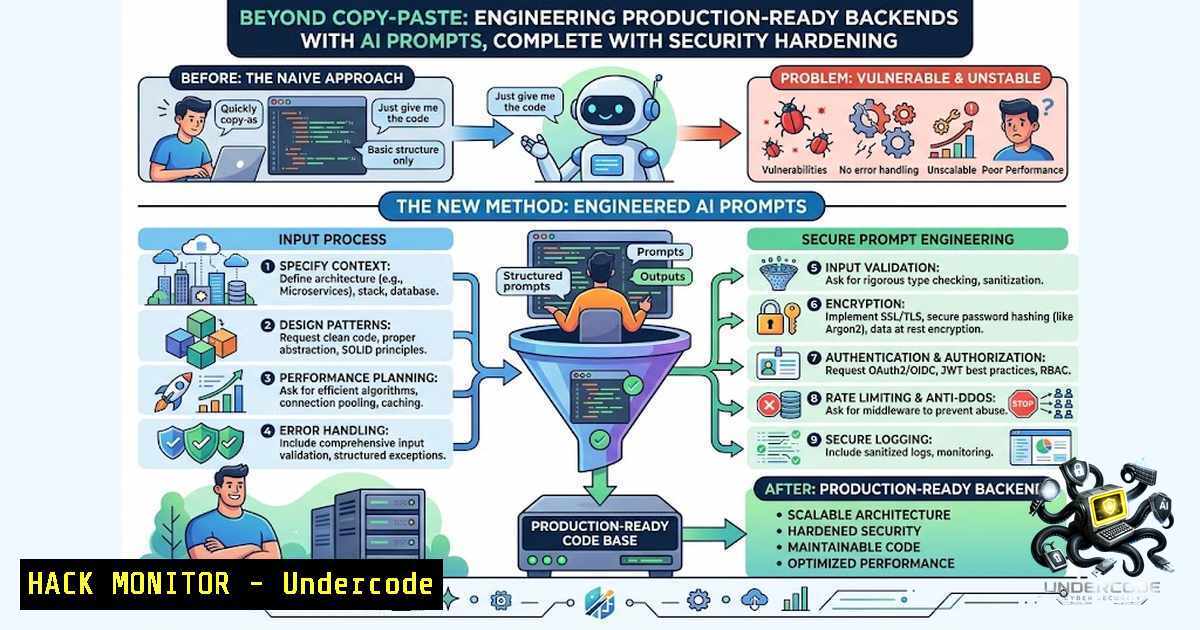
The evolution of backend development is shifting from manual code replication to AI-driven generation, where precise instructions yield consistent, high-quality production systems. Laureano Ivan Vera has released a comprehensive 10-page prompt document designed to generate complete Node.js + Express + TypeScript backends with integrated Redis caching, Supabase database connectivity, and enterprise-grade production disciplines. While this approach accelerates development dramatically, it raises critical questions about security implementation and the boundaries between generated foundations and production-hardened systems.
Learning Objectives & Secrets
- Objective 1: Production-Ready Architecture from Prompt Instructions – Learn how to structure a multi-version API system with `/api/v1/` and `/api/v2/` endpoints from day one, eliminating technical debt associated with versioning retrofits. The prompt enforces TypeScript strict mode, ensuring type safety across all modules.
-
Objective 2: Secret Cache-Aside Pattern with Silent Failure – Implement Redis cache-aside strategy that gracefully degrades when Redis is unavailable, preventing application crashes while maintaining performance. The configuration includes shared rate limiting using Redis Store for multi-instance deployments.
-
Objective 3: Structured Logging and Health Checks Secret – Configure Pino for JSON-structured logging with requestId correlation across distributed systems, alongside comprehensive healthcheck endpoints that verify database connectivity, Redis availability, and upstream service status.
You Should Know
- Understanding the Prompt Engineering Approach to Backend Generation
The core innovation here is replacing traditional boilerplate templates with an AI prompt that captures architectural decisions, security patterns, and production disciplines. Rather than copying code, developers provide the AI with detailed instructions about stack choices, error handling patterns, and operational requirements. This approach generates consistent code every time, adapting to specific project needs while maintaining quality standards.
Step-by-Step Implementation:
- Initialize the Project Structure: Begin with `npm init -y` and install core dependencies: `npm install express typescript @types/node redis @supabase/supabase-js pino pino-pretty jest supertest –save-dev`
- Configure TypeScript Strict Mode: Create `tsconfig.json` with
"strict": true,"noImplicitAny": true, and `”strictNullChecks”: true` to enforce type safety. -
Implement Versioned API Routes: Set up route structures:
// src/routes/v1/index.ts
import { Router } from 'express';
const router = Router();
router.get('/health', healthCheck);
export default router;
4. Configure Redis Cache-Aside Pattern:
// src/cache/redis-client.ts
import Redis from 'ioredis';
const redis = new Redis({ host: process.env.REDIS_HOST, port: 6379 });
export const cacheAside = async (key: string, fetchFn: () => Promise<any>) => {
try {
const cached = await redis.get(key);
if (cached) return JSON.parse(cached);
const data = await fetchFn();
await redis.setex(key, 3600, JSON.stringify(data));
return data;
} catch (error) {
console.warn('Redis unavailable, falling through');
return fetchFn();
}
};
5. Add Structured Logging with Pino:
// src/logger/index.ts
import pino from 'pino';
export const logger = pino({ level: process.env.LOG_LEVEL || 'info' });
// Add requestId middleware
app.use((req, res, next) => {
req.id = crypto.randomUUID();
logger.info({ reqId: req.id, method: req.method, url: req.url });
next();
});
6. Implement Graceful Shutdown:
process.on('SIGTERM', () => {
logger.info('SIGTERM received, closing connections');
server.close(() => {
redis.quit();
process.exit(0);
});
});
Windows/Linux Commands for Testing:
 Linux - Run Redis locally
sudo systemctl start redis-server
redis-cli ping

Windows - Using WSL or Docker
docker run -d -p 6379:6379 redis:alpine
wsl redis-cli ping

Run Jest tests with coverage
npm test -- --coverage --coverageThreshold='{"global":{"branches":80,"functions":80,"lines":80}}'
- Advanced Security: JWT with Rotating Refresh Tokens and Token Blacklisting
While the prompt generates a solid foundation, production deployments require sophisticated token management. JWT with refresh token rotation prevents token theft scenarios where stolen tokens remain valid indefinitely. Token families enable tracking of token lineage, detecting anomalies when multiple refresh tokens are used from different IPs.
Step-by-Step Security Hardening:
- Install Security Dependencies: `npm install jsonwebtoken bcrypt helmet express-rate-limit`
2. Implement Token Rotation Strategy:
// src/auth/token-manager.ts
import jwt from 'jsonwebtoken';
export const generateTokenPair = async (userId: string) => {
const accessToken = jwt.sign({ userId }, process.env.JWT_SECRET, { expiresIn: '15m' });
const refreshToken = jwt.sign({ userId, family: crypto.randomUUID() }, process.env.JWT_REFRESH_SECRET, { expiresIn: '7d' });
await redis.set(<code>refresh:${userId}</code>, refreshToken, 'EX', 604800);
return { accessToken, refreshToken };
};
3. Refresh Token Rotation Logic:
export const rotateRefreshToken = async (oldRefreshToken: string) => {
const decoded = jwt.verify(oldRefreshToken, process.env.JWT_REFRESH_SECRET);
const stored = await redis.get(<code>refresh:${decoded.userId}</code>);
if (stored !== oldRefreshToken) throw new Error('Token reused - possible theft');
const newPair = await generateTokenPair(decoded.userId);
await redis.set(<code>refresh:${decoded.userId}</code>, newPair.refreshToken, 'EX', 604800);
return newPair;
};
4. Token Blacklist for Immediate Invalidation:
export const blacklistToken = async (token: string) => {
const decoded = jwt.decode(token);
await redis.set(<code>blacklist:${decoded.jti}</code>, 'true', 'EX', decoded.exp - Math.floor(Date.now()/1000));
};
5. Implement IP and Email-Based Temporary Blocking:
const rateLimiter = rateLimit({
windowMs: 15  60  1000,
max: 5,
keyGenerator: (req) => req.ip || req.headers['x-forwarded-for'] as string,
handler: (req) => { redis.incr(<code>blocked:${req.ip}</code>); }
});
3. Secrets Management and WAF Implementation
Environment variables alone are insufficient for production-grade security. Secrets should be stored in dedicated vaults with rotation policies and access auditing. A Web Application Firewall (WAF) adds an essential layer by filtering malicious traffic before it reaches your application.
Step-by-Step Secrets Management:
- Install AWS Secrets Manager Client: `npm install @aws-sdk/client-secrets-manager`
2. Configure Secret Retrieval:
// src/secrets/manager.ts
import { SecretsManagerClient, GetSecretValueCommand } from '@aws-sdk/client-secrets-manager';
const client = new SecretsManagerClient({ region: 'us-east-1' });
export const getSecret = async (secretName: string) => {
const command = new GetSecretValueCommand({ SecretId: secretName });
const response = await client.send(command);
return JSON.parse(response.SecretString);
};
3. Integrate with Application Startup:
// src/index.ts
const secrets = await getSecret('prod/backend');
process.env.DB_PASSWORD = secrets.dbPassword;
process.env.JWT_SECRET = secrets.jwtSecret;
// Then initialize application
4. WAF Configuration (Cloudflare Example):
 Cloudflare WAF rule to block SQL injection
curl -X POST "https://api.cloudflare.com/client/v4/zones/{zone_id}/rulesets" \
-H "Authorization: Bearer {token}" \
-H "Content-Type: application/json" \
--data '{"name":"SQL Injection Block","rules":[{"action":"block","expression":"(http.request.uri.query matches \"(?i)(union|select|insert|delete|update|drop)\")"}]}'
5. AWS WAF Configuration:
aws wafv2 create-web-acl --1ame prod-waf --scope REGIONAL --default-action Allow={} \
--rules file://waf-rules.json --visibility-config SampledRequestsEnabled=true,CloudWatchMetricsEnabled=true,MetricName=prod-waf
4. CI/CD Security: SAST, DAST, and Vulnerability Scanning
Security must be embedded in the development pipeline, not treated as an afterthought. Static Application Security Testing (SAST) analyzes source code for vulnerabilities, while Dynamic Application Security Testing (DAST) probes running applications. Combined with package vulnerability scanning, these tools create a comprehensive security posture.
Step-by-Step CI/CD Security Implementation:
1. GitHub Actions Workflow for SAST:
 .github/workflows/security.yml
name: Security Scan
on: [push, pull_request]
jobs:
security:
runs-on: ubuntu-latest
steps:
- uses: actions/checkout@v3
- name: Run npm audit
run: npm audit --audit-level=high
- name: Run Snyk scan
run: npx snyk test --severity-threshold=high
- name: Run CodeQL Analysis
uses: github/codeql-action/analyze@v2
2. Configure Snyk for Continuous Monitoring:
 Install Snyk CLI
npm install -g snyk
snyk auth
 Test for vulnerabilities
snyk test --json > snyk-report.json
 Monitor for new vulnerabilities
snyk monitor --org=your-org
3. Set Up DAST with OWASP ZAP:
 Run ZAP baseline scan against staging
docker run -t owasp/zap2docker-stable zap-baseline.py \
-t https://staging-api.example.com \
-r zap-report.html
4. Implement Dependency Scanning:
 Check for outdated packages with known vulnerabilities
npm outdated
 Use npm-check-updates for interactive updates
npx npm-check-updates -u
5. Security Headers Configuration:
// src/middleware/security-headers.ts
import helmet from 'helmet';
app.use(helmet());
app.use(helmet.contentSecurityPolicy({
directives: { defaultSrc: ["'self'"], scriptSrc: ["'self'"] }
}));
app.use(helmet.referrerPolicy({ policy: 'strict-origin-when-cross-origin' }));
app.use(helmet.hsts({ maxAge: 31536000, includeSubDomains: true }));
5. Post-Production: Penetration Testing and Bug Bounty Programs
The prompt acknowledges that security depends on threat models, regulatory requirements, and budget constraints. Annual penetration testing and bug bounty programs are essential components of a mature security program. These activities uncover vulnerabilities that automated tools miss and provide real-world validation of security controls.
Step-by-Step Penetration Testing Preparation:
1. Set Up a Bug Bounty Program:
 Create vulnerability reporting endpoint
 src/routes/v1/security.ts
router.post('/report-vulnerability', async (req, res) => {
const { description, proof, severity } = req.body;
await sendSecurityAlert({ description, proof, severity, reporter: req.ip });
res.json({ message: 'Vulnerability reported. We will investigate within 72 hours.' });
});
2. Integrate Security Headers Analysis:
 Use securityheaders.com API
curl -X GET "https://securityheaders.com/?q=api.yourdomain.com&followRedirects=on"
3. Configure Log Immutability:
// src/audit/logger.ts
import winston from 'winston';
import { createWriteStream } from 'fs';
const auditLogger = winston.createLogger({
transports: [
new winston.transports.File({
filename: '/var/log/audit.log',
format: winston.format.json(),
options: { flags: 'a', mode: 0o444 } // Read-only after write
})
]
});
4. Annual Pentesting Checklist:
- OWASP Top 10 validation (Injection, Broken Auth, Sensitive Data Exposure)
- Business logic testing (race conditions, privilege escalation)
- Infrastructure testing (misconfigured S3 buckets, open ports)
- Social engineering and API enumeration
Windows/Linux Commands for Security Auditing:
 Windows - Scan open ports
Test-1etConnection -ComputerName api.yourdomain.com -Port 443

Linux - Use nmap for service discovery
nmap -sV -p 443,80 api.yourdomain.com

Check SSL/TLS configuration
openssl s_client -connect api.yourdomain.com:443 -tls1_2
What Undercode Say
Key Takeaway 1: The Prompt-Based Development Paradigm Shift
The transition from boilerplate copying to AI prompt engineering represents a fundamental change in how we build backends. This prompt captures years of architectural wisdom in a format that AI can interpret consistently, democratizing access to production-grade patterns. However, this efficiency gain must be balanced with an understanding that prompts generate foundations, not finished products.
Key Takeaway 2: Security Cannot Be Abstracted Entirely
The prompt author explicitly warns that security implementation depends on threat models, regulations, and budget—not copy-paste solutions. This acknowledges the hard truth that security is contextual and requires human judgment. While AI can generate secure patterns, it cannot replace security architects who understand business risks.
Key Takeaway 3: Production Readiness Requires Layered Defenses
Beyond the prompt’s generated code, production systems need WAF, token blacklisting, secrets management, CI/CD security scanning, and ongoing pen testing. The prompt provides the skeleton; developers must add the security muscle. This layered approach—caching, logging, rate limiting, and security controls—creates resilient systems.
Analysis:
The prompt represents an intelligent middle ground between full AI code generation and manual development. It recognizes that AI excels at implementing established patterns but requires human guidance for security decisions. The emphasis on security warnings is refreshingly honest in an industry prone to overselling AI capabilities.
The approach mirrors DevOps evolution: just as infrastructure-as-code transformed operations, prompt-based development may transform how we specify and generate applications. The key insight is that the prompt itself becomes the intellectual property—the distilled wisdom of years of production experience.
For developers, this means focusing more on architectural decisions and security contexts rather than boilerplate implementation. The prompt handles the repetitive aspects while developers invest in threat modeling, compliance, and business logic.
The security caveats—refresh token rotation, token families, vault integration—are non-1egotiable for any public-facing application. These patterns represent industry best practices that even AI-generated code must incorporate.
The most valuable aspect of this approach is the structured thinking it imposes. Developers must specify versioning, caching strategies, logging formats, and healthchecks upfront—exactly the decisions that are often deferred until production issues arise.
Ultimately, the prompt is a teaching tool that encodes production best practices into a repeatable format. It bridges the gap between knowing what a production backend should include and implementing it correctly. The final result is code that follows patterns battle-tested in real deployments, reducing the learning curve for new team members.
Prediction
+1 AI prompt engineering will become a specialized discipline within software architecture, with organizations building libraries of prompts that encode their specific security and compliance requirements.
+1 The distinction between “generated foundation” and “production-hardened system” will become standard vocabulary in development teams, establishing clear quality gates.
+1 Security requirements will increasingly be embedded directly into prompts, enabling AI to generate code with built-in compliance controls from the start.
-1 Organizations that rely solely on AI-generated code without implementing the security layers described in this prompt will face increased breach risks, particularly around token management and secrets handling.
+1 The practice of using prompts as documentation and architectural specifications will reduce technical debt by ensuring consistent implementation of production patterns across teams.
-1 Regulatory scrutiny will increase for AI-generated code, requiring organizations to demonstrate security controls and audit trails for all generated components.
+1 Integration of SAST, DAST, and vulnerability scanning into CI/CD pipelines will become mandatory for any organization using AI-generated code, creating a security scaffolding around the development process.
+1 The open-source nature of this prompt will accelerate community learning, as developers adapt and improve it based on their production experiences.
-1 The complexity of security implementation (token families, vault integration, WAF configuration) remains a barrier for smaller teams, potentially widening the security gap between enterprise and startup deployments.
+1 Ultimately, this prompt-based approach will elevate the baseline quality of backend applications, ensuring that even junior developers can create systems with production-grade patterns, provided they understand and implement the recommended security measures.
▶️ Related Video (84% Match):
🎯Let’s Practice For Free:
🎓 Live Courses & Certifications:
Join Undercode Academy for Verified Certifications
🚀 Request a Custom Project:
Secure, high-velocity infrastructure and disruptive technological engineering. Contact our engineering team for high-tier development and proprietary systems:
[email protected]
💎 Smart Architecture | 🛡️ Secure by Design | ⭐ Trusted by Thousands
IT/Security Reporter URL:
Reported By: https://lnkd.in/p/eY8dfmKg – Hackers Feeds
Extra Hub: Undercode MoN
Basic Verification: Pass ✅


