Listen to this Post
Introduction
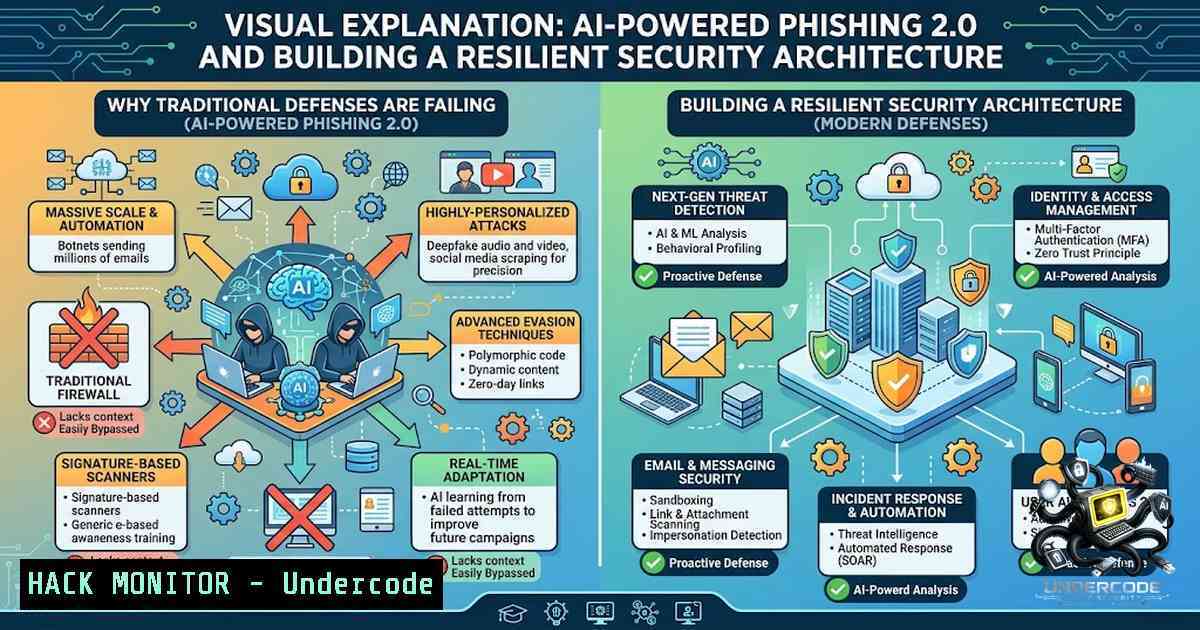
The cybersecurity landscape has undergone a seismic shift in 2026. Threat actors are no longer manually crafting deceptive emails; they are industrializing phishing operations with generative AI, automating entire attack workflows at scale. With AI-powered phishing attacks, ransomware, credential theft, and data breaches escalating at unprecedented rates, organizations can no longer rely on legacy security tools. Businesses must adopt proactive, multi-layered security strategies—including 24×7 monitoring, endpoint protection, advanced firewalls, and Security Operations Centers (SOC)—to detect and neutralize threats before they cause irreversible damage.
Learning Objectives
- Understand how AI is transforming phishing, ransomware, and credential theft into automated, scalable threats
- Master the implementation of critical security controls: endpoint protection, firewall hardening, and SOC operations
- Learn practical Linux and Windows commands for threat detection, log analysis, and incident response
You Should Know
- The New Face of Phishing: AI-Generated Attacks at Scale
The statistics are alarming. Cybercriminal groups are combining generative AI with automated workflows to industrialize phishing, leading to a nearly 15-fold increase in attacks that bypass traditional identity verification tools. Platforms like “EvilToken” have ramped up AI-enabled attacks by 1,380% in early 2026, offering subscription tiers from $600 to $1,500 that enable per-victim personalization at scale—bypassing even multi-factor authentication.
Attackers are now leveraging AI for context-aware spear phishing, scraping public social media data to profile communication styles and craft highly personalized lures. Meanwhile, vishing (voice phishing) platforms like “ATHR” use AI voice agents to automate social engineering, routing victims through Asterisk and WebRTC to AI-driven prompts that guide them through data theft. The “Forg365” platform industrializes Microsoft 365 phishing with AI-assisted lures, device-code phishing, and adversary-in-the-middle techniques.
Step‑by‑step guide to defend against AI-powered phishing:
- Deploy AI-powered defensive tools: Adopt AI-enabled security solutions for automated vulnerability detection, attack surface analysis, and threat detection to strengthen proactive defense capabilities.
- Implement layered email filtering: Combine traditional spam filters with machine learning-based anomaly detection that analyzes sender behavior, linguistic patterns, and contextual cues.
- Enforce phishing-resistant MFA: Move beyond SMS and OTP-based MFA to FIDO2/WebAuthn security keys that are immune to adversary-in-the-middle attacks.
- Conduct regular red-team exercises: Test security effectiveness against evolving AI-driven threats through red teaming, vulnerability assessments, penetration testing, and independent audits.
- Establish AI runtime guardrails: Implement guardrails that monitor for and block suspicious activity in AI systems, including prompt injection attempts.
Linux command for email header analysis:
 Analyze email headers for phishing indicators
cat suspicious_email.eml | grep -E "Return-Path|Received|From|Reply-To|Authentication-Results"

Check SPF, DKIM, DMARC records for a domain
dig TXT _spf.example.com
dig TXT _domainkey.example.com
dig TXT _dmarc.example.com
Windows PowerShell for header analysis:
 Parse email headers for authentication results
Get-Content suspicious_email.eml | Select-String -Pattern "Authentication-Results|DKIM|SPF|DMARC"
- Ransomware and Credential Theft: The AI Amplification Effect
The 2026 Verizon Data Breach Investigations Report (DBIR) reveals that vulnerability exploitation now accounts for 31% of breaches, surpassing stolen credentials as the top initial access vector for the first time in history. However, stolen credentials still appear in 39% of all breaches and remain the primary method attackers use to move laterally, escalate privileges, and monetize access. Alarmingly, 4 in 10 corporate users have reused an exposed password.
Ransomware tactics have evolved. According to Sophos, 79% of ransomware incidents now begin with compromised identities. Successful encryption occurred in 56% of attacks, up from 50% in 2025. Perhaps most concerning, 49% of ransomware victims detected attacks only after data had been stolen. Proofpoint research found that 65% of organizations affected by ransomware say AI made attacks more effective, with AI amplifying phishing, impersonation, and credential theft.
Step‑by‑step guide to mitigate ransomware and credential theft:
- Implement Zero Trust architecture: Adopt software-defined perimeters with distributed policy enforcement at endpoints, enforcing Zero Trust principles at the host level.
- Deploy endpoint detection and response (EDR): Use solutions with Security Heartbeat capabilities that monitor endpoints and automatically isolate compromised devices.
- Enforce credential hygiene: Implement password managers, enforce unique passwords, and deploy privileged access management (PAM) solutions.
- Conduct regular vulnerability scanning: Patch internet-facing flaws within 12 hours as recommended by CERT-In.
- Establish offline backups: Maintain immutable, offline backups to ensure recovery without paying ransom.
Linux commands for ransomware detection:
 Check for suspicious file encryption activity (bulk file modifications)
find / -type f -mtime -1 -size +1M -exec ls -la {} \; 2>/dev/null | grep -E ".encrypted|.locked|.crypt"

Monitor for unusual process activity
ps aux | grep -E "ransom|encrypt|crypt"

Check for unauthorized scheduled tasks (cron jobs)
crontab -l
cat /etc/crontab
ls -la /etc/cron.d/
Windows PowerShell for credential theft detection:
 Check for unusual scheduled tasks
Get-ScheduledTask | Where-Object {$_.State -1e "Disabled"}

Audit local group memberships (detect privilege escalation)
net localgroup administrators

Check for suspicious services
Get-Service | Where-Object {$_.Status -eq "Running"} | Select-Object Name, DisplayName, StartName

Monitor for credential dumping tools (Mimikatz, etc.)
Get-Process | Where-Object {$_.ProcessName -match "mimikatz|procdump|lsass"}
- Building a Security Operations Center (SOC) for Real-Time Threat Detection
Traditional SOCs struggle with large data volumes, complex threat landscapes, and slow response times. Modern SOCs must leverage AI-powered multi-agent platforms for real-time insider threat detection, behavioral anomaly analysis, risk assessment, and automated incident response. Open-source solutions like SENTINEL M//SOC provide real-time threat detection, GPT-4o AI triage, SIEM ingestion, incident response, and MITRE ATT&CK mapping.
Step‑by‑step guide to implement a modern SOC:
- Establish centralized logging: Aggregate logs from all endpoints, servers, firewalls, and applications into a SIEM platform.
- Deploy AI-powered detection engines: Implement machine learning models for behavioral anomaly detection and risk scoring.
- Map to MITRE ATT&CK: Align detection rules with MITRE ATT&CK techniques for comprehensive coverage.
- Implement real-time alerting: Configure automated alerts for high-risk events with human-in-the-loop validation.
- Develop incident response playbooks: Create documented strategies for detection, containment, eradication, recovery, and lessons learned.
Linux commands for SOC monitoring:
 Monitor auth logs for failed login attempts (brute force detection)
tail -f /var/log/auth.log | grep "Failed password"

Check for sudo abuse
grep "sudo" /var/log/auth.log

Monitor network connections for anomalies
ss -tunap | grep ESTABLISHED
netstat -tunap | grep LISTEN

Check for unauthorized listening ports
lsof -i -P -1 | grep LISTEN
Windows PowerShell for SOC monitoring:
 Monitor security event log for failed logins (Event ID 4625)
Get-WinEvent -FilterHashtable @{LogName='Security'; ID=4625} -MaxEvents 50

Check for privilege escalation (Event ID 4672)
Get-WinEvent -FilterHashtable @{LogName='Security'; ID=4672} -MaxEvents 50

Monitor for service creation (Event ID 4697)
Get-WinEvent -FilterHashtable @{LogName='Security'; ID=4697} -MaxEvents 50

Check active network connections
Get-1etTCPConnection | Where-Object {$_.State -eq "Established"}
4. Endpoint Protection and Advanced Firewall Security
Perimeters are porous; users click links, and devices roam off-1etwork. Endpoint protection is critical for stopping execution when the perimeter is breached. Modern next-generation firewalls (NGFWs) must evolve toward distributed policy enforcement at endpoints, creating software-defined perimeters at the host level.
Step‑by‑step guide to harden endpoints and firewalls:
- Segment networks: Configure zones and apply IPS policies to segregate networks.
- Enable encrypted traffic inspection: Inspect and protect encrypted traffic to prevent threats from hiding in SSL/TLS tunnels.
- Deploy endpoint firewall policies: Implement client firewall policies with rules processed in order of specificity.
- Integrate endpoint and firewall protection: Use Security Heartbeat to automatically quarantine compromised devices.
- Reduce attack surface: Remove unnecessary internet-facing services, disable unnecessary ports and protocols, and harden perimeter-facing systems.
Linux firewall commands (iptables/nftables):
 List current iptables rules
sudo iptables -L -1 -v

Block an IP address
sudo iptables -A INPUT -s 192.168.1.100 -j DROP

Allow SSH only from specific subnet
sudo iptables -A INPUT -p tcp --dport 22 -s 192.168.1.0/24 -j ACCEPT
sudo iptables -A INPUT -p tcp --dport 22 -j DROP

Log dropped packets for analysis
sudo iptables -A INPUT -j LOG --log-prefix "IPTables-Dropped: "

Save iptables rules (persistent)
sudo iptables-save > /etc/iptables/rules.v4
Windows Firewall commands (PowerShell):
 List all firewall rules
Get-1etFirewallRule | Select-Object DisplayName, Enabled, Direction, Action

Block an IP address
New-1etFirewallRule -DisplayName "Block IP 192.168.1.100" -Direction Inbound -RemoteAddress 192.168.1.100 -Action Block

Allow RDP only from specific subnet
New-1etFirewallRule -DisplayName "Allow RDP from 192.168.1.0/24" -Direction Inbound -Protocol TCP -LocalPort 3389 -RemoteAddress 192.168.1.0/24 -Action Allow

Enable logging for dropped packets
Set-1etFirewallProfile -Profile Domain,Public,Private -LogFileName "%SystemRoot%\System32\LogFiles\Firewall\pfirewall.log"
5. Incident Response: NIST CSF 2.0 Framework
The NIST Cybersecurity Framework (CSF) 2.0 provides a structured approach to incident response with six core functions. Organizations should adopt a living incident response plan (IRP) that defines detection, response, and recovery strategies. The SANS framework follows six phases: Preparation, Identification, Containment, Eradication, Recovery, and Lessons Learned.
Step‑by‑step guide to implement NIST CSF 2.0 incident response:
1. Identify: Catalog assets, risks, and vulnerabilities.
- Protect: Implement safeguards to limit the impact of incidents.
3. Detect: Deploy continuous monitoring to identify anomalies.
4. Respond: Execute containment, eradication, and recovery procedures.
5. Recover: Restore systems and improve resilience.
- Govern: Establish and maintain policies, procedures, and oversight.
Linux commands for incident response:
 Capture system state for forensic analysis
sudo tar -czf forensic_$(date +%Y%m%d_%H%M%S).tar.gz /var/log /etc/passwd /etc/shadow /var/spool/cron

Check for recently modified files (potential malware)
find / -type f -mtime -7 -exec ls -la {} \; 2>/dev/null | grep -v "/proc|/sys|/dev"

Identify running processes with network connections
lsof -i -P -1 | grep ESTABLISHED

Check for rootkits
sudo rkhunter --check
sudo chkrootkit
Windows PowerShell for incident response:
 Collect system information for forensic analysis
systeminfo > systeminfo_$(Get-Date -Format yyyyMMdd_HHmmss).txt
Get-Process | Export-Csv -Path processes_$(Get-Date -Format yyyyMMdd_HHmmss).csv
Get-Service | Where-Object {$<em>.Status -eq "Running"} | Export-Csv -Path services</em>$(Get-Date -Format yyyyMMdd_HHmmss).csv
Get-EventLog -LogName Security -1ewest 1000 | Export-Csv -Path security_logs_$(Get-Date -Format yyyyMMdd_HHmmss).csv

Check for suspicious scheduled tasks
Get-ScheduledTask | Where-Object {$_.State -1e "Disabled"} | Export-Csv -Path scheduled_tasks.csv

Check for startup programs (potential persistence)
Get-CimInstance Win32_StartupCommand | Select-Object Command, Location, User
6. Proactive Defense: CERT-In and Gartner Recommendations
CERT-In recommends implementing layered, risk-based, and continuously validated technical controls to reduce exposure to AI-assisted cyber threats. Organizations should:
– Adopt AI-enabled defensive security tools for automated vulnerability detection
– Test security effectiveness through red teaming and penetration testing
– Implement layered mitigation strategies including AI security testing, strong system prompts, and AI runtime guardrails
Gartner advises cybersecurity leaders to move toward an AI-first cybersecurity program to increase speed and redirect human effort toward more valuable risk-mitigation activities. Key actions include establishing targeted protection levels using outcome-driven metrics and increasing investments in cyber resilience.
What Undercode Say
- AI is a double-edged sword: While AI enables attackers to launch sophisticated, personalized attacks at scale, it also empowers defenders with automated threat detection, behavioral analytics, and rapid incident response capabilities. The organizations that win will be those that embrace AI-first security programs.
- Traditional perimeters are dead: With users roaming off-1etwork and devices connecting from anywhere, security must shift from perimeter-based to identity-based and endpoint-based models. Zero Trust architecture is no longer optional—it’s essential.
- Proactive beats reactive: Waiting for an attack to expose vulnerabilities is a losing strategy. Organizations must adopt 24×7 monitoring, real-time threat detection, and rapid incident response to stay ahead of adversaries.
- Human factors remain critical: Despite AI automation, credential theft and phishing succeed because of human error. Continuous security awareness training, phishing simulations, and MFA enforcement are non-1egotiable.
- Compliance and frameworks provide structure: NIST CSF 2.0, MITRE ATT&CK, and CERT-In guidelines offer proven frameworks for building resilient security programs. Organizations should map their controls to these standards.
- The economics favor defenders—if they act: Ransomware payment rates have collapsed from 76% in 2019 to 28% in 2026. This means victims are refusing to pay, but only if they have robust backups and recovery capabilities. Investing in resilience pays off.
- Speed is survival: With attackers weaponizing vulnerabilities within hours of disclosure, organizations must patch internet-facing flaws within 12 hours. Slow patching cycles are a death sentence.
Prediction
- +1 AI-powered cyberattacks will become fully autonomous by 2028, with self-learning malware that adapts defenses in real-time without human intervention.
- -1 Small and medium businesses (SMBs) without dedicated security teams will face disproportionate risk, as cybercriminal groups target them as low-hanging fruit for ransomware and data extortion.
- +1 The adoption of AI-first security operations centers (SOC) will become mainstream, reducing mean time to detect (MTTD) from days to minutes and mean time to respond (MTTR) from hours to seconds.
- -1 Credential theft will remain the top attack vector until passkeys and passwordless authentication achieve near-universal adoption—a transition that could take 5–10 years.
- +1 Regulatory frameworks will evolve to mandate AI security testing and runtime guardrails, driving investment in AI security startups and creating a new cybersecurity sub-industry.
- -1 The weaponization of AI for voice and video deepfakes will make social engineering attacks nearly impossible to detect, requiring biometric liveness detection and out-of-band verification for all sensitive transactions.
- +1 Organizations that invest in cyber resilience (backups, incident response playbooks, and recovery drills) will survive ransomware attacks without paying ransoms, further collapsing the ransomware business model.
- -1 The cybersecurity talent shortage will worsen as AI-driven attacks outpace the number of skilled defenders, accelerating the need for AI-powered automation to augment human analysts.
▶️ Related Video (76% Match):
🎯Let’s Practice For Free:
🎓 Live Courses & Certifications:
Join Undercode Academy for Verified Certifications
🚀 Request a Custom Project:
Secure, high-velocity infrastructure and disruptive technological engineering. Contact our engineering team for high-tier development and proprietary systems:
[email protected]
💎 Smart Architecture | 🛡️ Secure by Design | ⭐ Trusted by Thousands
IT/Security Reporter URL:
Reported By: Jubytech Cybersecurity – Hackers Feeds
Extra Hub: Undercode MoN
Basic Verification: Pass ✅


