
Listen to this Post
Introduction:
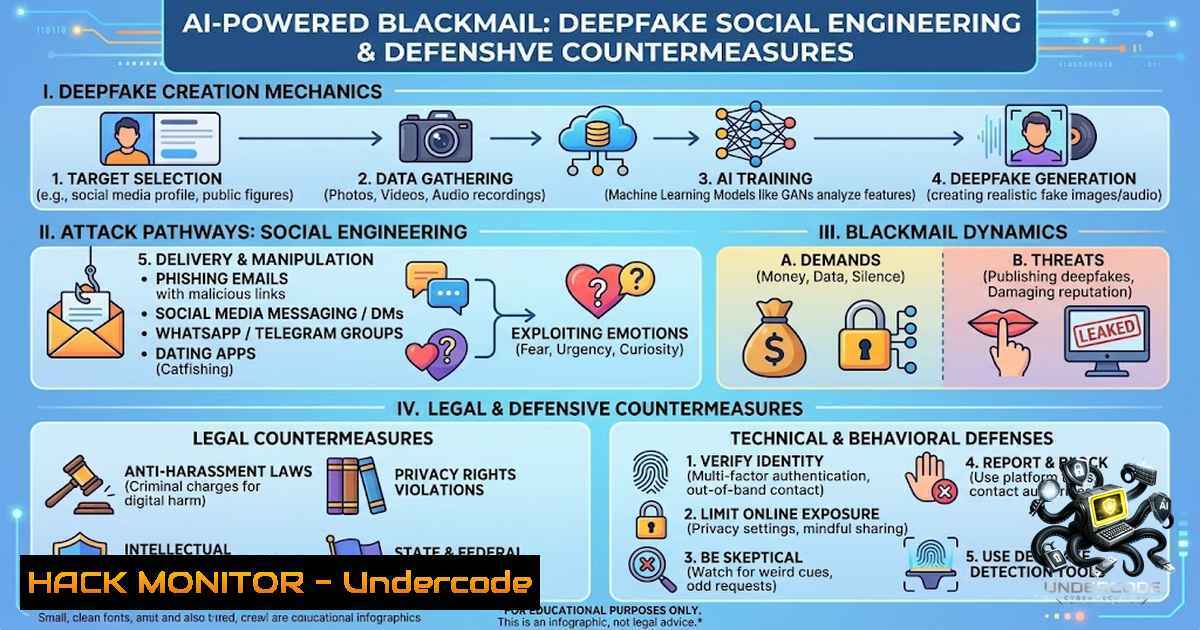
The convergence of generative artificial intelligence and social engineering has given rise to a new class of cyber threats, exemplified by incidents where malicious actors leverage AI-manipulated media for extortion and reputation damage. When attackers weaponize synthetic content alongside compromised personal networks, the attack surface extends beyond traditional phishing to include identity-based psychological manipulation. This article dissects the anatomy of such attacks, focusing on the detection of deepfakes, the hardening of communication channels, and the forensic preservation of evidence required for international law enforcement coordination, as demonstrated by recent cross-border blackmail attempts targeting European professionals.
Learning Objectives & Secrets:
- Objective 1: Implementing Rapid Incident Triage for Social Engineering Attacks. Learn to execute a swift containment protocol that isolates communication channels, blocks malicious sender domains via email gateway rules, and initiates a network-wide alert to prevent secondary infections or data exfiltration.
-
Objective 2 Secret Tips: Analyzing AI-Generated Metadata for Manipulation Clues. Master the extraction of EXIF and MIME metadata from suspicious media files using `exiftool` and `mediainfo` to identify inconsistencies in compression artifacts, color depth, or generative model fingerprints that distinguish synthetic content from authentic media.
-
Objective 3 Secret Tips: Leveraging International Legal Frameworks for Cyber Incident Reporting. Discover the procedural nuances of filing parallel complaints with the German BKA and Indian CERT-In, including the specific evidence artifacts (timestamps, IP headers, blockchain-verified hashes) required to trigger mutual legal assistance treaties (MLATs) effectively.
You Should Know:
- The Anatomy of AI-Facilitated Extortion and Social Graph Exploitation
Attackers in India often scrape professional networks like LinkedIn to map an individual’s close contacts. By weaponizing deepfake tools such as DeepFaceLab or StyleGAN, they generate manipulated videos or audio snippets that appear incriminating. The threat actor’s primary leverage is the “contact list”—they threaten to disseminate this fabricated content to colleagues, family, and business partners unless a ransom (usually cryptocurrency) is paid. To defend against this, you must implement a “zero-trust” communication policy where any media depicting yourself or executives is verified through a secondary out-of-band channel (e.g., a voice call using a pre-agreed code word).
Step-by-Step Guide to Social Graph Hardening:
- Step 1: Review your public social media visibility. Lock down friend lists and connection visibility to “Only Me” on platforms like LinkedIn and Facebook to deny attackers metadata about your inner circle.
- Step 2: Create a custom “Family and Close Friends” email distribution list in your organization’s M365 or Google Workspace tenant. In the event of a blackmail attempt, send a pre-signed PGP-encrypted advisory to this list only, warning them not to open external attachments.
- Step 3: Configure email transport rules in Exchange Admin Center or Gmail’s compliance settings to quarantine all incoming messages containing specific keywords related to the blackmail threat (e.g., your name + “scandal” or “exposed”) and send a copy to your incident response mailbox.
- Forensic Verification of Media Integrity Using Linux Command-Line Tools
To counter claims of authenticity, defenders must rapidly analyze the digital artifacts of the received blackmail media. This involves checking for audio-visual sync issues, unnatural blinking patterns, and pixel-level noise that is characteristic of generative adversarial networks (GANs). On a Linux forensics workstation, you can use a combination of `ffmpeg` and `exiftool` to dissect the file.
Step-by-Step Guide for Media Forensics:
- Step 1: Start with a hash capture to ensure chain of custody:
sha256sum suspicious_video.mp4 > hash.txt. - Step 2: Extract detailed metadata:
exiftool -All -j suspicious_video.mp4 > metadata.json. Look for missing GPS coordinates or inconsistent `Software` tags (often “Adobe Premiere Pro” or “OpenAI”). - Step 3: Analyze frame consistency using
ffmpeg: `ffmpeg -i suspicious_video.mp4 -vf “select=eq(n\,0)” -vsync vfr frame0.png` to extract the first frame. Then, use `identify -verbose frame0.png` (ImageMagick) to check for quantization tables that differ from standard camera models. - Step 4: For audio manipulation, run `ffprobe -v quiet -print_format json -show_streams suspicious_video.mp4` and verify the audio bitrate; deepfakes often have lower bitrates due to re-encoding.
3. Windows-Based Network Isolation and Incident Response Commands
When a blackmail attempt is received via direct message or email, the immediate risk is a link redirecting to a credential harvesting page or malware dropper. On a Windows Defender-equipped system, you must isolate the machine from the network without losing volatile memory data.
Step-by-Step Guide for Windows Incident Isolation:
- Step 1: Disable the network adapter immediately via PowerShell:
Disable-1etAdapter -1ame "Ethernet" -Confirm:$false. This cuts the kill chain if a dropper was inadvertently executed. - Step 2: Set a restrictive Windows Firewall rule to block all outbound traffic except to your SIEM:
New-1etFirewallRule -DisplayName "Block_All_Outbound_Except_SIEM" -Direction Outbound -Action Block. - Step 3: Extract the running processes list for forensic analysis:
Get-Process | Export-Csv -Path C:\Forensics\process_list.csv. This helps identify weird processes like `svchost.exe` running out of a temp directory. - Step 4: Use `Sysinternals Autoruns` to check for persistence mechanisms:
autoruns.exe -accepteula -a -c > autoruns.txt. Search for unfamiliar entries tied to the time of the received message.
4. Cloud API Security and Email Filtering Hardening
Attackers often infiltrate cloud environments by using the manipulated content to distract the victim while they attempt password resets via SMS or authenticator app notifications. To harden this, you must enforce Conditional Access Policies that block login attempts from the attacker’s geolocation (India) based on IP risk scores.
Step-by-Step Guide to Cloud Tenant Hardening:
- Step 1: In Azure AD (Entra ID), create a Named Location for India and set it to “Mark as trusted” (or untrusted). Then, create a Conditional Access policy that blocks access from that location for all users except global admins (with an emergency break-glass account).
- Step 2: Enable Unified Audit Log search to export logs for the time of the attack using the `Search-UnifiedAuditLog -StartDate` cmdlet in Exchange Online PowerShell. Filter for `OperationType=UserLoggedIn` and export to CSV for law enforcement.
- Step 3: Enable “Impersonation Protection” in Microsoft Defender for Office 365. Set it to intercept emails where the sender’s display name matches the victim’s name but originates from an external domain (the blackmailer often impersonates the victim to send fake evidence to their own contacts).
5. Vulnerability Exploitation Mitigation: The “Secondary Channel” Protocol
The core vulnerability exploited is not a technical bug but a human trust deficit. The attacker relies on the fact that the victim cannot immediately verify the authenticity of the content on their own (as they don’t have access to the original media). The mitigation involves a proactive “Authenticity Verification” protocol.
Step-by-Step Guide for Establishing Verification Protocols:
- Step 1: Agree on a “Security Password” with your executive assistant and public relations team. If a blackmail incident occurs, the first step is to use Signal or Threema (not SMS) to send the password to your legal counsel to authorize a forensic audit.
- Step 2: Instruct IT to create a honeypot file (a decoy document with unique tracking IDs) and place it on a shared drive. If the attacker accesses it, you’ll know they have breached the internal network, changing the threat model from simple blackmail to data extortion.
- Step 3: Use `CertUtil` on Windows to generate a hash certificate for the original media used in the blackmail:
certutil -hashfile original_footage.mp4 SHA256. Present this to the investigating authorities to prove the original exists and the manipulated copy is the anomaly.
What Undercode Say:
- Key Takeaway 1: Deepfake blackmail is inherently a credibility attack, not a data attack. The defender’s primary goal is to de-escalate the crisis by quickly proving the media’s inauthenticity through public metadata analysis, thereby neutralizing the attacker’s leverage.
- Key Takeaway 2: Proactive geographic filtering and user behavior analytics (UBA) are more effective than reactive analysis. By restricting access to cloud apps from high-risk countries (even for a short duration), you can block the reconnaissance phase of the attack, preventing the attacker from scraping contact lists in the first place.
The integration of AI into cybercrime lowers the barrier to entry for extortionists but provides forensic analysts with deterministic artifacts—the “uncanny valley” left by neural networks. A swift, transparent response involving legal, PR, and technical teams transforms a potential reputation disaster into a manageable incident, reinforcing stakeholder trust.
Prediction:
- +1: The increasing availability of open-source deepfake detection tools (like Microsoft’s Video Authenticator) will democratize media forensics, allowing small businesses to perform real-time verification without hiring external incident response firms.
- -1: The sophistication of Generative AI will outpace the efficacy of metadata-based detection within the next 12-18 months, forcing organizations to adopt cryptographic watermarking and blockchain-based content provenance standards (like C2PA) as a mandatory defensive baseline.
- -1: Attackers will shift from static deepfakes to “live” manipulation via AI voice cloning during phone calls, bypassing detection tools that rely solely on video file analysis, leading to a rise in business email compromise (BEC) 3.0 attacks.
- +1: International law enforcement agencies will establish faster, automated channels for mutual legal assistance requests specifically for cyber extortion, driven by the high-profile nature of AI-generated content, reducing response times from months to hours.
- -1: As defenders implement robust email filters, attackers will pivot to exploiting SMS (smishing) and encrypted messaging app vulnerability reports, moving the attack vector to platforms with less stringent enterprise-level monitoring, increasing the difficulty of forensic preservation.
▶️ Related Video (84% Match):
🎯Let’s Practice For Free:
🎓 Live Courses & Certifications:
Join Undercode Academy for Verified Certifications
🚀 Request a Custom Project:
Secure, high-velocity infrastructure and disruptive technological engineering. Contact our engineering team for high-tier development and proprietary systems:
[email protected]
💎 Smart Architecture | 🛡️ Secure by Design | ⭐ Trusted by Thousands
IT/Security Reporter URL:
Reported By: https://lnkd.in/p/ep5W26Kj – Hackers Feeds
Extra Hub: Undercode MoN
Basic Verification: Pass ✅


