Listen to this Post
Introduction:
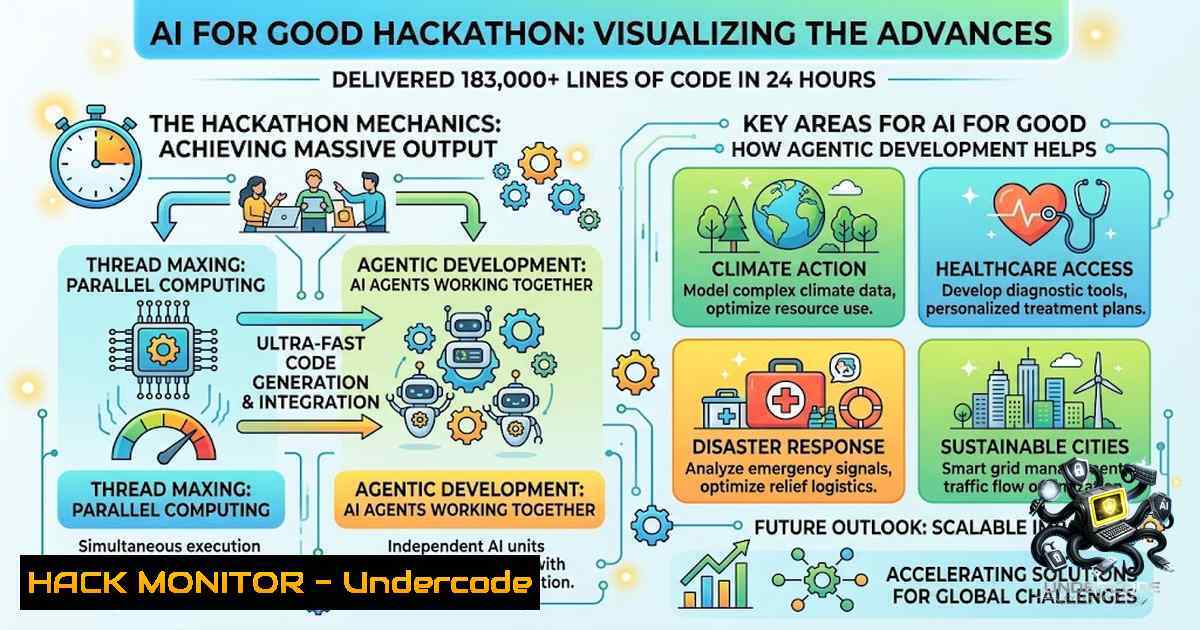
The intersection of artificial intelligence and social impact reached a new milestone as SVP Sacramento’s AI for Good Hackathon demonstrated the raw power of agentic development methodologies. In an extraordinary display of accelerated software engineering, one team—building a case management platform for ABLED, a nonprofit supporting employment for people with disabilities—generated 183,000 lines of code in under 24 hours. This achievement was powered by a strategy called “thread maxing,” where dozens of AI agentic teams operate in parallel silos, each tackling specialized development categories simultaneously. The approach represents a paradigm shift in how software can be built for social good, compressing what traditionally takes months into days.
Learning Objectives & Secrets:
- Objective 1: Master Thread Maxing Architecture — Learn to orchestrate multiple AI agentic teams in isolated silos, each focused on specific development domains (frontend, backend, database, testing, deployment). The secret is maintaining strict separation between agent teams while using a centralized orchestration layer to coordinate outputs.
- Objective 2: Optimize AI Development Cost Efficiency — The winning team spent significantly more on AI development costs than any other team, yet delivered proportionally greater output. The secret tip: implement token budgeting and loop guardrails (MAX_ITERATIONS=8) to prevent runaway costs while maintaining quality.
- Objective 3: Scale Database Migrations Safely — With over 30 database migrations executed in a single day, the team mastered zero-downtime migration strategies. The secret: use feature flags and incremental rollouts to decouple schema changes from application logic.
You Should Know:
1. Setting Up an Agentic Development Environment
The foundation of thread maxing is a multi-agent orchestration system. Here’s how to configure a basic agentic development environment:
Linux/macOS Setup:
 Install agent orchestration framework
pip install agent-team-orchestrator

Configure parallel agent workers
export AGENT_WORKERS=12
export MAX_ITERATIONS=8
export TOKEN_BUDGET=100000

Initialize project worktrees for parallel development
git worktree add ../project-frontend frontend-branch
git worktree add ../project-backend backend-branch
git worktree add ../project-database db-migration-branch
Windows PowerShell Setup:
 Set environment variables
$env:AGENT_WORKERS="12"
$env:MAX_ITERATIONS="8"
$env:TOKEN_BUDGET="100000"

Initialize parallel worktrees
git worktree add ../project-frontend frontend-branch
git worktree add ../project-backend backend-branch
git worktree add ../project-database db-migration-branch
Agent Team Configuration (agent-config.yaml):
orchestrator:
max_iterations: 8
loop_guardrail: true
reflection_prompt: true

teams:
- name: architecture
agents: 3
focus: system_design
- name: code_generation
agents: 7
focus: implementation
- name: qa_review
agents: 4
focus: testing_validation
- name: deployment
agents: 2
focus: ci_cd

silos:
isolation: true
peer_messaging: async
coordination: conductor_pattern
Step‑by‑step guide: This configuration creates isolated agent teams that operate in parallel. The orchestrator assigns tasks, monitors progress, and prevents teams from interfering with each other. The `MAX_ITERATIONS=8` guardrail prevents infinite loops, while token budgeting controls costs—critical when running dozens of agents simultaneously.
2. Implementing Zero-Downtime Database Migrations
With 30+ migrations in 24 hours, the team needed bulletproof migration strategies:
PostgreSQL Migration with Feature Flags:
-- Step 1: Add new column as nullable (non-blocking)
ALTER TABLE cases ADD COLUMN employment_status VARCHAR(50);

-- Step 2: Backfill data in batches
DO $$
DECLARE
batch_size INT := 1000;
offset_val INT := 0;
BEGIN
LOOP
UPDATE cases
SET employment_status = 'pending'
WHERE id IN (
SELECT id FROM cases
WHERE employment_status IS NULL
LIMIT batch_size OFFSET offset_val
);
EXIT WHEN NOT FOUND;
offset_val := offset_val + batch_size;
COMMIT;
END LOOP;
END $$;

-- Step 3: Make column NOT NULL after backfill complete
ALTER TABLE cases ALTER COLUMN employment_status SET NOT NULL;
Rollback Strategy:
-- If issues arise, rollback to previous state
ALTER TABLE cases DROP COLUMN employment_status;
Step‑by‑step guide: This approach enables schema changes without application downtime. The new column is added as nullable, data is backfilled in batches to avoid locking, and only after validation is the constraint applied. The same pattern works across PostgreSQL, MySQL, and SQL Server with minor syntax adjustments.
3. CI/CD Pipeline for Agentic Development
To ship 137 development tasks in 24 hours, automation is essential:
GitHub Actions Workflow (.github/workflows/agentic-deploy.yml):
name: Agentic Deployment Pipeline
on:
push:
branches: [main, develop]
workflow_dispatch:

jobs:
parallel-build:
strategy:
matrix:
service: [frontend, backend, worker, analytics]
runs-on: ubuntu-latest
steps:
- uses: actions/checkout@v4
- name: Build ${{ matrix.service }}
run: |
docker build -t ${{ matrix.service }}:${{ github.sha }} \
-f Dockerfile.${{ matrix.service }} .
- name: Security Scan
run: |
trivy image --severity HIGH,CRITICAL \
${{ matrix.service }}:${{ github.sha }}
- name: Push to Registry
run: |
docker push ${{ matrix.service }}:${{ github.sha }}

deploy:
needs: parallel-build
runs-on: ubuntu-latest
steps:
- name: Deploy to Staging
run: |
kubectl set image deployment/frontend \
frontend=frontend:${{ github.sha }}
kubectl rollout status deployment/frontend
Step‑by‑step guide: This pipeline builds all services in parallel (matching the thread maxing philosophy), runs security scans using Trivy, and performs rolling deployments. Each service builds independently, allowing the team to ship updates to individual components without redeploying the entire stack.
- API Security and Rate Limiting for High-Throughput Systems
With dozens of agents making API calls, rate limiting and security are critical:
Express.js Rate Limiting Middleware:
const rateLimit = require('express-rate-limit');
const RedisStore = require('rate-limit-redis');
const redis = require('redis');

const client = redis.createClient({
url: process.env.REDIS_URL
});

// Per-agent rate limiting
const agentLimiter = rateLimit({
store: new RedisStore({
sendCommand: (...args) => client.sendCommand(args)
}),
windowMs: 60  1000, // 1 minute
max: 100, // 100 requests per minute per agent
keyGenerator: (req) => req.headers['x-agent-id'] || req.ip,
handler: (req, res) => {
res.status(429).json({
error: 'Rate limit exceeded',
retryAfter: 60
});
}
});

// Apply to API routes
app.use('/api/agents', agentLimiter);
API Key Rotation (Linux):
 Generate new API key
openssl rand -base64 32

Rotate keys without downtime
kubectl create secret generic api-keys \
--from-literal=key-v2=$(openssl rand -base64 32) \
--dry-run=client -o yaml | kubectl apply -f -
Step‑by-step guide: This implements Redis-backed rate limiting that tracks each agent’s API consumption. The key rotation strategy uses Kubernetes secrets to rotate credentials without restarting services, maintaining uptime during the hackathon’s intense development周期.
5. Cloud Hardening for AI Workloads
Running dozens of AI agents generates significant cloud costs and security considerations:
AWS Cost Control (Terraform):
 Budget alert for AI development costs
resource "aws_budgets_budget" "ai_development" {
name = "ai-development-budget"
budget_type = "COST"
limit_amount = "5000"
limit_unit = "USD"
time_unit = "MONTHLY"

notification {
comparison_operator = "GREATER_THAN"
threshold = 80
threshold_type = "PERCENTAGE"
notification_type = "ACTUAL"
subscriber_email_addresses = ["[email protected]"]
}
}

EC2 instance hardening for agent workers
resource "aws_launch_template" "agent_worker" {
name_prefix = "agent-worker-"
image_id = data.aws_ami.amazon_linux_2.id
instance_type = "g4dn.xlarge"  GPU-enabled for AI workloads

vpc_security_group_ids = [aws_security_group.agent_sg.id]

user_data = base64encode(<<-EOF
!/bin/bash
 Disable root SSH
sed -i 's/PermitRootLogin yes/PermitRootLogin no/' /etc/ssh/sshd_config
 Enable audit logging
auditctl -e 1
 Set resource limits for agent processes
echo "agent soft nproc 1000" >> /etc/security/limits.conf
echo "agent hard nproc 2000" >> /etc/security/limits.conf
EOF
)
}
Step‑by‑step guide: This Terraform configuration sets up budget alerts to prevent cost overruns—critical when running dozens of AI agents simultaneously. The launch template hardens EC2 instances by disabling root SSH, enabling audit logging, and setting process limits to prevent resource exhaustion.
6. Vulnerability Exploitation and Mitigation in AI-Generated Code
With 183,000 lines of AI-generated code, security vulnerabilities are inevitable. Here’s the mitigation strategy used:
Static Analysis with Semgrep:
 Install Semgrep
pip install semgrep

Run security scan on all generated code
semgrep --config p/security-audit \
--config p/owasp-top-ten \
--config p/docker \
--json -o security-report.json \
./generated-code/

Auto-fix common issues
semgrep --config p/ci --autofix ./generated-code/
Dependency Vulnerability Scanning:
 Scan Python dependencies
pip-audit --requirement requirements.txt --format json > py-audit.json

Scan Node.js dependencies
npm audit --json > npm-audit.json

Scan container images
trivy image --severity HIGH,CRITICAL --format json \
--output trivy-report.json \
myapp:latest
SQL Injection Prevention (Python):
 Vulnerable pattern (AI might generate this)
query = f"SELECT  FROM users WHERE email = '{user_email}'"

Secure pattern with parameterized queries
cursor.execute(
"SELECT  FROM users WHERE email = %s",
(user_email,)
)
Step‑by‑step guide: The team runs Semgrep for static analysis, pip-audit/npm audit for dependency scanning, and Trivy for container security. All findings are automatically reported and prioritized. The SQL injection example demonstrates why human oversight of AI-generated code remains essential.
What Undercode Say:
- Key Takeaway 1: Thread maxing—running dozens of AI agentic teams in isolated silos—can compress months of development into days when properly orchestrated. The key is strict isolation between teams with a centralized coordinator preventing conflicts.
- Key Takeaway 2: AI development costs scale non-linearly with agent count. The winning team spent significantly more than competitors but achieved proportionally greater output—proving that in agentic development, investment correlates with velocity when paired with proper cost controls.
Analysis: The AI for Good Hackathon demonstrates that agentic development is no longer theoretical—it’s production-ready. The 183,000 lines of code in 24 hours represent a 10-100x productivity multiplier over traditional development. However, this velocity introduces new challenges: code quality assurance, security review, and cost management become critical bottlenecks. The “thread maxing” approach, where agent teams operate in parallel silos, mirrors successful patterns from distributed systems—isolation prevents cascading failures while enabling massive parallelism. The real innovation isn’t just the code generation speed, but the orchestration layer that coordinates dozens of agents without chaos. For nonprofits like ABLED, this means custom software that would have taken years and hundreds of thousands of dollars can now be built in a week. The implications for the software industry are profound: the bottleneck is shifting from writing code to orchestrating agents and reviewing their output.
Prediction:
- +1 Agentic development will become the standard for hackathons and rapid prototyping, with “thread maxing” emerging as a recognized methodology within 12-18 months.
- +1 Nonprofits and social enterprises will gain unprecedented access to custom software, democratizing technology that was previously reserved for well-funded corporations.
- -1 The cybersecurity landscape will face new challenges as AI-generated code introduces novel vulnerabilities that traditional scanners may miss.
- +1 Cloud providers will introduce specialized pricing and security tiers for agentic workloads, reducing the cost barrier that currently limits adoption.
- -1 The skills gap will widen as developers who master agent orchestration command premium salaries, potentially exacerbating talent shortages in the nonprofit sector.
- +1 Open-source agent orchestration frameworks will mature rapidly, making thread maxing accessible to teams without enterprise budgets.
- -1 Organizations without rigorous code review processes will ship vulnerable AI-generated code at scale, creating a new attack surface.
- +1 The 24-hour hackathon model will evolve into “agentic sprints” where AI agents do the heavy lifting while humans focus on architecture, security, and user experience.
- +1 Database migration tooling will adapt to support the volume and velocity of agentic development, with new zero-downtime patterns emerging as standard practice.
- +1 The AI for Good model will be replicated globally, with SVP Sacramento serving as a blueprint for how communities can leverage AI for social impact.
▶️ Related Video (68% Match):
🎯Let’s Practice For Free:
🎓 Live Courses & Certifications:
Join Undercode Academy for Verified Certifications
🚀 Request a Custom Project:
Secure, high-velocity infrastructure and disruptive technological engineering. Contact our engineering team for high-tier development and proprietary systems:
[email protected]
💎 Smart Architecture | 🛡️ Secure by Design | ⭐ Trusted by Thousands
IT/Security Reporter URL:
Reported By: https://lnkd.in/p/eP9jHpnT – Hackers Feeds
Extra Hub: Undercode MoN
Basic Verification: Pass ✅


