Listen to this Post
Introduction:
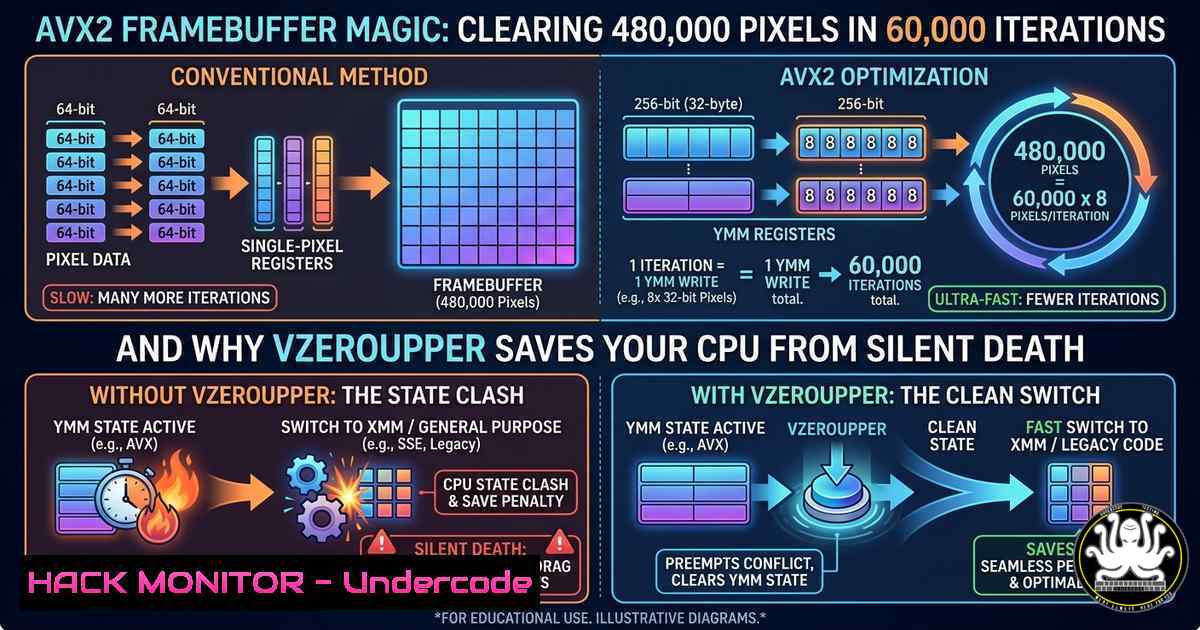
Modern CPUs can process multiple data points in a single instruction using SIMD (Single Instruction, Multiple Data). AVX2 extends this to 256‑bit registers, enabling operations on eight 32‑bit pixels at once. When manipulating framebuffers – the memory region that holds what you see on screen – naive per‑pixel writes create massive overhead, while AVX2 drastically reduces loop iterations. However, mixing AVX2 with legacy SSE instructions without the `vzeroupper` instruction causes hidden state penalties that silently cripple performance.
Learning Objectives:
- Understand how AVX2 vectorization reduces framebuffer clear/copy operations from O(pixels) to O(pixels/8).
- Write and benchmark assembly/intrinsics code for screen clearing and double‑buffering.
- Identify the performance impact of missing `vzeroupper` and implement mitigation strategies.
You Should Know:
- Checking CPU Support for AVX2 on Linux and Windows
Before using AVX2 instructions, verify that your processor supports them.
Linux:
grep -o 'avx2' /proc/cpuinfo | uniq
Or use `lscpu | grep -i “avx2″`.
Windows (PowerShell as Admin):
Get-WmiObject -Class Win32_Processor | Select-Object -ExpandProperty Name
Then compare with Intel/AMD feature lists, or run:
(Get-CimInstance CIM_Processor).Caption
 Then use freeware like Coreinfo (Sysinternals) for detailed flags:
.\coreinfo.exe | findstr "AVX2"
Step‑by‑step guide:
- On Linux, if `avx2` appears, your CPU and kernel support it.
- On Windows, download Coreinfo from Microsoft, run
coreinfo -f | find "AVX2". - If AVX2 is missing, fall back to SSE or scalar code. For development, enable AVX2 compiler flags: `-mavx2` (GCC/Clang) or `/arch:AVX2` (MSVC).
-
Implementing AVX2 Framebuffer Clear in C with Intrinsics
Use Intel intrinsics to write portable AVX2 code without raw assembly.include <immintrin.h> void clear_framebuffer_avx2(uint32_t framebuffer, uint32_t color, size_t pixel_count) { __m256i vec_color = _mm256_set1_epi32(color); // broadcast color to 8 lanes size_t vec_iter = pixel_count / 8; for (size_t i = 0; i < vec_iter; i++) { _mm256_store_si256((__m256i)&framebuffer[bash], vec_color); } // Handle remaining pixels (pixel_count % 8) with scalar loop }
Step‑by‑step:
1. Include `` and compile with `-mavx2`.
- Broadcast the 32‑bit ARGB color into all 8 lanes of a 256‑bit register.
- Loop `pixel_count / 8` times, storing 8 pixels per iteration using aligned stores (
_mm256_store_si256). - Ensure framebuffer memory is 32‑byte aligned for best performance (use
aligned_alloc). -
Benchmark against a scalar loop to see 6‑8× speedup.
-
Copying Backbuffer to Frontbuffer – Double Buffering Without Tearing
Double buffering renders off‑screen then copies to the visible framebuffer.; NASM syntax – copy 32 bytes (8 pixels) per iteration copy_loop: vmovdqu ymm0, [bash] ; load 32 bytes from backbuffer (rsi) vmovdqu [bash], ymm0 ; store to frontbuffer (rdi) add rsi, 32 add rdi, 32 dec rcx jnz copy_loop vzeroupper ; CRITICAL after any YMM usage
Step‑by‑step guide to integrate:
- Set `rsi` = backbuffer address, `rdi` = frontbuffer address, `rcx` = total bytes/32.
- Use unaligned moves (
vmovdqu) because buffers may not be aligned. - After the loop, call `vzeroupper` before any SSE instruction (including `ret` if the caller uses SSE).
-
On Windows x64, preserve non‑volatile registers (
rsi,rdi,rbx) if writing inline assembly; prefer intrinsics for safety. -
The `vzeroupper` Penalty – Measuring Silent Performance Degradation
Withoutvzeroupper, switching from AVX2 to SSE causes a costly state‑change penalty (up to 70‑80 cycles per transition).
Benchmark code (Linux perf):
// Test A: AVX2 loop followed by SSE loop, no vzeroupper
// Test B: Same with vzeroupper before SSE
Compile and run:
gcc -mavx2 -msse4.2 test.c -o test
perf stat -e cpu-cycles ./test
Step‑by‑step:
- Write a function that writes YMM registers then calls `_mm_add_ps` (SSE).
- Measure with `perf stat` – cycles will be 2–3× higher without
vzeroupper. - Add `_mm256_zeroupper()` intrinsic before the SSE call; cycles drop dramatically.
4. On Windows, use `QueryPerformanceCounter` or Intel VTune.
- Remember: `vzeroupper` is not automatically inserted by compilers unless you use
-mavx2 -mno-avx? Actually GCC may insert it at function boundaries, but explicit call guarantees safety. -
Real‑World Mitigation: When and Where to Insert `vzeroupper`
– After any function that uses YMM registers and before calling any library that may use SSE (e.g., libc `memcpy` optimized with SSE).
– Before returning from a function if the caller might contain SSE code.
– In signal handlers that could interrupt AVX2 code.
Example best practice:
void avx2_process(float data, int n) {
// ... AVX2 operations ...
_mm256_zeroupper(); // clean transition
}
void sse_function() {
// ... safe to use SSE ...
}
Step‑by‑step guide to audit existing code:
1. Grep for `_mm256_` intrinsics.
- For each function containing them, add `_mm256_zeroupper()` before any `return` or call to external non‑AVX2 code.
- Use static analysis tools like Clang Static Analyzer with AVX2 checks.
- Profile mixed‑code paths with `perf top` looking for high `cpu-migrations` or `msr` events – indicators of AVX‑SSE transitions.
-
Extending to 512‑bit AVX‑512 – Even Fewer Iterations
For AVX‑512 capable CPUs, you can clear 16 pixels per iteration (512 bits / 32 bits = 16).__m512i vec_color = _mm512_set1_epi32(color); _mm512_store_si512((__m512i)&framebuffer[bash], vec_color);
Step‑by‑step:
1. Check `avx512f` flag in `/proc/cpuinfo`.
2. Use `-mavx512f` and `include `.
3. Adjust loop: `pixel_count / 16` iterations.
- After AVX‑512 code, call `_mm512_zeroupper()` (or `_mm256_zeroupper()` is sufficient, but `_mm512_zeroupper` exists).
- Note: AVX‑512 may cause frequency throttling; benchmark power/thermal tradeoffs.
What Undercode Say:
- Key Takeaway 1: SIMD vectorisation is not just about speed – it’s about memory bandwidth efficiency. Reducing loop iterations from 480k to 60k cuts instruction decode overhead and branch mispredictions.
- Key Takeaway 2: The `vzeroupper` instruction is non‑optional when mixing AVX2 and SSE. Its absence leads to silent performance degradation that is invisible in basic tests but kills throughput in real‑time rendering or game loops.
- Analysis: Many low‑level developers focus on the “glamorous” 8× store reduction but forget the state management. The post’s warning – “Forget this one instruction? Your entire program slows down.” – highlights a classic trap. In cybersecurity contexts, this can also be exploited: a malicious library could omit `vzeroupper` to degrade system performance as a denial‑of‑service vector. Conversely, forensic analysts can detect AVX‑SSE transitions via performance counters to identify suspicious code. The link in the original post likely points to deeper AVX2 optimization guides (e.g., Intel’s optimization manual). Practical recommendation: always use `_mm256_zeroupper()` at function boundaries when YMM registers are used, and rely on compiler flags `-mavx2 -mno-sse` only if you control all call chains. For framebuffer operations, combine AVX2 with non‑temporal stores (
_mm256_stream_si256) for write‑combining to VRAM, achieving even lower cache pollution.
Prediction:
As AI workloads and real‑time rendering converge (e.g., neural framebuffer upscalers), mixed‑precision SIMD code will become ubiquitous. Future compilers may auto‑insert `vzeroupper` heuristically, but manual control will remain critical for latency‑sensitive systems. The rise of RISC‑V with vector extensions also mirrors this pattern – state management across vector lengths will be a recurring performance pitfall. Expect more CVEs related to transient execution attacks that leverage AVX register state leaks; `vzeroupper` already plays a role in zeroing upper bits to prevent cross‑process information disclosure.
▶️ Related Video (66% Match):
🎯Let’s Practice For Free:
IT/Security Reporter URL:
Reported By: Renaud Mercier – Hackers Feeds
Extra Hub: Undercode MoN
Basic Verification: Pass ✅


