Listen to this Post
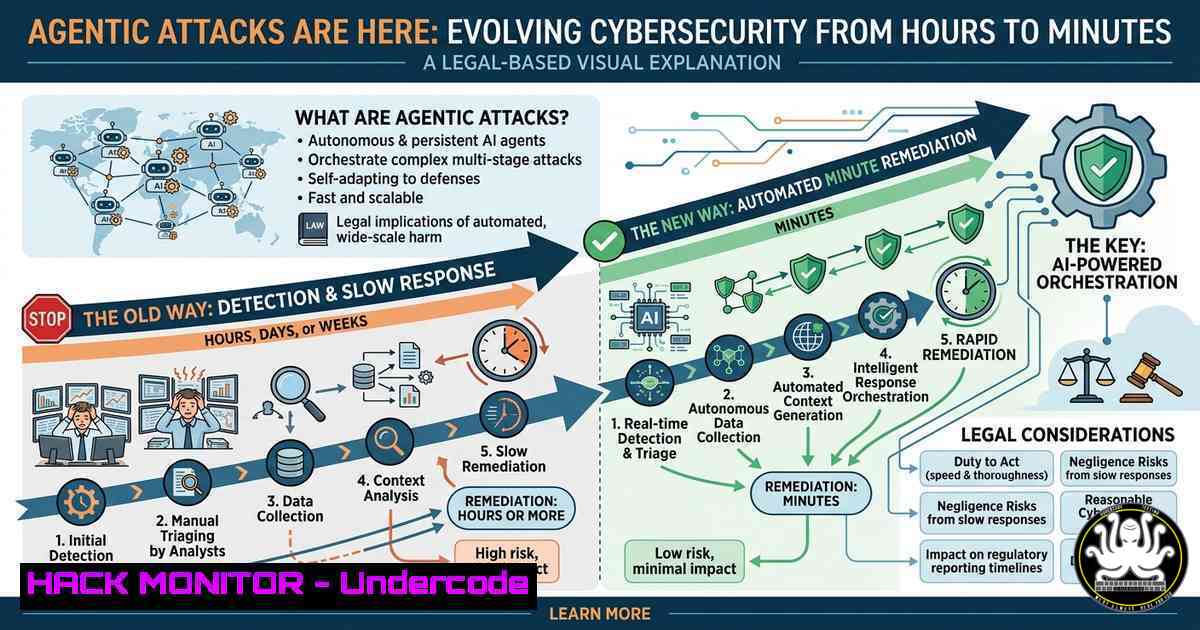
Introduction:
Adversaries have moved beyond static vulnerability scanning and now employ autonomous AI “agents” that continuously probe environments, chain discovered weaknesses into exploit paths, and escalate from initial access to lateral movement in mere hours. In response, defenders must evolve from periodic scans and manual triage to a continuous, validated, and low-friction remediation model. Closing the remediation gap is the new imperative: as Check Point’s analysis shows, shrinking mean time to remediate (MTTR) to under one hour is achievable and transforms the security equation entirely.
Learning Objectives:
- Understand Agentic Attacks: Grasp the mechanics of autonomous AI attacks and their operational tempo differential compared to traditional detection.
- Implement Agentic Exposure Validation (AEV): Learn to adopt AEV frameworks that prove exploitability rather than flagging theoretical risks.
- Build an Agentic Remediation Pipeline: Master the operational infrastructure—safe validation, automated prioritization, low-friction execution, and fix verification—to close exposures at machine speed.
You Should Know:
- Defensive Reconnaissance: Enumerate and Harden Your AI Attack Surface
Before you can defend, you must see. AI agents live on endpoints and in cloud workloads, communicating via APIs and executing scripts. Linux and Windows commands provide the first line of visibility.
Linux Monitoring:
 List all running processes for potential AI agent activity
ps aux | grep -E "(agent|ai|automation)" | grep -v grep

Monitor real-time system load and agent resource usage
top

Check open ports commonly used by AI agents (e.g., 5000, 8000)
netstat -tuln | grep -E ':(5000|8000)\s'

View agent service logs from the last hour
journalctl -u ai-agent-service --since "1 hour ago" | tail -20
Windows Monitoring (PowerShell & CMD):
 List tasks and filter for agent executables
tasklist /FI "IMAGENAME eq ai_agent.exe"

Find processes with detailed command lines
wmic process where "name like '%agent%'" get processid,commandline

Identify open ports used by agents
netstat -ano | findstr :5000

Enable deep PowerShell logging to capture agent script blocks
Set-ItemProperty -Path "HKLM:\SOFTWARE\Policies\Microsoft\Windows\PowerShell\ScriptBlockLogging" -Name "EnableScriptBlockLogging" -Value 1

Retrieve AI agent events from the last hour
Get-EventLog -LogName Application -Source "AI_Agent" -After (Get-Date).AddHours(-1)
Step-by-step guide: Implement these commands as baseline monitoring. For Linux, use a cron job to run `ps aux | grep …` every 5 minutes and log changes. On Windows, schedule a PowerShell script with Task Scheduler to export `wmic` outputs. Integrate these logs into your SIEM, creating alerts for new or unexpected agent processes. This visibility transforms raw endpoint data into actionable detection intelligence.
2. API Security Hardening for Agent Communication
AI agents use APIs for everything: retrieving context, invoking tools, and exfiltrating data. Each API call is a potential attack surface. Hardening API interactions is non-negotiable.
Secure API Call (cURL):
curl -X POST https://yourapi.com/agent-endpoint \
-H "Content-Type: application/json" \
-H "Authorization: Bearer $(gcloud auth print-access-token)" \
-H "X-API-Key: your-secure-api-key" \
-H "X-Agent-ID: $(hostname)-ai-agent-001" \
--data '{"task":"process_data","parameters":{"sensitivity":"confidential"}}'
Request Signing (Python with HMAC):
import requests
import hashlib
import hmac
import time

def create_secure_request(api_secret, payload):
timestamp = str(int(time.time()))
signature = hmac.new(
api_secret.encode(),
(payload + timestamp).encode(),
hashlib.sha256
).hexdigest()
headers = {
'X-Signature': signature,
'X-Timestamp': timestamp,
'Content-Type': 'application/json'
}
return headers
Step-by-step guide:
- Authenticate and authorize every request with a short-lived JWT and API key.
- Sign requests using HMAC-SHA256 with a timestamp to prevent replay attacks.
- Implement rate limiting per agent ID to curb automated abuse.
4. Validate all inputs—treat agent-generated data as untrusted.
- Log every API call with the agent ID, timestamp, and action performed.
These measures ensure that only authorized agents can communicate with your APIs and that tampered or replayed requests are rejected.
3. Container Isolation and Hardening for AI Agents
In cloud-native environments, AI agents often run inside containers. Runtime escape and privilege boundary breaches are top concerns. Harden container deployments aggressively.
Docker Hardening Example:
docker run -d --name ai-agent \
--security-opt=no-new-privileges:true \
--cap-drop=ALL \
--cap-add=NET_BIND_SERVICE \
--memory=2g \
--cpus=2.0 \
--read-only \
--tmpfs /tmp:rw,size=1g \
-v /etc/agent/config:/etc/agent/config:ro \
-v /app/logs:/app/logs:rw \
your-agent-image:latest
Step-by-step guide:
- Drop all Linux capabilities and add back only those strictly required (e.g., `NET_BIND_SERVICE` for web agents).
- Set memory and CPU limits to prevent DoS or runaway crypto-mining.
- Mount the root filesystem as read-only so the agent cannot install persistent backdoors.
- Use a tmpfs mount for temporary data; it exists only in memory and disappears on restart.
- Apply no-new-privileges to block privilege escalation via setuid binaries.
For orchestration, enforce these settings as admission control policies in Kubernetes. This creates a minimal, immutable runtime that severely constrains an agent’s ability to escape or persist.
- Incident Response for AI Agents: A Three-Type Playbook
Standard IR runbooks collapse AI agent incidents into a single category, but agentic attacks fall into three structurally different types, each requiring a distinct response.
- Runtime Execution Escape: The agent reaches outside its sandbox (e.g., cross-container file operations). Containment: workload isolation. Forensics: capture the kernel’s namespace transitions and syscall logs.
- Privilege Boundary Escape: The agent uses its legitimate credentials in unauthorized ways (e.g., a read-only role making writes). Containment: revoke credentials, rotate keys. Forensics: audit IAM logs and API call sequences.
- Reasoning Compromise (New & Critical): The agent’s prompts, retrieved context, or tool descriptions were manipulated, and it acted on poisoned input. Containment: pause the agent, disconnect from its data sources. Forensics: before killing the pod, preserve the six key artifacts: prompt history with timestamps, retrieved context with source provenance, tool call sequence, agent identity assumptions, downstream agent invocations, and the LLM output trace.
Step-by-step containment (reasoning compromise):
- Do not immediately terminate the agent pod—killing it destroys the reasoning trace.
- Use the orchestrator API to pause the container or block network egress.
3. Capture `/var/log/pods` and `kubectl logs` with timestamps.
- Snapshot the agent’s state and prompt queue from memory.
- Isolate the agent by disconnecting it from vector databases and LLM APIs.
6. Rotate any credentials the agent accessed.
- Restore the agent from a known-clean image and replay validated prompts only.
This playbook, aligned with NIST IR phases, turns the AI agent from an uncontrollable black box into a manageable incident subject.
- Agentic Exposure Validation (AEV): From Scan Noise to Actionable Evidence
Traditional vulnerability scanners output theoretical findings—CVSS scores and pattern matches—that generate remediation tickets which often languish for weeks. Agentic Exposure Validation (AEV) takes a different path: it reasons about your specific environment and safely executes a validation path to prove exploitability.
How AEV works:
- Fuses external discovery, breach intel, CVE context, and live threat research.
- Builds a targeted validation plan and executes it with read‑only probes.
- Returns undisputable proof: the exact HTTP request, the actual response, and the extracted data.
Step-by-step integration of AEV findings:
- Replace your quarterly scanner with a continuous AEV engine.
- Configure the engine to output findings that include proof of exploitability (e.g., `jq` the JSON output for a `proof` field).
- Route findings directly to your Vulnerability Operations Center (VOC) or SOAR.
- Use a simple script to auto-create tickets only for confirmed exposures:
 Example: process AEV JSON output, create ticket only if proof exists
for finding in $(jq -c '.findings[]' aev_output.json); do
if echo $finding | jq -e '.has_proof == true' > /dev/null; then
echo "Creating ticket for: $(echo $finding | jq -r '.id')"
 Call your ticketing system API here
else
echo "Skipping unproven finding: $(echo $finding | jq -r '.id')"
fi
done
This eliminates triage debates and accelerates remediation from “maybe” to “must fix now.”
What Undercode Say:
- The remediation gap—not detection speed—is today’s most critical security vulnerability. Attackers use AI to move at machine speed, while defenders still operate on human time. Closing this gap requires structural change, not just tooling.
- Agentic Exposure Validation fundamentally alters the risk conversation. When a finding arrives with the exact HTTP request and extracted data, there is no debate. This shifts security teams from processing scan output to operating a continuous exposure reduction function.
Expected Output:
Organizations adopting AEV and agentic remediation achieve sub‑one‑hour MTTR, as proven in a live healthcare environment (0.87 hours), with zero IPS bypass events and 100% hardening effectiveness. This transforms the attack surface from a lagging indicator to a continuously managed asset. The shift from a periodic, ticket‑based workflow to a real‑time, evidence‑driven VOC model eliminates the friction that slows down remediation and gives defenders back the speed advantage.
Prediction:
By 2027, over 40% of organizations will have moved from traditional vulnerability management to Vulnerability Operations Centers (VOCs) running agentic tooling. Standard scanners will become secondary; AEV will be the norm for any cloud‑native or AI‑augmented workload. Simultaneously, regulatory bodies will begin requiring proof‑of‑exploitability for critical findings, not just CVE presence. Organizations that lag will face a growing asymmetry as agentic attacks become the default method for initial access and lateral movement, widening the gap between those who remediate in hours and those who still measure MTTR in weeks. The security industry’s next major evolution will be measured not in detections per second, but in exposures closed per minute.
▶️ Related Video (78% Match):
🎯Let’s Practice For Free:
IT/Security Reporter URL:
Reported By: Charles K – Hackers Feeds
Extra Hub: Undercode MoN
Basic Verification: Pass ✅


