Listen to this Post
Introduction:
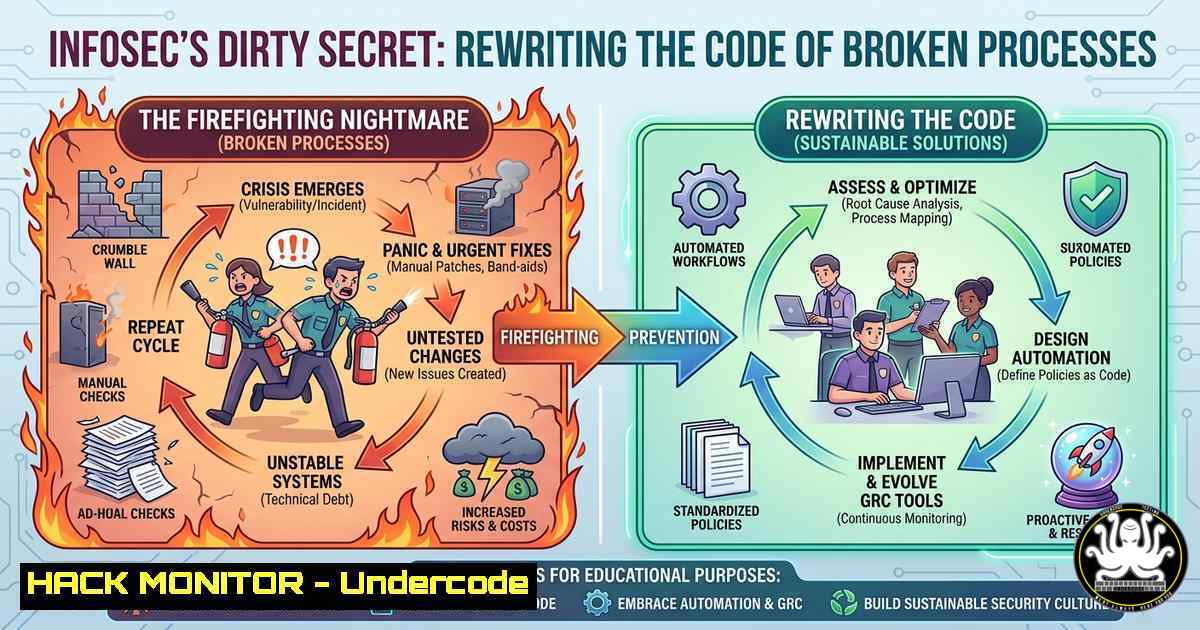
Security teams are constantly blamed when inherently flawed business processes fail, yet they rarely have the authority to redesign those processes from the ground up. This disconnect—where InfoSec inherits the fallout of broken procurement, development, and operations workflows—leads to burnout, reactive firefighting, and systemic vulnerabilities that no firewall can fix. The quotes from Frank McGovern and Joseph McMahon highlight a painful reality: “InfoSec is frequently bearing the brunt of broken processes” while being expected to “drive multiple initiatives” that other domains should own.
Learning Objectives:
- Audit and map broken organizational processes that create security debt using MITRE ATT&CK and process mining techniques.
- Implement secure re-architecting strategies with infrastructure-as-code and CI/CD pipeline hardening.
- Automate security controls into legacy workflows using PowerShell, Bash, and API gateways to shift left without burning out your team.
You Should Know:
1. Process Deconstruction: Identifying the “Woefully Insecure” Workflow
Joseph McMahon’s sarcastic offer—“You are welcome to re-architect the process from scratch for us”—is a goldmine. Before you can rebuild, you must dissect the existing broken process. Start by mapping every step, ownership boundary, and security control gap.
Step‑by‑step guide to deconstruct a process:
Step 1: Identify the process generating the most security tickets (e.g., user provisioning, code deployment, vendor access).
Step 2: Create a value stream map. Use a simple CSV or a tool like draw.io. List: Step, Owner, Input, Output, Security Check? (Y/N), Fallout Rate.
Step 3: For each step without a security check, run a lightweight threat model using STRIDE.
Linux command to trace process dependencies (example for a CI/CD pipeline):
 Find all Jenkins jobs that trigger without security scans
grep -r "pipeline {" /var/lib/jenkins/jobs//config.xml | grep -v "trivy|snyk|sonar"
Windows PowerShell to detect unmonitored scheduled tasks (common in broken IT processes):
Get-ScheduledTask | Where-Object {$<em>.State -ne "Disabled"} | ForEach-Object {
$action = $</em>.Actions[bash].Execute
if (-not (Get-MpThreatDetection -FilePath $action)) {
Write-Host "No antivirus scan on: $action"
}
}
What this does: It uncovers where automated security checks are missing. Use the output to prioritize re-architecture.
- Re-Architecting Without Starting Over: The “K Thx” Playbook
You cannot rebuild every process from scratch, but you can inject security as immutable automation layers. Focus on choke points—single steps where adding a control protects the entire workflow.
Step‑by‑step guide for secure injection:
Step 1: Choose one high‑risk process (e.g., employee offboarding).
Step 2: Write a lightweight API wrapper around the legacy system.
Step 3: Enforce a “security gate” webhook that fails the process unless conditions are met.
Example using a Python FastAPI middleware (API security):
from fastapi import FastAPI, HTTPException, Header
import hashlib

app = FastAPI()

def verify_process_integrity(payload: dict, expected_hash: str) -> bool:
computed = hashlib.sha256(str(sorted(payload.items())).encode()).hexdigest()
return computed == expected_hash

@app.post("/offboard")
async def offboard_user(user_id: str, x_process_hash: str = Header(...)):
 Simulated process step
if not verify_process_integrity({"uid": user_id}, x_process_hash):
raise HTTPException(status_code=403, detail="Broken process — re-architect required")
return {"status": "secure offboard initiated"}
Windows PowerShell remediation script to harden an insecure file copy process:
 Before: plain copy. After: enforce encryption & audit.
$source = "\legacyShare.conf"
$dest = "\secureShare\archived\"
Get-ChildItem $source | ForEach-Object {
$destFile = Join-Path $dest $<em>.Name
Copy-Item $</em>.FullName $destFile -Force
 Add a write-once audit
Write-EventLog -LogName Security -Source "ProcessFix" -EventId 1001 -Message "Copied $($_.Name) under new guard"
 Encrypt at rest
cipher /e $destFile
}
Why this works: You don’t replace the legacy tool; you gate its inputs and outputs, making the process secure without a full rewrite.
- Automation as the Burnout Antidote: Shifting Left on Other Teams’ Turf
Frank McGovern notes that InfoSec drives initiatives that other areas should own. Automation turns “ownership” into code. Create self‑service security controls that other teams embed willingly.
Step‑by‑step guide to automate security gates:
Step 1: Identify a repetitive InfoSec task (e.g., checking S3 buckets for public access).
Step 2: Package it as a GitHub Action or Azure DevOps task.
Step 3: Publish it internally with one‑line integration.
Linux/Bash command to check all AWS S3 ACLs (cloud hardening):
 Install AWS CLI, then:
for bucket in $(aws s3api list-buckets --query "Buckets[].Name" --output text); do
acl=$(aws s3api get-bucket-acl --bucket $bucket --query "Grants[?Grantee.URI=='http://acs.amazonaws.com/groups/global/AllUsers']" --output text)
if [ -n "$acl" ]; then
echo "VULN: $bucket is public"
 Automatically remediate? Only if approved.
 aws s3api put-bucket-acl --bucket $bucket --acl private
fi
done
Windows Command Prompt (using Azure CLI) to detect overly permissive NSGs:
az network nsg list --query "[?securityRules[?access=='Allow' && sourceAddressPrefix=='0.0.0.0/0' && destinationPortRange=='3389']].name" -o table
Tool configuration tip: Integrate these scans into your CI/CD as “advisory only” first. Once teams see value, flip to mandatory. This prevents InfoSec from being the process police.
- Vulnerability Exploitation of Broken Processes: The Attacker’s View
Attackers love broken processes because they are predictable. For example, an insecure user approval process (email‑based) allows privilege escalation via email spoofing. Understanding exploitation helps you prioritize fixes.
Step‑by‑step exploitation simulation (ethical, lab only):
Step 1: In a test environment, create a process where password resets are approved via unauthenticated HTTP.
Step 2: Use `curl` to forge an approval.
Step 3: Demonstrate the escalation.
Linux command to spoof a process approval (if no integrity check):
 Assuming a vulnerable approval API
curl -X POST http://broken-process.internal/approve_reset \
-H "Content-Type: application/json" \
-d '{"user":"admin","approved":true,"approver":"[email protected]"}'
Mitigation: Add HMAC to every state‑changing request. Example using openssl:
 Server-side: generate shared secret
echo -n "user=admin&action=reset" | openssl dgst -sha256 -hmac "supersecret"
 Client sends: payload + signature. Server re-computes and compares.
Windows PowerShell equivalent (HMAC validation):
$secret = "supersecret"
$message = "user=admin&action=reset"
$hmac = New-Object System.Security.Cryptography.HMACSHA256
$hmac.key = [Text.Encoding]::UTF8.GetBytes($secret)
$signature = [bash]::ToBase64String($hmac.ComputeHash([Text.Encoding]::UTF8.GetBytes($message)))
Write-Host "Send this signature: $signature"
- From Firefighting to Process Ownership: Metrics That Matter
InfoSec can’t own every broken process, but they can own the metrics that expose ownership gaps. Create a dashboard that visualizes “security debt by team.”
Step‑by‑step guide to build a process health dashboard:
Step 1: Pull Jira/ServiceNow tickets tagged “security” and group by “root cause team.”
Step 2: Use a lightweight ELK stack or even Excel Power Query.
Step 3: Publish a weekly “Process Fragility Index” – top 3 broken workflows.
Linux command to parse Apache logs for insecure redirects (common process flaw):
sudo grep "redirect" /var/log/apache2/access.log | grep "http://" | awk '{print $1, $7}' | sort | uniq -c
Windows PowerShell (Event Log analysis for process failures):
Get-WinEvent -LogName Application | Where-Object {$<em>.ProviderName -eq "Security-SPP" -and $</em>.Id -eq 16394} | Group-Object -Property Message | Sort-Object Count -Descending | Select-Object -First 5
Pro tip: Automate sending these metrics to team leads before they ask InfoSec to fix something. It shifts the conversation from “you fix it” to “your process is broken.”
What Undercode Say:
- Key Takeaway 1: Broken processes are not InfoSec’s fault, but InfoSec is uniquely positioned to expose the breakage with automation and metrics. Refusing to own the fix is different from refusing to measure the failure.
- Key Takeaway 2: Sarcastic offers to “re-architect from scratch” are a trap. Instead, inject security controls at integration points—API gateways, webhooks, and pipeline steps. This buys you time to advocate for real process re-engineering.
Analysis: The three quotes reveal a systemic issue: security is treated as a “band‑aid” function for poorly designed workflows. Frank McGovern’s observation that fundamentals owned by other areas still need work is a call to action for security leaders to enforce accountability through data, not emotion. Joseph McMahon’s sarcasm is a defense mechanism against scope creep. Bartlomiej Duda’s focus on identity automation (implied by his role) is the practical solution—embedding security as code into provisioning, access reviews, and onboarding. Without this, InfoSec remains the department of “no” without the power to say “yes, if you fix the process first.”
Prediction:
By 2027, organizations that fail to shift process ownership out of InfoSec will face an average of 40% higher breach costs, as attackers increasingly target workflow logic (e.g., approvals, data handoffs) rather than traditional vulnerabilities. We will see the rise of “Process Detection and Response” (PDR) platforms—a new category of tools that map business processes to security controls and automatically escalate ownership violations to C‑level dashboards. Security teams will transition from firefighting to process architecture, and the most sought‑after hires will be those with Lean Six Sigma and DevSecOps hybrid skills. The leaders who start re‑architecting today—starting with one process, one automation, one metric—will finally stop being the brunt of brokenness.
▶️ Related Video (76% Match):
🎯Let’s Practice For Free:
IT/Security Reporter URL:
Reported By: Frankmcgovern Infosec – Hackers Feeds
Extra Hub: Undercode MoN
Basic Verification: Pass ✅


