
Listen to this Post
Introduction:
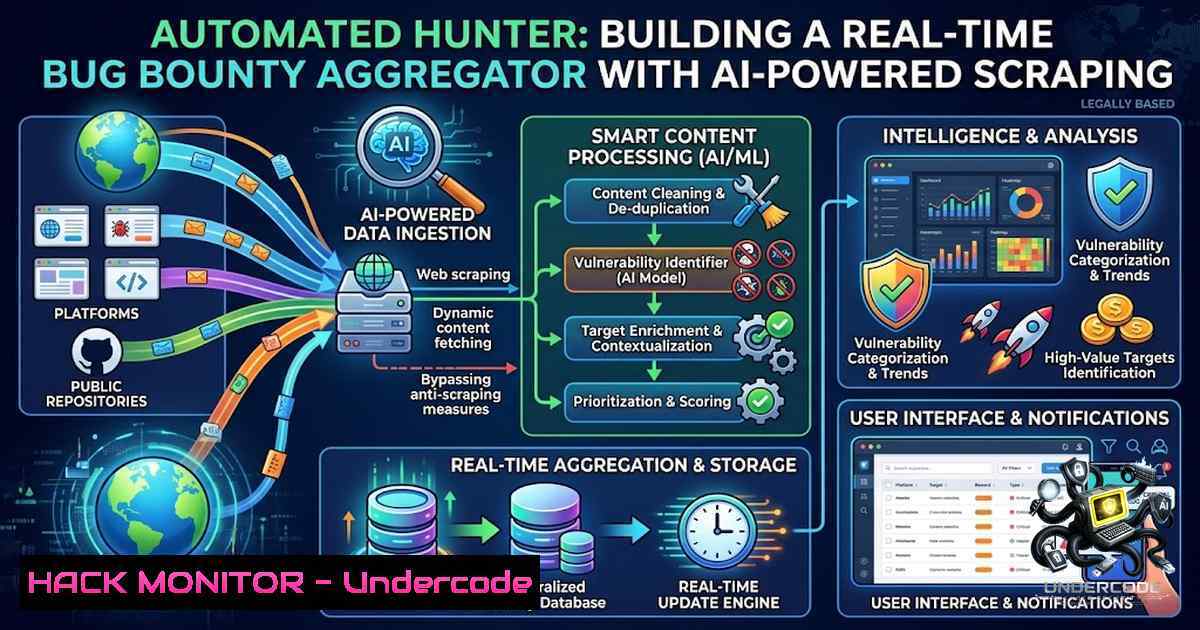
In the competitive world of bug bounty hunting, timing is everything; a vulnerability discovered minutes after a program launches can mean the difference between a $5,000 payout and a duplicate report. To solve this, security researchers are increasingly turning to automation and AI to monitor multiple disclosure platforms in real-time. This article explores the creation of a cross-platform bug bounty scraper, detailing the architecture, the AI tools used for development, and the critical validation steps required to ensure data integrity.
Learning Objectives & Secrets:
- Objective 1: Master the fundamentals of web scraping for bug bounty programs across platforms like HackerOne, Bugcrowd, and Intigriti.
- Objective 2 (Secret Tip): Don’t just rely on the raw HTML; learn to identify and parse the JSON endpoints often used to fetch data dynamically, which are faster and more reliable.
- Objective 3 (Secret Tip): Implement a “health check” system that validates the structural integrity of your scraped data (e.g., does each row contain a URL and a bounty amount?) to automatically detect and alert you to a broken scraper.
You Should Know:
1. The Scraping Architecture & AI Repair Mechanism
The core of this project involves using “Scraper Studio,” an AI-assisted tool that writes the scraping logic based on natural language prompts. Instead of manually writing XPath or CSS selectors, the engineer described the target data (program name, launch date, payout range) and the AI generated the code.
Step‑by‑Step Guide to Setting Up an AI-Assisted Scraper:
- Step 1: Sign up for a web scraping platform that offers AI integration (e.g., Bright Data’s Scraper Studio).
- Step 2: Define your “Dataset” by providing sample URLs from the target platform.
- Step 3: Use natural language prompts like: “Extract the program name, the URL, and the current bounty amount from this listing page.”
- Step 4: The AI generates the scraping code. Deploy the scraper to a cloud environment to run on a schedule.
- Step 5: Implement an error-handling webhook. If the scraped data structure deviates (e.g., the HTML changes), the AI triggers an auto-repair process to update the selectors.
- Step 6: Set up a notification (e.g., via Telegram or email) to alert you when a new program is successfully scraped.
2. Data Validation and Integrity Checks
As noted in the post, “a scraper can return 63 rows and still be completely broken.” This is a classic data validation pitfall where the structure is fine, but the content is stale or irrelevant. The solution involves creating a secondary validation layer that checks the parsed data against a set of business rules.
Step‑by‑Step Guide to Validating Scraped Data:
- Step 1: Write a Python script that reads the scraped output (e.g., a CSV or JSON file).
- Step 2: Define a list of “must-have” keywords or regex patterns for the data, such as the presence of a date or a specific currency symbol.
- Step 3: Example Linux command to validate a CSV line count vs. expected structure:
Check if the CSV has the correct number of columns (e.g., 3) awk -F, '{print NF}' scraped_data.csv | sort -u - Step 4: Write a Python script to verify that the “Program URL” field contains a valid domain.
import pandas as pd df = pd.read_csv('scraped_data.csv') Check for null values in critical columns assert df['Program Name'].notna().all(), "Missing program names!" Check if URLs start with http assert df['URL'].str.startswith('http').all(), "Invalid URLs detected!" - Step 5: If validation fails, trigger a rollback to the previous known-good data set or send a high-priority alert.
3. Multi-Platform Aggregation and Scheduling
To watch “six platforms,” you need a scheduler. This involves using cron jobs (Linux) or Task Scheduler (Windows) to run your scrapers at staggered intervals, respecting the target websites’ `robots.txt` and rate limits.
Step‑by‑Step Guide to Scheduling Scrapers:
- Step 1: Organize your scrapers into a single directory.
- Step 2: Write a master bash script to run them sequentially.
- Step 3: Linux Crontab example to run every hour:
Edit crontab
crontab -e
Add line: 0     /usr/bin/python3 /path/to/master_scraper.py >> /var/log/scraper.log 2>&1
- Step 4: For Windows, use Task Scheduler to trigger a PowerShell script:
save as run_scraper.ps1
python C:\scrapers\master_scraper.py
- Step 5: Rotate user-agents and proxies to avoid IP bans. Implement a proxy list in your scraper configuration.
4. Integration and Notification Systems
The “secret sauce” is the notification system. Once a new bug bounty is detected and validated, it must be pushed to the researcher immediately. This is typically done via Discord webhooks, Slack bots, or email.
Step‑by‑Step Guide to Setting Up a Notification Pipeline:
- Step 1: Generate a Webhook URL in your Discord server or Slack workspace.
- Step 2: In your Python script, add a function to send a POST request to the webhook.
- Step 3: Example code to send a Discord notification:
import requests def send_discord_alert(program_name, url): webhook_url = "YOUR_DISCORD_WEBHOOK_URL" data = {"content": f"🚨 NEW BOUNTY ALERT! {program_name} - {url}"} response = requests.post(webhook_url, json=data) - Step 4: Add a deduplication check to ensure you don’t send the same alert twice.
5. Security Considerations for Scrapers
When building scrapers, you interact with third-party APIs and websites. This presents risks such as leaking API keys or scraping sensitive data unintentionally. The tool must be hardened.
Step‑by‑Step Security Hardening Guide:
- Step 1: Never hardcode credentials. Use environment variables.
export SCRAPER_API_KEY="your_key_here"
- Step 2: In your Python code, use `os.getenv(‘SCRAPER_API_KEY’)` to retrieve them.
- Step 3: If you are scraping bug bounty platforms, ensure you are within their terms of service (usually, public program listings are fine, but private programs are not).
- Step 4: Sanitize your logs. Avoid printing sensitive data.
- Step 5: Limit the scraper’s scope strictly to the public program index pages to avoid accidentally executing JavaScript-heavy sections that could violate policies.
6. Handling Scraper Errors and Auto-Recovery
The post mentions a scraper breaking “halfway through the week” and the AI repairing it. This is a futuristic approach to error handling. In more traditional terms, this involves try/except blocks and fallback selectors.
Step‑by‑Step Guide to Implementing AI-Driven Recovery:
- Step 1: Implement a heartbeat check. If the script returns an error code (e.g., 403 for forbidden or 500 for server error), the system triggers a “re-prompt.”
- Step 2: The recovery script sends the current HTML snippet back to the Scraper Studio API asking for new selectors.
- Step 3: The new selectors are tested against a local cached “correct” dataset. If the test passes, the scraper is updated live and the script restarts.
What Undercode Say:
- Key Takeaway 1: Speed in bug bounty is not just about being fast; it’s about being automated. Building the tool to remove human latency from the discovery phase is the ultimate competitive advantage.
- Key Takeaway 2: The biggest challenge isn’t writing the scraper—it’s maintaining it. The ability to automatically validate data and repair broken scrapers (whether via AI or robust code) is what separates a successful tool from a fragile proof-of-concept.
- Analysis: The use of “AI” to write and repair scrapers is a double-edged sword. It democratizes web scraping, allowing less experienced engineers to build complex tools quickly. However, the reliance on AI can lead to a lack of understanding of the underlying web technologies, which is dangerous when you need to manually debug a complex anti-scraping mechanism. The core lesson here is that while AI accelerates development, data validation remains a critical human-in-the-loop task. The failure point is rarely the scraping itself, but the misinterpretation of the scraped data. This tool highlights the necessity of building robust observability into your automation pipelines.
Prediction:
- +1: The trend of AI-generated scraper code will significantly lower the barrier to entry for bug bounty hunting, leading to a surge in the volume of reported vulnerabilities, which is positive for software security.
- +1: This approach will force bug bounty platforms to adopt more robust API solutions for program data, as scraping becomes less efficient, leading to better official channels for researchers.
- -1: Increased automation may lead to a higher volume of low-quality, automated vulnerability reports, overwhelming triage teams and potentially causing high-signal reports to be lost in the noise.
- -1: If not carefully managed, aggressive scraping by thousands of individual researchers could be perceived as a DDoS attack, resulting in IP bans or legal challenges for the researchers.
▶️ Related Video (86% Match):
🎯Let’s Practice For Free:
🎓 Live Courses & Certifications:
Join Undercode Academy for Verified Certifications
🚀 Request a Custom Project:
Secure, high-velocity infrastructure and disruptive technological engineering. Contact our engineering team for high-tier development and proprietary systems:
[email protected]
💎 Smart Architecture | 🛡️ Secure by Design | ⭐ Trusted by Thousands
IT/Security Reporter URL:
Reported By: https://lnkd.in/p/ehQj6cCJ – Hackers Feeds
Extra Hub: Undercode MoN
Basic Verification: Pass ✅


