
Listen to this Post
Introduction:
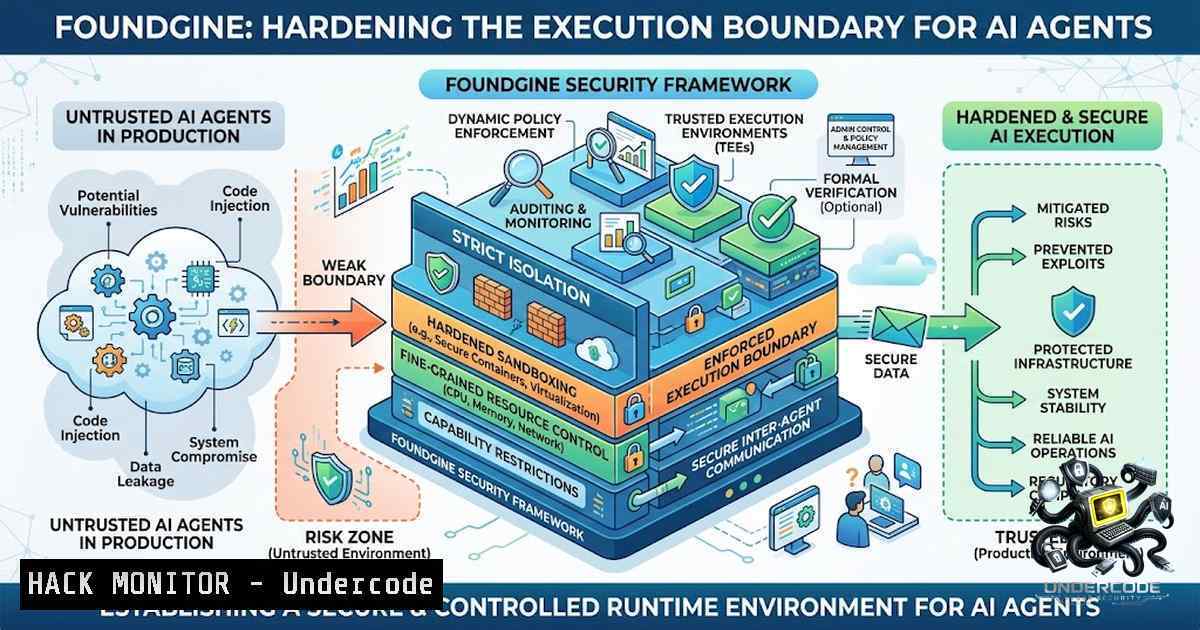
As organizations rapidly deploy AI agents capable of expressing intent and invoking actions, a critical security question emerges: how do you ensure that an agent’s request does not translate into unauthorized control over protected application state? Foundgine addresses this by establishing a controlled execution path—from intent to PostgreSQL—where authorization, ownership, and business logic remain firmly outside the agent’s reach【0†L16-L20】. With 9,226 NuGet downloads in just nine days, the project is now undergoing rigorous adversarial testing to validate that its architecture can reliably enforce these boundaries at scale【0†L4-L6】.
Learning Objectives & Secrets:
- Objective 1 – Understand the Intent-to-Execution Pipeline: Learn how Foundgine transforms an AI agent’s natural language or structured intent into a semantically validated execution plan, ensuring that the agent never directly manipulates application state.
- Objective 2 Secret Tip – Exploit Authorization Gaps Before They Exploit You: When pen-testing agentic systems, always attempt to mix valid, invalid, and unauthorized operations in a single session. Foundgine’s Supply Chain benchmark deliberately does this to test whether the execution boundary holds when requests are malformed or malicious【0†L16-L18】.
- Objective 3 Secret Tip – Leverage Idempotency as a Security Control: Replay attacks are a hidden threat in agent-driven workflows. Foundgine’s PlaceOrder flow includes replay/idempotency protection—a control that many teams overlook when designing agent APIs【0†L14-L15】.
You Should Know:
- The Execution Boundary: Why AI Agents Must Never Control State
The core invariant of Foundgine is simple yet profound: an AI agent may express intent, but it must not control protected application state【0†L20】. This means the agent cannot decide what it is authorized to do, whose data it can modify, what a price should be, whether inventory exists, whether a mutation should be committed, or whether a replay should be accepted【0†L18-L20】. All these decisions remain inside the controlled execution path: Intent → MCP → Semantics → Authorization → Planner → ExecutionIR → PostgreSQL【0†L21-L22】.
Step‑by‑step guide to testing the execution boundary:
- Isolate the authorization layer: Run unit tests that validate semantic, execution, authorization, and security components in isolation【0†L9】.
- Simulate adversarial intent: Use penetration tests that deliberately attempt to manipulate semantic intent or bypass the intended execution model【0†L11】.
- Test authorization violations: Craft requests with invalid ownership, expired tokens, or cross-tenant data access to see if the execution boundary rejects them【0†L12】.
- Monitor the execution evidence: Foundgine generates execution evidence for each operation—use this to audit what the agent requested versus what was actually committed【0†L15】.
-
The Supply Chain Agent Benchmark: A Real-World Workload
Foundgine’s end-to-end benchmark—AI Agent → MCP → Foundgine → PostgreSQL—is not a synthetic test【0†L13】. It exercises real supply chain logic including authorization, ownership enforcement, inventory validation, server-side pricing, atomic mutations, replay/idempotency protection, and execution evidence generation【0†L14-L15】. The benchmark deliberately mixes valid, invalid, and unauthorized operations to test what happens when those requests cross the boundary【0†L23】.
Step‑by‑step guide to running the benchmark (conceptual):
- Clone the Foundgine benchmark repository and configure your PostgreSQL instance.
- Set up the MCP (Model Context Protocol) server to route agent requests to Foundgine.
- Run the test suite that exercises the PlaceOrder flow with a mix of legitimate and malicious payloads.
- Review the execution logs to confirm that unauthorized price modifications, inventory overrides, and replay attempts were all rejected at the authorization layer.
3. Hardening PostgreSQL for Agentic Workloads
Since Foundgine uses PostgreSQL as the persistence layer, database-level hardening is essential【0†L10】. Agent-generated queries must be sanitized, and row-level security (RLS) policies should enforce ownership checks at the database level.
PostgreSQL hardening commands:
-- Enable row-level security on the orders table
ALTER TABLE orders ENABLE ROW LEVEL SECURITY;

-- Create a policy that ensures users can only access their own orders
CREATE POLICY order_isolation ON orders
USING (user_id = current_setting('app.current_user_id')::INT);

-- Revoke public write permissions and grant only through stored procedures
REVOKE INSERT, UPDATE, DELETE ON orders FROM PUBLIC;
GRANT EXECUTE ON FUNCTION place_order(...) TO app_role;
Linux command to monitor PostgreSQL connections and detect anomalies:
 Watch active connections and query patterns
watch -1 2 "psql -U postgres -c 'SELECT pid, usename, application_name, client_addr, state, query FROM pg_stat_activity WHERE state = \"active\";'"

Log all queries for audit (set in postgresql.conf)
log_statement = 'all'
log_line_prefix = '%t [%p]: [%l-1] user=%u,db=%d,app=%a,client=%h '
4. Securing the MCP (Model Context Protocol) Layer
The MCP layer acts as the gateway between the AI agent and Foundgine【0†L13】. Any vulnerability here could allow an attacker to inject malicious context or bypass authorization checks.
Step‑by‑step guide to MCP security:
- Validate all incoming context: Ensure that the MCP server validates the structure and schema of every request before forwarding it to Foundgine.
- Implement rate limiting: Agentic systems can generate high request volumes—use token-bucket or sliding-window rate limiters to prevent DoS.
- Enforce TLS mutual authentication: Require client certificates for all MCP connections to prevent man-in-the-middle attacks.
- Log all MCP requests: Maintain an audit trail of every intent expressed by the agent, including the raw payload and the resulting execution plan.
Linux command to set up a basic rate limiter with iptables:
 Limit MCP traffic to 100 connections per minute per IP
iptables -A INPUT -p tcp --dport 8080 -m state --state NEW -m recent --set
iptables -A INPUT -p tcp --dport 8080 -m state --state NEW -m recent --update --seconds 60 --hitcount 100 -j DROP
5. Penetration Testing Agentic Systems: What to Break
Foundgine’s adversarial intent tests are designed to deliberately attempt to manipulate semantic intent or bypass the execution model【0†L11】. This is a crucial practice for any organization deploying AI agents.
Step‑by‑step guide to pen-testing your agentic system:
- Test semantic injection: Attempt to craft agent prompts that cause the system to interpret “delete” as “update” or “transfer” as “grant”.
- Test authorization boundary bypass: Try to access resources owned by other tenants or users by manipulating the agent’s context.
- Test replay attacks: Capture a legitimate request and replay it multiple times to see if idempotency controls reject duplicates【0†L15】.
- Test inventory manipulation: Attempt to place orders for negative quantities or items that are out of stock to see if server-side validation holds【0†L14】.
- Test price override: Try to modify the price field in the agent’s request and verify that the server-side pricing logic overrides it【0†L14】.
Windows PowerShell command to simulate a replay attack:
 Capture a request and replay it with Invoke-WebRequest
$body = @{ "orderId" = "123"; "quantity" = 5 } | ConvertTo-Json
Invoke-WebRequest -Uri "https://your-foundgine-api/placeorder" -Method POST -Body $body -ContentType "application/json"

Replay the same request immediately
Invoke-WebRequest -Uri "https://your-foundgine-api/placeorder" -Method POST -Body $body -ContentType "application/json"
 Expected: second request should be rejected due to idempotency protection
What Undercode Say:
- Key Takeaway 1: Downloads are not proof of security. Foundgine’s 9,226 downloads in 9 days【0†L4-L5】 are encouraging, but the real validation comes from the adversarial tests that deliberately try to break the execution boundary【0†L6-L8】. This mindset—testing for failure rather than celebrating adoption—is what separates production-ready systems from prototypes.
- Key Takeaway 2: The execution boundary is the single most important control in agentic AI. By keeping authorization, pricing, inventory, and mutation decisions inside the controlled path【0†L18-L20】, Foundgine ensures that even if an agent is compromised or prompt-injected, the underlying application state remains protected. This is a architectural pattern that every AI engineering team should adopt.
Analysis: The Foundgine approach highlights a broader trend in AI security: the shift from perimeter-based defenses to intent-based controls. Traditional security assumes a human user with explicit credentials; agentic security must assume an AI that can generate infinite variations of requests, some of which may be malicious or unintended. Foundgine’s pipeline—where intent is parsed, authorized, planned, and only then executed—provides a blueprint for how to build agentic systems that are both powerful and safe. The inclusion of execution evidence is particularly noteworthy, as it creates an immutable audit trail that can be used for post-incident analysis and regulatory compliance. As agentic AI moves from demo to production, expect to see more frameworks adopting similar patterns, with a focus on semantic validation and invariant enforcement at every layer of the stack.
Prediction:
- +1 The demand for agentic AI security frameworks will surge over the next 12–18 months, with Foundgine positioning itself as a reference architecture for .NET-based agent deployments.
- +1 The MCP (Model Context Protocol) will become a standard interface for agent-to-system communication, driving the need for standardized security controls across all MCP implementations.
- -1 Organizations that deploy AI agents without an execution boundary like Foundgine’s will face significant security incidents, including data exfiltration and unauthorized state mutations, as attackers increasingly target the agent layer.
- -1 The complexity of testing agentic systems—mixing valid, invalid, and unauthorized operations【0†L23】—will overwhelm under-resourced security teams, leading to a wave of agent-related vulnerabilities in production.
- +1 Open-source projects like Foundgine that openly share their test harnesses and benchmarks【0†L13-L15】 will accelerate the maturation of the entire agentic AI ecosystem, reducing the learning curve for new adopters.
▶️ Related Video (88% Match):
🎯Let’s Practice For Free:
🎓 Live Courses & Certifications:
Join Undercode Academy for Verified Certifications
🚀 Request a Custom Project:
Secure, high-velocity infrastructure and disruptive technological engineering. Contact our engineering team for high-tier development and proprietary systems:
[email protected]
💎 Smart Architecture | 🛡️ Secure by Design | ⭐ Trusted by Thousands
IT/Security Reporter URL:
Reported By: https://lnkd.in/p/ePR22kYp – Hackers Feeds
Extra Hub: Undercode MoN
Basic Verification: Pass ✅


