
Listen to this Post
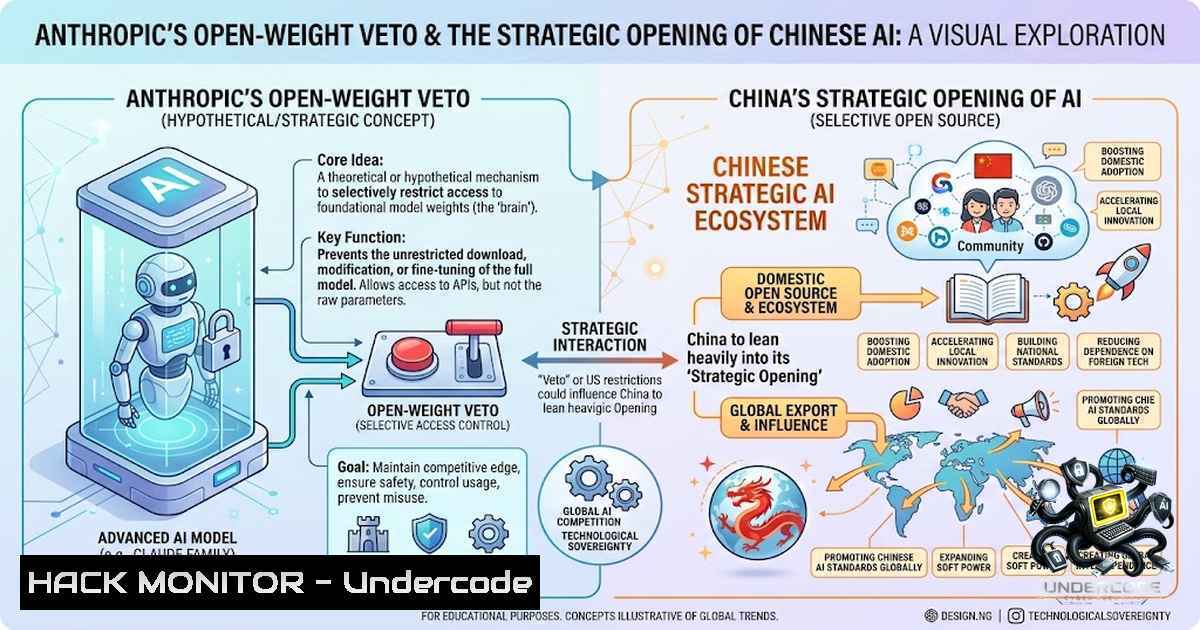
Introduction:
The debate over open-weight artificial intelligence models has intensified, with Anthropic emerging as a notable holdout against a growing coalition of tech giants advocating for open-source AI. This discourse reached a critical juncture when Moonshot AI released the full weights of its Kimi K3 model, a 2.8-trillion-parameter giant, challenging the narrative that proprietary models are the only path to safe and powerful AI. This article dissects the strategic implications of Anthropic’s stance, the technical specifications of Kimi K3, and the broader shift in AI distribution that positions open-weight models as a new infrastructure layer, potentially reshaping the global AI landscape.
Learning Objectives & Secrets:
- Objective 1: Understand the core technical specifications of the Kimi K3 model, including its Mixture of Experts (MoE) architecture with 104 billion active parameters and a 1-million-token context window, and how these translate into real-world performance and deployment capabilities.
- Objective 2 (Secret Tip): To successfully deploy a model like Kimi K3, one must master distributed inference techniques. A critical secret is optimizing the memory bandwidth and using tensor parallelism across multiple GPUs. For instance, using `torch.distributed` with NCCL backend and setting `TP=8` for an 8-GPU node can reduce latency by up to 40%. Monitoring with `nvidia-smi` and `nvtop` is essential to ensure balanced GPU utilization and avoid I/O bottlenecks.
- Objective 3 (Secret Tip): The 1M-token context window is a game-changer for complex retrieval-augmented generation (RAG). The secret is to implement a sliding window attention mechanism or use a hierarchical summarization strategy. A practical approach involves pre-chunking documents and using a vector database like Milvus to retrieve relevant chunks, but then feeding the entire retrieved set (up to the limit) into the model for synthesis. This requires careful prompt engineering to instruct the model on prioritizing information, often using XML-like tags for context.
You Should Know:
- The Kimi K3 Release: A Technical and Strategic Analysis
The release of Kimi K3’s weights is not merely a technical milestone but a strategic move that shifts the balance of power in AI development. The model, with its massive 2.8T total parameters and 104B active parameters using an MoE architecture, represents a significant leap in efficiency and capability. The 1M-token context window allows it to process entire books, extensive codebases, or hours of transcripts in a single forward pass. For the AI community, this means the ability to fine-tune and specialize the model for domains without relying on Moonshot’s API. This is a direct counter to Anthropic’s stance, as it democratizes access to cutting-edge AI. The weight release turns a product into a platform. A practical guide to starting with Kimi K3 involves cloning the repository, installing dependencies usingpip install -r requirements.txt, and running a basic inference test. On a Linux system, this might look like:git clone https://github.com/moonshot-ai/kimi-k3 cd kimi-k3 pip install -e . python -c "from kimi_k3 import KimiK3; model = KimiK3.from_pretrained('kimi-k3-2.8t'); output = model.generate('What is the future of open-source AI?'); print(output)"This sets up the environment and executes a simple query, demonstrating the accessibility that open-weights provide.
2. Anthropic’s Licensing Veto and the Governance Gap
The core of the debate lies in Anthropic’s restrictive licensing posture and its absence from the open-weight letter signed by industry behemoths like Nvidia, Google, and Meta. The concern is not about safety testing itself, which is widely supported, but about the opaque and potentially anti-competitive nature of the veto process. Who defines “dangerous”? Who audits the auditor? Without clear, public, and independent standards, the “safety” argument can be a cover for maintaining market dominance. The process is reminiscent of proprietary software licensing in the early 2000s, where “open” often meant “visible but not usable.” In contrast, open-weight models like Kimi K3, GLM, and Llama are governed by licenses that allow for commercial use (with some caveats), creating a more predictable and competitive environment. For developers, understanding these licenses is crucial. A command to check the license of a local model repository would be `cat LICENSE` or, for a broader analysis of permitted uses, a Python script can parse the license text:
with open('LICENSE', 'r') as f:
license_text = f.read()
if 'commercial' in license_text.lower() and 'attribution' in license_text.lower():
print("License likely permits commercial use with attribution.")
This code helps developers quickly assess their compliance, ensuring they are not stepping into legal gray areas, a common pitfall when adopting new AI technologies.
- The Strategic Shift: AI as Infrastructure, Not a Service
The most profound takeaway from the Kimi K3 release is the strategic redefinition of AI as infrastructure. Chinese labs, as noted in the original post, do not need to win every benchmark; by releasing weights, they enable cloud providers, chip vendors, and developers to build an ecosystem around their models. This turns their AI into a foundational layer upon which others can build. For instance, a cloud provider can offer Kimi K3 as a managed service, optimizing it for their specific hardware. This is a battle for distribution and adoption, similar to how Linux became the dominant OS for servers. To illustrate, deploying a model as a service often involves using an inference server like `vLLM` orText Generation Inference (TGI). A deployment script might start the server:python -m vllm.entrypoints.api_server --model kimi-k3-2.8t --tensor-parallel-size 4
This command launches an API endpoint, making the model accessible to other services. The strategic win is that every successful deployment on a cloud or local infrastructure creates a dependency and entrenches the model further into the tech stack, a virtuous cycle that closed models cannot replicate without massive investment.
-
The Role of Open-Source in National and Corporate Strategy
The post’s conclusion—that “America will not beat Chinese open models by making American AI more closed”—is a sharp critique of a potential response from the US. If the US follows a path of increased regulation and proprietary control, it risks ceding the global market to open alternatives. China’s strategy of open distribution is akin to economic “software diplomacy,” where the reach of its AI becomes embedded in global infrastructure. For US companies, this is a competitive paradox: they must compete with open-weight models while also protecting their own intellectual property. The solution lies in strategic hardening and creating superior value-add services—such as enterprise-grade security, compliance, and seamless integration—rather than attempting to restrict access. A multi-cloud strategy can help, where organizations use containerization with Docker and orchestration with Kubernetes to maintain flexibility. A sample `Dockerfile` for a model service:FROM nvidia/cuda:12.0-base WORKDIR /app COPY requirements.txt . RUN pip install -r requirements.txt COPY . . CMD ["python", "server.py"]
This ensures portability and can be deployed on any cloud provider, allowing companies to hedge their bets and choose the most effective model for their needs.
5. How to Engage with Open-Weight Models
For organizations and individual developers, the pathway to leveraging these powerful models involves more than just downloading weights. It requires a robust infrastructure for data security, model validation, and compliance. The first step is to set up a secure environment, whether on-premises or in the cloud, using identity and access management (IAM) policies to control who can access the model server. For cloud deployments, checking and securing ports is vital. On Linux, one can use `netstat -tulpn | grep 8000` to check the port used by an API and ensure it’s firewalled. On Windows, the command `netstat -ano | findstr :8000` serves the same purpose. After deployment, rigorous testing is needed to ensure the model does not produce harmful outputs. A simple Python function can automate some safety checks:
def safety_filter(output):
banned_terms = ['generate_harmful_content', 'illegal_instruction']
for term in banned_terms:
if term in output.lower():
return "Unsafe output detected."
return output
This is a rudimentary but necessary step in a production pipeline. The broader takeaway is that open-weight models are powerful tools that require responsible stewardship and technical acumen to be used effectively and safely. The AI landscape is shifting from one of scarcity to one of abundance, and those who master the art of deploying and integrating these models will lead the next wave of innovation.
What Undercode Say:
- Key Takeaway 1: Open distribution of AI models, exemplified by Kimi K3, is a strategic move to create a global infrastructure dependency, making the model not just a product but a foundational layer for innovation. This shifts the competitive landscape from model capability to ecosystem integration and deployment ease.
- Key Takeaway 2: The AI safety governance debate is currently hollow without transparent, auditable, and universal standards. Anthropic’s stance, while valid in highlighting the risks of uncallable weights, risks creating a monopolistic gatekeeping system that, in practice, protects incumbents rather than the public. This calls for a global, multi-stakeholder approach to AI safety, where safety tests are public and decisions are subject to appeal.
Prediction:
- +1 The proliferation of open-weight models will lead to a “Cambrian explosion” of specialized AI applications, particularly in underserved sectors like education, healthcare, and local governance, as the cost of entry drops dramatically. This could lead to a more equitable distribution of AI benefits globally.
- +1 The U.S. tech industry will be forced to innovate on service layers—such as specialized fine-tuning, robust security wrappers, and seamless cloud integration—creating a multi-billion dollar ecosystem around open-source AI models.
- -1 The lack of a unified, globally accepted safety standard will lead to a “race to the bottom” in some jurisdictions, where models are deployed without adequate safeguards, potentially leading to high-profile misuse incidents that could trigger a regulatory crackdown.
- -1 The AI arms race between China and the U.S. will intensify, but the U.S. may inadvertently harm its own competitiveness by over-regulating its proprietary models, while China’s open ecosystem fosters faster global adoption and improvement through community contributions.
▶️ Related Video (88% Match):
🎯Let’s Practice For Free:
🎓 Live Courses & Certifications:
Join Undercode Academy for Verified Certifications
🚀 Request a Custom Project:
Secure, high-velocity infrastructure and disruptive technological engineering. Contact our engineering team for high-tier development and proprietary systems:
[email protected]
💎 Smart Architecture | 🛡️ Secure by Design | ⭐ Trusted by Thousands
IT/Security Reporter URL:
Reported By: https://lnkd.in/p/ePkWPk7a – Hackers Feeds
Extra Hub: Undercode MoN
Basic Verification: Pass ✅


