
Listen to this Post
Introduction:
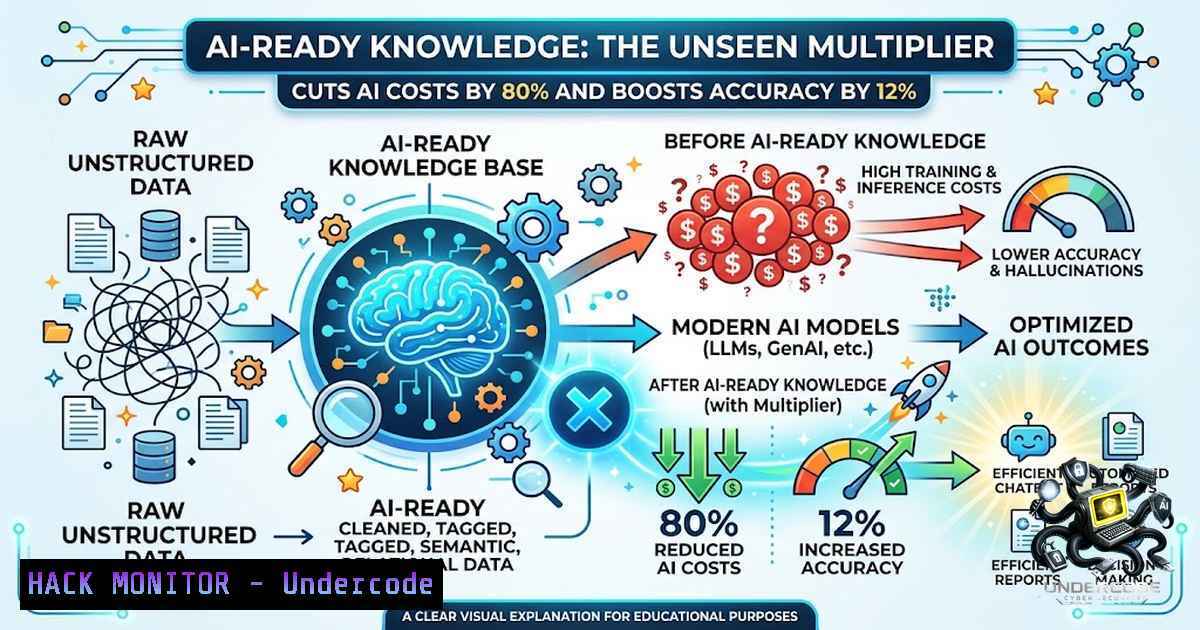
The artificial intelligence landscape has been dominated by a relentless pursuit of more sophisticated models. The prevailing narrative insists that the newest, largest, and most expensive model is the key to unlocking superior performance. However, a paradigm-shifting benchmark released this month challenges this assumption, revealing that the true bottleneck—and the greatest opportunity—lies not in the model itself, but in the quality and structure of the data it consumes. The results are staggering: a 12% increase in accuracy and an 80% reduction in cost, achieved simply by providing a well-governed “knowledge layer” to the same AI model. This effectively redefines AI ROI, proving that infrastructure and data governance are the new frontiers of competitive advantage. This article explores the technical and strategic imperatives of preparing your enterprise knowledge for the AI era.
Learning Objectives & Secrets:
- Objective 1: Data Governance as a Performance Lever. Understand how a structured, governed knowledge layer enhances model accuracy and efficiency, shifting focus from model selection to data preparedness.
- Objective 2: The Permissioning and Duplication Tax. Discover how messy SharePoint permissions and duplicate policy documents create “AI noise,” degrading performance and increasing operational costs. Secret Tip: Perform a data audit to identify and remediate conflicting data sources before any AI deployment.
- Objective 3: The Compound Value of a Static Knowledge Layer. Learn to view your knowledge architecture as a strategic asset that appreciates over time, independent of the rapidly changing AI model landscape. Secret Tip: Implement a “single source of truth” protocol for all critical business documents to ensure consistency.
You Should Know:
1. Auditing Your Data Landscape for AI Readiness
Before implementing any AI solution, a comprehensive audit of your data ecosystem is non-1egotiable. The benchmark highlighted that a lack of structure and governance directly impacts performance. Here’s how to start your audit.
Step-by-Step Guide:
- Step 1: Inventory Data Sources. Use PowerShell to scan your network for unstructured data. For a Windows environment, consider using the `Get-ChildItem` command to recursively list files and metadata.
Get-ChildItem -Path "\YourNetworkShare\" -File -Recurse | Select-Object FullName, Name, Extension, Length, LastWriteTime | Export-Csv -Path "C:\temp\file_inventory.csv" -1oTypeInformation
- Step 2: Analyze SharePoint Permissions. Misconfigured permissions lead to information silos and inconsistent data. Use the Microsoft Graph API or PowerShell modules to export site permissions for review.
Example to connect and list site permissions (requires PnP.PowerShell)
Connect-PnPOnline -Url "https://yourtenant.sharepoint.com/sites/yoursite" -Interactive
Get-PnPSitePermission | Export-Csv "C:\temp\site_permissions.csv"
- Step 3: Identify Duplicate Data. Use tools or scripts to find duplicate files by hash to eliminate “three different versions of the same policy doc.” On Linux, you can use
fdupes.fdupes -r /mnt/data/enterprise_share/ > duplicate_files.txt
- Step 4: Data Classification. Classify data based on sensitivity and relevance. Cloud-1ative tools like Microsoft Purview can automate this, but a quick script can tag files based on naming conventions or content patterns.
2. Building the Permissions and Access Logic
The “mess” of SharePoint permissions is a primary killer of AI accuracy. If your Copilot or AI model cannot reliably access the correct information, it will either hallucinate or fail. A well-structured permissions model is critical.
Step-by-Step Guide:
- Step 1: Define a Minimum Viable Access Policy. Adopt a Zero-Trust approach to data access. Ensure that permissions are granted only to the individuals or groups that need them.
- Step 2: Map Data to User Roles. Create a mapping of data repositories to organizational roles. For instance, HR data should only be accessible to HR and specific executives.
- Step 3: Automate Permission Provisioning. Use Active Directory (AD) or Azure AD groups to manage permissions dynamically.
Add a user to an AD Group to grant SharePoint access
Add-ADGroupMember -Identity "SharePoint_Sales_Read" -Members "[email protected]"
- Step 4: Regular Permission Reviews. Schedule periodic reviews to audit and revoke stale permissions. The following PowerShell script can be used to find inactive users:
Find inactive users in AD
Get-ADUser -Filter {Enabled -eq $true} -Properties LastLogonDate | Where-Object {$_.LastLogonDate -lt (Get-Date).AddDays(-90)}
3. Structuring Your AI-Ready Knowledge Graph
Instead of a flat file system, the benchmark suggests a “proper knowledge layer” that can be as sophisticated as a knowledge graph. This involves structuring data in a way that creates connections and context for the AI.
Step-by-Step Guide:
- Step 1: Define Your Ontology. Identify the key entities in your business (e.g., “Customer,” “Product,” “Contract”) and the relationships between them.
- Step 2: Represent Data in a Graph Format. For development, tools like Neo4j allow you to build and query a graph database. Use a CSV or JSON structure to import data.
- Step 3: Ingest Data into a Vector Database. For AI integration, use a vector database (like Pinecone, Weaviate, or Azure Cosmos DB) to store embeddings of your data. This enables semantic search.
Example Python snippet to generate embeddings and store them
import openai
import weaviate
(Assuming you have a client and api keys)
response = openai.Embedding.create(input="Your document text", model="text-embedding-ada-002")
embedding = response['data'][bash]['embedding']
Store embedding in Weaviate
client.data_object.create(data_object={"content": "Your text"}, class_name="Document", vector=embedding)
- The Cost-Saving Power of Context Windows and Compression
One reason costs dropped in the benchmark is that a well-structured knowledge layer allows the AI to find the exact piece of information needed instead of processing an entire document. This is the difference between a model consuming a 100-page contract vs. a single relevant clause.
Step-by-Step Guide:
- Step 1: Implement Data Chunking. Break down large documents into smaller, manageable “chunks” to be stored in the vector database.
- Step 2: Use Semantic Search for Retrieval. Write a retrieval function that only fetches the top-k most relevant chunks based on the user query.
- Step 3: Optimize Prompt Engineering. Structure your prompt to include only the retrieved context, drastically reducing the token count and thus the cost per inference. Refer to OpenAI’s best practices on prompt engineering for cost efficiency.
Pseudo-code for efficient prompting
query = "What is the cancellation policy for contract X?"
relevant_chunks = vector_db.search(query, k=3)
prompt = f"Based on the following context, answer the question.\nContext: {relevant_chunks}\nQuestion: {query}"
- Securing the AI Pipeline: API and Cloud Hardening
With the knowledge layer being the new crown jewel, securing it is paramount. The pipeline from user query to AI response must be hardened against data exfiltration and prompt injection attacks.
Step-by-Step Guide:
- Step 1: Implement API Gateways. All calls to the AI model should pass through an API gateway to enforce authentication, rate limiting, and input validation.
- Step 2: Use Azure Key Vault or AWS Secrets Manager. Never hardcode API keys. Use secrets management tools.
Using Azure CLI to retrieve a secret
az keyvault secret show --vault-1ame "MyKeyVault" --1ame "OpenAI-Key" --query "value" -o tsv
- Step 3: Apply Content Filters. Implement input and output filters to prevent prompt injection and to block sensitive data from being inadvertently returned by the model.
- Step 4: Monitor and Log. Enable detailed logging for your AI services. Use `Azure Monitor` or `CloudWatch` to track API usage, errors, and anomalous access patterns.
6. Monitoring API Usage and Performance
To ensure you are reaping the 80% cost benefit, you must monitor your AI’s performance and token consumption.
Step-by-Step Guide:
- Step 1: Set Up Alerts. Configure alerts for cost thresholds and performance anomalies.
- Step 2: Log Token Usage. Ensure your application logs the
prompt_tokens,completion_tokens, and `total_tokens` for every transaction. - Step 3: Create a Simple Monitoring Dashboard. Use a tool like Grafana or Power BI to visualize performance. A simple bash script can also be used to parse logs.
Script to monitor token usage from a log file
grep "total_tokens" /var/log/ai_app.log | awk '{sum += $2} END {print "Total Tokens: " sum}'
7. Future-Proofing Your AI Model Strategy
The post emphasizes that the model will change (GPT today, Claude tomorrow). The knowledge layer is the constant. This requires an “abstraction” layer in your code.
Step-by-Step Guide:
- Step 1: Use Adapter Patterns. Write a wrapper class in your code that handles the interaction with the AI model. This allows you to swap out model providers (e.g., from OpenAI to Azure OpenAI) without rewriting the entire application.
class AIClient:
def <strong>init</strong>(self, provider):
if provider == "openai":
self.client = openai.OpenAI()
elif provider == "azure":
self.client = openai.AzureOpenAI()
... etc.
def generate(self, prompt):
return self.client.completions.create(...)
- Step 2: Write Vendor-Agnostic Prompts. Avoid vendor-specific instructions in your system prompts.
- Step 3: Test Against Multiple Models. Regularly benchmark your knowledge layer against different models to gauge relative performance.
What Undercode Say:
- Key Takeaway 1: The Data is the Strategy. The market is saturated with models, but the true differentiator for an enterprise will be the quality and structure of its proprietary data. Organizations that invest in data governance and knowledge management are building a durable competitive edge that compounds over time, unlike the rapidly depreciating “model of the week.”
- Key Takeaway 2: Cost Optimization is a Data Problem. The dramatic cost reduction in the benchmark highlights a critical insight: optimizing for efficiency is not solely a model-slimming exercise; it begins with data preparation. A clean, well-indexed knowledge layer minimizes token consumption and computational overhead, directly impacting the bottom line of any AI initiative.
Analysis:
The benchmark results serve as a wake-up call for CIOs and AI leaders who have been fixated on the “AI arms race.” The 80% cost reduction is particularly significant, as it challenges the assumption that high-performing AI is inherently expensive. It reveals that a significant portion of the cost associated with Large Language Models is “waste” caused by poor data contextualization. By forcing the model to sift through irrelevant or conflicting data, organizations are effectively paying a “confusion tax.” This means that the fastest path to AI ROI is not through haggling with model vendors but through disciplined internal data hygiene. The call to action is clear: stop asking “which model is best” and start asking “is our data ready for AI?” This shift from a model-centric to a data-centric approach will define successful AI adoption in the next five years. It validates that the principles of data management (governance, security, and structure) are more critical than ever in the age of generative AI.
Prediction:
- +1: The emphasis on data layer optimization will spawn a new wave of “KnowledgeOps” tools and roles, creating a booming ecosystem for data management software and highly specialized data engineering jobs.
- +1: Enterprises that successfully execute a data-centric AI strategy will see a faster time-to-market and higher adoption rates for internal AI tools, as employees will trust the accuracy and reliability of the outputs.
- -1: Organizations that fail to audit and clean their data before AI integration will suffer a “hallucination cascade,” where compounding data errors erode trust in AI solutions and lead to costly operational failures and security breaches.
- -1: The reliance on a centralized, well-structured knowledge layer creates a high-value target for adversaries. This trend will likely lead to an increase in sophisticated data exfiltration attempts and “data poisoning” attacks, necessitating a new frontier in AI security.
▶️ Related Video (76% Match):
🎯Let’s Practice For Free:
🎓 Live Courses & Certifications:
Join Undercode Academy for Verified Certifications
🚀 Request a Custom Project:
Secure, high-velocity infrastructure and disruptive technological engineering. Contact our engineering team for high-tier development and proprietary systems:
[email protected]
💎 Smart Architecture | 🛡️ Secure by Design | ⭐ Trusted by Thousands
IT/Security Reporter URL:
Reported By: https://lnkd.in/p/eQXKdN4i – Hackers Feeds
Extra Hub: Undercode MoN
Basic Verification: Pass ✅


