Listen to this Post
Introduction:
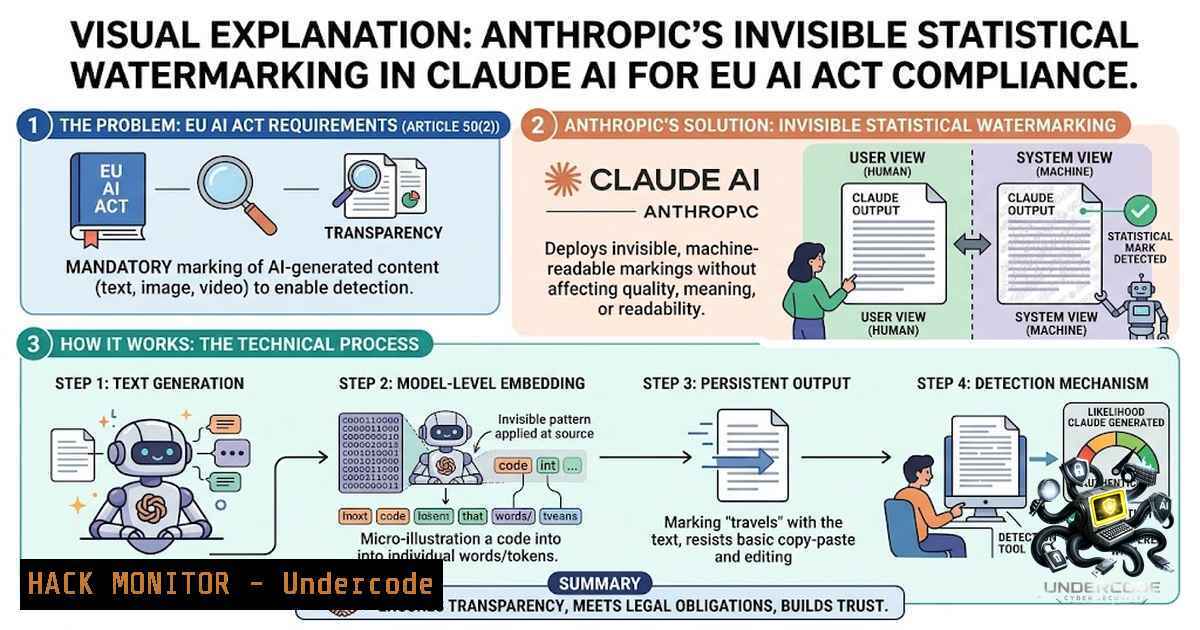
Anthropic has begun embedding imperceptible, model-level watermarks into all text generated by its Claude large language models, effective August 2, 2026, as part of its commitment to the EU AI Act’s 50(2) Code of Practice on Transparency of AI-Generated Content. Unlike visible markers or hidden characters, the system modifies the source of randomness during Claude’s token selection process—leaving a subtle statistical pattern across the output that is undetectable to human readers but verifiable with a cryptographic key. This watermarking applies globally across all Claude products including the API, Claude Code, Claude Cowork, and enterprise deployments through AWS, Google Cloud, and Microsoft Foundry, representing one of the first large-scale implementations of generative text watermarking in production.
Learning Objectives:
- Understand the technical implementation of Anthropic’s SynthID-Text-based watermarking and how it modifies token sampling without affecting output quality
- Learn to identify the scope of watermark deployment across Claude products, API endpoints, and cloud platforms
- Master detection methodologies including the forthcoming public API and statistical verification techniques
You Should Know:
- How Claude’s Statistical Watermark Works at the Token Level
Large language models generate text by selecting one token at a time from a probability distribution over possible next words. For example, given the prompt “The weather today was cold and…”, the model might consider “overcast” or “grey” as equally plausible continuations. Under normal circumstances, this choice is settled by a random number generator. Anthropic’s watermarking intercepts this process: instead of using an arbitrary random number generator, the system uses a cryptographic key combined with preceding context to influence which semantically equivalent token is selected.
The technical mechanism draws from Google DeepMind’s SynthID-Text approach, published in Nature in 2024. During generation, possible next tokens are divided into “green” and “red” lists using pseudorandomization. Tokens on the green list receive a small logit bonus, making them slightly more likely to be selected—but not so much that the model chooses words it wouldn’t normally consider. Over hundreds of token selections, this creates a detectable statistical signature: watermarked text will contain a higher proportion of green-list tokens than expected by chance. Detection involves counting these tokens and applying standard statistical tests to determine whether the deviation from expected distribution is significant.
For cybersecurity professionals, this represents a novel class of forensic evidence: unlike traditional malware signatures or network indicators, the watermark is a probabilistic signal embedded in the semantic structure of language itself. The watermark does not add characters, modify finished responses, or require extra tokens—meaning generation speed and cost remain unchanged.
2. Deployment Scope and Global Rollout Strategy
Anthropic began applying watermarks to all supported Claude models launched on or after August 2, 2026. The deployment is global, not regionally scoped, because the company stated it “doesn’t yet have a durable way to scope it by region”. This means users worldwide receive watermarked output regardless of location.
The watermarking covers:
- Claude Platform (API): All API responses from supported models carry the statistical watermark
- Claude Web Application: Consumer-facing chat outputs are watermarked
- Claude Code: Programming assistant outputs carry the watermark, though code generation may have reduced watermarking to preserve exactness
- Claude Cowork and Claude Tag: Enterprise collaboration tools are included
- Cloud Partner Deployments: Models accessed through AWS, Google Cloud, and Microsoft Foundry are watermarked
For file-based outputs including SVG, PNG, and JPG formats, Anthropic uses a complementary mechanism: signed provenance metadata based on the Coalition for Content Provenance and Authenticity (C2PA) open standard. This cryptographic signature acts as a “digital identity card” that can verify Claude processed the file and detect subsequent tampering.
Older Claude models launched before August 2, 2026 are covered by the EU’s transition period. Anthropic is working to retroactively add watermarking to these models over the coming months.
3. Detection API and Verification Methodology
Anthropic plans to release a free application programming interface (API) that will allow users and third parties to check text for Claude’s watermark. This addresses a key concern raised by tech investor Bill Gurley that only Anthropic would be able to identify the watermark, making the company “judge, jury, and prosecutor”.
The detection API will not definitively prove authorship—it estimates the probability that Claude generated or heavily edited a given text. Detection works by comparing the observed sequence of token choices against what would be expected if the watermark key were used during generation. Importantly, detection does not require access to the underlying LLM or computationally expensive operations, making it practical for large-scale content moderation.
For security researchers and developers, the detection workflow will resemble:
 Conceptual detection API call (forthcoming)
import requests

response = requests.post(
"https://api.anthropic.com/v1/detect-watermark",
headers={"Authorization": "Bearer YOUR_API_KEY"},
json={"text": "Suspicious content to check"}
)
 Returns: {"probability": 0.94, "confidence_interval": [0.89, 0.97]}
However, as of August 2026, Anthropic had not yet publicly disclosed the complete internal specifications of the sampling method, key management, or detector API. The company has committed to publishing detailed technical documentation as the system matures.
4. Limitations and Forensic Boundaries
The watermark has significant limitations that cybersecurity professionals must understand:
Watermark Persistence: While the watermark survives copy-paste, it “may persist through some editing” but not all. Heavy editing, paraphrasing, translation, or summarization can weaken or eliminate the signal. A text originally generated by Claude may lose its watermark after intensive human revision, while a human-written text that Claude subsequently proofreads or translates may acquire the watermark.
Not Definitive Authorship: The watermark indicates Claude processed the text, not necessarily that Claude authored it. This distinction matters for academic integrity, copyright claims, and content moderation. As one analysis noted, “the watermark can indicate technical processing, but does not automatically answer who conducted the research, formulated the text, or performed the essential intellectual work”.
Short Text Limitations: Very short passages may provide insufficient statistical material for reliable detection. The watermark relies on aggregating signals across many token selections.
Code and Factual Outputs: Watermarking is reduced or omitted in contexts requiring exact outputs, such as factual statements and code, to maintain correctness. This creates a forensic blind spot for technical content.
No User Identification: The watermark carries no identifying information and cannot be traced to a specific person, organization, or chat session. It is not a surveillance tool but a provenance signal.
5. Security Implications and the Watermark Removal Market
Within days of Anthropic’s announcement, a market for AI watermark removal emerged. Multiple “watermark remover” tools surfaced, including an open-source project with over 4,500 GitHub stars and paid AI detection evasion services. However, BleepingComputer reported that “none of the tools can be independently verified to actually remove the proprietary watermark, because Anthropic has not disclosed the watermark algorithm or released a detector”.
For security teams, this presents several considerations:
- Evasion Risk: Adversaries may attempt to strip watermarks through paraphrasing, translation, or token-level modifications. The statistical nature of the watermark means it is probabilistic rather than absolute.
- False Attribution Risk: Because Claude can watermark human-written text through proofreading or editing, organizations using detection alone may incorrectly flag legitimate human content.
- Compliance Requirements: Organizations deploying Claude in their own products should independently assess what 50 of the EU AI Act requires of their products and services. Non-compliance can result in fines up to €15 million or 3% of global annual turnover.
Technical Verification Exercise
For security researchers wanting to understand the underlying mechanism, consider this simplified Python simulation of the watermarking concept:
import random
import hashlib

Simplified illustration of green/red list watermarking
def simulate_watermarked_selection(candidates, key, prefix):
"""
Simulates watermark-biased token selection.
In production, this uses cryptographic PRF, not simple hashing.
"""
 Deterministically partition candidates using key + prefix
seed = int(hashlib.sha256(f"{key}{prefix}".encode()).hexdigest(), 16)
random.seed(seed)

Shuffle candidates deterministically
shuffled = candidates.copy()
random.shuffle(shuffled)

First half = "green list" (preferred)
green_list = set(shuffled[:len(shuffled)//2])

Slight bias toward green list tokens
 In production, this is a logit bonus, not rejection sampling
if random.random() < 0.6:  60% chance to prefer green
green_candidates = [t for t in candidates if t in green_list]
return random.choice(green_candidates) if green_candidates else random.choice(candidates)
return random.choice(candidates)

Detection: check if proportion of green tokens exceeds expected baseline
def detect_watermark(text_tokens, key, expected_green_rate=0.5):
"""
Simplified detection: count how many tokens fall in green list.
Statistical test would determine significance.
"""
green_count = 0
for i, token in enumerate(text_tokens):
prefix = " ".join(text_tokens[max(0, i-3):i])
seed = int(hashlib.sha256(f"{key}{prefix}".encode()).hexdigest(), 16)
random.seed(seed)
shuffled = text_tokens.copy()
random.shuffle(shuffled)
green_list = set(shuffled[:len(shuffled)//2])
if token in green_list:
green_count += 1
observed_rate = green_count / len(text_tokens)
return observed_rate > expected_green_rate  1.1  Threshold for demo
What Undercode Say:
- Key Takeaway 1: Anthropic’s watermark represents a fundamental shift from post-hoc AI detection (which analyzes style and predictability) to proactive signal embedding during generation. This is comparable to checking a security feature rather than assessing something based on outward appearance. The forensic community must develop new methodologies for statistical watermark detection and evasion analysis.
-
Key Takeaway 2: The watermark’s limitations—particularly its susceptibility to editing and its inability to distinguish between AI authorship and AI assistance—create significant challenges for content moderation, academic integrity, and copyright enforcement. Organizations cannot treat detection as definitive proof but rather as a probabilistic signal requiring human judgment.
Analysis: The deployment of invisible watermarks across Claude’s global output represents a watershed moment for AI transparency, but it also introduces new attack surfaces. Adversaries will inevitably develop watermark-stripping techniques through paraphrasing, translation, and token substitution—raising questions about the long-term efficacy of statistical watermarking as a forensic control. Meanwhile, the emergence of “watermark remover” tools with thousands of GitHub stars demonstrates the cat-and-mouse dynamic that will define this space. For defenders, the priority should be integrating Anthropic’s forthcoming detection API into content moderation workflows while understanding that the watermark is a compliance measure, not a security boundary. The EU’s enforcement mechanism—fines up to €15 million—provides strong incentive for compliance, but the technical limitations mean watermarks will supplement rather than replace human content review.
Prediction:
- +1 The widespread adoption of text watermarking by major AI providers (Anthropic, Google, OpenAI) will create a standardized provenance ecosystem, enabling platforms to automatically flag AI-generated content at scale and reducing the spread of AI-generated disinformation.
-
-1 The watermark’s statistical nature and vulnerability to editing will lead to a persistent arms race between watermarking developers and evasion tool creators, with no permanent technical solution—only escalating complexity and computational overhead.
-
+1 Anthropic’s decision to release a free detection API will foster third-party innovation in content provenance tools, creating new opportunities for cybersecurity vendors to build AI content verification services.
-
-1 False attribution risks—where human-written text edited by Claude acquires a watermark—could lead to wrongful content moderation decisions, academic integrity disputes, and legal challenges around copyright and authorship.
-
+1 The EU AI Act’s transparency requirements are driving technical innovation that may eventually become global standards, similar to GDPR’s influence on privacy practices worldwide.
-
-1 Organizations that fail to implement proper content provenance workflows may face regulatory penalties, particularly in the EU where fines can reach €15 million or 3% of global annual turnover.
▶️ Related Video (78% Match):
https://www.youtube.com/watch?v=0vKkbBrLLeo
🎯Let’s Practice For Free:
🎓 Live Courses & Certifications:
Join Undercode Academy for Verified Certifications
🚀 Request a Custom Project:
Secure, high-velocity infrastructure and disruptive technological engineering. Contact our engineering team for high-tier development and proprietary systems:
[email protected]
💎 Smart Architecture | 🛡️ Secure by Design | ⭐ Trusted by Thousands
IT/Security Reporter URL:
Reported By: https://lnkd.in/p/exvRa5Y7 – Hackers Feeds
Extra Hub: Undercode MoN
Basic Verification: Pass ✅


