Listen to this Post
Introduction:
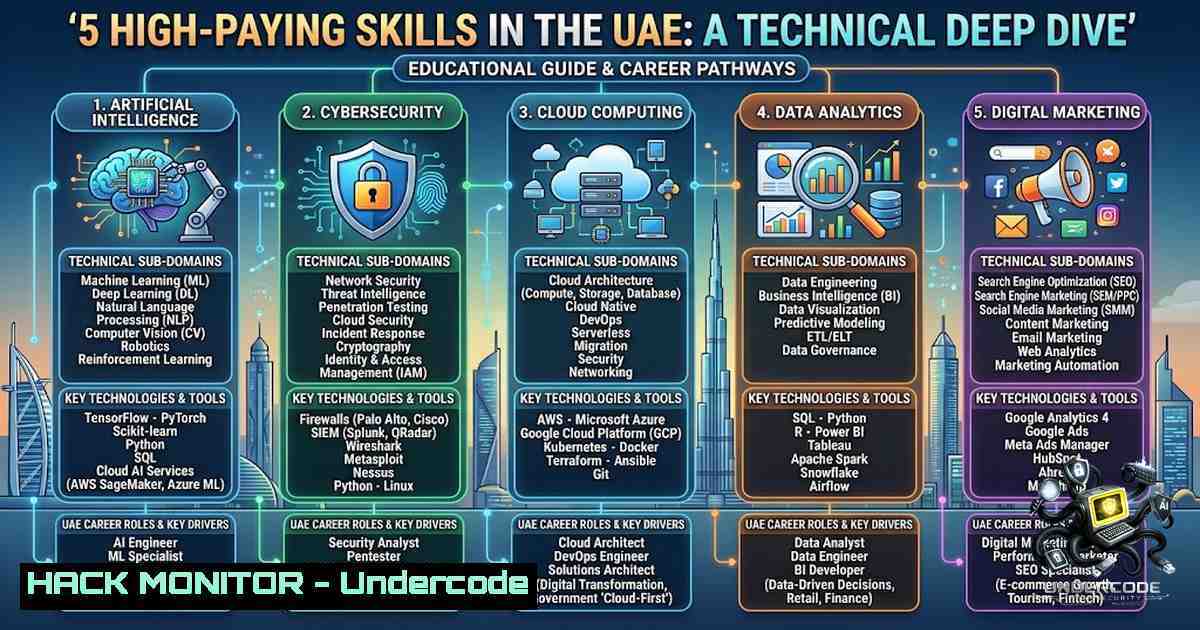
The UAE’s technology job market in 2026 is undergoing a fundamental restructuring driven by the Dubai D33 Economic Agenda and the Abu Dhabi Economic Vision 2030. Unlike global tech cycles that corrected in 2022–2023, the UAE has sustained demand for cloud architects, cybersecurity engineers, AI specialists, and data professionals, with cybersecurity architects earning AED 40,000–55,000 monthly. The National Cybersecurity Authority (NCA) and Telecommunications and Digital Government Regulatory Authority (TDRA) have made specific technical certifications and security competencies mandatory for roles in critical infrastructure and government systems. This article provides hands-on technical guidance across the five highest-demand skills identified in the UAE market: Artificial Intelligence & Machine Learning, Cybersecurity, Data Analytics & Data Science, Cloud Computing, and Digital Marketing & E-commerce.
Learning Objectives:
- Configure and harden cloud infrastructure using AWS CLI and Azure CLI with identity-based security controls
- Implement server hardening techniques including iptables, SELinux, and SSH security configurations
- Deploy AI-powered security tools for phishing detection and log analysis using Python and machine learning
- Execute penetration testing workflows using Kali Linux tools including SSTImap, Nmap, and Metasploit
- Build end-to-end data analytics pipelines integrating Python, SQL, and Power BI for business intelligence
- Cloud Security Hardening: AWS CLI and IAM Best Practices
Cloud security in the UAE enterprise landscape requires mastery of identity and access management (IAM) across AWS and Azure environments. The foundational principle is least privilege—granting only the permissions required for specific tasks.
Step 1: AWS CLI Configuration with IAM Identity Center (SSO)
Static IAM access keys are long-term credentials that pose a significant security risk if accidentally committed to version control or shared improperly. The AWS-recommended best practice is to use IAM Identity Center for temporary, short-lived credentials.
Enable IAM Identity Center via the AWS Management Console (must be done from the management account in AWS Organizations). Locate your SSO Start URL (format: `https://d-xxxxxxxxx.awsapps.com/start`) and region.
Configure the AWS CLI for SSO authentication:
aws configure sso
Follow the interactive prompts to enter your SSO Start URL, region, and preferred output format. This creates a profile in `~/.aws/config` that uses temporary credentials.
To verify your current identity and permissions:
aws sts get-caller-identity
This command confirms which account and identity principal is active.
Step 2: IAM Policy Enforcement
Never use root account credentials for daily operations—root has unlimited permissions and poses a catastrophic risk if compromised. Instead, create IAM users with specific policies:
{
"Version": "2012-10-17",
"Statement": [
{
"Effect": "Allow",
"Action": "s3:GetObject",
"Resource": "arn:aws:s3:::example-bucket/"
}
]
}
Enforce Multi-Factor Authentication (MFA) for all IAM users and implement a strong password policy. For enterprise environments, use named profiles to separate development, staging, and production environments:
aws configure --profile dev
aws configure --profile stg
aws configure --profile prod
Step 3: Azure CLI Security Configuration
For Azure environments, harden Network Security Groups (NSGs) with least-privilege inbound rules:
RG=rg-secure-demo
LOC=westeurope
VNET=vnet-secure
SUBNET=app-subnet
NSG=nsg-app

Create resource group and virtual network
az group create -1 $RG -l $LOC
az network vnet create -g $RG -1 $VNET -l $LOC \
--address-prefixes 10.10.0.0/16 \
--subnet-1ame $SUBNET --subnet-prefix 10.10.1.0/24

Create NSG and add HTTPS rule
az network nsg create -g $RG -1 $NSG
az network nsg rule create -g $RG --1sg-1ame $NSG -1 Allow-HTTPS-Internet \
--priority 100 --direction Inbound --access Allow --protocol Tcp \
--source-address-prefixes Internet --destination-port-ranges 443

Attach NSG to subnet
az network vnet subnet update -g $RG --vnet-1ame $VNET -1 $SUBNET \
--1etwork-security-group $NSG
Enable Azure CLI secrets warnings (enabled by default in Azure CLI 2.61+) to detect when commands output sensitive information:
az config set clients.show_secrets_warning=yes
- Linux Server Hardening: Firewall, SSH, and Mandatory Access Control
Server hardening is a critical cybersecurity skill for cloud security engineers and penetration testers. This section covers essential Linux security configurations applicable to Ubuntu 22.04+, Debian 12+, and RHEL-based distributions.
Step 1: SSH Hardening
Secure SSH by editing `/etc/ssh/sshd_config` with these settings:
PermitRootLogin no
PasswordAuthentication no
PubkeyAuthentication yes
AuthenticationMethods publickey
MaxAuthTries 3
MaxSessions 3
LoginGraceTime 30
ClientAliveInterval 300
ClientAliveCountMax 2
X11Forwarding no
AllowTcpForwarding no
AllowAgentForwarding no
PermitTunnel no
Restart SSH and test before closing existing sessions:
sudo systemctl restart sshd
Step 2: Firewall Configuration with iptables
Iptables operates at the kernel level to filter network packets. Implement a default-deny policy with specific allow rules:
 Allow SSH (before default deny)
sudo iptables -A INPUT -p tcp --dport 22 -j ACCEPT
 Allow localhost
sudo iptables -A INPUT -i lo -j ACCEPT
 Allow established connections
sudo iptables -A INPUT -m state --state ESTABLISHED,RELATED -j ACCEPT
 Allow HTTP/HTTPS
sudo iptables -A INPUT -p tcp --dport 80 -j ACCEPT
sudo iptables -A INPUT -p tcp --dport 443 -j ACCEPT
 Default deny incoming
sudo iptables -A INPUT -j DROP
Drop invalid packets and block port scanning attempts:
sudo iptables -A INPUT -m conntrack --ctstate INVALID -j DROP
sudo iptables -A INPUT -p tcp --tcp-flags ALL NONE -j DROP
sudo iptables -A INPUT -p tcp --tcp-flags ALL ALL -j DROP
Save rules persistently (Ubuntu/Debian):
sudo apt install iptables-persistent
sudo iptables-save > /etc/iptables/rules.v4
Step 3: SELinux and Mandatory Access Control
SELinux (Security-Enhanced Linux) enforces mandatory access controls:
 Check current SELinux mode
getenforce
 Set to permissive mode (logs violations without enforcing)
sudo setenforce 0
 Set to enforcing mode
sudo setenforce 1
Disable unnecessary services and remove unused packages to reduce attack surface:
sudo systemctl disable cups bluetooth avahi
sudo apt remove --purge xserver-xorg
sudo ss -tlnp | grep LISTEN  Audit open ports
3. AI-Powered Cybersecurity: Machine Learning for Threat Detection
Artificial Intelligence and Machine Learning are transforming cybersecurity operations. Security practitioners are building AI-powered tools for phishing detection, log analysis, and automated incident response.
Step 1: Building a Phishing Detection Classifier
Using Python with scikit-learn, build a phishing email classifier that achieves 96%+ accuracy:
 labs/lab10-phishing-classifier/solution/main.py
import pandas as pd
from sklearn.feature_extraction.text import TfidfVectorizer
from sklearn.ensemble import RandomForestClassifier
from sklearn.model_selection import train_test_split

Load labeled email dataset
emails = pd.read_csv('phishing_emails.csv')
X = emails['email_text']
y = emails['label']  1 = phishing, 0 = legitimate

Vectorize text with TF-IDF
vectorizer = TfidfVectorizer(max_features=847)
X_tfidf = vectorizer.fit_transform(X)

Train Random Forest classifier
model = RandomForestClassifier(n_estimators=100)
model.fit(X_tfidf, y)

Predict new emails
def predict_email(text):
vec = vectorizer.transform([bash])
prob = model.predict_proba(vec)[bash][bash]
return "PHISHING" if prob > 0.7 else "LEGIT" if prob < 0.3 else "SUSPICIOUS"
Step 2: LLM-Powered Security Log Analysis
Large Language Models (LLMs) can parse security logs and extract Indicators of Compromise (IOCs). A typical pipeline includes parsing log entries, analyzing for threats, and generating incident reports.
Step 3: Automated Incident Response
Integrate Python scripts with AI to analyze authentication logs from Linux-hosted web servers. Use frameworks like TheHive for incident response platform integration.
For hands-on practice, explore the AI for the Win repository with 50+ labs covering ML, LLMs, RAG, threat detection, and DFIR.
4. Penetration Testing with Kali Linux
Ethical hacking and penetration testing are core cybersecurity skills in the UAE, driven by NCA regulations and increased attack surfaces from digital transformation. Kali Linux 2026.1 includes essential tools for vulnerability assessment.
Step 1: Server-Side Template Injection (SSTI) Detection with SSTImap
SSTImap is a penetration testing tool officially included in Kali Linux 2026.1 for detecting and exploiting SSTI vulnerabilities that can lead to Remote Code Execution (RCE).
Install and verify:
sudo apt update
sudo apt install sstimap -y
sstimap -h
Basic parameter scan:
sstimap -u "http://target.com/page?name=John"
Interactive mode for dynamic adjustments:
sstimap -i -u "http://target.com/page?name=John"
OS shell exploitation:
sstimap -u "http://target.com/page?name=John" --os-shell
Crawl and test forms automatically:
sstimap -u "http://target.com/" --crawl 5 --forms
Step 2: Network Scanning and Exploitation
Essential Kali tools for penetration testing:
 Network scanning
nmap -sV -sC target.com
 SQL injection detection
sqlmap -u "http://target.com/page?id=1" --dbs
 Web directory brute force
gobuster dir -u target.com -w /usr/share/wordlists/dirbuster/directory-list-2.3-medium.txt
 Web vulnerability scanning
nikto -h target.com
Step 3: Automated Penetration Testing Frameworks
Sn1per automates 90+ tools into a single command:
sniper -t target.com -m normal
AI agents can now connect to Kali Linux security tools via MCP (Model Context Protocol).
- Data Analytics Pipeline: Python, SQL, and Power BI
Data analytics and business intelligence combine Python for data processing, SQL for structured querying, and Power BI for visualization.
Step 1: Data Processing with Python
import pandas as pd
import numpy as np

Load dataset
df = pd.read_csv('sales_data.csv')

Clean and transform
df = df.dropna()
df['date'] = pd.to_datetime(df['date'])
df['month'] = df['date'].dt.month
df['revenue'] = df['quantity']  df['price']

Aggregate
monthly_revenue = df.groupby('month')['revenue'].sum()
Step 2: SQL Queries for Analysis
-- Customer behavior analysis
SELECT
customer_id,
COUNT(order_id) as order_count,
SUM(total_amount) as total_spent,
AVG(total_amount) as avg_order_value
FROM orders
GROUP BY customer_id
HAVING COUNT(order_id) > 5
ORDER BY total_spent DESC;
Use JOIN operations to merge data from different tables.
Step 3: Power BI Integration
Connect Power BI to PostgreSQL or MySQL databases to extract structured data. Use Power Query for ETL (Extract, Transform, Load) operations and DAX (Data Analysis Expressions) for calculated measures.
Install dependencies:
pip install -r requirements.txt pandas, sqlalchemy, psycopg2
What Undercode Say:
- Cloud security is non-1egotiable: The UAE’s NCA regulations mandate specific security competencies for cloud professionals. Mastering IAM, SSO, and infrastructure hardening is essential for career progression.
-
AI is augmenting, not replacing, security roles: AI-powered tools for phishing detection and log analysis achieve 96%+ accuracy, but human expertise remains critical for interpreting results and making strategic decisions.
-
The UAE market rewards specialization: Cybersecurity architects earn 50% more than generalists. Focus on deep expertise in one domain—whether cloud security, penetration testing, or AI security—rather than superficial knowledge across all areas.
-
Hands-on practice beats theory: Real-world deployments require more than memorizing concepts. Setting up hardened environments, running penetration tests, and building AI classifiers provides the practical experience employers value.
-
Regulatory compliance drives demand: TDRA, NCA, and VARA regulations have created sustained demand for cybersecurity and cloud professionals. Understanding compliance requirements is as important as technical skills.
-
Digital transformation is accelerating: UAE enterprises have completed on-premise to cloud migrations and now need specialists to manage, optimize, and secure cloud environments.
Prediction:
+1 The UAE’s technology job market will continue to outperform global trends through 2027, driven by government economic agendas and sustained investment in AI and cloud infrastructure.
+1 AI-powered security tools will become standard in SOC operations, with machine learning models achieving 98%+ accuracy in threat detection within 18 months.
-1 The cybersecurity skills gap in the UAE will widen as NCA regulations create mandatory certification requirements that outpace the supply of qualified professionals.
+1 Cloud security engineering will emerge as the highest-paid cybersecurity specialization in MENA, with salaries exceeding AED 55,000 monthly for senior roles.
-1 Organizations that delay adopting SSO and temporary credential models will face increased security incidents from compromised static IAM keys.
+1 The integration of AI agents with penetration testing tools will reduce assessment times by 60%, enabling more frequent and comprehensive security evaluations.
▶️ Related Video (70% Match):
🎯Let’s Practice For Free:
🎓 Live Courses & Certifications:
Join Undercode Academy for Verified Certifications
🚀 Request a Custom Project:
Secure, high-velocity infrastructure and disruptive technological engineering. Contact our engineering team for high-tier development and proprietary systems:
[email protected]
💎 Smart Architecture | 🛡️ Secure by Design | ⭐ Trusted by Thousands
IT/Security Reporter URL:
Reported By: https://lnkd.in/p/eNWWV28J – Hackers Feeds
Extra Hub: Undercode MoN
Basic Verification: Pass ✅


