
Listen to this Post
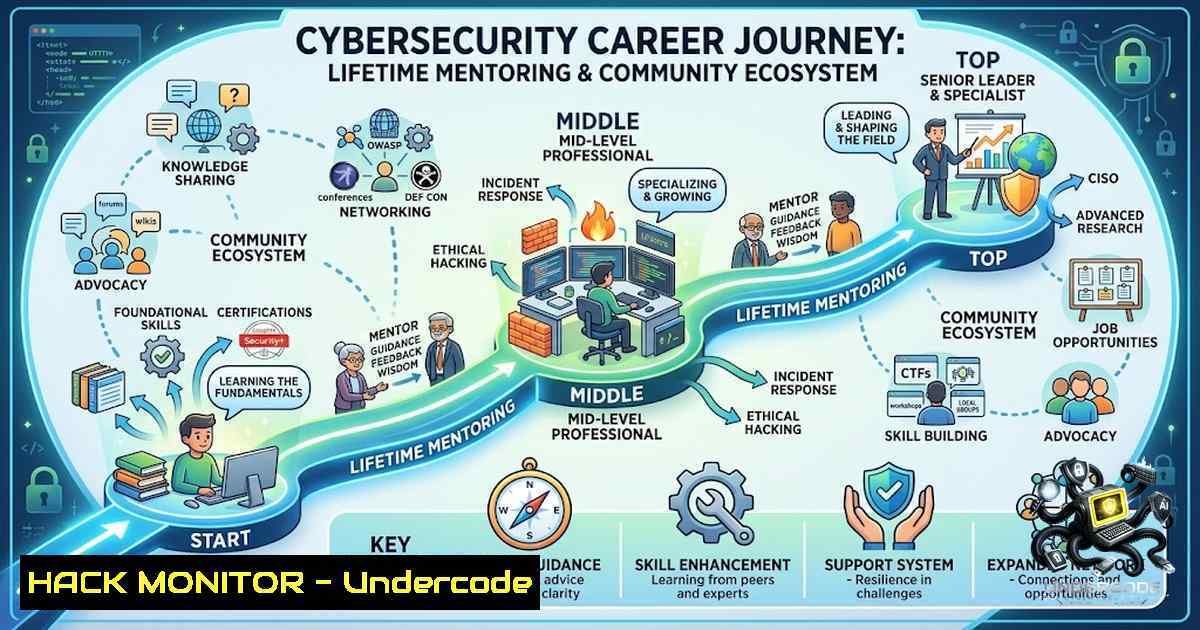
Introduction:
The cybersecurity landscape is in a state of perpetual flux, with new vulnerabilities, AI-driven attack vectors, and complex cloud architectures emerging daily. This reality renders traditional, static certification courses insufficient; a career in defense now demands a commitment to continuous, adaptive learning. The concept of a lifetime mentoring and community ecosystem directly addresses this need, offering a structured yet dynamic pathway for professionals to move beyond theory and cultivate practical, battle-ready skills.
Learning Objectives & Secrets:
- Objective 1: Master Continuous Skill Development – Implement a cyclical “Learn → Practice → Build” routine using hands-on labs and real-world scenarios to solidify theoretical knowledge.
- Objective 2: Leverage Community Intelligence for Threat Awareness – Actively participate in OSINT, Threat Intelligence, and SOC communities to gain early warnings on emerging threats and understand attacker methodologies in real-time.
- Objective 3: Streamline Career Advancement with Practical Certifications – Combine structured certification preparation (e.g., CISSP, CEH, OSCP) with community-sourced “secret tips” on interview techniques and practical penetration testing workflows to accelerate professional growth.
You Should Know:
1. Linux Command Line Mastery for Penetration Testing
A solid grasp of the Linux command line is the bedrock of any security professional’s toolkit. It allows for efficient system navigation, process manipulation, and the execution of complex security tools. The ability to automate tasks with shell scripts significantly enhances productivity during vulnerability assessments and incident response.
- Step‑by‑step guide to basic reconnaissance & file manipulation:
- Network Reconnaissance: Use `nmap -sV -p- 192.168.1.1` to perform a comprehensive port and service version scan on a target host.
- Log Analysis: Employ `grep “Failed password” /var/log/auth.log` to filter authentication failures from system logs and `tail -f /var/log/syslog` to monitor system activity in real-time.
- File Permissions: Hardening your system often involves strict permission settings. Use `chmod 600 ~/.ssh/id_rsa` to secure a private SSH key and `chown root:root /etc/shadow` to ensure critical files are owned by the root user.
- Data Extraction: Master text processing with `awk ‘{print $1}’ access.log | sort | uniq -c` to extract and count unique IP addresses from web server logs.
2. Windows Security Hardening and PowerShell Automation
Defending Windows environments requires a deep understanding of Active Directory, Group Policy, and PowerShell scripting. Attackers frequently leverage misconfigurations in these areas for privilege escalation and lateral movement.
- Step‑by‑step guide for basic system hardening:
- Disable Unnecessary Services: Use `Get-Service` to list all services and `Set-Service -1ame “PrintSpooler” -StartupType Disabled` to disable high-risk services like the Print Spooler.
- Audit Local Users and Groups: Execute `Get-LocalUser` to view all accounts and `Remove-LocalUser -1ame “Guest”` to remove or disable potentially vulnerable default accounts.
- Windows Firewall Configuration: Block a specific port using
New-1etFirewallRule -DisplayName "Block Port 3389" -Direction Inbound -Protocol TCP -LocalPort 3389 -Action Block. - Event Log Analysis: Utilize `Get-WinEvent -LogName Security -FilterXPath “[System[EventID=4625]]”` to query the Security log for failed login attempts (Event ID 4625).
3. Practical Vulnerability Assessment and Mitigation
Identifying a vulnerability is only half the battle; understanding how to remediate it effectively is what defines a skilled professional. This process involves scanning, verification, and patching within a risk-managed framework.
- Step‑by‑step guide for a basic web application assessment:
- Reconnaissance: Run `whatweb target.com` to identify the webserver, CMS, and underlying technologies.
- Directory Enumeration: Use `gobuster dir -u http://target.com -w /usr/share/wordlists/dirb/common.txt` to discover hidden directories and files.
- Basic SQL Injection Testing: Manually test parameters (e.g.,
id=1' AND '1'='1) to detect simple SQL injection flaws in a web application. - Mitigation Strategies: For identified issues like SQLi, implement parameterized queries. For cross-site scripting (XSS), implement strict Content Security Policies (CSP) and output encoding.
4. OSINT and Threat Intelligence Workflows
Open Source Intelligence (OSINT) is a crucial phase for reconnaissance, allowing security teams to understand an organization’s digital footprint before an attacker exploits it. Integrating OSINT with threat intelligence feeds provides actionable context for defensive strategies.
- Step‑by‑step guide for passive reconnaissance:
- DNS Enumeration: Use `dig target.com ANY` to gather all DNS records and `whois target.com` to retrieve domain registration information.
- Subdomain Discovery: Employ tools like `sublist3r -d target.com` or `amass enum -d target.com` to uncover subdomains that could be potential entry points.
- Email and Credential Leak Checks: Query public data breach repositories using tools like `theHarvester -d target.com -b google,linkedin` to find exposed email addresses and potential credentials.
- Actionable Intelligence: Correlate findings with threat intelligence platforms (MISP, AlienVault OTX) to check if discovered domains or IPs are associated with known malicious activity.
5. Cloud Security Hardening with AWS CLI
Cloud misconfigurations are a leading cause of data breaches. Mastering the AWS Command Line Interface (CLI) is essential for automating security posture checks and implementing robust controls in a scalable manner.
- Step‑by‑step guide for foundational security checks:
- S3 Bucket Policy Review: List all buckets with `aws s3 ls` and check public access settings using
aws s3api get-bucket-public-access-block --bucket my-bucket. - Security Group Analysis: List all security groups in a region:
aws ec2 describe-security-groups --query 'SecurityGroups[].GroupName'. Then inspect a specific group for overly permissive rules:aws ec2 describe-security-group-rules --group-id sg-xxxxxxxx. - IAM User Assessment: Generate a list of users with administrative privileges: `aws iam list-users` and then check attached policies. Use `aws iam list-user-policies –user-1ame AdminUser` to verify inline policies.
- CloudTrail Logging Verification: Ensure logging is enabled and logs are being delivered to S3:
aws cloudtrail describe-trails.
What Undercode Say:
- Key Takeaway 1: The transition from student to professional requires more than just passing exams; it demands practical, hands-on experience and a supportive network to navigate real-world challenges.
- Key Takeaway 2: The “Lifetime Mentoring + Community Access” model is a strategic investment, recognizing that cybersecurity is an ongoing journey of continuous improvement, not a one-time destination.
This offering effectively bridges the gap between academic knowledge and the demands of the security industry. By providing lifetime access to a diverse range of communities—from OSINT to AI and Certification Prep—it acknowledges the multifaceted nature of the field. The value proposition lies in its holistic approach, moving beyond isolated courses to foster a growth environment where skill development is intertwined with career progression and peer support. This model is particularly advantageous for professionals looking to specialize or pivot within the industry, as it provides the flexibility to explore various domains (e.g., SOC, Pen Testing, Cloud Security) under one umbrella. The subscription cost of $65 USD is a relatively low barrier to entry for such comprehensive access, potentially offering a significant return on investment through career advancement opportunities and accelerated skill acquisition.
Prediction:
- +1 The “lifetime access” model will gain further traction as the industry evolves, providing a stable revenue stream for educators and a predictable, long-term resource for professionals. This fosters deeper, more meaningful community relationships over time.
- +1 As AI-powered threats become more prevalent, the integration of “AI & Prompt Engineering” and “AI Security” communities will be critical, positioning members at the forefront of defending against and utilizing AI in their workflows.
- -1 The primary risk is the potential dilution of quality if community engagement wanes or if the content is not regularly updated to keep pace with rapid technological shifts, which could lead to member churn.
- +1 The focus on “Interview & Career Preparation” and “Certification Preparation” directly addresses a critical pain point for many professionals, potentially increasing the membership’s value as a comprehensive career tool.
▶️ Related Video (92% Match):
🎯Let’s Practice For Free:
🎓 Live Courses & Certifications:
Join Undercode Academy for Verified Certifications
🚀 Request a Custom Project:
Secure, high-velocity infrastructure and disruptive technological engineering. Contact our engineering team for high-tier development and proprietary systems:
[email protected]
💎 Smart Architecture | 🛡️ Secure by Design | ⭐ Trusted by Thousands
IT/Security Reporter URL:
Reported By: https://lnkd.in/p/eTPp9Gjx – Hackers Feeds
Extra Hub: Undercode MoN
Basic Verification: Pass ✅


