Listen to this Post
Introduction:
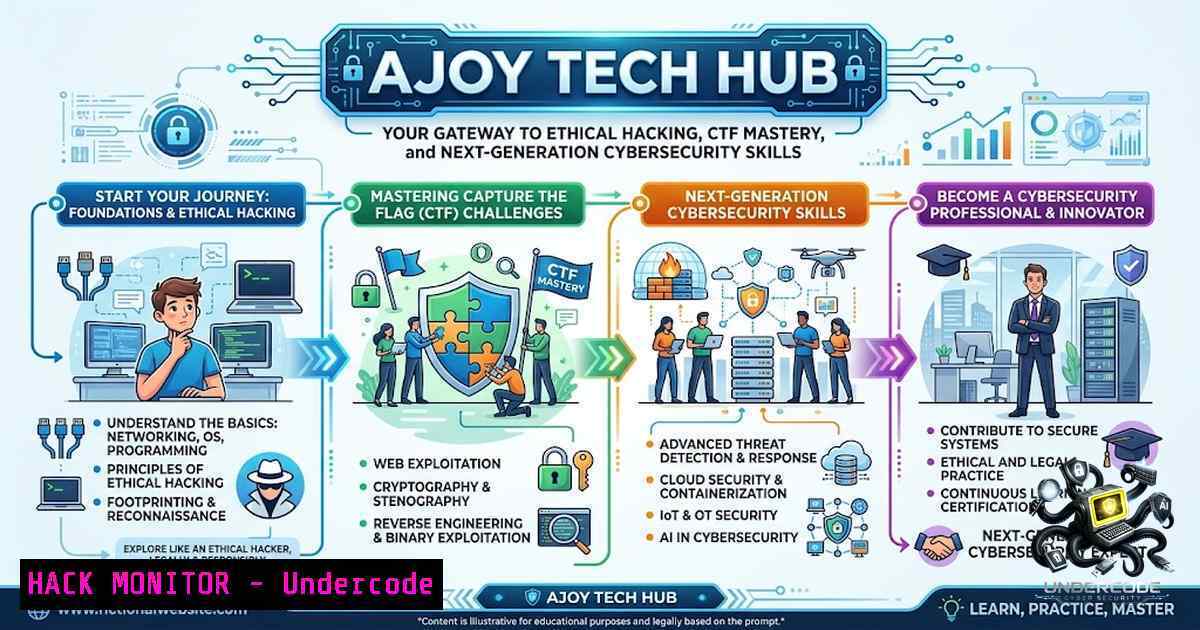
The cybersecurity landscape is evolving at an unprecedented pace, with attack surfaces expanding across cloud infrastructures, APIs, and AI-driven systems. Platforms like AJOY TECH HUB serve as critical knowledge-sharing ecosystems where aspiring ethical hackers, CTF enthusiasts, and IT professionals can access curated learning resources, practical tooling, and community-driven insights. This article synthesizes the technical pillars of modern cybersecurity education—from CEH certification frameworks and TryHackMe learning paths to offensive security tooling and cloud hardening—providing a comprehensive roadmap for practitioners at every level.
Learning Objectives:
- Master the core modules of the Certified Ethical Hacker (CEH v13) curriculum, including footprinting, scanning, enumeration, and vulnerability analysis.
- Navigate TryHackMe’s 2026 learning paths—Cyber Security 101, Jr Penetration Tester, and AI Security—to build hands-on offensive and defensive skills.
- Develop proficiency in Capture The Flag (CTF) competition strategies, from reconnaissance to reverse-engineering and flag extraction.
- Acquire practical command-line proficiency across Linux and Windows environments for penetration testing, enumeration, and incident response.
- Implement API security testing methodologies and cloud-hardening checklists aligned with OWASP Top 10 and CIS benchmarks.
You Should Know:
- Certified Ethical Hacker (CEH v13) – Curriculum Deep Dive & Lab Setup
The CEH v13 certification remains the gold standard for entry-level ethical hacking, now incorporating AI-driven ethical hacking tools, ChatGPT-powered penetration testing assistants, and the MITRE ATT&CK framework. The curriculum spans 20 modules, beginning with information security fundamentals, relevant laws, and standard procedures, and progressing through footprinting, reconnaissance, network scanning, enumeration, malware threats, sniffing, social engineering, and cloud computing concepts.
Step-by-Step Lab Environment Setup:
- Deploy Virtual Machines: Install Kali Linux as your attack machine, Windows 10/11 as a target, and Metasploitable 2 or DVWA (Damn Vulnerable Web Application) as vulnerable practice targets.
- Network Configuration: Use NAT or host-only networking to isolate your lab environment from production networks.
- Initial Reconnaissance: Execute `nmap -sP 192.168.1.0/24` to discover live hosts, followed by `nmap -sV -p- 192.168.1.100` for detailed version and port scanning.
- Enumeration Techniques: Utilize `enum4linux -a 192.168.1.100` for SMB enumeration and `snmpwalk -v 2c -c public 192.168.1.100` for SNMP data extraction.
- Vulnerability Analysis: Deploy Nessus or OpenVAS for automated vulnerability scanning, then manually validate findings using Metasploit frameworks.
-
TryHackMe 2026 Learning Paths – From Zero to SOC Analyst
TryHackMe has revamped its offerings for 2026, retiring legacy paths and introducing Cyber Security 101 as the new beginner gateway. The platform now features structured learning paths including Pre-Security (revamped), Cyber Security 101, Jr Penetration Tester, SOC Level 1, Defending AWS, Web Application Red Teaming, and AI Security.
Step-by-Step Learning Progression:
- Foundation Building: Start with the Pre-Security path covering Linux fundamentals, Windows & Active Directory basics, command-line proficiency, networking fundamentals, and cryptography.
- Core Offensive Skills: Progress to Cyber Security 101, which includes exploitation basics, web hacking fundamentals, and offensive security tooling. Complete rooms like `beginnerpathintro` and
enumerationbruteforce. - Specialized Tracks: Choose between defensive (SOC Level 1) and offensive (Jr Penetration Tester) paths. The pentester roadmap emphasizes: fundamentals → reconnaissance → web exploitation → privilege escalation → Active Directory → cloud → red teaming → professional reporting.
4. Hands-On Labs: Execute practical exercises:
- Linux enumeration: `linpeas.sh` for privilege escalation checks
- Web exploitation: SQL injection, XSS, and CSRF against OWASP Top 10 targets
- Cryptography: Brute-force password cracking using hashcat
- Capture The Flag (CTF) Competition Strategies & Tooling
CTF competitions in 2026 span multiple domains: web exploitation, reverse-engineering, binary exploitation, OSINT, steganography, and cryptography. Winning strategies balance speed, accuracy, and prioritization—starting with lower-complexity tasks to accumulate early points.
Step-by-Step CTF Approach:
- Reconnaissance Phase: Use Payload Playground’s Smart Paste tool to identify unknown data types—JWTs, hashes, encoded strings. Catalogue all exposed endpoints and parameters.
- Web Exploitation: Test for SQL injection (
' OR '1'='1), GraphQL injection, authentication bypass, and sourcemap leaks. - Reverse-Engineering: Analyze custom binaries using Ghidra or IDA Pro; identify buffer overflow vulnerabilities and craft exploit scripts.
- Flag Extraction: Use `base64 -w 0 file` for data exfiltration and `xxd -p boot12.bin | tr -d ‘\n’` for hexdump processing.
- Ethical Boundaries: Never attack competition infrastructure beyond specified endpoints; never share flags with other teams.
4. Linux Command-Line Arsenal for Penetration Testing
Linux remains the operating system of choice for ethical hackers, with Kali Linux providing a preconfigured toolkit. Mastery of core commands is non-1egotiable.
Essential Commands & Use Cases:
- Host Discovery: `nmap -sP 192.168.1.0/24` – Ping sweep to identify live hosts
- Service Scanning: `nmap -sV -p- 192.168.1.100` – Comprehensive version and port scanning
- File Permissions: `chmod +x payload.sh` – Make scripts executable
- Secure Shell Tunneling: `ssh -D 9050 [email protected]` – Dynamic port forwarding for proxying
- Process Monitoring: `ps aux | grep root` – Identify processes running as root
- Archiving & Exfiltration: `tar -czvf exfil.tar.gz /sensitive/data` – Compress and archive sensitive data
- Privilege Escalation Checks: `./linpeas.sh` – Automated Linux privilege escalation auditing
- Exploit Suggestion: `./linux-exploit-suggester.sh` – Identify kernel exploits
- Process Monitoring (Rootless): `./pspy` – Monitor processes without root privileges
- Windows Command Line & PowerShell for Security Operations
Windows environments remain prime targets for adversaries, with techniques like T1059.003 (Windows Command Shell) used to execute commands, scripts, and binaries while remaining undetected. Security professionals must master both CMD and PowerShell for incident response and threat hunting.
Step-by-Step Windows Security Triage:
- Process Inspection: Use `tasklist` to view running processes and attributes; employ `WMIC process` for detailed inspection.
- IOC Enrichment: Deploy Horus, a single-file Windows security triage tool with zero dependencies, for PE static analysis and IOC enrichment.
- PowerShell Automation: Build scripts for threat detection, log analysis, and automated response. Example: `Get-EventLog -LogName Security -InstanceId 4625` to audit failed logon attempts.
- Defender for Cloud CLI: Install the Microsoft Defender for Cloud CLI for cloud workload protection.
- MITRE ATT&CK Mapping: Correlate detected behaviors with T1059.003 for command and scripting interpreter abuse.
-
API Security Penetration Testing – OWASP Top 10 in Practice
APIs are the backbone of modern applications, and the OWASP API Security Top 10 provides a critical risk framework. Comprehensive API pentests must cover every exposed endpoint—not just those in public documentation.
Step-by-Step API Security Testing:
- Reconnaissance & Inventory: Map all API endpoints, parameters, and authentication requirements.
- Authentication Testing: Stress-test JWT validation, implement multi-factor authentication for sensitive endpoints, and verify rate limiting.
- Business Logic Abuse: Simulate scraping, inventory manipulation, and authorization bypass scenarios.
- Shadow API Detection: Identify undocumented or deprecated endpoints that may expose sensitive data.
- Token Management: Keep access tokens short-lived (e.g., 15 minutes) and use refresh tokens.
- Zero-Trust Authorization: Implement Policy-Based Access Control (PBAC) instead of simple role-based models.
- CI/CD Integration: Embed API security testing into CI/CD pipelines for continuous assessment.
-
Cloud Hardening – AWS, Azure, and GCP Security Checklists
Cloud security in 2026 demands a multi-layered approach encompassing identity management, network segmentation, encryption, and continuous monitoring. CIS-aligned baseline hardening provides a structured framework.
Step-by-Step Cloud Hardening Checklist:
- Identity & Access Management (IAM): Enforce least privilege, role-based access, and just-in-time elevation. Eliminate long-lived access keys in CI/CD or developer machines.
- Network Security: Implement secure network design and segmentation strategies. Deploy NSGs, Azure Firewall, or AWS Security Groups with explicit deny-all rules.
- Data Protection: Enable encryption at rest and in transit; manage keys using AWS Secrets Manager, SSM Parameter Store, or Azure Key Vault with managed identity access.
- Logging & Monitoring: Enable comprehensive audit trails, integrate with SIEM solutions, and validate against Defender for Cloud Secure Score.
- OS Hardening: Use cloud-init hardening with auditd and audisp-syslog with kernel audit rules on first boot.
- Compliance Validation: Apply CIS Azure Foundations Benchmark v2.1 and AWS CIS benchmarks.
What Undercode Say:
- Key Takeaway 1: The convergence of AI-powered ethical hacking tools and traditional penetration testing frameworks is reshaping the cybersecurity workforce. CEH v13’s inclusion of ChatGPT-powered AI tools signals a paradigm shift where human intuition is augmented by machine intelligence—but foundational skills in Linux, networking, and scripting remain non-1egotiable.
- Key Takeaway 2: Platforms like TryHackMe and CTF competitions are democratizing cybersecurity education, offering structured, hands-on learning paths that bridge the gap between theory and practice. The 2026 curriculum updates—retiring legacy paths and introducing AI Security and Defending AWS—reflect the industry’s urgent need for cloud-1ative and AI-security expertise.
Analysis: The cybersecurity community is witnessing a maturation of educational ecosystems. Traditional certifications (CEH) are evolving to incorporate AI and cloud modules, while gamified platforms (TryHackMe, CTFs) are providing scalable, practical skill development. However, the proliferation of tools and frameworks creates a paradox of choice—practitioners must curate their learning paths strategically, focusing on foundational competencies (Linux, networking, scripting) before specializing in niche domains like API security or cloud hardening. The community-driven model exemplified by AJOY TECH HUB—sharing resources, quizzes, and updates—addresses this by providing curated, contextualized learning journeys that reduce decision fatigue and accelerate skill acquisition.
Prediction:
- +1 The integration of AI-powered penetration testing assistants will reduce the barrier to entry for ethical hacking, enabling a new wave of security professionals to conduct sophisticated assessments with reduced manual effort.
- +1 Cloud-1ative security certifications and hands-on labs (Defending AWS, Azure hardening) will overtake traditional on-premise security training by 2028, as enterprise workloads continue their mass migration to multi-cloud environments.
- -1 The rapid adoption of AI in offensive security will also lower the skill floor for malicious actors, leading to a surge in automated, AI-driven cyberattacks that outpace traditional signature-based defenses.
- -1 The fragmentation of cybersecurity education—across certifications, platforms, and community channels—risks creating skill silos, where practitioners master specific tools but lack holistic understanding of the kill chain and defense-in-depth strategies.
- +1 Community-driven knowledge-sharing hubs like AJOY TECH HUB will become indispensable as centralized aggregators of curated content, offsetting fragmentation by providing structured learning pathways and peer support networks.
AJOY TECH HUB – Learn • Explore • Secure • Grow
🔗 Follow on WhatsApp: https://whatsapp.com/channel/0029VbD6eP8CHDyeWP38DY0h
▶️ Related Video (80% Match):
🎯Let’s Practice For Free:
🎓 Live Courses & Certifications:
Join Undercode Academy for Verified Certifications
🚀 Request a Custom Project:
Secure, high-velocity infrastructure and disruptive technological engineering. Contact our engineering team for high-tier development and proprietary systems:
[email protected]
💎 Smart Architecture | 🛡️ Secure by Design | ⭐ Trusted by Thousands
IT/Security Reporter URL:
Reported By: Ajoy Ruidas – Hackers Feeds
Extra Hub: Undercode MoN
Basic Verification: Pass ✅


