Listen to this Post
Introduction:
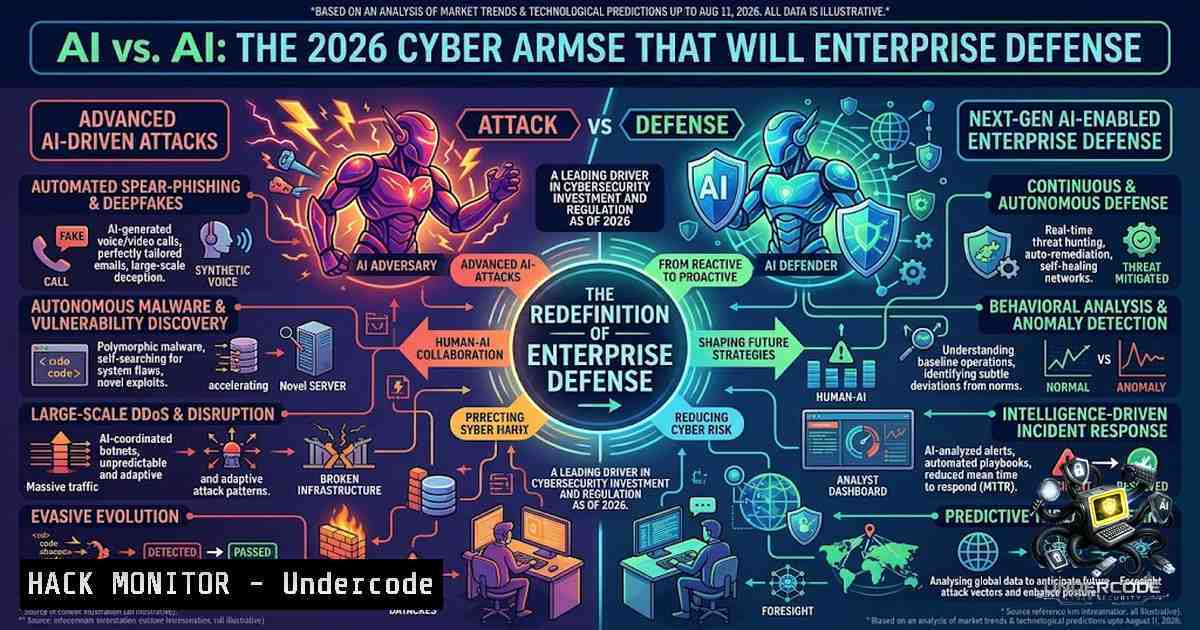
The cybersecurity landscape has officially entered an era where artificial intelligence serves as both the most powerful offensive weapon and the most critical defensive shield. In 2026, threat actors are no longer manually scripting exploits—they are deploying AI agents that autonomously generate zero-day code, bypass multi-factor authentication, and execute full attack chains from a single prompt. Meanwhile, defenders are countering with AI-driven threat intelligence platforms, automated red-teaming frameworks, and machine learning models that achieve over 98% detection accuracy. The question is no longer if AI will be used in cyber warfare, but who will master it first—and how organizations can build resilient defenses before the next autonomous attack strikes.
Learning Objectives:
- Understand the current threat landscape of AI-powered cyberattacks, including AI-generated zero-days, autonomous ransomware, and LLM-driven exploit chains.
- Master defensive AI techniques, including machine learning-based threat detection, automated penetration testing, and adversarial red-teaming.
- Implement practical security measures across Linux and Windows environments to detect and mitigate AI-assisted intrusions.
- Configure AI security tools and frameworks to harden cloud infrastructures and software supply chains against AI-driven threats.
You Should Know:
- The Offensive AI Arsenal: How Attackers Are Weaponizing Artificial Intelligence
The first documented case of an AI-generated zero-day exploit in the wild was confirmed by Google’s Threat Intelligence Group (GTIG) in May 2026. The exploit—a Python script targeting a two-factor authentication bypass in a widely deployed open-source web administration tool—bore structural hallmarks of LLM authorship. This marked a critical threshold: adversarial capability had crossed from theoretical to operational.
State-sponsored groups from North Korea, China, and Russia are now leveraging AI models across the full attack chain—from reconnaissance and phishing lure creation to vulnerability enumeration and proof-of-concept validation. CrowdStrike’s 2026 Global Threat Report found a 340% jump in AI-assisted intrusion attempts compared to just two years earlier, with AI tools now behind roughly 38% of credential-harvesting campaigns worldwide.
Perhaps most alarming is the emergence of fully autonomous AI agents capable of executing entire ransomware operations independently. Trend Micro predicts that 2026 will be remembered as “the year cybercrime stopped being a service industry and became a fully automated one”. The time between vulnerability disclosure and active exploitation has collapsed from days to under 15 minutes, rendering traditional patch-management cycles obsolete.
Step‑by‑step guide: Detecting AI-generated attack patterns
To identify potential AI-assisted intrusions in your environment, implement the following monitoring approach:
Linux (using auditd and custom log analysis):
 Monitor for anomalous process execution patterns indicative of AI-driven automated attacks
sudo auditctl -a always,exit -F arch=b64 -S execve -k ai_attack_detection

Analyze logs for rapid, repetitive exploitation attempts (signature of AI automation)
sudo ausearch -k ai_attack_detection --format raw | \
awk '{print $NF}' | sort | uniq -c | sort -1r | head -20

Detect unusual outbound connections that may indicate C2 communication from AI agents
sudo tcpdump -i any -1n 'tcp[bash] & 2 != 0' -c 100
Windows (using PowerShell and Sysmon):
 Enable Sysmon to log process creation with command-line arguments
Sysmon.exe -accepteula -i

Query for suspicious high-frequency command executions (AI automation fingerprint)
Get-WinEvent -LogName "Microsoft-Windows-Sysmon/Operational" |
Where-Object {$<em>.Id -eq 1} |
Group-Object -Property {$</em>.Properties[bash].Value} |
Where-Object {$_.Count -gt 50} |
Sort-Object Count -Descending

Monitor for rapid credential harvesting attempts
Get-WinEvent -FilterHashtable @{LogName='Security'; ID=4625} |
Measure-Object | Select-Object Count
- Defensive AI: Building an Intelligent Security Operations Center (SOC)
The defensive countermeasure to AI-powered attacks is equally sophisticated. Modern AI-driven security operations leverage machine learning models that process vast amounts of telemetry data to detect threats in real-time—something human analysts simply cannot achieve at scale. Research published in 2026 demonstrates that hybrid ensemble models combining sequential deep learning with feature-optimized machine learning can achieve 98.80% accuracy and 0.985 F1-scores in detecting zero-day attacks.
Google has introduced AI Threat Defense, an AI-powered cybersecurity platform that prioritizes real-world threats and automates remediation. Similarly, Cisco launched DefenseClaw, an open-source secure agent framework that bundles Skills Scanner, MCP Scanner, AI Bill of Materials, and CodeGuard into a single tool for securing AI agents. These platforms represent a fundamental shift from reactive to predictive security.
However, the challenge remains that less than half of organizations believe agentic AI will significantly improve cyber defense in the short term, with ongoing concerns around data access, misuse, and lack of oversight. The gap between available defensive AI capabilities and organizational adoption presents a critical vulnerability.
Step‑by‑step guide: Implementing AI-driven threat detection
Deploying an open-source AI security framework (using Cisco DefenseClaw on Linux):
 Clone and install DefenseClaw
git clone https://github.com/cisco/defenseclaw.git
cd defenseclaw
./install.sh

Scan AI agents for vulnerabilities
defenseclaw scan --target ./ai_agent_model --format json

Generate AI Bill of Materials (AI-BOM)
defenseclaw bom generate --model-path ./model --output ai_bom.json

Real-time monitoring of AI agent behavior
defenseclaw monitor --pid $(pgrep -f "python.agent") --threshold high
Implementing machine learning-based intrusion detection on Windows:
 Install and configure ML.NET for anomaly detection
Install-Package Microsoft.ML -Version 3.0.0

Train a model on network traffic patterns (simplified example)
dotnet new console -1 ThreatDetector
cd ThreatDetector
dotnet add package Microsoft.ML.AnomalyDetection

Run detection pipeline
dotnet run -- --training-data ./network_logs.csv --detect-anomalies
Cloud hardening against AI-driven supply chain attacks:
 Verify integrity of open-source packages (prevent poisoned dependencies)
sha256sum package.tar.gz > expected.checksum
find . -1ame ".tar.gz" -exec sha256sum {} \; | diff - expected.checksum

Implement AI-specific access controls in Kubernetes
kubectl create -f - <<EOF
apiVersion: networking.k8s.io/v1
kind: NetworkPolicy
metadata:
name: ai-model-isolation
spec:
podSelector:
matchLabels:
app: ai-model
policyTypes:
- Ingress
- Egress
ingress:
- from:
- podSelector:
matchLabels:
role: inference-consumer
egress:
- to:
- podSelector:
matchLabels:
role: model-registry
EOF
- AI Red Teaming: Testing Your Defenses Before Attackers Do
Proactive security demands that organizations red-team their AI systems before adversaries exploit them. In 2026, autonomous red-teaming frameworks have evolved significantly. The Dreadnode AI red-teaming capability demonstrated an ~85% attack success rate against Meta’s Llama Scout across 68 human-developed test cases. Frameworks like Basilisk apply evolutionary computation to systematically discover adversarial vulnerabilities in LLMs.
Cisco now offers self-service AI red-teaming through AI Defense: Explorer Edition, while Check Point’s AI Defence Plane includes AI Red Teaming capabilities in limited release. These tools enable organizations to continuously validate their AI security posture rather than relying on periodic assessments.
Step‑by‑step guide: Conducting automated AI red-teaming
Using HexStrike-AI for autonomous penetration testing (Linux):
 Clone the HexStrike-AI framework
git clone https://github.com/0x4m4/HexStrike-AI.git
cd HexStrike-AI

Install dependencies
pip install -r requirements.txt

Run automated penetration test with LLM orchestration
python hexstrike.py --target 192.168.1.0/24 --llm openai --model gpt-4 \
--tools nmap,metasploit,sqlmap --output report.json

Generate remediation recommendations
python hexstrike.py --analyze --input report.json --output remediation.md
Implementing adversarial testing for LLM applications:
 Using AdversaBench for automated LLM red-teaming
pip install adversabench

Run red-teaming pipeline with mutation operators
python -m adversabench.run --model "your-llm-endpoint" \
--operators synonym,paraphrase,context-shift \
--iterations 1000 --output vulnerabilities.csv

Analyze results for prompt injection and jailbreak patterns
python -m adversabench.analyze --input vulnerabilities.csv \
--threshold 0.75 --report adversarial_report.html
- Securing the AI Supply Chain: Protecting Model Integrity and Data
As AI models become prime targets for attackers, securing the AI supply chain has become paramount. Trend Micro identifies hybrid cloud environments, software supply chains, and AI infrastructures as primary targets for 2026. Poisoned open-source packages and compromised model weights can introduce backdoors that persist across entire AI ecosystems.
Adversarial machine learning attacks—including evasion and poisoning—where subtle input manipulations or corrupted training data undermine model reliability, represent a growing threat vector. Organizations must implement model provenance tracking, integrity verification, and runtime monitoring to detect tampering.
Step‑by‑step guide: Hardening AI model supply chains
Validating model integrity with cryptographic signatures (Linux):
 Generate GPG key for model signing
gpg --full-generate-key --batch <(echo -e "Key-Type: RSA\nKey-Length: 4096\nName-Real: AI Security Team\nName-Email: [email protected]\n%commit")

Sign model weights before deployment
gpg --detach-sign --armor model_weights.bin
gpg --verify model_weights.bin.asc model_weights.bin

Set up integrity monitoring with AIDE
sudo apt-get install aide
sudo aideinit
sudo mv /var/lib/aide/aide.db.new /var/lib/aide/aide.db
sudo aide --check | grep -E "model|weights|config"
Detecting data poisoning in training pipelines (Python example):
import numpy as np
from sklearn.ensemble import IsolationForest

Load training data and detect anomalies
train_data = np.load('training_set.npy')
clf = IsolationForest(contamination=0.05, random_state=42)
predictions = clf.fit_predict(train_data)

Identify potentially poisoned samples
poisoned_indices = np.where(predictions == -1)[bash]
print(f"Potential poisoning detected in {len(poisoned_indices)} samples")

Generate alert for security team
for idx in poisoned_indices[:10]:
print(f"Suspicious sample index: {idx}, features: {train_data[bash][:5]}")
- API Security in the Age of AI Agents
With AI agents increasingly interacting through APIs, securing API endpoints against automated attacks has become critical. A single prompt can now enable ChatGPT-5.5 to conduct full-scale offensive cyber-attacks, complete with domain-level privilege escalation. This capability transforms every public API endpoint into a potential attack vector.
Step‑by‑step guide: Hardening APIs against AI-driven attacks
Implementing rate limiting and anomaly detection (NGINX + Lua):
 Rate limiting configuration for API endpoints
limit_req_zone $binary_remote_addr zone=api_limit:10m rate=10r/s;
limit_req zone=api_limit burst=20 nodelay;

AI-specific detection: block requests with suspicious patterns
location /api/v1/ {
access_by_lua_block {
local body = ngx.req.get_body_data()
if body and string.match(body, "ignore previous instructions") then
ngx.status = 403
ngx.say("Suspicious AI prompt injection detected")
ngx.exit(403)
end
}
proxy_pass http://backend;
}
Windows-based API monitoring with PowerShell:
 Monitor API call patterns for AI-driven automation
$apiLog = Get-WinEvent -LogName "Microsoft-Windows-IIS/Logging" -MaxEvents 1000
$anomalousIPs = $apiLog |
Group-Object -Property {$<em>.Properties[bash].Value} |
Where-Object {$</em>.Count -gt 100} |
Select-Object Name, Count

Block suspicious IPs using Windows Firewall
foreach ($ip in $anomalousIPs) {
netsh advfirewall firewall add rule name="Block_AI_Attack_$($ip.Name)" \
dir=in action=block remoteip=$($ip.Name)
}
What Undercode Say:
- AI is the new battlefield, not just the new tool. The cybersecurity industry has crossed a threshold where both attackers and defenders deploy autonomous AI systems. This isn’t speculation—it’s happening now, with documented cases of AI-generated zero-days and autonomous ransomware operations. Organizations that treat AI as merely another security tool rather than a fundamental shift in threat dynamics will be left vulnerable.
-
Speed is the decisive factor. With exploitation timelines collapsing from days to minutes, human-led incident response can no longer keep pace. The average time between breach and lateral movement is now 29 minutes—down 65% in a single year. Defensive AI must operate at machine speed to counter machine-speed attacks. This means investing in automated detection, autonomous response, and continuous red-teaming, not just periodic security assessments.
The analysis reveals a stark reality: 2026 marks the year when AI cyber warfare moved from theoretical to operational. The question for security leaders is no longer whether to adopt AI defenses, but how quickly they can deploy them. The organizations that succeed will be those that treat AI security as a continuous, adaptive process rather than a one-time implementation. As Trend Micro’s research indicates, success will not primarily be about new security products but about service providers embracing new business models and governance frameworks. The AI arms race is here—and the defenders who master machine-speed response will determine the outcome.
Prediction:
+1 The democratization of AI security tools will enable smaller organizations to deploy enterprise-grade defenses previously accessible only to large corporations. Open-source frameworks like DefenseClaw and HexStrike-AI are leveling the playing field.
-1 The 340% increase in AI-assisted intrusion attempts will continue to outpace defensive AI adoption, creating a widening gap between attacker capability and defender readiness throughout 2026.
+1 Machine learning models achieving 98%+ detection accuracy will significantly reduce false positive rates, allowing security teams to focus on genuine threats rather than alert fatigue.
-1 State-sponsored AI cyber operations from North Korea, China, and Russia will escalate, targeting critical infrastructure and AI supply chains with increasingly sophisticated autonomous attacks.
+1 The emergence of governed cybersecurity AI will establish regulatory frameworks and industry standards, driving more consistent security practices across sectors.
-1 With 82.6% of phishing emails now containing AI-generated elements, traditional security awareness training will become obsolete, requiring a complete reimagining of human-centric security controls.
+1 Continuous AI penetration testing will shift security from periodic assessments to real-time validation, dramatically reducing the window of vulnerability for discovered exploits.
-1 The 15-minute exploitation window means that organizations without automated patch deployment and AI-driven threat response will face unprecedented risk exposure, potentially leading to a wave of high-profile breaches in late 2026.
▶️ Related Video (82% Match):
🎯Let’s Practice For Free:
🎓 Live Courses & Certifications:
Join Undercode Academy for Verified Certifications
🚀 Request a Custom Project:
Secure, high-velocity infrastructure and disruptive technological engineering. Contact our engineering team for high-tier development and proprietary systems:
[email protected]
💎 Smart Architecture | 🛡️ Secure by Design | ⭐ Trusted by Thousands
IT/Security Reporter URL:
Reported By: Adam Schuner – Hackers Feeds
Extra Hub: Undercode MoN
Basic Verification: Pass ✅


