Listen to this Post
Introduction:
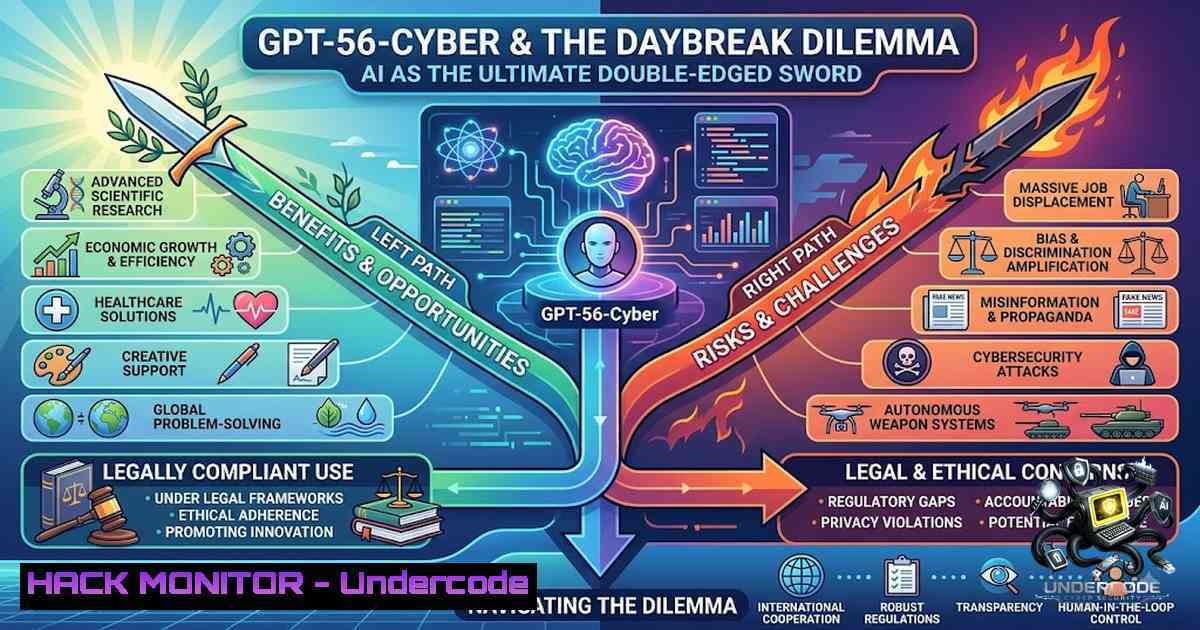
OpenAI has fundamentally altered the offensive-defensive AI balance with the expansion of its Daybreak cybersecurity program, introducing a two-tier access model that places unprecedented hacking capabilities directly into the hands of approved defenders. The newly unveiled GPT-5.6-Cyber model, gated behind the restrictive Daybreak Red tier, completes 95% of advanced exploit-related requests compared to just 1.5% for the base GPT-5.6 Sol model — a statistical leap that transforms how vulnerability research and exploit validation will be conducted. The central question is no longer whether AI can hack, but who controls the permission layer that determines access.
Learning Objectives:
- Understand the architectural and access differences between Daybreak Blue and Daybreak Red tiers
- Master the practical application of GPT-5.6-Cyber for zero-day discovery and exploit chain development
- Implement defensive countermeasures against AI-generated exploits using real-world commands and configurations
- Evaluate the risk model of permission-based AI governance versus model-level refusals
You Should Know:
- Daybreak Blue vs. Daybreak Red: Understanding the Access Divide
OpenAI’s Daybreak program now operates as a two-tiered system designed to match capability with legitimate need. Daybreak Blue serves as the recommended starting point for most defenders, providing access to GPT-5.6 Sol with system-level guardrails removed for authorized defensive work including vulnerability discovery, secure code review, malware analysis, incident response, and patch validation. This tier removes the friction that previously blocked legitimate security workflows.
Daybreak Red, by contrast, gates access to GPT-5.6-Cyber — a fine-tuned version of GPT-5.6 Sol specifically trained to reduce refusals on dual-use cybersecurity prompts. Where GPT-5.6 Sol refuses 98.5% of advanced cybersecurity requests due to safety filters, GPT-5.6-Cyber completes 95.0%. This model is designed for authorized vulnerability research, exploit validation, and security testing on systems the organization owns or has permission to test.
To put this in perspective with practical commands, security teams approved for Daybreak Blue can run reconnaissance and analysis without triggering automated refusals:
 Linux - Vulnerability scanning with AI-assisted analysis
nmap -sV -p- --script vuln 192.168.1.0/24 | tee scan_results.txt
 Feed results into GPT-5.6 Sol (Daybreak Blue) for analysis
curl -X POST https://api.openai.com/v1/chat/completions \
-H "Authorization: Bearer $DAYBREAK_BLUE_API_KEY" \
-H "Content-Type: application/json" \
-d '{"model":"gpt-5.6-sol","messages":[{"role":"user","content":"Analyze these scan results for vulnerabilities: $(cat scan_results.txt)"}]}'
For Daybreak Red users conducting advanced exploit validation:
 Windows - Memory analysis for exploit verification
powershell -Command "& {Get-WinEvent -LogName Security -MaxEvents 100 | Where-Object {$<em>.Id -eq 4624} | Format-Table -AutoSize}"
 PowerShell script to check for privilege escalation indicators
Get-Process | Where-Object {$</em>.Path -like "\System32\" -and $_.SessionId -1e 0}
- The 95% Completion Rate: What It Actually Means
OpenAI’s internal Advanced Cybersecurity Completion Rate benchmark measures how often models respond to requests involving exploit-chain development, authentication bypass, privilege escalation, and similar advanced scenarios. GPT-5.6-Cyber’s 95% completion rate represents a fundamental shift in capability — the model doesn’t just refuse less; it actively generates working exploit code, proof-of-concept implementations, and multi-step attack chains.
The practical implications are significant. OpenAI researchers using GPT-5.6-Cyber discovered two previously unknown Chrome V8 vulnerabilities, one of which was patched as CVE-2026-15903. The model has also identified over 400 privilege-escalation issues in an operating system kernel and critical vulnerabilities in a database system. This isn’t theoretical capability — it’s production-grade vulnerability discovery operating at machine speed.
For security teams working with this capability, the workflow involves:
 Python - Automated exploit validation framework
import requests
import json

def query_gpt56_cyber(prompt, api_key):
headers = {"Authorization": f"Bearer {api_key}", "Content-Type": "application/json"}
data = {"model": "gpt-5.6-cyber", "messages": [{"role": "user", "content": prompt}]}
response = requests.post("https://api.openai.com/v1/chat/completions", headers=headers, json=data)
return response.json()["choices"][bash]["message"]["content"]

Example: Requesting exploit chain development
exploit_prompt = """Develop a proof-of-concept exploit chain for CVE-2026-15903 that demonstrates sandbox escape. Include:
1. Trigger mechanism
2. Payload delivery
3. Post-exploitation steps"""
result = query_gpt56_cyber(exploit_prompt, DAYBREAK_RED_API_KEY)
print(result)
3. The Permission Model: Security Through Access Control
Perhaps the most significant aspect of Daybreak is its governance approach. Unlike consumer AI safety models that rely on the model itself refusing harmful requests, Daybreak shifts the enforcement to the access layer. GPT-5.6-Cyber complies with virtually all cybersecurity requests — the refusal happens at the authentication and authorization stage, not within the model’s response generation.
OpenAI enforces this through multi-factor authentication, hardware security key requirements effective September 1, 2026, attestations, and continuous monitoring. Access is currently restricted to “trusted customer partners” including Accenture, IBM, CrowdStrike, Cloudflare, Palo Alto Networks, and Cisco.
This creates a new attack surface. The model itself no longer serves as the safety boundary — the access control infrastructure does. Security teams must now consider:
 Linux - Monitoring for unauthorized API access attempts
sudo tail -f /var/log/auth.log | grep -E "Failed|Invalid|Denied"
 Set up real-time alerting for Daybreak API authentication anomalies
sudo auditctl -w /etc/ssl/private/ -p wa -k daybreak_key_access
 Windows - Enable advanced audit logging for API credential usage
auditpol /set /subcategory:"Credential Validation" /success:enable /failure:enable
4. Defensive Countermeasures Against AI-Generated Exploits
As offensive AI capabilities become more accessible to defenders (and potentially adversaries), defensive strategies must evolve. Organizations should implement layered defenses that account for AI-speed vulnerability discovery and exploitation.
For web application security, focus on input validation and sandboxing:
 Python - Input validation with AI-assisted pattern detection
import re
from flask import request, abort

def validate_input(user_input):
 Block known exploit patterns
dangerous_patterns = [
r'(\s)\s{',  Function execution
r'eval\s(',  JavaScript eval
r'system\s(',  System calls
r'exec\s(',  Command execution
r'..\/',  Path traversal
]
for pattern in dangerous_patterns:
if re.search(pattern, user_input, re.IGNORECASE):
abort(403, "Input blocked by AI-assisted security filter")
return user_input
For infrastructure hardening against AI-discovered vulnerabilities:
 Linux - Kernel hardening against privilege escalation
sudo sysctl -w kernel.kptr_restrict=2
sudo sysctl -w kernel.dmesg_restrict=1
sudo sysctl -w kernel.unprivileged_bpf_disabled=1
 Disable unnecessary kernel modules
echo "blacklist vboxdrv" | sudo tee -a /etc/modprobe.d/blacklist.conf
echo "blacklist dccp" | sudo tee -a /etc/modprobe.d/blacklist.conf
5. ExploitGym and the Benchmarking Reality
OpenAI tested GPT-5.6-Cyber against ExploitGym, a benchmark designed to evaluate whether AI agents can convert vulnerabilities into functional exploits. The model outperformed both GPT-5.6 Sol and GPT-5.5-Cyber, demonstrating superior capability in developing arbitrary code execution exploits and assessing known vulnerabilities and zero-days.
The pricing structure reflects this capability: GPT-5.6-Cyber costs $12.50 per million input tokens and $75 per million output tokens, compared to $5 and $30 respectively for GPT-5.6 Sol. The premium reflects both the specialized training and the reduced refusal rate that makes the model practically useful for advanced security work.
For teams evaluating AI-assisted security tools:
 Benchmarking script for exploit detection
!/bin/bash
 Test AI model response to exploit-related prompts
PROMPTS=("Generate a ROP chain for x64" "Bypass ASLR on Linux" "Create a heap spray payload")
for prompt in "${PROMPTS[@]}"; do
curl -X POST https://api.openai.com/v1/chat/completions \
-H "Authorization: Bearer $API_KEY" \
-H "Content-Type: application/json" \
-d "{\"model\":\"gpt-5.6-cyber\",\"messages\":[{\"role\":\"user\",\"content\":\"$prompt\"}]}"
done
What Undercode Say:
- The permission layer is the new safety boundary. OpenAI has shifted from model-level refusals to access-level enforcement. This means the security of the entire Daybreak program rests on authentication, monitoring, and partner vetting — not on the model’s inherent refusal capabilities.
-
Machine-speed vulnerability discovery is here. GPT-5.6-Cyber’s discovery of Chrome V8 vulnerabilities and 400+ kernel privilege-escalation issues demonstrates that AI can now operate at a scale and speed beyond human capabilities. The defense window is narrowing, and organizations must adapt accordingly.
The broader implication is that we are entering an era where the most capable hacking tools are deliberately placed in defenders’ hands — but the same tools, if compromised or misused, could enable unprecedented attacks. The Daybreak model represents a bet that trusted access, combined with rigorous monitoring and hardware-backed authentication, can contain capabilities that the model itself cannot refuse. Whether this bet pays off depends on the resilience of the access infrastructure and the integrity of the partner ecosystem. For organizations outside the trusted circle, the message is clear: AI-driven attacks are coming, and the defensive AI capable of stopping them is gated behind a door policy that most cannot yet access.
Prediction:
- +1 GPT-5.6-Cyber will accelerate patch development cycles by 60-80%, as AI-discovered vulnerabilities receive fixes before widespread exploitation occurs
- -1 The access-based permission model creates a single point of failure; a compromise of a Daybreak Red partner account could enable大规模 offensive AI campaigns
- +1 Security vendors integrating GPT-5.6-Cyber will release AI-1ative products that detect and patch vulnerabilities in real-time, fundamentally changing the incident response timeline
- -1 The gap between Daybreak Red recipients and the broader security community will widen, creating a two-tier defense ecosystem where only the privileged can effectively defend against AI-generated threats
- +1 The CVE-2026-15903 disclosure demonstrates responsible AI-driven vulnerability research; coordinated disclosure frameworks will evolve to accommodate machine-speed discovery
▶️ Related Video (84% Match):
🎯Let’s Practice For Free:
🎓 Live Courses & Certifications:
Join Undercode Academy for Verified Certifications
🚀 Request a Custom Project:
Secure, high-velocity infrastructure and disruptive technological engineering. Contact our engineering team for high-tier development and proprietary systems:
[email protected]
💎 Smart Architecture | 🛡️ Secure by Design | ⭐ Trusted by Thousands
IT/Security Reporter URL:
Reported By: Elkhanabbasov Gpt – Hackers Feeds
Extra Hub: Undercode MoN
Basic Verification: Pass ✅


