Listen to this Post
Introduction:
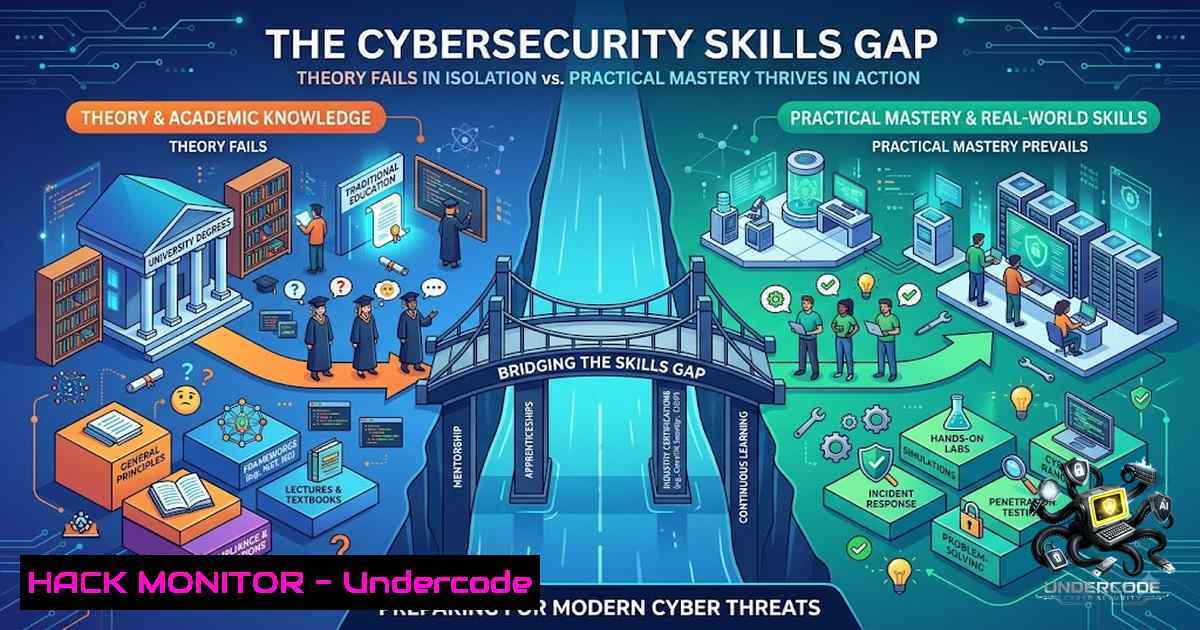
In the rapidly evolving landscape of digital threats, a dangerous misconception persists: that cybersecurity is synonymous with hacking. While penetration testing captures the imagination, the true essence of cyber defense lies in a holistic cycle of protection, detection, response, and recovery. The industry is currently saturated with individuals who can recite theoretical attack vectors but lack the practical muscle to stop them, creating a critical shortage of “battle-ready” professionals.
Learning Objectives:
- Understand the distinction between theoretical knowledge and practical cybersecurity execution.
- Identify the core domains of cybersecurity beyond ethical hacking, including SOC operations and forensics.
- Acquire actionable, real-world commands and methodologies to build verifiable technical skills.
- Develop a framework for continuous learning and hands-on practice using industry-standard tools.
You Should Know:
- The Art of Active Defense: Moving Beyond the Tutorial
The post emphasizes, “Don’t just watch tutorials. Build practical skills.” This is the single most important advice for any aspiring professional. Tutorials provide a passive understanding; cybersecurity requires active engagement. To move from a passive learner to an active defender, you must simulate real-world environments. Start by setting up a home lab using virtualization platforms like VMware or VirtualBox. Create a vulnerable Active Directory (AD) environment to understand lateral movement, or use containers to simulate web application firewalls (WAF). The goal is to see how systems behave under stress, not just read about it. To test your understanding of system logging, run the following command to simulate a brute-force attack attempt and analyze the log output on a Linux system:
 Simulate failed login attempts on a Linux system (DO NOT RUN ON PRODUCTION)
for i in {1..10}; do echo "Failed password for invalid user root from 192.168.1.$i" >> /var/log/auth.log; done
 Analyze the log for patterns
grep "Failed password" /var/log/auth.log | awk '{print $9, $11}' | sort | uniq -c
On Windows, use PowerShell to query security logs for failed logon events (Event ID 4625) to identify potential brute force attacks:
Get-WinEvent -LogName Security | Where-Object { $_.Id -eq 4625 } | Select-Object TimeCreated, Message
- Building a SOC Analyst Mindset: Logs, Metrics, and Detection
The “SOC & Threat Detection” pillar is the nerve center of any enterprise. It is not about catching the “uber-hacker” but about anomaly detection. A SOC analyst must be proficient in Security Information and Event Management (SIEM) tools like Splunk or Elastic Stack. The practice begins with log aggregation and normalization. A common, yet critical, task is to correlate firewall logs with endpoint detection and response (EDR) data. For instance, a surge in outbound traffic on port 445 (SMB) from a single workstation followed by a ransomware encryption event is a classic indicator of compromise (IOC). To practice threat hunting, set up a local Elastic Stack and ingest Apache logs. Create a query to detect directory traversal attempts:
 Elasticsearch Query DSL to detect directory traversal
{
"query": {
"wildcard": {
"request": {
"value": "../"
}
}
}
}
Furthermore, harden Windows workstations against credential dumping by modifying the Local Security Authority (LSA) protection. Use the following PowerShell command to enable LSA protection:
Set-ItemProperty -Path "HKLM:\SYSTEM\CurrentControlSet\Control\Lsa" -1ame "RunAsPPL" -Value 1
3. The VAPT Lifecycle: Recon to Remediation
Vulnerability Assessment and Penetration Testing (VAPT) is often misunderstood as a single event. It is a cyclic process. It starts with reconnaissance (passive and active), vulnerability scanning (using tools like Nessus or OpenVAS), exploitation (using Metasploit or custom scripts), and finally, remediation verification. The key is not just exploiting a vulnerability but understanding the business impact. When testing web applications, SQL injection remains a primary vector. To verify a SQL injection vulnerability manually without relying solely on automated scanners, use `curl` to inject a time-based payload into a vulnerable URL parameter. This tests if the server responds with a time delay, indicating execution of the injected query:
curl "http://vulnerable-site.com/page?id=1 AND SLEEP(5)" -v
On the defense side, if you are a blue team member, you must know how to mitigate these attacks. Implement a Web Application Firewall (WAF) rule to block SQLi patterns. If using ModSecurity on Apache, add the following rule to block `UNION SELECT` statements:
SecRule ARGS "UNION.SELECT" "id:100,phase:1,deny,status:403,msg:'SQL Injection Blocked'"
- Forensics and Incident Response: The Art of the “Deep Dive”
Digital Forensics is about reconstructing the timeline of an attack. For students, this means moving beyond just viewing files and understanding metadata, file carving, and memory analysis. In a ransomware attack, the initial entry point is often a phishing email. To analyze a suspicious executable in a sandbox, you can use `strings` on Linux to extract human-readable content and `ltrace` to trace library calls. However, a crucial skill is memory analysis. Using tools like Volatility to dump the memory of a compromised Windows machine, you can find the malicious process injection. For example, to identify hidden processes in a memory dump:
volatility -f memory.dmp --profile=Win10x64 pslist
Compare this with `psscan` to find unlinked processes (injected code):
volatility -f memory.dmp --profile=Win10x64 psscan
5. Cloud Security and Automation: The New Frontier
The post highlights “Cloud & Network Security,” a domain where traditional perimeter defenses are obsolete. In the cloud, security is a shared responsibility. An S3 bucket misconfiguration is the number one cause of data leaks. Students must learn to audit cloud environments using CLI tools. For AWS, the command `aws s3 ls` will list buckets, but you must check the permissions. To automate the detection of open buckets, you can use a simple script that checks for public access:
aws s3api get-bucket-acl --bucket your-bucket-1ame --query 'Grants[?Grantee.URI==`http://acs.amazonaws.com/groups/global/AllUsers`]'
Furthermore, network security in the cloud relies on Security Groups (SGs) and Network Access Control Lists (NACLs). A common mistake is opening SSH (port 22) to the world (0.0.0.0/0). A hardened environment uses bastion hosts and restricts SSH to specific IPs. To audit this on AWS, use the CLI to revoke overly permissive rules:
aws ec2 revoke-security-group-ingress --group-id sg-12345678 --protocol tcp --port 22 --cidr 0.0.0.0/0
6. The Role of AI in Cybersecurity
“AI & Cybersecurity” is a dual-edged sword. Attackers use AI to generate convincing phishing emails, crack CAPTCHAs, and bypass anomaly detection. Defenders use AI to automate threat hunting, analyze network traffic at scale, and predict zero-day exploits. For students, understanding machine learning (ML) algorithms is key. For instance, a simple Random Forest classifier can be used to detect malicious URLs based on features like URL length, number of special characters, and entropy. This bridges the gap between data science and security, allowing for proactive defense. You can practice by building a Python script using `scikit-learn` to classify URLs:
from sklearn.ensemble import RandomForestClassifier
import pandas as pd
 Load dataset (features: length, dots, entropy)
X = pd.read_csv('url_features.csv')
y = pd.read_csv('url_labels.csv')
model = RandomForestClassifier()
model.fit(X, y)
What Undercode Say:
- Key Takeaway 1: Cybersecurity education is failing if it prioritizes certifications over practical lab work. Build a home lab, break it, fix it, then break it again.
- Key Takeaway 2: The industry doesn’t need more hackers; it needs more guardians. Focus on detection and recovery mechanics because attacks are inevitable.
- Key Takeaway 3: Automation and scripting (Bash, PowerShell, Python) are non-1egotiable skills. If you can’t script, you can’t scale your defense or attack efficiently.
- Key Takeaway 4: The “hybrid” approach of combining AI with traditional security measures will define the next generation of defense strategies. The human analyst augmented by AI will dominate the industry.
- Key Takeaway 5: Don’t wait for a classroom; the internet is your lab. Utilize platforms like TryHackMe and Hack The Box but supplement them with your own infrastructure to truly understand the architecture. The journey is a marathon, not a sprint, involving continuous iteration and adaptation to evolving threat landscapes.
Prediction:
- +1 The demand for professionals with demonstrated practical skills will skyrocket, with organizations shifting hiring practices toward hands-on assessments rather than credential checks.
- +1 AI-driven defense mechanisms will mature, leading to “self-healing” networks that can isolate compromised segments without human intervention by 2028.
- -1 The gap between available defensive tools and the shortage of skilled analysts will widen, leaving organizations vulnerable to sophisticated, human-operated ransomware gangs.
- -1 The reliance on AI for threat detection will create a “black box” problem, where security teams trust false negatives, leading to catastrophic breaches from novel attacks.
- +1 Training programs will increasingly adopt immersive, gamified learning, fostering a generation of cybersecurity professionals who are “born” in the cloud and proficient with DevSecOps pipelines.
▶️ Related Video (86% Match):
🎯Let’s Practice For Free:
🎓 Live Courses & Certifications:
Join Undercode Academy for Verified Certifications
🚀 Request a Custom Project:
Secure, high-velocity infrastructure and disruptive technological engineering. Contact our engineering team for high-tier development and proprietary systems:
[email protected]
💎 Smart Architecture | 🛡️ Secure by Design | ⭐ Trusted by Thousands
IT/Security Reporter URL:
Reported By: Cyberon Cybersecurity – Hackers Feeds
Extra Hub: Undercode MoN
Basic Verification: Pass ✅


