Listen to this Post
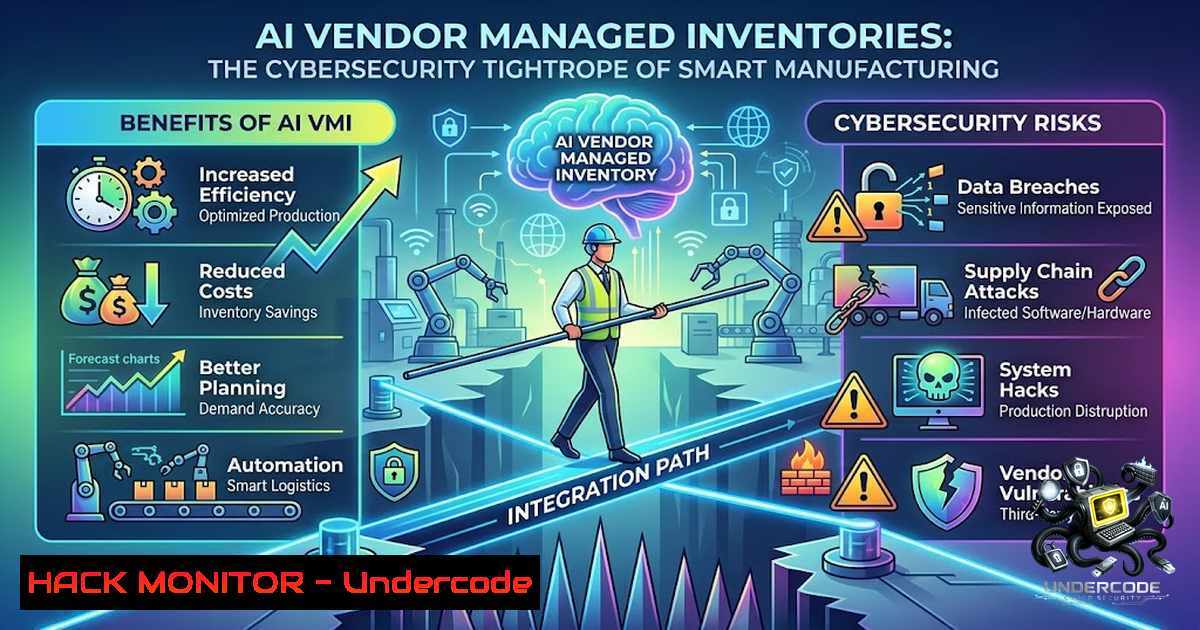
Introduction:
The convergence of artificial intelligence with vendor-managed inventory (VMI) programs is reshaping industrial supply chains, with major integrators deploying AI-driven predictive maintenance and automated scale-binned inventory systems to pursue the ambitious goal of eliminating stockouts entirely. However, this transformation demands real-time network access to manufacturers’ operational systems, creating a complex security calculus where data leakage, adversarial AI attacks, and vendor lock-in converge as existential threats. As 84% of manufacturers now generate measurable value from AI, the imperative to secure these interconnected systems has never been more urgent.
Learning Objectives & Secrets:
- Objective 1: Assess the AI-VMI Attack Surface – Map all network entry points, API integrations, and data flows between AI inventory systems and OT/IT environments to identify exposure vectors including misconfigured cloud storage, insecure APIs, and AI model poisoning.
-
Objective 2 (Secret Tip): Implement Least Model Privilege – Restrict AI model access to only the minimum data and control functions required for inventory predictions, preventing compromised agents from executing unauthorized Modbus or DNP3 commands that could disrupt operations.
-
Objective 3 (Secret Tip): Deploy Continuous Model Integrity Validation – Establish cryptographic hashing and behavioral baselining for AI models to detect data poisoning, model drift, and adversarial manipulation before they corrupt inventory forecasts or trigger phantom purchase orders.
You Should Know:
- Mapping the AI-VMI Threat Landscape: From Smart Bins to Supply Chain Sabotage
AI-powered VMI programs introduce a cascading series of vulnerabilities that extend far beyond traditional IT security concerns. The foundational risk begins with the “smart bins” and IoT sensors deployed throughout manufacturing facilities—devices that continuously monitor inventory levels, environmental conditions, and consumption patterns. These endpoints, often running outdated firmware with known vulnerabilities, become attractive targets for attackers seeking to falsify container status, spoof sensor data, or launch denial-of-service attacks that disrupt data collection.
The threat escalates at the network layer where AI systems require access to real-time operational data. Predictive maintenance agents legitimately need Modbus access to read engine parameters, but this same access can be weaponized through compromised agents that issue unauthorized Modbus WRITE_SINGLE_COIL commands. The 2026 threat landscape has evolved beyond traditional IT/OT segmentation concerns; legacy frameworks like NIST 800-82r3 and IEC 62443-3-3, designed for pre-AI, air-gapped environments, now fail to address AI-augmented HMI attacks and state-sponsored actor TTPs.
Perhaps most insidious is the risk of data leakage through AI tools themselves. Teams experimenting with AI often upload sensitive operational data into ungoverned, unmonitored platforms, creating security, confidentiality, and compliance risks. When combined with the accelerating trend of attackers using AI to detect and exploit software vulnerabilities, the manufacturing sector faces an unprecedented convergence of threats.
- Securing the AI-VMI Pipeline: A Zero Trust Implementation Guide
To mitigate these risks, organizations must adopt a Zero Trust architecture specifically tailored for AI-enabled OT environments. The following step-by-step guide provides a framework for implementation:
Step 1: Comprehensive Asset Discovery and Inventory
Begin by establishing a complete inventory of all IoT, OT, and IT assets connected to or interacting with the AI-VMI system. Leverage AI-powered discovery tools that automatically classify and fingerprint devices across the entire enterprise network. Document every AI model, library, dataset, framework, and third-party service dependency.
Step 2: Network Segmentation and Microsegmentation
Implement strict network segmentation to isolate AI-VMI systems from critical OT control networks. Deploy microsegmentation policies that restrict communication to only explicitly permitted flows. For OT protocols lacking native authentication (Modbus, DNP3, S7), implement identity-bound command execution through authenticated proxies.
Step 3: Identity-Based Access Control
Enforce Zero Trust principles by never assuming the OT network is trustworthy simply because it sits behind a firewall. Implement role-based access controls that limit AI model privileges to the minimum necessary functions. All AI-generated commands and recommendations must be treated as untrusted content until verified against deterministic sources such as historian raw data or safety instrumented system independent readings.
Step 4: Continuous Monitoring and Threat Hunting
Deploy real-time monitoring solutions that detect anomalous behavior across the AI-VMI ecosystem. This includes monitoring AI model outputs for drift, detecting unusual data exfiltration patterns, and correlating threat intelligence across IT and OT environments. Establish automated CVE synchronization to keep vulnerability surfaces current without manual intervention.
Step 5: Incident Response and Recovery Planning
Develop and test incident response playbooks specifically for AI-VMI compromise scenarios. Include procedures for isolating compromised AI agents, reverting to manual inventory management, and forensic analysis of model manipulation attempts.
3. Hardening AI-VMI Deployments: Essential Commands and Configurations
Linux Commands for AI Model Security:
 Generate cryptographic hash for model integrity verification
sha256sum /opt/ai-models/inventory_model.pt > model_hash.txt

Monitor AI model API endpoints for anomalous traffic
sudo tcpdump -i eth0 -1n 'port 5000 and (tcp[bash] & 2 != 0)'

Implement rate limiting on AI inference endpoints
iptables -A INPUT -p tcp --dport 5000 -m limit --limit 10/minute -j ACCEPT

Audit AI model file permissions
find /opt/ai-models -type f -exec ls -la {} \; | grep -v "^-rw-r--r--"
Windows PowerShell Commands for AI-VMI Security:
 Monitor AI service processes for unusual behavior
Get-Process | Where-Object {$_.ProcessName -match "ai|model|inference"} |
Select-Object ProcessName, CPU, WorkingSet

Audit network connections from AI services
Get-1etTCPConnection | Where-Object {$<em>.State -eq "Established" -and
$</em>.LocalPort -in (5000,5001,8080)} | Format-Table

Configure Windows Firewall for AI API restrictions
New-1etFirewallRule -DisplayName "AI Inference Rate Limit" -Direction Inbound
-Protocol TCP -LocalPort 5000 -Action Block -RemoteAddress 192.168.1.0/24
OT Network Configuration (Cisco IOS Example):
! Implement ACL to restrict Modbus access
access-list 150 permit tcp host 10.1.1.100 host 10.2.2.200 eq 502
access-list 150 deny tcp any host 10.2.2.200 eq 502
! Apply to OT interface
interface GigabitEthernet0/1
ip access-group 150 in
API Security Hardening:
{
"rate_limiting": {
"enabled": true,
"requests_per_minute": 100,
"burst_limit": 150
},
"input_validation": {
"max_payload_size": "1MB",
"allowed_content_types": ["application/json"],
"schema_validation": true
},
"authentication": {
"type": "oauth2",
"token_expiry": 3600,
"refresh_enabled": true
}
}
4. Breaking Vendor Lock-in: Open Architecture Strategies
The vendor lock-in risk identified in the original post represents a critical strategic vulnerability. Organizations should demand open API standards and vendor-1eutral data architectures that preserve the ability to switch integrators without operational paralysis. Key strategies include:
- Data Portability Requirements: Contractually mandate that all operational data collected by the AI-VMI system remains the manufacturer’s property in open, exportable formats.
-
API-First Architecture: Insist on RESTful or GraphQL APIs with comprehensive documentation, enabling integration with alternative systems.
-
Containerized AI Models: Deploy AI models as containerized applications (Docker/Kubernetes) that can be migrated between infrastructure providers.
-
Open Source Dependencies: Where possible, utilize open-source AI frameworks and libraries to reduce dependency on proprietary vendor implementations.
5. Regulatory Compliance and AI Governance
The evolving regulatory landscape compounds the security challenges of AI-VMI deployments. NIST’s AI Risk Management Framework (AI RMF 1.0) and the Generative AI Profile (NIST AI 600-1) establish baseline requirements for AI governance. Organizations must:
- Maintain an inventory of all AI applications touching the shopfloor, with full audit trails and human approval requirements.
-
Extend NIST SP 800-53 supply chain risk management controls (SR-3) to include AI model provenance and third-party component verification.
-
Apply NIST CSF 2.0’s Govern function to explicitly address cybersecurity supply chain risk management for AI systems.
-
Document and test compliance with emerging regulations including the EU AI Act’s requirements for high-risk AI systems.
What Undercode Say:
-
Key Takeaway 1: The pursuit of zero stockouts through AI-VMI creates a fundamental security trade-off—network accessibility for real-time data enables unprecedented inventory optimization but simultaneously exposes manufacturers to data leakage, adversarial AI attacks, and operational disruption. Organizations must view this not as a binary choice but as a risk management challenge requiring systematic controls.
-
Key Takeaway 2: Vendor lock-in in AI-VMI programs represents a strategic vulnerability that extends beyond financial considerations. When an integrator’s proprietary systems permeate operational workflows to the point of inextricability, manufacturers lose negotiating leverage and strategic flexibility. Open architectures, data portability, and API-first designs are essential countermeasures that preserve long-term autonomy.
The analysis reveals that the industrial sector stands at a pivotal moment. The 84% of manufacturers already generating value from AI must now mature their security postures to match their innovation velocity. The threats are not hypothetical—compromised AI agents can execute unauthorized control commands, manipulated models can trigger phantom purchase orders or mask critical stockouts, and data leakage can expose competitive advantages. Organizations that treat AI security as an afterthought will find themselves victims of the same technology that promised operational excellence. Those that embed Zero Trust principles, continuous validation, and open architectures into their AI-VMI programs from the outset will capture the productivity gains while maintaining the strategic control essential for long-term success.
Prediction:
+N The next 24 months will see the emergence of specialized AI-VMI security auditing firms and certification programs, creating a new consulting ecosystem that helps manufacturers navigate the security complexities of AI-powered inventory management.
-1 Manufacturers that rush to deploy AI-VMI without comprehensive security architectures will experience at least one major incident—ranging from data breach to operational disruption—by 2027, prompting a regulatory response similar to the cybersecurity mandates seen in critical infrastructure sectors.
+N Open-source AI inventory management frameworks will gain significant traction as organizations seek to reduce vendor lock-in and increase transparency into model behavior, paralleling the open-source movement in enterprise software.
-1 The technical debt from legacy OT systems (outdated firmware, unpatched vulnerabilities) will become the primary exploitation vector for AI-VMI attacks, with attackers increasingly targeting the intersection of aging industrial equipment and modern AI interfaces.
+N Industry consortiums and standards bodies will accelerate development of AI-specific OT security frameworks, building on NIST’s AI RMF and CSF 2.0 to create manufacturing-sector implementation guides.
-1 The consolidation of industrial integrators around proprietary AI-VMI platforms will intensify vendor lock-in pressures, creating a two-tier market where large manufacturers with negotiating power maintain flexibility while smaller players become captive to single-vendor ecosystems.
▶️ Related Video (88% Match):
🎯Let’s Practice For Free:
🎓 Live Courses & Certifications:
Join Undercode Academy for Verified Certifications
🚀 Request a Custom Project:
Secure, high-velocity infrastructure and disruptive technological engineering. Contact our engineering team for high-tier development and proprietary systems:
[email protected]
💎 Smart Architecture | 🛡️ Secure by Design | ⭐ Trusted by Thousands
IT/Security Reporter URL:
Reported By: https://lnkd.in/p/e6BuPp5r – Hackers Feeds
Extra Hub: Undercode MoN
Basic Verification: Pass ✅


